
If you find value in #ComplexityThoughts, consider helping it grow by subscribing and sharing it with friends, colleagues or on social media. Your support makes a real difference.
→ Don’t miss the podcast version of this post: click on “Spotify/Apple Podcast” above!
Can “architecture” be a scientific concept for life and not just a metaphor?
Surviving perturbations requires more than connectivity. What must persist are processes: production of metabolites, maintenance of internal variables, coordination across subsystems. In network terms, this brings attention to a recurring structural feature, i.e. loops, but their role depends on what they actually close.
Based on the more technical arguments developed in my recent paper, this is the third step in our attempt to understand whether “architecture” in living systems is a real, measurable concept or just a convenient metaphor. I have introduced the key idea in the previous posts:
where I have outlined how function in living systems emerges from the coupling between logic (what the system does) and circuitry (how it is physically implemented).
A cell that loses one enzyme may still grow because flux passes through another metabolic route. A bacterium exposed to an attractant changes its motion, then adapts, because its sensory network adjusts receptor sensitivity. A mixture of RNA fragments may replicate better as a cooperative set than as isolated molecules, because some fragments help generate others. All three cases involve loops, although the biological mechanisms differ.
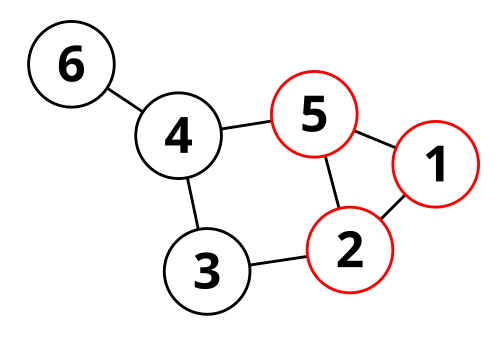
A closed path in a graph is a topological object: start from one node, follow links through other nodes and return to the starting point. In biological systems, the same graphical pattern may carry metabolites, signals, catalytic dependencies, energy, matter or information: the function depends on what circulates through the path and how the system constrains that circulation.
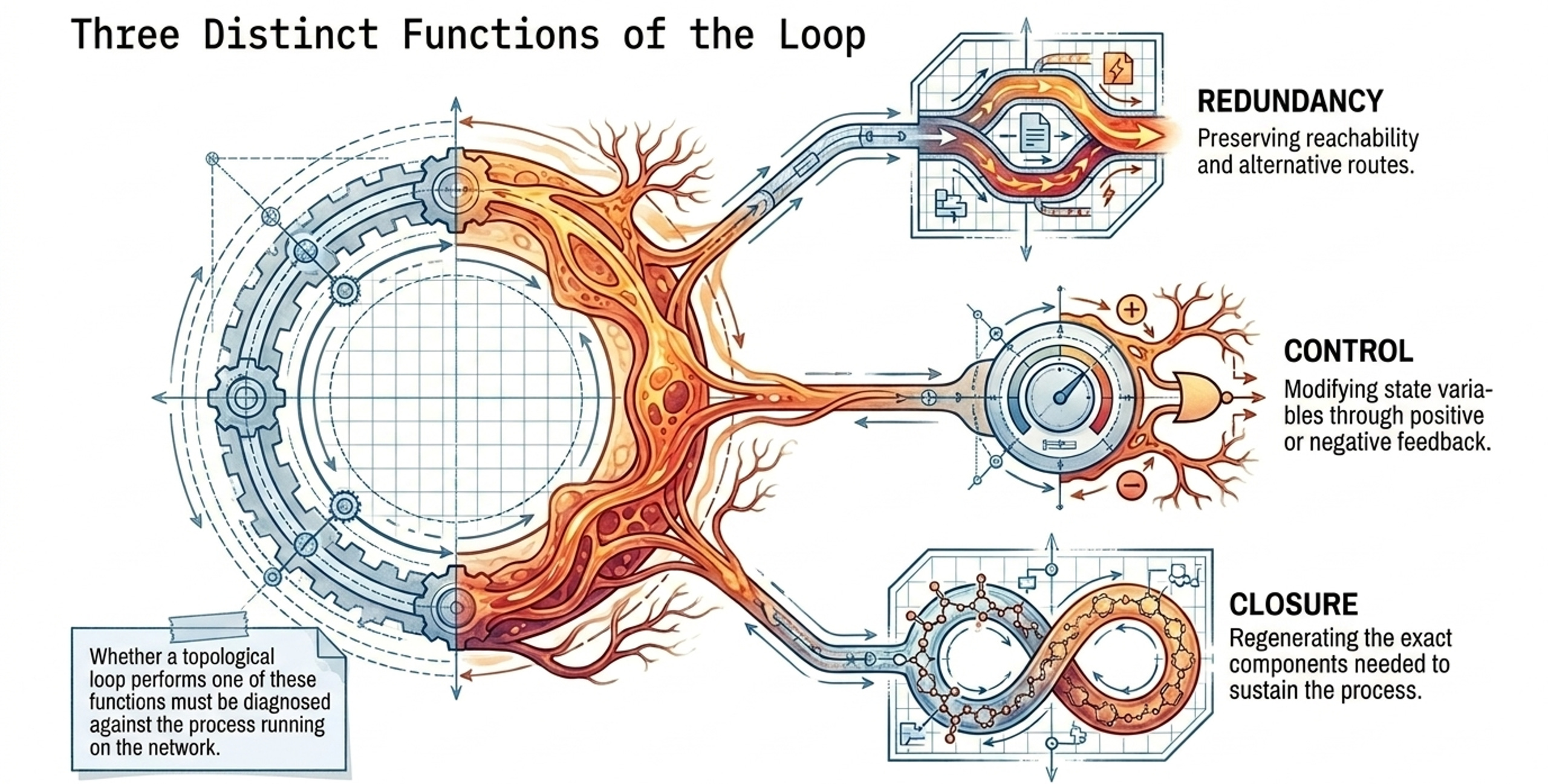
However, let’s see loops here as a minimal architectural lens, for the moment, since they help us locate three recurrent functions: redundancy, control and closure. Whether a particular loop performs one of these functions has to be checked against the process running on the network.
In my paper, I discuss cycles beginning from random networks: the probability of forming closed paths depends on the degree distribution, especially on the first two moments of that distribution. Heterogeneous sparse networks can generate cyclic structure without becoming fully dense, whereas dense networks generate many more cycles at a much higher construction and maintenance cost, at least in principle.
This connects directly with what we have seen in the previous post: if the genome cannot encode a full wiring diagram, and if biological connections must be built anyway, regulated, repaired, and sometimes removed, living systems cannot use indiscriminate redundancy. So: which loops are worth maintaining, given their functional role and cost?
The simplest use of a loop is to preserve reachability, since if one route is blocked then another route may still connect two parts of the system.
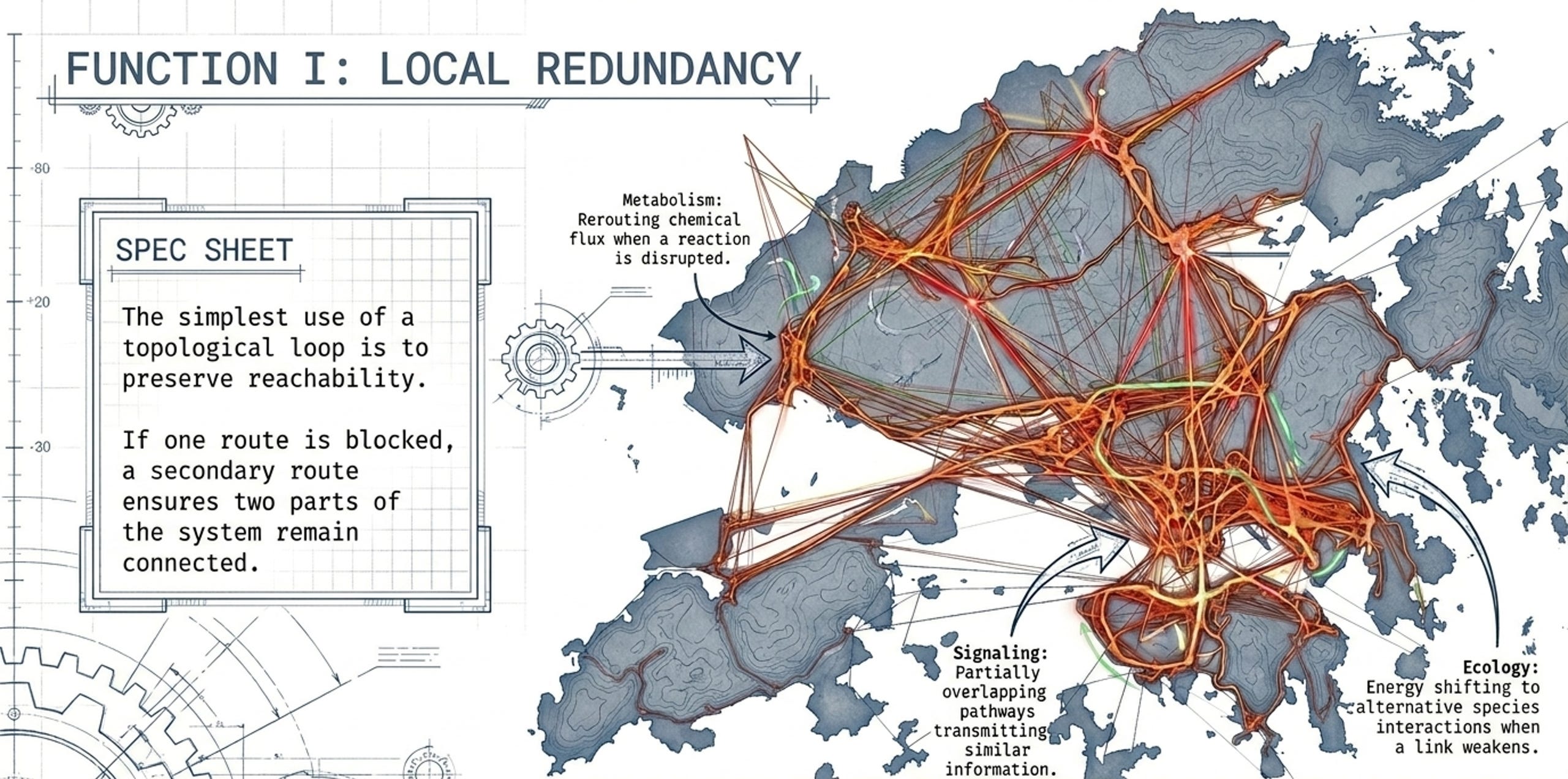
In metabolism, this can mean that flux can be “rerouted” after a specific reaction is disrupted for some reason. In signaling, it can mean that partially overlapping pathways transmit similar information. In ecological networks, matter or energy may continue to move through alternative species interactions when one link weakens.
However, a topological alternative route is only a candidate for redundancy. In a metabolic network, a bypass requires compatible stoichiometry, sufficient enzyme expression, available substrates, as well as regulatory conditions that allow the alternative route to operate on the relevant time scale. Therefore, a path that exists in a reconstructed network may remain physiologically inaccessible in a particular environment.
Work on E. coli metabolism illustrates the point. Using a metabolite-centered analysis it has been shown that robustness cannot be inferred only from gene essentiality: some metabolites are structurally central because many fluxes depend on them, and maintaining flux around these metabolites can be associated with cellular robustness and fragility.
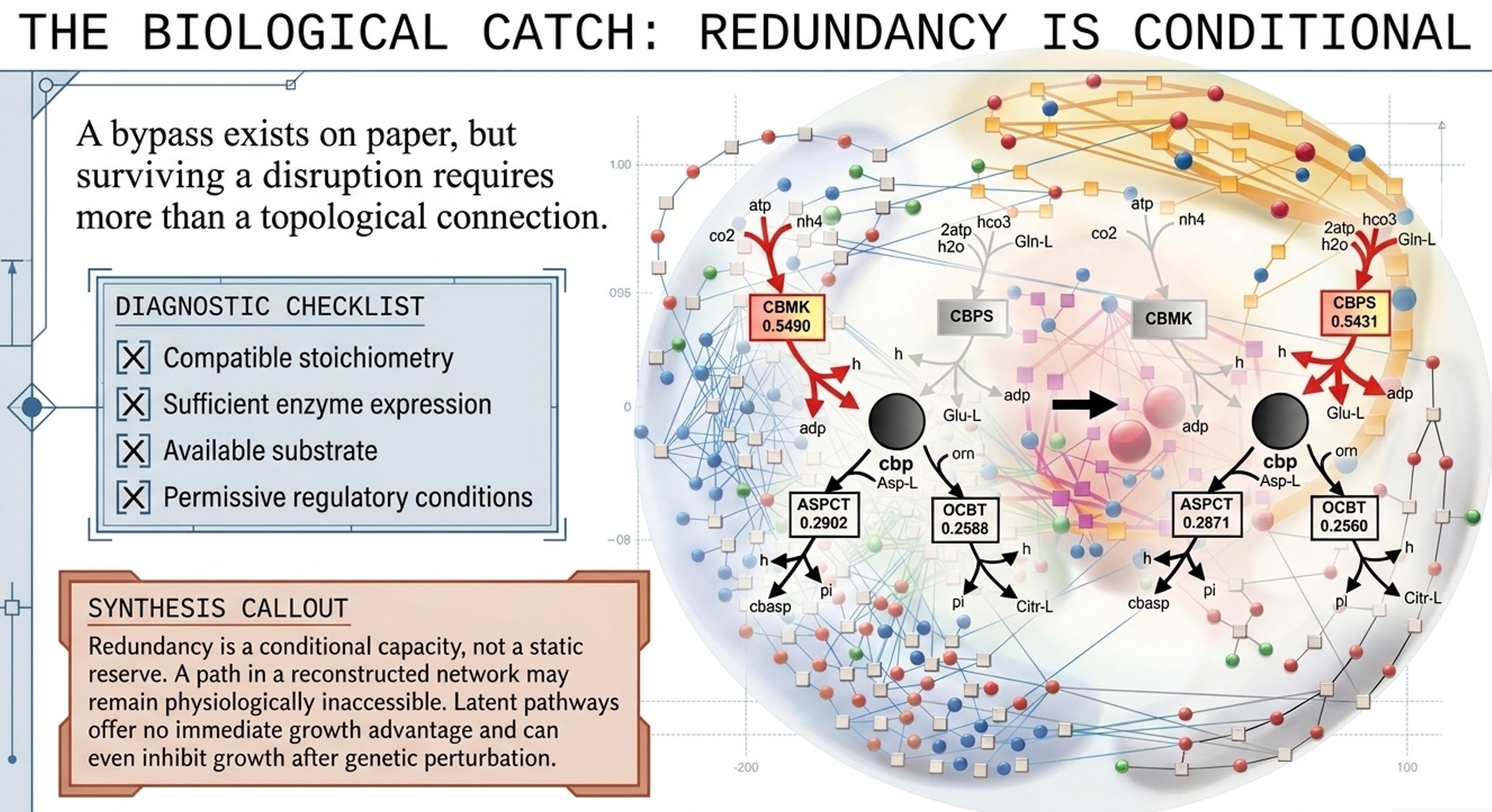
Interestingly, after perturbations, one can also show that latent pathways often offer no immediate growth advantage and can even inhibit growth after genetic perturbation.
Redundancy therefore functions as a conditional capacity, not as a static reserve: the system must be able to access the alternative route, regulate it and pay its metabolic cost.
A feedback loop exists when a variable affects its own future through the system:
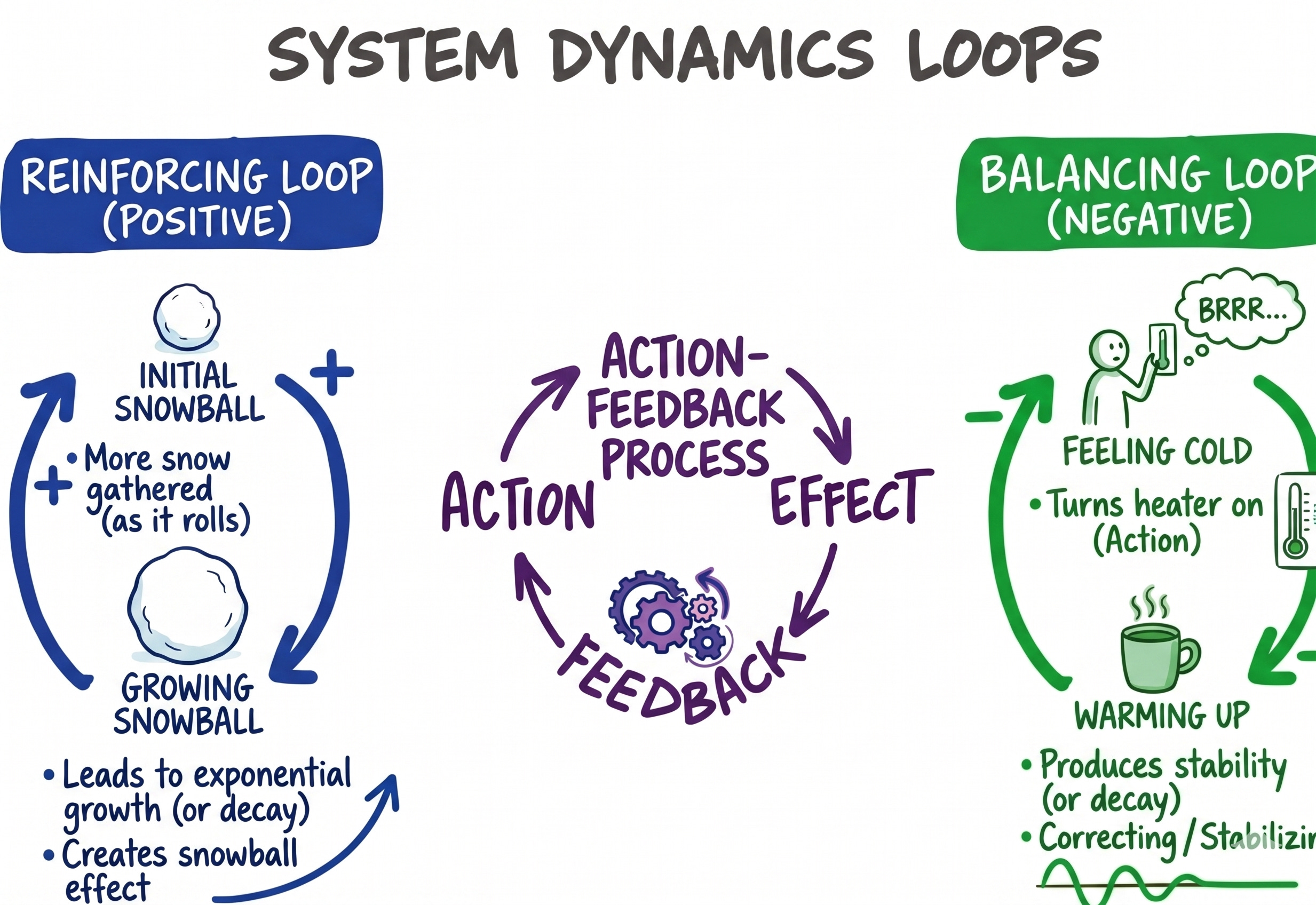
This may be visible as a cycle in a molecular interaction graph, but it may also appear only after coarse-graining many biochemical steps into an effective control circuit.
Negative feedback reduces deviations from an operating range. For instance, bacterial chemotaxis provides a standard example because the system adapts after stimulation: receptor activity changes after exposure to attractant, while methylation dynamics adjust sensitivity so that activity returns toward baseline. This adaptation can remain robust despite variation in biochemical parameters, and it can be interpreted through integral feedback control, making explicit why adaptation requires a particular control structure rather than the mere presence of a cycle.
Positive feedback, instead, amplifies differences and can support bistability, switching, hysteresis and memory. This behavior is useful in development and cell-fate decisions, where a transient signal must sometimes produce a stable commitment. But the same mechanism also creates risks: a loop that stores history can preserve an inappropriate state after the conditions that produced it have disappeared.
Feedback modifies state variables: its effect depends on sign, gain, delay and coupling to the rest of the system.
Closure is stricter than redundancy or feedback. A process is closed when its outputs help regenerate the components or conditions that make the process possible.
This is a common concept in origin-of-life theories, but it needs precision. Kauffman’s autocatalytic-set idea made catalytic closure central: a set of molecules can collectively catalyze reactions that generate members of the same set. In later RAF theory, the formal object is a reaction set that is reflexively autocatalytic and food-generated (RAF): reactions are catalyzed by molecules from within the set, and the required molecules can be built from an available food set.
The RAF formulation is stronger than the visual image of a simple ring, since a closed reaction system needs inputs, catalytic support, suitable side conditions and protection from processes that drain intermediates faster than they are regenerated.
A less widely remembered contribution came from Rössler in 19711, where he described a system-theoretic model of biogenesis based on generalized catalysis and what he named “second-order autonomous growth”. In a nutshell, an autocatalytic cycle can expand chemical space by sustaining new molecular species, and that enlarged space can increase the probability of discovering further cycles: the growth of autocatalytic systems then becomes part of the process being amplified. This does not settle origin-of-life theory, but it identifies a mechanism worth keeping in mind: once a loop sustains new components, it can modify the space of possible future loops.
Morowitz and Smith work on intermediary metabolism argued that parts of core metabolism, especially the reductive tricarboxylic acid cycle, can be understood as a network-autocatalytic structure shaped by carbon chemistry, energetics, and reaction topology.
Let’s remark how the narrow formulation is important: a biochemical cycle does not become life-like just because it is cyclic. Here, the main claim is that some cycles persist because matter and energy flow through constrained reaction networks in ways that regenerate key intermediates.
The argument holds beyond metabolism and extends to other biochemical networks, such as mixtures of RNA fragments that self-assemble into self-replicating ribozymes, for which it has been experimentally shown the emergence of cooperative catalytic cycles and networks2.
Overall, this is why closure is a central concept for living architecture: the unit that matters is sometimes the molecule, but in other cases it is the looped set of reactions that makes new molecular behavior possible.
A redundant route requires enzymes, substrates and regulation. A feedback controller requires sensing, response and timing. A production loop requires access to matter and energy, plus constraints that prevent side reactions or parasitic processes from exhausting the system.
These mechanisms have been placed within a broader account of cellular robustness, emphasizing that biological robustness uses combinations of feedback control, redundancy, modularity and structural organization. An emblematic example used in that work is E. coli chemotaxis:
However, the same mechanisms can introduce vulnerabilities. For instance, Doyle and collaborators described this general pattern as “robust yet fragile” in the context of the Internet: systems may tolerate common perturbations while remaining sensitive to disturbances that hit hidden dependencies. However, for biology, that phrase should be used as a systems analogy, not as a direct equivalence between cells and engineered communication networks. Here, the useful lesson is that robustness always has a reference class: a system may handle frequent local shocks and still be vulnerable to rare, targeted or correlated perturbations.
In fact, excessive looping can overcouple the system: perturbations then travel across modules, positive feedback amplifies fluctuations and useful dependencies under ordinary conditions become channels for failure under unusual conditions.
A useful loop must therefore remain local enough to contain damage and connected enough to sustain the process it serves. I know, it is complex, as usual.
A loop becomes informative only after three questions are answered:
First, what is being looped: a metabolite flux, a regulatory signal, a catalytic dependency, or an ecological interaction?
Second, what does the loop do dynamically: preserve reachability, reduce deviations, amplify differences, switch state, store memory, or regenerate production?
Third, what does the loop cost: enzyme expression, regulatory complexity, maintenance, repair, error correction, or exposure to correlated failure?
The common rationale is that topology is strictly connected to mechanism: a motif in a graph is a constraint on possible dynamics, but function depends on the process, the environment and the scale at which the system is described.
In this chapter we have learned that loops (i) help living systems preserve routes, regulate variables, and regenerate components; and (ii) contribute to robustness when the looped process is biologically relevant and the maintenance cost remains affordable.
The storage and maintenance constraints from the previous post still apply: life cannot store or maintain arbitrary connectivity; instead it uses selected circuits that buy function without making the entire system overcoupled. We could speculate that what we observe today is the natural selection of processes satisfying these requirements.
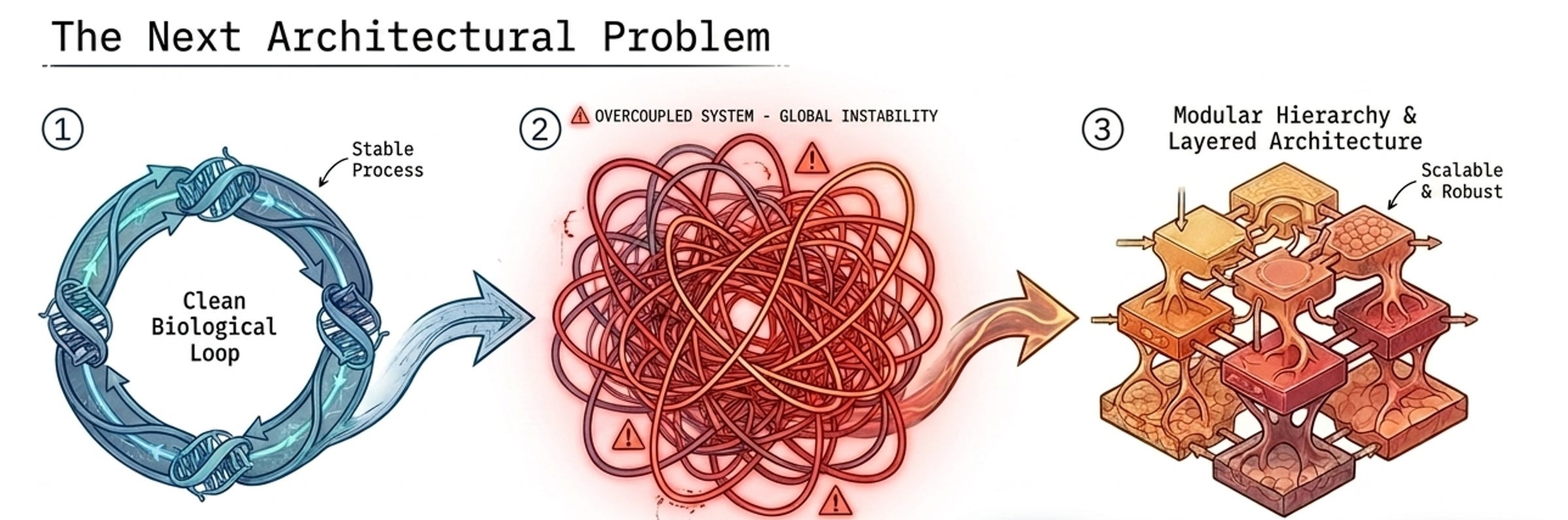
And this creates the next architectural problem: a living system needs loops to sustain and regulate its processes, but it also needs a way to prevent loops from coupling everything to everything.
A scalable solution is hierarchy: loops organized into modules, modules organized into layers and layers coupled strongly enough to coordinate function without turning every local perturbation into a global one.
→ Please, remind that if you find value in #ComplexityThoughts, you might consider helping it grow by subscribing, or by sharing it with friends, colleagues or on social media. See also this post to learn more about this space.
Note that the experiment did not produce a complete living system. Its relevance is more specific: network-level growth can emerge from catalytic cooperation among replicators, and the behavior of the system is not reducible to isolated selfish replicators.
Comments
Nothing yet. Say the first thing.
Sign in to join the conversation.