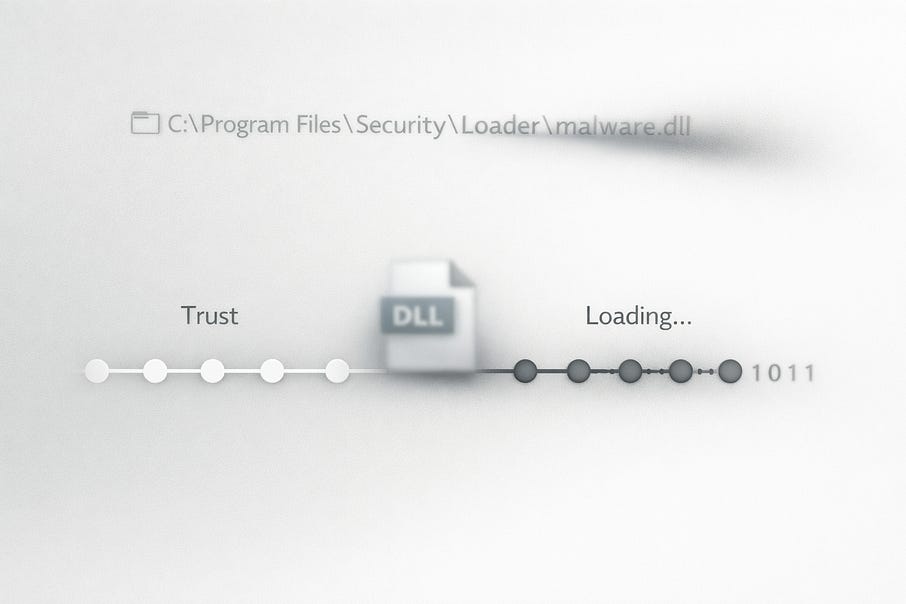
Most security teams spend their energy chasing the next big thing: zero-days, ransomware variants, AI-driven malware.
Meanwhile, some attackers are still winning with techniques that have existed for decades.
One of them is DLL hijacking not because it’s sophisticated, but because it’s quietly ignored.
That should concern every defender.
DLL hijacking doesn’t exploit a vulnerability in the traditional sense.
It exploits how Windows is designed to work.
When an application loads a DLL without specifying its full path, Windows searches for that DLL using a predefined DLL search order. If a malicious DLL with the same name exists in a higher-priority location, Windows may load it without complaint.
No crash.
No warning.
No exploit required.
This is not a flaw in Windows. It’s expected behavior.
And that’s exactly why it’s dangerous.
If DLL hijacking is so old, why do advanced threat actors still rely on it?
The answer is simple: it blends in perfectly.
Directories such as:
C:\Users\Public\AppData\LocalMisconfigured application folders
are writable by standard users. No admin privileges needed.
If a trusted executable loads a DLL from one of these locations, defenders often assume it’s legitimate.
Attackers know this.
Many applications attempt to load DLLs that:
Don’t exist
Are optional
Were removed during installation or updates
Windows keeps searching until it finds something.
If an attacker supplies a DLL with the expected name in a writable path, the system treats it as if it belongs there.
This is why missing DLL scenarios are especially attractive nothing looks broken.
In some cases, an application tries to load a DLL that was never shipped at all.
These phantom DLLs may exist due to:
Legacy code
Unused features
Hardcoded imports
Defenders rarely baseline for something that “was never supposed to exist.”
Attackers exploit that silence.
Attackers don’t start by writing malware.
They start by asking questions:
Which signed binaries load DLLs insecurely?
Which paths can a low-privileged user write to?
Which DLL name would look boring in logs?
This is why DLL hijacking remains effective for APT groups:
it leverages trusted execution paths and avoids obvious exploit telemetry.
From a MITRE ATT&CK perspective, this behavior aligns with:
T1574.001 — DLL Search Order Hijacking
T1574.002 — DLL Side-Loading
Nothing exotic.
Just quietly effective.
DLL hijacking is not invisible.
It’s just rarely monitored correctly.
A signed, trusted binary loading a DLL from:
User directories
Temp folders
Non-standard locations
should always raise questions.
Legitimate software rarely depends on DLLs stored in user-controlled paths.
This is one of the strongest signals defenders have.
If a trusted executable loads:
An unsigned DLL
Or a DLL signed by an unknown vendor
it deserves immediate attention especially outside standard install directories.
DLL hijacking often relies on:
Generic-sounding DLL names
Files that execute once
DLLs that appear in logs but never again
Frequency matters more than signatures here.
At minimum, defenders should care about:
Event ID 7 — Image loaded
Event ID 1 — Process creation
Event ID 11 — File creation
Event ID 15 — File stream creation
But logs alone are not enough.
The real questions are:
Where was this DLL loaded from?
Has this DLL ever appeared before?
Does this path make sense for this process?
Here’s the uncomfortable truth:
Many SOCs monitor what executed, not what was loaded.
DLL hijacking lives entirely in that gap.
If your detection strategy doesn’t:
Baseline DLL load paths
Flag user-writable DLL locations
Correlate signed processes with unsigned modules
then this technique will bypass your defenses without triggering alarms.
Not because it’s advanced but because no one is looking.
DLL hijacking isn’t powerful because attackers are clever.
It’s powerful because defenders stopped paying attention to it.
And that is exactly why it still works.
Building detection rules that actually work in real environments is what drives me. The gap between theory and practice is huge, and that’s where the interesting problems are.
If you’re working on detection engineering, scaling your SOC, or trying to improve threat hunting in your environment, I’m interested in talking about it.
I’m open to remote contract work or project-based collaboration where I can contribute expertise in detection engineering. If your team is serious about improving threat detection capabilities and understanding real-world attack patterns, let’s connect.
LinkedIn: https://www.linkedin.com/in/manishrawat-soc/
GitHub: https://github.com/Manishrawat21/
No posts
Comments
Nothing yet. Say the first thing.
Sign in to join the conversation.