
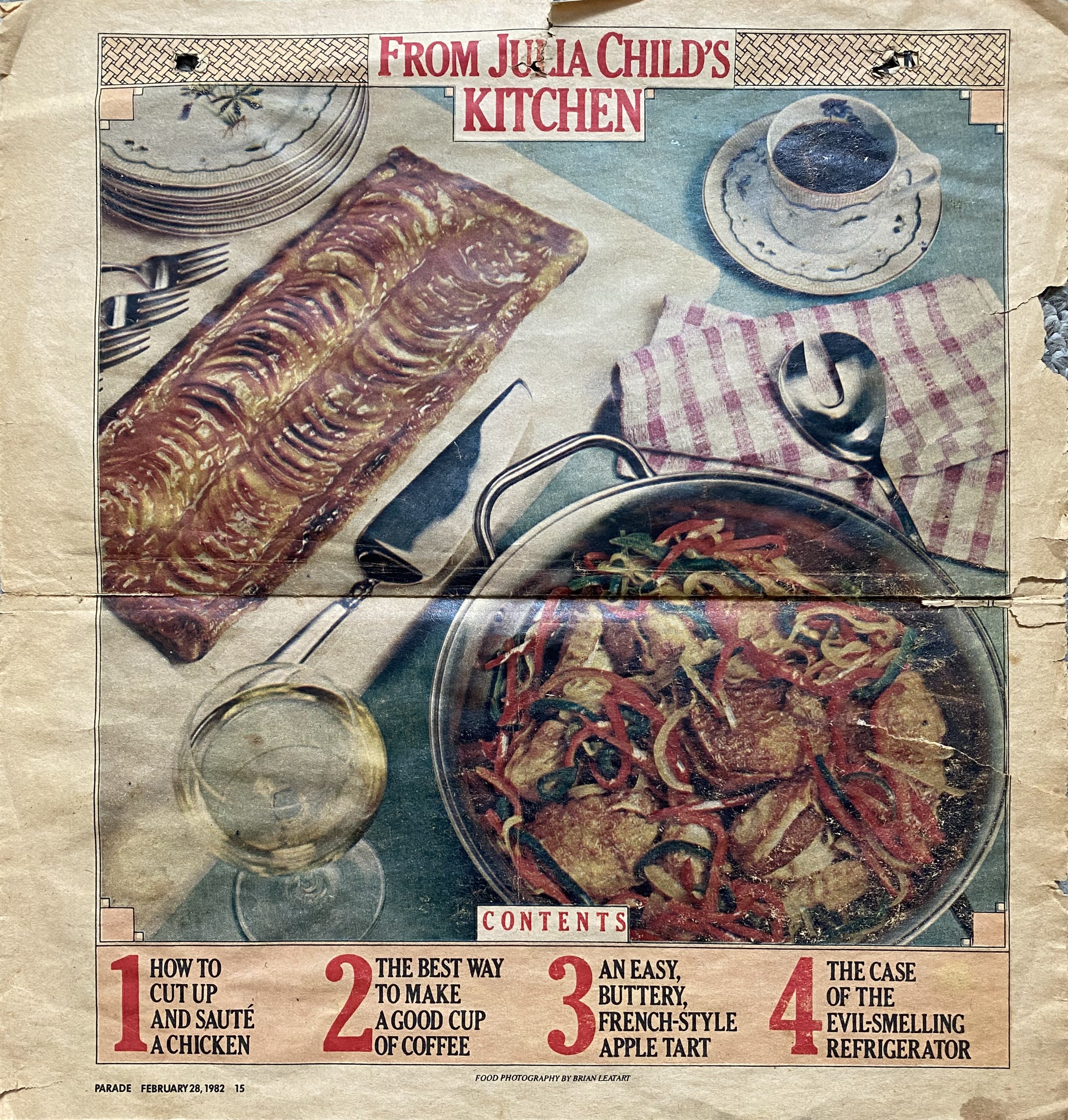
The first time I encountered “The Greatest Apple Tart” was when I was a graduate student in Pittsburgh. At that time, Parade magazine, a popular supplement in Sunday newspapers nationwide, carried a weekly cooking feature written by Julia Child. What prompted me to save the insert was not the apple tart, but the leading recipe – for sauteed chicken. The variation with peppers and onions quickly became my specialty.
I was very curious about the tart, but the communal kitchen I shared with several housemates was too cramped to attempt anything that elaborate. In June, though, I moved into a large two-bedroom apartment which I sublet from a professor who spent his summers in Wisconsin. Although he let me have it at a bargain price, it was still a financial stretch for me. No matter! I now had the entire place to myself – moreover, the kitchen came with all the equipment I might need.
So I attempted the tart. It came out just as promised – glistening and golden and delicious. The puffed edges, crisp and brushed with apricot glaze, were the best part – even better than the apple-covered interior. The tart quickly became my new signature dish – though I winced at the price of all the ingredients I was buying – jars of apricot jelly, two different types of flour, endless sticks of butter.
I graduated and started teaching in Baltimore. The tart remained a favorite – now that I had a job, I could buy all the jelly and butter I needed without a second thought. As I got deeper into cooking, I started acquiring cookbooks – including Julia Child’s co-written tome, “Mastering the art of French Cooking.” I realized the Parade recipe was a variation of a recipe for “Tarte Aux Pommes” in Volume 2 of this work. But Volume 1 had a completely different version: circular instead of rectangular, with a more traditional pie crust, and sliced apples arranged in a base of applesauce. I tried making it and was thoroughly put off by its mushy filling – this was a tart I never needed to revisit.
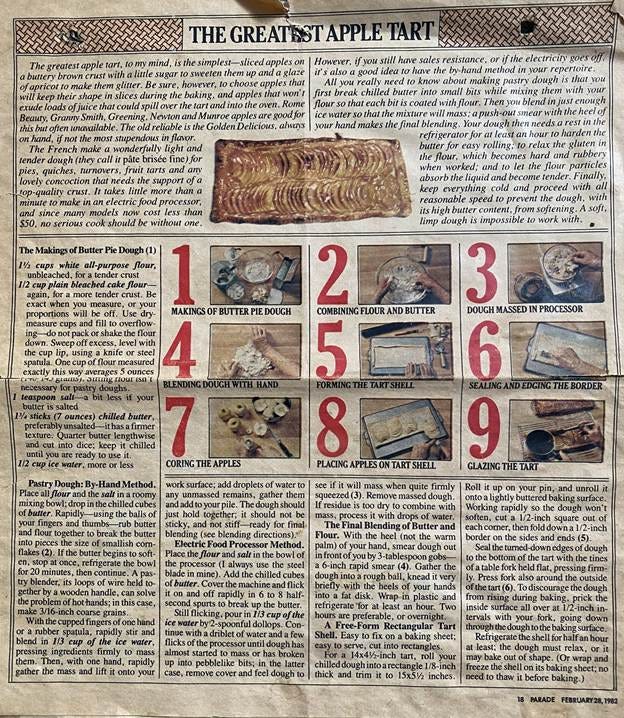
I’ve now made the original Parade recipe tart at least 50 times (it’s become a fall ritual, to be performed after buying golden delicious apples from my favorite vendor, Roy’s, near Little Washington, VA ). You can see from the images how proudly battle-scarred my Parade insert has become.
Last Friday, I was invited to a multi-course participatory French dinner where all the recipes had to be from Julia Child. The menu included gougères and stuffed mushrooms as appetizers, followed by a splendid salade niçoise, and then coquilles St. Jacques, coq au vin and boeuf bourguignon as entrees. Naturally, I chose to make the tart from my Parade insert. There were going to be 16 people at the dinner, so I needed to double the recipe.
Should I make one enormous tart? Roll the dough into a base with twice the area (14 × 9 inches instead of 14 × 4.5)? A little geometrical contemplation made me realize this would not be a good idea.
The reason was that while the apples were delicious, it was the apricot-glazed ridge of pastry all along the edges that was the true star of the show. My husband Larry and I would always be careful to cut off pieces so that this ridge was evenly divided – we each wanted our fair share of the shatteringly crisp crust.
With a 14 × 9 tart, I’d get an edge (i.e. perimeter) that was 14 + 14 + 9 + 9 = 46 inches in length. But with two 14 × 4.5 tarts, the total edge for each tart would be 37 inches, so the combined total for two of them would be a whopping 74 inches. Leading to much more pleasurable crunching at the dinner table.
But wait. What if I made 3 tarts instead? It turned out that I could make 3 tarts that were each 7 × 6 square inches, and this would yield exactly the same area. Plus, this would give me a perimeter of 3 × (7 + 7 + 6 + 6) = 78 inches, which was a little higher than the two-tart option above.
But wait some more. If I made each of the three tarts to be 14 × 3 (i.e. the same area as a 7 × 6 tart), then they might look very thin and a bit weird. But the perimeter would jump to an incredible 102 inches!
And yet more: what if I divided the dough into quarters to make 4 tarts? Or fifths to make 5? Perhaps I ought to just divide the dough into 16 equal pieces to make 16 individual tarts! Each person might get just a little apple, but they’d have four of their own crusty edges to devour!
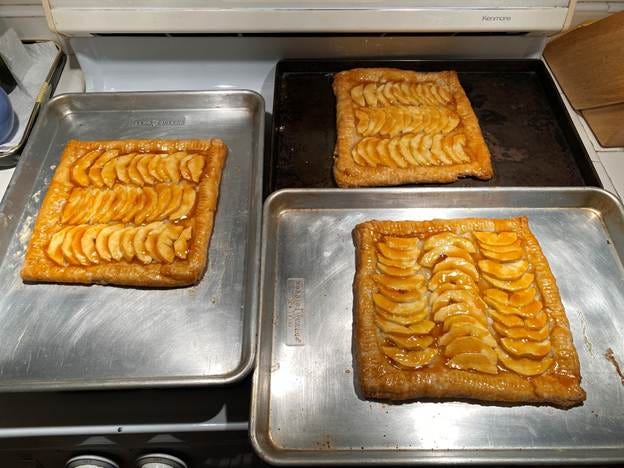
Fortunately, I managed to get out of this geometrical death spiral. I decided to make 3 tarts. I purposely didn’t bring out my measuring tape (didn’t want to relapse into mathemania). Instead, I just tried to stretch out the rectangles into shapes that looked appropriate and still seemed to have a good apple-to-edge ratio. (Now that I’m writing this and looking at the dimensions of my ad hoc rectangles, I may have subconsciously gotten near the 1.618-to-1 golden ratio, which some claim is the “most pleasing” to humans.)
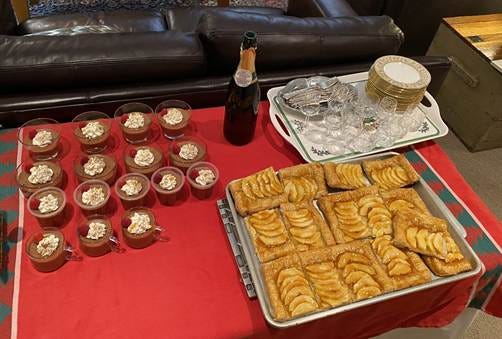
The dinner was delicious, and dessert included both pot de crème and my apple tart. You’ll notice from the picture that several pieces had crusty edges along two sides, rather than just one. I kept watch, and sure enough, those were the first to go!
Some more geometrical thoughts
If you want to maximize the perimeter of a rectangular tart using the same amount of dough, you should roll it into as long and slender a rectangle as possible. (Mathematically speaking, you could even make the perimeter infinite, by stretching the length to infinity and making the width vanishingly small!) That’s not a good solution, since you do want it to be an apple tart, not an all-crust tart. It was for this reason that I switched from measurement to intuition – and ended up with tarts whose dimensions were “pleasing.” (Which, as I mentioned, may have been close to the “Golden Ratio” – something I can no longer verify, since all the tarts have been eaten.)
Let’s also look at the opposite problem. What if you really had no confidence in your crust, and wanted to minimize the edges? That is, if you knew your guests would appreciate the apple-covered parts much more than the edges? What shape should you choose?
Mathematics gives the answer: a circle! For a fixed amount of dough (i.e. a fixed area), rolling it into a circle will give you the least perimeter out of all possible shapes. For instance, recall that a 14 × 9 tart had a total edge (perimeter) of 46. Re-rolling the same dough into a circle would give you a perimeter of slightly less than 40 inches. This is the smallest perimeter possible with that area!
Which brings me to one final (deliberately imprecise) question. Going back to the task of maximizing the perimeter, is there another shape of tart you can think of which might be generally even better than rectangular in yielding proportionately more edge?
Comments
Nothing yet. Say the first thing.
Sign in to join the conversation.