
Note: I planned to post this on July 4, but an eye injury sent me to the ER, and I was on limited screen time for five days.
Content warning for discussion of suicide.
For the past three years, my son and I celebrated the Fourth of July, aka Independence Day, by watching Hamilton on Disney+. It should not come as a surprise that I am not particularly patriotic. The height of my feelings of national pride can be described by Alyssa Liu winning the gold medal last February. These days it’s difficult to see the line between patriotism and nationalism in the old U.S. of A. To paraphrase George Lucas, all that fear of and anger at the other lead directly to hate and suffering. But we watch Hamilton. It’s not any form of protest or activism (lol), just acknowledgment of the day, a nod to celebration. It’s tradition now. It’s fun, a good story told well.
The Pitt is being heralded (and marketed) as a throwback to the pre-streaming era of television. Initially conceived as a reboot of the classic series ER (1994-2009), The Pitt is a dyed-in-the-wool medical procedural with a large, dynamic cast and storylines driven by its setting, which releases new episodes weekly and returns yearly. The Pitt is ER’s legacy, deliberately, and its success with both critics and mainstream audiences is a seemingly ringing endorsement for the alleged return to formula.
I say alleged because while The Pitt does have something in common with 90s TV, and specifically, ER, it’s also its own thing. The most magical part to me, besides the acting, which really can’t be understated, is that it works so very well both week-to-week and binge-watching the whole season. And not in the way a Law & Order does; I love me a P4L weekend, but generally speaking, the greatness of an SVU marathon is the comforting formula that lets you drop in and out of an episode or episodes as much and as many times as you want. The Pitt’s ‘real time’ portrayal of intricate, while also routine drama, all but forces you to pay attention to the whole hour(s). And it’s different when you watch one hour at a time versus back-to-back!
In this interview, Noah Wyle lists five points that make The Pitt work. I’m going to mention two of them: first, the series is shot “with almost exclusively 50-millimeter or 65-millimeter lenses, which is the most comparable to the human eye—and only shooting from the point of view of a human being that’s present in this space. There are no cameras on gurney wheels going in the hallway. There’s no cameras on the ceiling looking down from a God point of view. You are limited to the perspective of a participant. You can look away, but you can’t leave, and it becomes an endurance test for you to stay on your feet as long as we’re on our feet.” And second: “Real time has an aggregate sense of tension that you don’t get in any other form of storytelling. What happened before is happening now, and these two things are going to add up to the next thing. And if we throw more ingredients into this cooker and keep ratcheting it up, it’s going to pop.”
These creative choices immerse the audience in the action and remove the number of barriers between us and the characters. It makes us feel like we are in the story and may even partly explain the sometimes disturbing parasocial relationship of the series’ most rabid fans. But my point is, The Pitt isn’t successful because of nostalgia. The Pitt is successful because of many deliberate choices that create specific moments. Some of those are built on the bones of what came before, but others are a leap into potential.
The Pitt is ER’s legacy, and perhaps Noah Wyle’s (and John Wells’ and R. Scott Gemmill’s) legacy, but Michael Robinovitch is not John Carter’s legacy, nor any of the doctors from whom Carter learned. Robby is Dr. Adamson’s legacy.
Dr. Montgomery Adamson was Dr. Robby’s predecessor and mentor, but we never met him. Adamson died during the COVID-19 pandemic, years before the series premiere. The first season takes place on the anniversary of his death and shows he’s warmly remembered. Robby suffers a handful of flashbacks to Adamson’s illness and death, culminating in a panic attack and breakdown after the Pitt Fest emergency (that won Noah Wyle his Emmy). But besides Robby’s trauma-driven memories and a photo on the wall, we, the audience, know nothing about Dr. Adamson. Our only real context for him is Robby, and to a lesser extent, Abbot and Dana, otherwise known as Adamson’s legacy.
There’s some online noise asking for a Very Special Episode or some kind of limited series spin-off set in the beforetimes, when Adamson was in charge. This feels very much part and parcel of the modern desire/determination to explain absolutely every detail of a story or character on screen, something that I think has led to our collective decline in media literacy. I prefer the thought experiment. Perhaps Adamson was a mentor in the vein of Peter Benton, someone who practiced tough love and very begrudging respect, for whom every compliment came with a caveat. Perhaps Adamson is the one who taught Robby to push the boundaries of a healthy working relationship. Perhaps his sometimes overly harsh demeanor is an homage. Or perhaps Adamson was a mentor like Mark Greene, someone who led with compassion, who served as the moral compass of the emergency room. We see this type of personality in Robby’s practices after the death of a patient and in his speeches to the whole staff.
Who Dr. Adamason was does not matter to us, only to Robby. We need to focus on who Robby is.
The Pitt season two takes place on the Fourth of July. It’s Robby’s last day at the hospital before a three-month-long sabbatical. As the day/season goes on, Robby becomes more and more anxious to leave. To escape. He needs a vacation, yes, but this is more than that. He has a plan to ride away on his motorcycle, without a helmet and without a care. He has a plan to die, if that’s how it happens. He wants to be free.
There is a lot of chatter about how mean Robby is this season, how demeaning, how sexist and racist and ageist, how selfish. And more than once, I have seen these comments alongside a complaint my brother has discussed in depth: “mental illness doesn’t do that.” I.e., “Robby’s suicidal depression would not make him an asshole.” And while, yes, that’s true on its face, Robby’s suicidal depression did not cause him to be an asshole, there is a correlation. Depressed and suicidal people are mean and selfish and the worst versions of themselves.
Robby wants to die because Robby hates himself, too.
The Pitt of The Pitt is a trauma center. Many, if not most, of the people who come to the emergency room are experiencing an emergency, something that can’t wait for normal business hours, something that requires immediate attention, something that might be life or death. That kind of environment can be harmful to the people who work in it, and instances of burnout in healthcare workers have soared even higher since the pandemic. The vagaries of the predatory and inadequate US Healthcare system only make it harder for the people tasked with working within it.
Mid-season, the Pitt said goodbye to one of their long-term regular patients, Louie, an unhoused alcoholic who came in for treatment periodically, sometimes twice in one day. His death reverberates through the ER, and at the end of the hour, the staff all gather to share reflections on Louie. For me, the scene told me more about them than about him. Langdon suggests no one ever believed Louie would give up drinking, and turns to share a look with Robby. This is significant because it’s Langdon’s first day back at work after rehab for a pill addiction, and there is a lot of tension between the two of them. Hours before Louie’s death, Langdon confessed to stealing his medication the last time he saw him (in the first season of the series). Louie accepted Langdon’s apology; Robby does not.
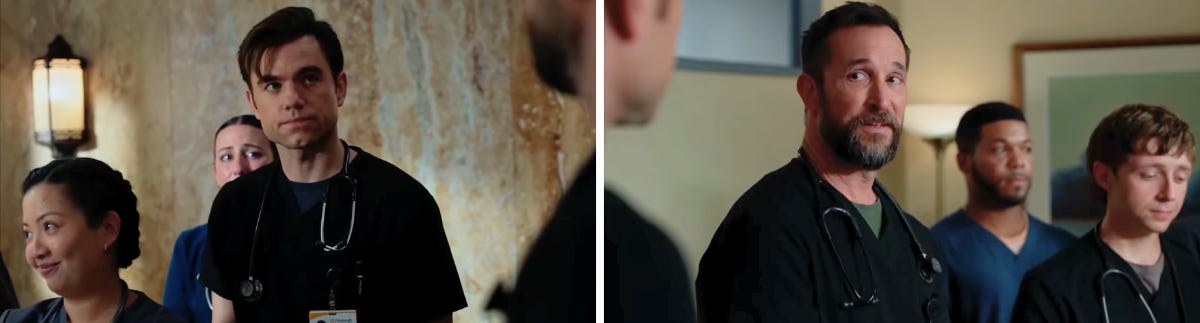
After this look, Langdon holds up a photo of Louie with a woman, presumably his wife, found after his death. Robby tells the gathered staff what he learned about Louie one night some years back when he was “feeling talkative.” Louie had a job, a home, and plans for the future until his pregnant wife was killed in a car crash a month before her due date. He drank to excess because living with that was too painful. Nurse-in-training Emma, who’d started that morning and didn’t know Louie the way the rest did, gently took his hand, as if he could still feel it. That’s when I cried.
The revelation of Louie’s trauma provided context for his condition, but the staff didn’t need it to care for or about him. Neither, I’d argue, did the audience. We took our cues from his doctors, the heroes of the story. Their empathy is not unconditional; Robby and the rest can be judgmental, particularly of the antivaxxers, wild-birthers, and other MAHA-adjacent people who preach against medical intervention. They are less than charitable with the security guard who tased a law student, and they side-eye those who ignore the clear and present dangers of fireworks, motorcycles, and sunbathing. Santos is openly hostile toward anyone she suspects of sexual abuse or child endangerment. Addiction is tricky, and they are not uncritical, but generally, they treated Louie with kindness. They cared about him as a person, and therefore, we do, too.
Robby was Not Okay in season one. He was struggling with post-traumatic stress from the death of Adamson and the COVID-19 pandemic as a whole. His downward spiral didn’t start with Langdon’s addiction, but it took a dark turn. Maybe more happened in the ten months between seasons one and two, but that’s not the story they are telling. In this story, Robby sends Langdon away, and we start back up with his return.
As Robby is Adamson’s legacy, Langdon was meant to be Robby’s legacy. Langdon was his special boy, his number one, his chosen successor. Thus, Robby took Langdon’s addiction personally. He took it as a betrayal. That’s why he spends half of the second season running from him and the other half damning him. Robby didn’t want to see Langdon before his motorcycle ride to oblivion. Maybe he wanted to die disappointed, or maybe he wanted to forget that Langdon ever mattered to him. Mostly, he wanted to mask that pain, to manage it with adrenaline the way Louie did with alcohol. Instead, Langdon’s presence pokes at the wound. It reminds Robby that he failed the future (Langdon) as much as the past (Adamson). That’s why he’s so frantic to leave before they can spend any time together. My beloved Dr. Ellis (welcome to the S3 main cast!) makes the subtext text in this perfect scene:
But as much as Langdon is a reminder of failure, his return is also a reference to resilience, to hope. So are Whitaker and Santos, who’ve moved into the place Langdon vacated in Robby’s hierarchy of attention. So is Javedi, whose potential Robby sees clearer than her overbearing parents do. So is Mohan, whom Robby pushes to leave not because she’s a bad doctor, but because this is a bad place for her. So is Al-Hashimi, who represents a future without Robby. So is McKay, who is secure enough in herself to push him even though she doesn’t have the cachet from work or friendship Al-Hashimi or Dana do. And so are Abbot and Dana, who know and love him best. All of them represent failures and hopes, and Robby is equally ill-equipped to deal with both.
I’ve often described the relationship between Robby and Dana as that of siblings. Now, I would like to expand that to the ensemble. “Team-as-Family” is a tried-and-true trope in storytelling, and while birth order theory is fake, it maps very well here.
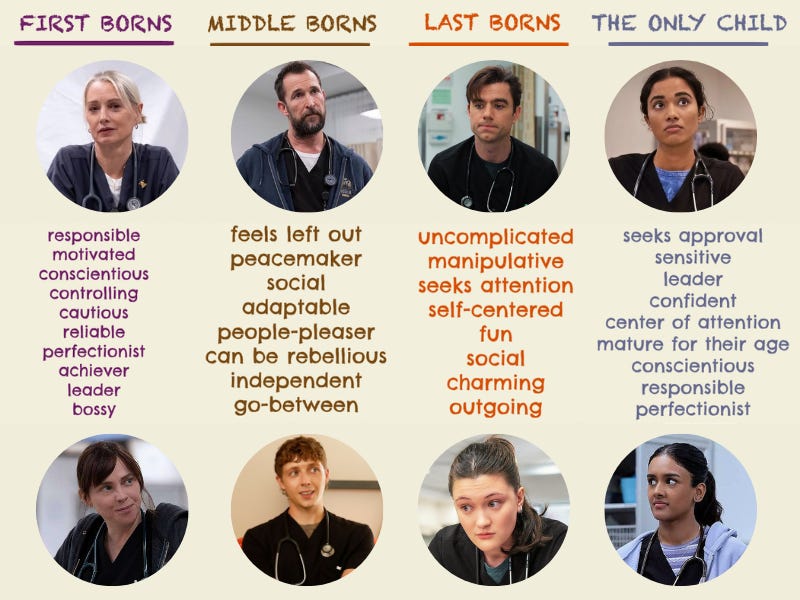
This is what Robby is running away from, and these are the people he spends the season letting down: his family. His brothers and sisters in arms. The second season is Robby’s ill-fated Independence Day. He wants to be free. He is suicidal and selfish, and he makes it everybody’s problem. He has an overinflated idea of his impact while simultaneously wanting to disappear.
America is now 250. That would be old for a person, which is how we people conceive of age, but it is quite young for a country. Noah Wyle is 55. Middle-aged. But also when we start to feel older, if not old, especially in our youth-obsessed culture. Robby probably feels even older. He’s seen so much death. So much pain. So much heartbreak. He feels stuck. Tied to the Pitt, trapped in the trauma. Constantly spinning his wheels and never moving forward. Robby only reached the top because his hero died, because he chose to let Adamson’s heart stop beating. He’s tired, and his legacy is tainted. He survived, but he paid for it.
Enter Baby Jane Doe, metaphor made flesh. Here she is, the future. The unknown. Promise. Potential. A baby. Helpless. Needy. Unable to survive on her own. A great, unfinished symphony. Legacy.
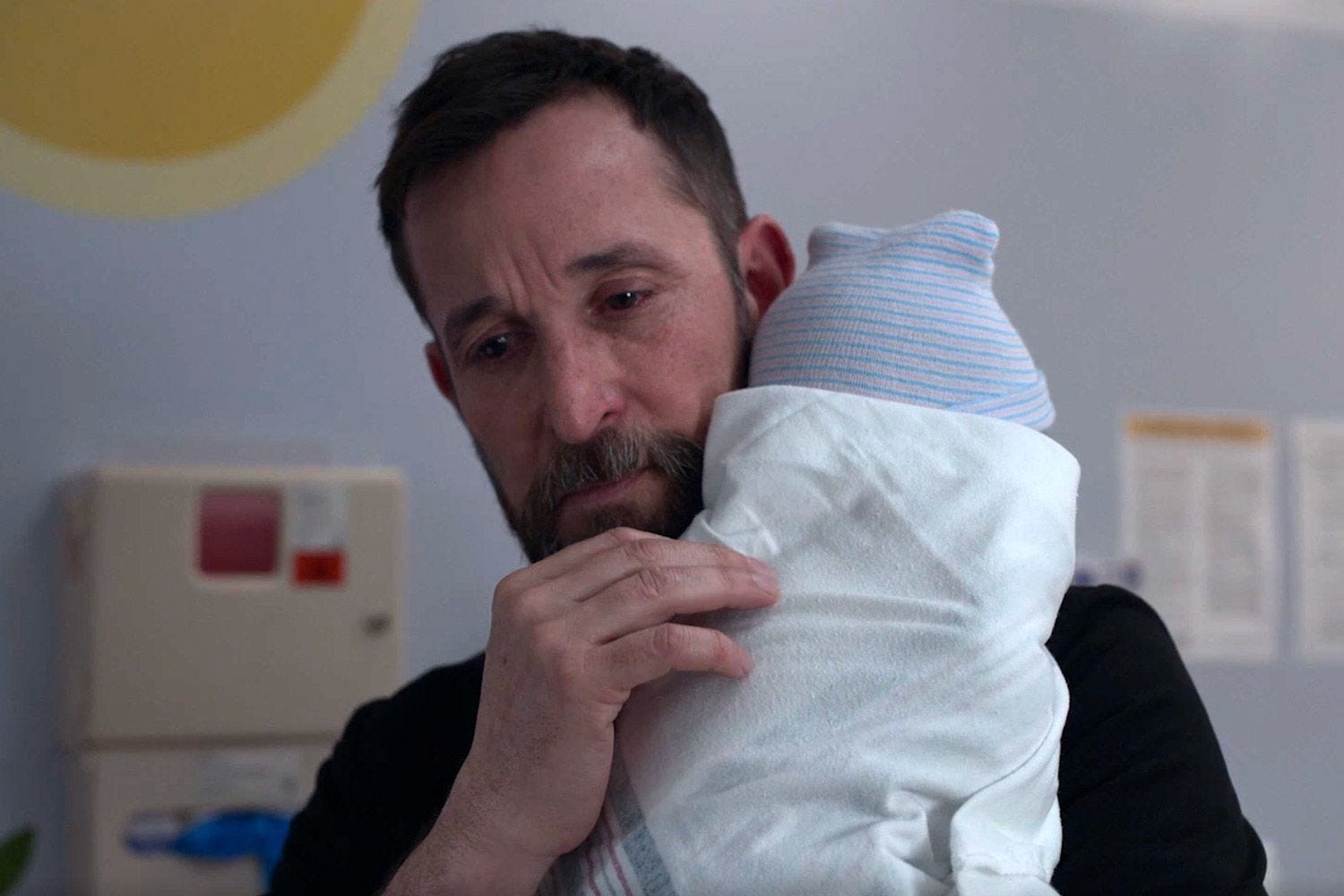
Robby ends the season telling Baby Jane Doe that it’s gonna be okay. He’d just, finally, talked to Langdon about their tension. And Langdon had the upper hand in the conversation. He told Robby, clearly and definitively, that he needed to get help. It is the same message Robby gave him last year, and the same message Robby gave Al-Hashimi minutes before: you can’t handle this on your own. Robby does not want to listen because Robby is used to doing it on his own. It’s why his relationships don’t work out. It’s why he holds himself apart. It’s why he’s so scared of being left behind that he’d rather run away. It’s why the only person he can tell he’s lonely and hurting is a two-month-old infant without a name.
Dana spends the last hour looking for someone to take the baby home, stating that nurses and doctors qualify for “kinship adoption.” In the same episode, Whitaker is shown acting like a father to the baby of a patient who died, something Robby, Santos, and the show find questionable. Mohan is not speaking to her mother, and Mel is struggling with her sister’s self-sufficiency. Abbot is Robby’s emergency contact. Family, blood or chosen, is complicated.
Robby was abandoned at eight years old. For him, independence is also a burden. But everyone in the ER came to see the baby. Everyone watching wants the best for her. I want what’s best for Robby, too. And his hospital family. I think that’s the point.
If you are experiencing a mental health crisis, call or text 988 anytime to speak with a trained counselor, or chat online via the 988 Lifeline website.
No posts
Comments
Nothing yet. Say the first thing.
Sign in to join the conversation.