
This post is part of my Reproductive Health, Rights, and Justice project examining the portrayal of reproductive healthcare on television. I am a social scientist, not a medical provider or lawyer.
Content Notes: This post contains discussion of murder and extremist violence. Researching it was difficult, and I also encourage caution when reading the links.
Law & Order Episode 5.12 “Progeny”
Premiered: January 25, 1995
Law & Order is an episodic crime procedural and legal drama centered on NYPD homicide detectives and prosecutors. Each episode follows a case from initial discovery through the trial. Their stories are often “ripped from the headlines.”
Anti-abortion zealots murder a doctor as part of a conspiracy to plead justifiable homicide in the defense of others.
Dr. Eileen Reed (Kathy Morath), a doctor who performs abortions two days a week
Randall Jenkins (Thomas Schall), who confesses to killing Dr. Reed
“Father” Drew Seely (Edward Herrmann), a former priest turned anti-abortion activist who allegedly set up the murder
Nancy Gunther (Anne Bobby), another activist who infiltrates the clinic as a new patient to obtain the doctor’s identity and address
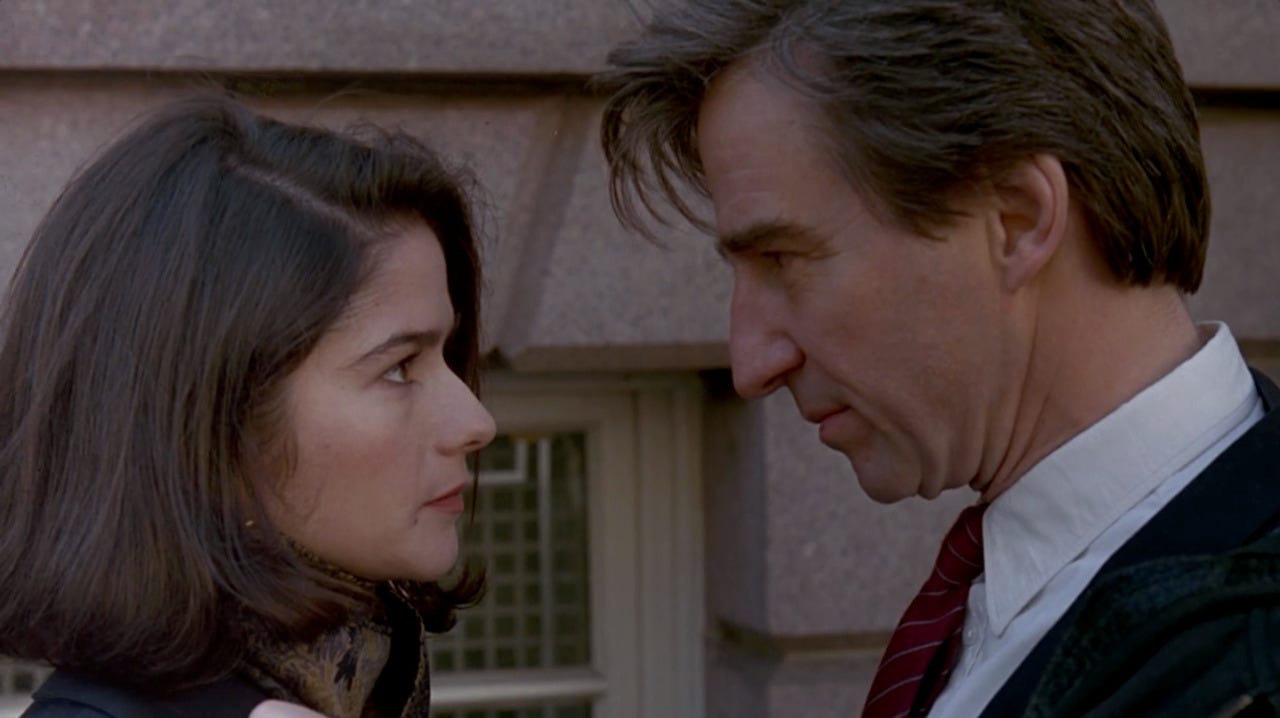
Executive Assistant District Attorney Jack McCoy (Sam Waterston), a prosecutor in New York City
Assistant District Attorney Claire Kincaid (Jill Hennessey), Jack’s second chair
Attorney Charles Garnett (James Rebhorn), the lawyer for the defense of Randall Jenkins. Mr. Seely acts as his own lawyer.
Seely orchestrates the crime to put abortion on trial through a justification defense. At first, Jenkins claims Dr. Reed’s murder was justified because he was preventing the deaths of unborn babies. However, Claire uncovers that Jenkins’ ex-wife had an abortion, and his real motive was revenge. Seely then claims that he directed Jenkins to kill the doctor and provided the gun. He is subsequently put on trial for conspiracy to commit murder and also claims justification. During an intense cross-examination, McCoy shows that while Seely believes that killing abortionists is moral, he knows it’s a sin, and therefore, unjustifiable. Both Jenkins and Seely take plea deals on lesser charges and go to prison.
“A nice lady doctor wearing a bulletproof vest.”
—Detective Lennie Briscoe, describing the victim
Twenty years after Roe v Wade made abortion legal for everyone in the United States, “pro-life” anti-abortion extremist Michael Frederick Griffin shot and killed Dr. David Gunn. It was the first documented murder of a doctor targeted for providing abortions. During the trial, the defense suggested Griffin was “brainwashed” by his spiritual advisor, John Burt, the regional director of anti-abortion group Rescue America, and an all-around horrible person. “Progeny” debuted ten months after Griffin was found guilty.
Violence and terror have been tactics of the anti-abortion movement from the beginning, and it has not slowed even in response to seeming victories, such as the overturning of Roe v Wade. The Freedom of Access to Clinic Entrances (FACE) Act, written to protect reproductive health providers and patients from harassment and violence, was signed into law in 1994. Days after his inauguration in January 2025, President Trump pardoned 23 people convicted under the FACE Act, and the following day, his Department of Justice directed the dismissal of pending FACE Act prosecutions. Instead of prosecuting violence against reproductive health clinics, most of which provide a wide variety of care outside of abortions, the Trump DOJ is using the FACE Act to go after protesters and journalists. Feeling emboldened, anti-abortion extremists continue to plot acts of terror and murder.
Arguing against the defendant’s claim of justifiable homicide, Jack states, “Justifiable force can only be claimed in defense of a person, Your Honor. Under New York law, a fetus is not a person.” This remains true in New York; however, the strength of Jack’s statement varies across state lines. “Fetal personhood” laws would grant full legal rights to a fetus, beginning at fertilization, though the ‘fetal stage’ is only achieved at nine weeks. These harmful laws criminalize not only abortion but miscarriage and stillbirth, and threaten the use of birth control and in vitro fertilization. They could be used to enact a federal, nationwide ban on abortion.
Both sides of the abortion debate are voiced in this episode. The anti-abortion cohort is represented by three extremists: Randall, the shooter. Nancy, the spy. And Father Seely, the mastermind who manipulated the crime and the defense specifically to put abortion on trial. None of them is particularly sympathetic. Nancy is a pawn, Randall and Seely are convicted murderers, and their views are presented as extreme and hypocritical.
However, their argument is given the most screentime. Seely preaches about conception and quotes the bible. He likens abortion to a holocaust and reproductive health clinics to death camps. He tells the jury that he and his colleagues are saving lives while the victim was a baby-killer. In his opening statement, Seely points out that 150 years ago, Black people and women were not considered people with legal rights, and could be lawfully prosecuted and punished for fighting against that belief. Two non-violent anti-abortionists are also featured: an OB-GYN who used to provide abortions but now considers it murder, and an activist who tells the police she also marched against the Vietnam War and nuclear weapons. She considers all three causes to be pro-life.
Meanwhile, on the opposing side, they are mainly concerned with the hypocrisy, illegality, and success of the anti-abortionists’ violent tactics. The victim’s husband wanted her to stop. Her coworkers described how many doctors had already stopped, for fear of their lives. To the police and the prosecution, Randall’s and Seely’s anti-abortion views are simply motive and intent. All of Jack’s arguments point to abortion being protected by the law, and he uses Seely’s moral and biblical stances against him. He wins by getting Seeky to admit he had to manipulate others into killing doctors because he knows murder is a sin. ‘Pro-life’ is used seven times in the script. ‘Pro-choice’ is used once. ‘Anti-abortion’ or ‘anti-choice’ is not used.
Claire, the only woman on the legal team, is also the only one to mention the right to choose, which she describes as both ‘legal’ and ‘constitutional.’ She brings it up twice, and both times her male bosses dismiss her. DA Schiff prioritizes the right to speech, claims ‘two wrongs don’t make a right,1’ and belittles her education, while Jack straight-up tells her, “Claire, if we make this trial about feminism, we’ll be taking the bait and arguing the wrong issues.” And he’s not wrong about the letter of the law, or that arguing for abortion is a risk. Nor do I expect Law & Order, of all series, to be unashamedly pro-abortion. But it’s telling that Claire and the whole concept of feminism are shuffled to the side.
Throughout the episode, Jack is very clear that abortion is the law and the unborn are not people. Unfortunately, United States law has weakened on both statements over the thirty years between the episode and today. Now, access to an abortion is only sometimes the law, and various states are pushing fetal personhood. No television series can be held accountable for government decisions, but creative choices and audience perception feed each other. “Progeny” is clear that murder is murder, but equivocates on abortion. Claire is never allowed to make the pro-choice argument. To me, that was a mistake.
Explore More
National Abortion Federation: Safety & Security, statistics on and overview of violence in the anti-abortion movement
The Anti-Abortion Movement Has Been Pushing a “Fetal Personhood” Strategy, fact sheets
Everything You Need to Know About Fetal Personhood, a conversation with Mary Ziegler
Fetal Personhood Law In the United States, a legal timeline
Schiff: Oh, you want to revoke his right to free speech?
Kincaid: He’s trying to revoke a woman’s Constitutional right to choose.
Schiff: Oh, so two wrongs make a right? Is that what they taught you in Harvard Law School?
To be up front, this does not overtly suggest abortion is wrong; however, the phrase “two wrongs don’t make a right” is often used by opponents to abortion and to abortion exceptions for rape, incest, age, etc.
No posts
Comments
Nothing yet. Say the first thing.
Sign in to join the conversation.