

Hello and welcome to part two of the afterword(s) of Atsushi Kaneko’s Search and Destroy, based on Dororo by Osamu Tezuka. As you know the manga wrapped up last week, with all 18 chapters available to read for subscribers until the end of this year (links below). This manga is translated into English by Ben Applegate, lettered by Phil Christie, and edited by myself, Christopher Woodrow-Butcher. This manga is published in print by Fantagraphics (Volume 3 of the printed manga arrives in stores November 25th, 2025!) and you can get the series at their website or wherever there are good books.
Search and Destroy Previous Chapters:
Volume One: Introduction (Free) | 00-01 (Free) | 02 | 03 | 04 | 05 | 06 |
Volume Two: 07 (Free) | 08 | 09 | 10 | 11 | 12
Volume Three: 13 (Free) | 14 | 15 | 16 | 17 | 18
Editor Christopher here. As noted this is part two of our afterwords, with some of the fun rare artwork from the series revealed in our newsletter post earlier today. In this post we’ll dig into some of the justifiably angrier and more militant themes underpinning the work, reflecting the very difficult times in which we live. In this post you can look forward to:
Atsushi Kaneko’s Original Afterword to Search and Destroy Volume 3
Translator Ben Applegate’s final thoughts on working on Search and Destroy
Christopher Woodrow-Butcher offers thanks to the folks who helped make this happen.
So with that said, buckle up for these epilogues to Search and Destroy.
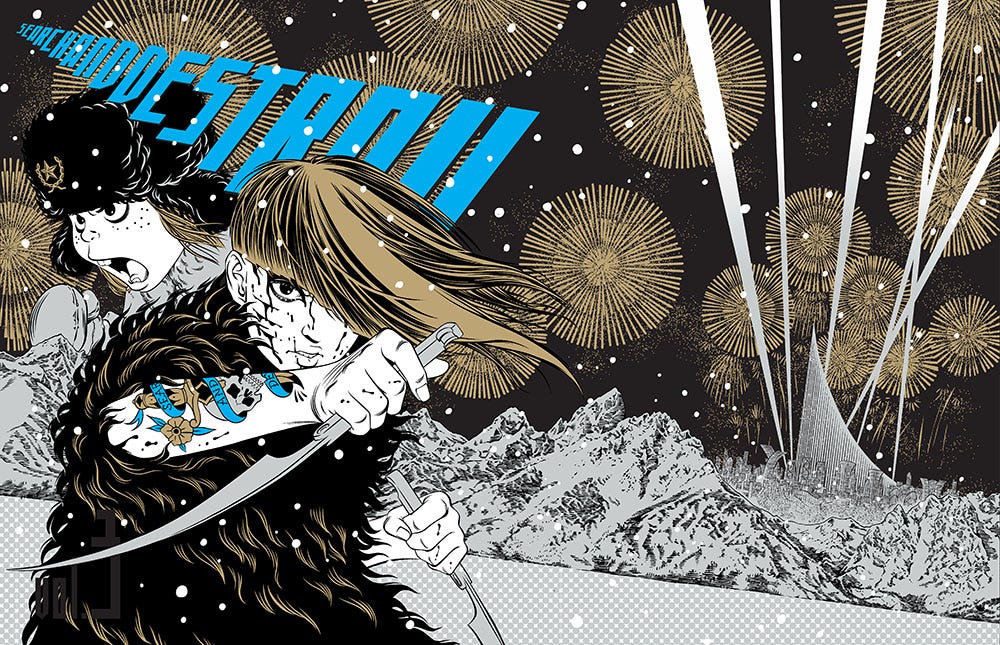
At the foundation of Osamu Tezuka’s works, I feel a deep and intense rage. That rage sometimes takes the form of a blazing fire that burns humanity to ash along with all our sins, or sometimes the form of a prayer offering condolence for the despair of the weak. During the time Osamu Tezuka lived, and during the time we live today, humanity was and remains foolish. We have failed to eliminate conflict, intolerance, and irrationality. As one person who lives in that world and has chosen the path of artistic expression, I also find myself motivated to work by rage.
In Dororo, a series that was unpopular even compared to the other works that Tezuka wrote in the middle of his life because its bleak tone made any broad appeal to readers of its time impossible, I can likewise feel a profound rage. It takes place in an age of disorder, populated by those who aspire to rule and those they oppress. Wild dogs swarm around endless piles of corpses. Demons run rampant, the byproducts of an apocalyptic age permeated by the stench of death. Hyakkimaru and Dororo are depicted as having had everything taken from them by this era, and they each face their own trials, with their rage as their only strength to carry on. Their rage is Tezuka’s own rage, and the merciless curses they hurl at the tyranny and violence of the ruling class are unmistakably Tezuka’s own words. From another standpoint, it is a story about identity. As he takes back, one at a time, the body parts that the demons stole from him, Hyakkimaru asks the question, “Who am I?” Though Search and Destroy is very different on the surface, I wanted it to carry on Dororo’s legacy at its core, even as I added elements that I hoped would give it modern appeal. For example, Hyaku, the equivalent of Hyakkimaru, has become a woman. I thought this would be a poignant choice, since her body is treated as a thing, an object to be thoroughly exploited and consumed. I also established the setting as a time of increasing inequality, discrimination, and social breakdown, intending for that to serve as one reason to draw a new Dororo for a modern age. To me, a story is a mirror to reflect the world, and I think of this one as a declaration of my rage against that world. This manga may be based on Dororo, but the rage I imbued it with had to be my own rage.
From the beginning of the story to the end, Hyaku possesses a fierce rage. Her rage is a wind at her back that seems as if it might sweep away her cruel fate, and it serves as something like pride, to keep her from losing herself. Her rage is just one of the things that Hyaku has inherited from her adoptive father Tsukumo, and which she then passes on to Doro. As the final kreach, the “microbiologist,” puts it, they are all rebels who relentlessly defy a cruel world and pass on the strength of that rage to others.
When we feel the irrational rage that is so abundant in this world, we can’t help but feel alone—because that feeling amounts to a realization of our own insignificance and powerlessness. At those times, touching something that has been charged with someone else’s rage, like a manga, book, movie, music, or other piece of art, demonstrates that there is someone else out there feeling the same rage, and that this feeling welling up inside us is not a mistake. Even if culture does not drive politics directly, it can change the hearts of people, one at a time. I do believe that rage, passed on in this way, can eventually change the world.
I am certain that the rage embedded in Tezuka’s manga is alive within me, giving me the courage, even now, to keep drawing my manga.
There could be no greater happiness for me than for my manga to wipe away someone else’s loneliness and give them the strength to keep raging.
Atsushi Kaneko
February 2020
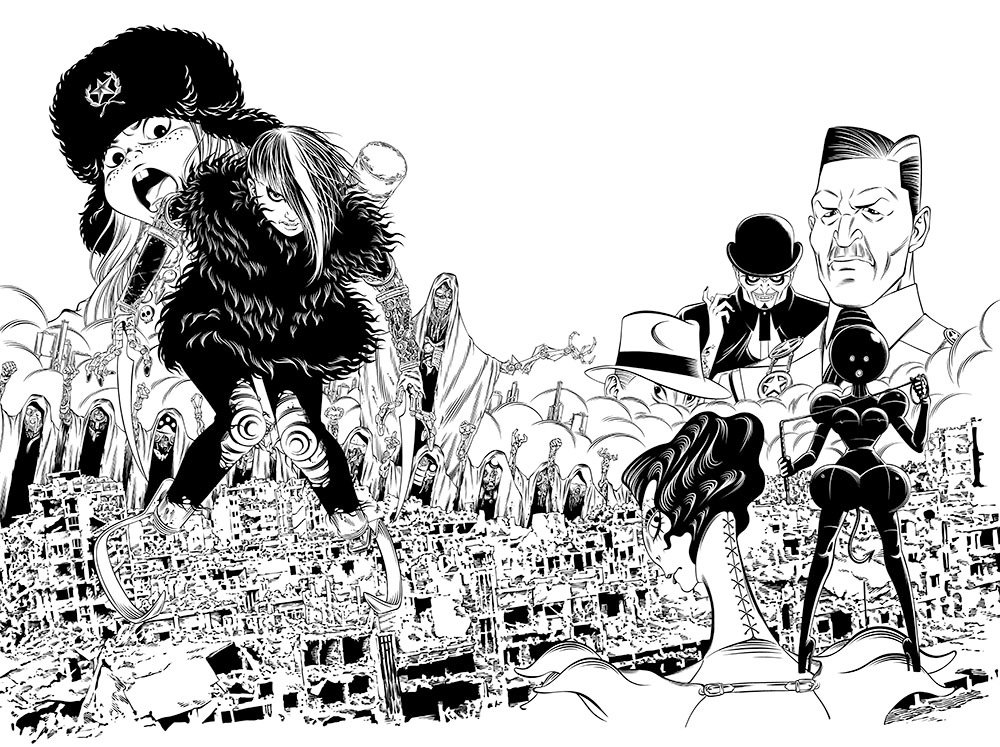
In its author's words, Search and Destroy by Atsushi Kaneko is a story about anger. For me, at least, this has been the defining emotion of 2025. Most days, I wake up angry, perhaps having heard the latest death tolls from Gaza or Sudan, and I go to sleep angry, perhaps having seen a report about a journalist being assaulted or arrested in Los Angeles or Washington, D.C. I have been deeply and persistently upset before, but my anger has never been the dominating force in my life that it is now. In this, relative to my fellow Americans, I am “late to the party.” There are people who spent all day angry before this year. The sources of their anger vary. Some of them helped make Donald Trump president again.
If you find yourself in need of a way to contextualize your anger, Search and Destroy is my prescription. In the manga's inspiration, Dororo by Osamu Tezuka, there is a pulsing, animating anger—at personal wrongs but also at a broader unfairness—that Search and Destroy's author Atsushi Kaneko has identified and preserved in his new work. Both manga take place in worlds where petty monsters serve an amoral master whose ambitions can only take root because of social rot. It was a familiar story to Tezuka, who as a teenager walked through the ashes of the Osaka firebombing, and, sadly, it's familiar to us today.
As Search and Destroy begins, a global conflict has left open a power vacuum that one clever human megalomaniac (the “mayor”) and his 48 robotic “collaborators” rush to fill. The bitterness, devastation, and inequality that are war's legacy have deadened society's empathy toward individuals, which at the lower end of the social order include both decaying robots (known as “creatures”) and obsolete human workers. The personification of this broken world is Hyaku, who as a baby had her body broken up at the behest of the mayor, the parts distributed among his underlings.
We can look to these collaborators, who have each physically appropriated and jealously guard a part of Hyaku's dismembered body, to remind us that followers of fascist regimes do not pledge their loyalty to the leader because they are brave, but because they are cowardly; not because they alone have figured out the singular secret behind the good life, but because they have chosen cruelty and blind obedience as a way to paper over diverse individual deficiencies. Any crime is justified in exchange for their human parts—arms, eyes, ears, lungs, a tongue—and this taste of organic sensation unmediated by technology overloads their circuits, driving them into ecstasy.
Standing against the mayor are the racist, humans-first political opposition, and a Luddite mob that roams the street tearing apart innocent creatures. Social trust has all but disappeared. The enemy of my enemy is another enemy. The only righteous causes are those of Hyaku, Doro, and the migrant creatures who are drawn to the city by promises of freedom but end up held captive in an underground rare earth mineral mine, there to forge a pure, elemental conception of self and to foment a revolution.
I was honored to have the opportunity to translate Search and Destroy and pleased that it has been recognized by the comics community with an Eisner nomination and the most nominations of any series at the American Manga Awards in 2025—primarily because Kaneko-sensei is a brilliant artist who has been unknown in this country for far too long (here's hoping this is just the beginning). I’m especially pleased that this attention is coming this year, because Search and Destroy’s anti-fascism could not possibly be more relevant, rooted as it is in a blazing, indignant rage on behalf of the people in this, the real world.
I've spent several days this year visiting Delaney Hall, a private prison in Newark, New Jersey, near my home. First I went as a protester, hoping to prevent the facility from reopening, and now I volunteer on the weekends to help support people there hoping to visit their loved ones in detention. There is no way to make an appointment, and the process to get in is always changing. Currently, you have to figure out which “unit” your loved one is in, then come for one of just two sessions a week. Some people arrive as early as 6 am, because there is no way to tell whether the gate guard will strictly limit the number of inmates who can see visitors to as few as 15 or will be more lenient. There is no waiting area or amenities for visitors. Volunteers who dedicate many more hours than I do arrive early with chairs, drinks, and food. They erect tents in the triangular space of black asphalt, which is bordered by a driveway, a barbed-wire fence, and a road that also leads to a waste processing plant and a fat rendering facility. (When there's no wind, and the hot, acrid air settles, I have to launder my clothes as soon as I get home.)
One day last month, a mother and her 5-year-old daughter had driven three-and-a-half hours to see her father, who’s likely to be deported any day now if he hasn’t been already. I played with that little girl for an hour while her mother spoke to an attendant in a corporate polo shirt. The kid was hilarious. Her English was about as good as my Spanish, but we pretended a big sign covered in anti-ICE graffiti was a drum set, and we wailed on it with sticks until it “broke” and she had to fix it with her “screwdriver” (another stick). That weekend was one of the stricter ones, and they hadn’t shown up early, so in the end they had to get back in the car and drive the three-and-a-half hours home without seeing their husband and father.
Last weekend, I met a woman whose father has been in Delaney for four weeks. He has lived in the U.S. for thirty years and works in construction, she said, and when he returned to a job site to clean up, he was arrested because the cops thought he was “stealing scrap.” That misunderstanding became a troublesome legal case, which became a settlement to make it go away. But it didn't go away. Her mother and father went in to renew their immigration status on the same day, as they have many times before, but this time only her mother came out. I also met a Japanese woman who said she has lived in the U.S. for three years and met her husband here. They were planning to move overseas for her new job posting in four months. Instead, he was arrested at a routine immigration appointment in Manhattan. We talked for hours in Japanese, including about manga.
To members of their respective in-groups, the fascism of the 20th century offered, and the American fascism of Donald Trump offers today, the chance to flatten the disquieting individuality of their personal grievances into a simple, comforting unity of purpose: the spiteful exercise of power to disintegrate social identities and physical bodies that don't fit in. Search and Destroy offers elegant comment on this brutalizing, seductive formula with its human-robot divide (whose complexity certainly puts it on par with the best science fiction) and its very literal metaphor of Hyaku and Doro's physical bodies being captured and compromised by those in power. In this, it does better than provide the fleeting analgesic of escapism—it brings the lasting assurance that someone understands.
At this moment, when fascism is resurgent around the world, when pregnant and trans and queer people are being treated with a cruelty that has nothing to do with the lives they just want to be left alone to live, when unaccountable homeland security officers are kidnapping our neighbors and their children to fill a national network of concentration camps they have just secured funding to expand, I sometimes lose faith that what I do for a living, working in comics, really matters. I even despair that there is anything I can do that will have any kind of real impact on the world. There can be no single antidote to that feeling, but Search & Destroy helps. No one could sum up why better than Kaneko-sensei himself, so I urge you to read his afterword to this scintillating manga; remember that you belong to you, not them—and stay angry.
Ben Applegate
August, 2025
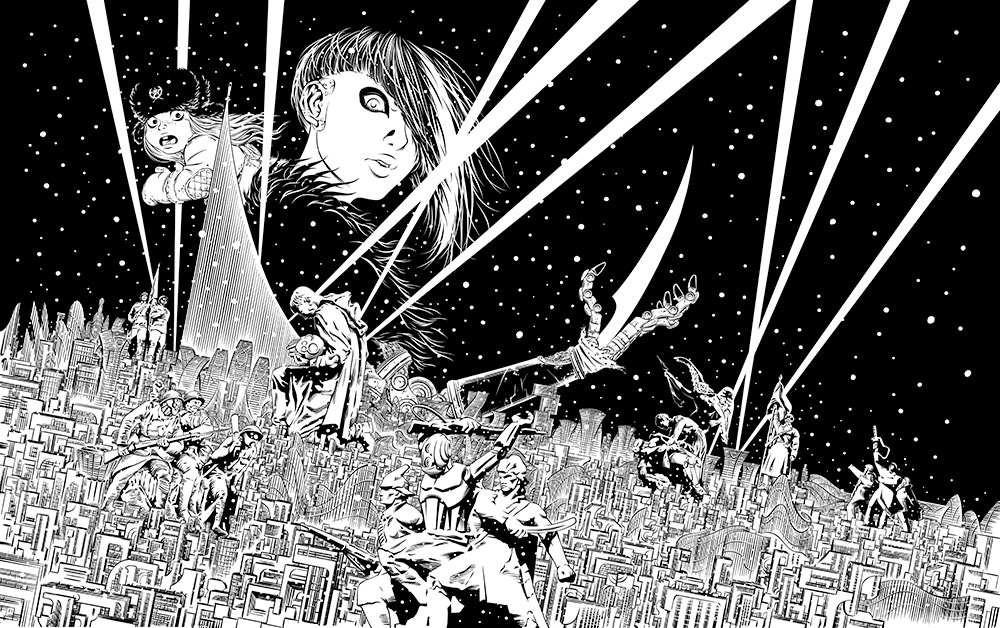
Well after that one-two punch by Kaneko-sensei and Ben, there’s really not a lot left to say about this work. For my part, it was my honor to help bring it to English readers for the first time, its core message ringing deeply true to me and hopefully, as Ben says, something of an antidote to the times we live in. It’s not lost on my that the very website upon which this is serialized this is definitely hewing towards the fascist forces of the day, but while we still can, I’m proud to share these works and, to paraphrase Kaneko-sensei, to be a rebel who relentlessly defies a cruel world and passes on the strength of that rage to others.
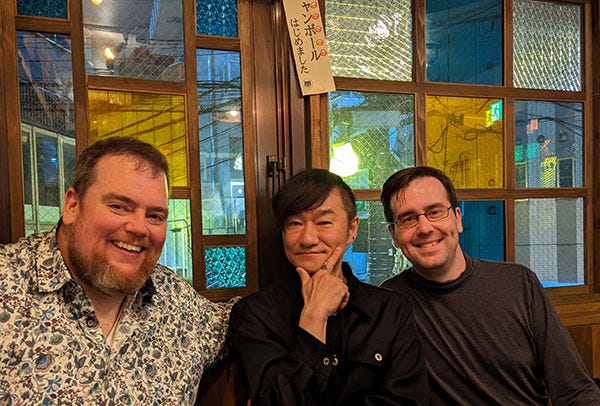
So, some thanks are in order to the many folks who helped bring this work into English with me.
Jocelyne Allen & Peter Birkemoe: Thank you both for your support and for introducing me to the works of Atsushi Kaneko many, many years ago. If it wasn’t for you I wouldn’t have known just how good his work is.
Stéphane Beaujean and Sébastien Ludmann: When I first talked about publishing Kaneko-sensei in English, I appreciated your strong support and encouragement, even recommending Search and Destroy as a great first work in English. Thank you both!
Frederic Toutlemonde of Tezuka Productions: Thank you for taking a chance on MSX and going to bat for us, and for your years of friendship. I greatly appreciate everything you’ve done. Our sincere thanks to TezukaPro for their support as well!
Eric Reynolds: Book Numbers 2, 3, and 4! Dozens more to go. Thanks man, amazing working with you and the team.
Jacq Cohen, Tucker Stone, Paul Baresh, and David Hyde: I’m really floored by the incredible work all of you did to help spread the word about this series. I’ve never done so many podcast appearances or interviews! Thanks to all of you for your hard work, it was great working with you.
Aki Yanagi: Thanks for everything you’ve done to help coordinate between MSX and our friends in Japan, and for your friendship! I greatly appreciate it.
Frederico Anzalone and Peach Momoko: Thanks to you both for contributing important and excellent pieces to the print editions of Search and Destroy!
Deb Aoki: Thank you for your support of this title, and for editing its cohort partner Wandering Cat’s Cage at the same time. And for the million other amazing things you do that make all of our lives better.
To Chip and David and Deb (again) the Mangasplaining crew: This couldn’t happen without all y’all. Looking forward to releasing that next episode soon.
To the creative team of translator Ben Applegate and letterer Phil Christie: Can I just say how much I appreciate your phenomenal enthusiasm for this project? Both of you responding so strongly and positively to the then-secret news that we had licensed Search and Destroy made me realize we’d done something very right, at a time when things were very difficult. Thanks to both of you, and I hope we can work together on another project in future (if your insanely busy schedules allow).
Atsushi Kaneko: Thank you for entrusting your creation to us, and for working so closely with us to help make the release of Search and Destroy in English something special. It’s a rare gift in an industry that usually works as hard as possible to keep the North American team segregated from the Japanese creators, and I think all of our editions were made so much better for this close relationship. I hope we are able to work together again soon.
To The Readers and especially paid subscribers: You are absolutely helping to make manga projects like this possible, thank you.
Special thanks of course to my incredible husband and my brother and family for their support during the early days of serialization with this title, Wandering Cat’s Cage, and Okinawa. 2022 feels like a million years ago.
Finally, I’d like to take a moment to recognize the achievements of designer Ryan McCardle who designed Search and Destroy Volume 1 (and whose templates we used for the rest of the series). Ryan passed away last year, and he did an amazing job on our book. My condolences to his friends and family.
Christopher Woodrow-Butcher
PRAISE FOR SEARCH AND DESTROY:
"Kaneko reimagines Tezuka's 1960s epic fantasy saga Dororo as a gritty, fast-paced cyberpunk thriller ... Kaneko retains Tezuka's relentless pacing, flair for melodrama, and thematic focus on justice, corruption, and individuality within an oppressive society, while integrating elements of body horror and an increased focus on the unsustainability of societies where vital resources are controlled by a thriving minority, to the detriment of the masses." — Library Journal Starred Review
"It's a blast of pure cyberpunk energy." — Publishers Weekly Starred Review
"Richly imagined..." — The New York Times
"Search and Destroy grabs you by the throat with its opening chapter and never lets go." — Multiversity Comics
"A captivating work... This series would be great for fans of Naoki Ursawa's Pluto books or Tsutomu Nihei's Knights of Sidonia series." — Booklist
Comments
Nothing yet. Say the first thing.
Sign in to join the conversation.