
3 years ago, I was working on a complex cross-team project and hit a wall. I couldn’t move forward without a decision from someone on the other team.
So I did what I thought was clever and proactive. I messaged my manager:
“Hey, I’m blocked by person X. Can you help me unblock it?”
After the project wrapped, my manager gave me feedback that stumped me:
“Your communication can be improved - be more proactive and solution-focused.”
What? I thought I was doing exactly that.
Then he said something I’ve never forgotten, and now teach every mentee and employee:
“Before escalating a problem, always show the work you’ve done and your proposed solution. You’re hired for your brain, not just your ability to execute.”
I’ll show you exactly how I should have messaged him at the end of this article.
Here’s the line that finally made it click for me:
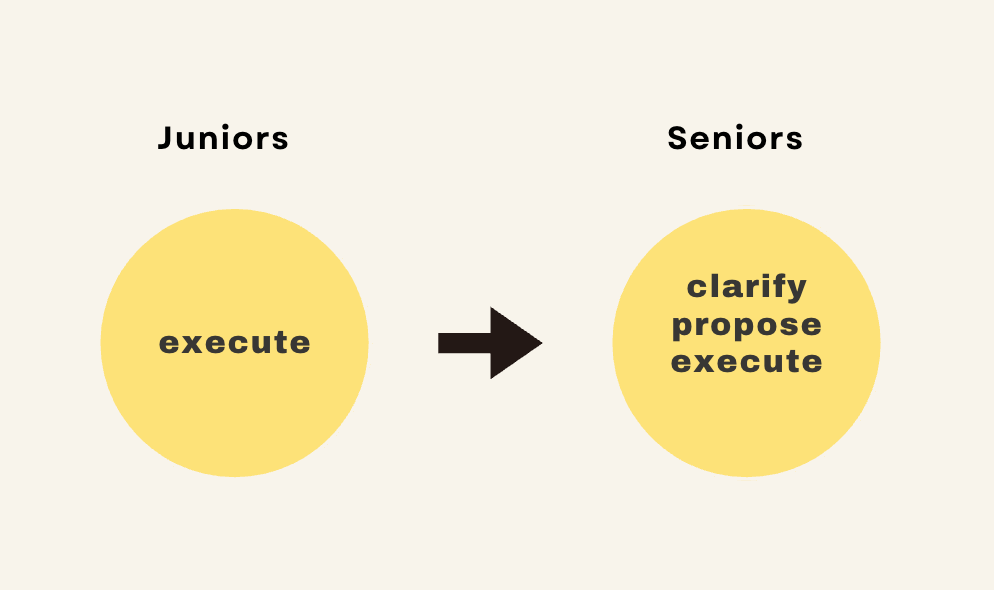
Juniors execute. Seniors clarify, propose, and execute.
Have you been told to be “proactive”? Have you seen it on every job description?
Did you assume “being proactive” means raising issues early or volunteering for more work?
That’s what I thought.
I was totally wrong.
After 9 years in consulting and data science:
Failing and excelling performance reviews
building my coaching business from zero
and now running a team of 5
I finally understand what proactive really means:
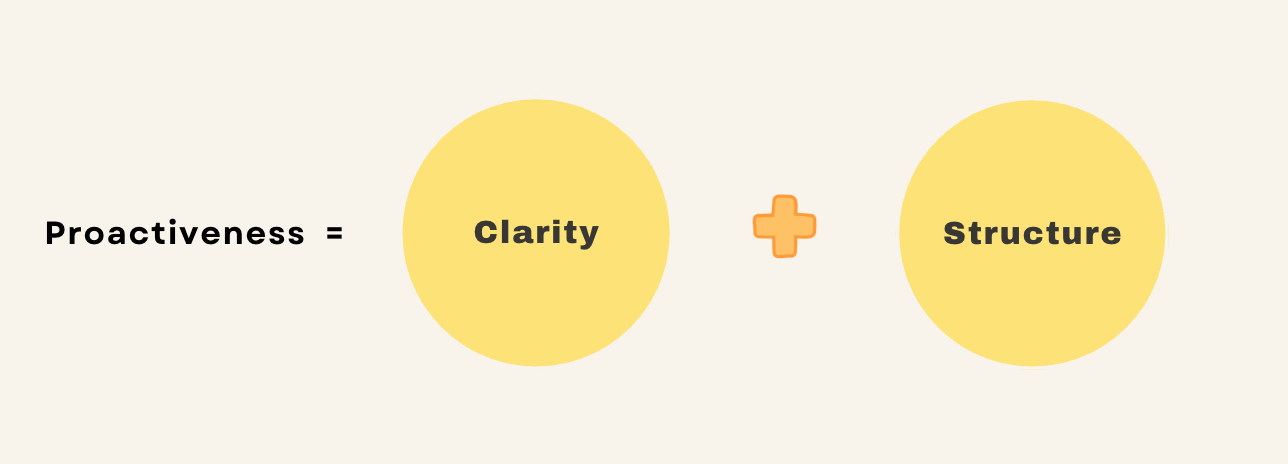
Being proactive means adding clarity and structure that makes decisions easier for others, not harder.
Below are the two frameworks that will get you there.
Word of caution though: Don’t blame me if your manager starts loving you a little too much.
When mentoring people new to a company, I get this question constantly:
“I don’t want to be a burden, but I’m new and have a million questions. What’s the right balance between figuring things out myself and asking?”
I made this mistake for years - either suffering in silence or asking questions the wrong way. It wasn’t until I hired and onboarded my own team that I realized:
Asking questions isn’t the problem. Asking them the wrong way is.
The right structure:
Show your work + your constraints + your proposed solution + ask for input
Instead of:
“Hey boss, I’m not sure how to do X?”
Try:
“Hey boss, can you sanity-check my approach to X?
I tried [way 1] and [way 2], but I’m stuck on Y.
I think the right path is Z. Am I off, or is there something I’m missing?”
Real example:
“Hey Mandy, can you check if I’m troubleshooting the key metrics dashboard correctly?
I checked two things: 1) the data source and 2) the dashboard filters. Nothing looks broken, but revenue and leads from last few months are still wrong.
To fix it, I’m planning to: 1) loop in Mike (data engineer) for a quick data check today, and 2) post a Slack announcement so the team knows I’m on it.
I’ll have both done by 4pm. Anything I’m missing?”
Mandy: Sounds great. Have you checked the CRM’s latest docs? They announced big changes last week - could be how our dashboard is wired.
You: On it. Will update you before EoD.
See the difference?
You’re not there to simply to ask questions or provide information. You’re there to provide structure.
I learned this from Robert Thompson, and it changed how I respond to every important request:
Never answer a request with a concept. Answer it with a deliverable.
Most professionals say things like:
“I’ll look into that”
“Let me think about it”
“I’ll do some research”
These are activity-based responses. They tell your manager you’re going to be busy, but give them zero confidence that you’ll deliver value.
High-performers respond with:
“By [DATE], I will deliver [SPECIFIC OUTPUT] that enables [DECISION/ACTION].”
Examples:
Bad: “I’ll think about our Q4 marketing strategy.”
Good: “By Friday, I’ll deliver a 2-page memo outlining three options for Q4 marketing, with pros/cons and my recommendation. That should give us what we need for Monday’s planning meeting.”
Bad: “Let me research our competitors.”
Good: “By EOD Wednesday, I’ll send you a comparison table of our top 3 competitors’ pricing, features, and positioning, so we can finalize our go-to-market strategy.”
Bad: “I’ll analyze our churn data.”
Good: “By Thursday, I’ll deliver a one-pager identifying the top 2 drivers of churn and recommending one experiment we can run this month to test solutions.”
Do you see the difference?
The strong version tells your manager:
What you’re delivering (specific format)
When they’ll have it (specific date)
Why it matters (what decision it enables)
This is the shift from task-taker to project owner.
Instead of: “Hey manager, I’m blocked by person X. Can you help me unblock it?”
Here’s what I should have written:
“Hey, I’m blocked by person X on [issue]. Here’s what I’ve done so far:
Asked X directly to prioritize our request - declined; they’re focused on internal tickets.
Escalated to X’s manager - same answer.
Two paths forward:
Communicate the delay to our team while X works through the queue. I’d pick up project Z in the meantime.
Escalate to our director and try to pull in another team to expedite.
I’m leaning toward option 2 - it minimizes the delay - but I’d need your help escalating to the director. If you agree, I can draft a short Slack message for you to send by 2pm today.
Happy to go with option 1 if you’d rather. I can also draft that comms email today.
Let me know what you think - or point me toward something I haven’t considered.”
Same problem. Completely different signal.
Proactiveness is not “timely communication” or “doing more than asked.”
Proactiveness = bringing clarity for others by solving problems and proposing next steps.
This is also exactly where AI can’t replace you. AI can’t:
Navigate political dynamics to understand what stakeholders actually need
Structure ambiguity in a way that enables human decision-making
Take ownership of outcomes (not just tasks)
These are human skills - emotional intelligence, political awareness, strategic judgment, communication nuance, leadership presence.
Your next steps
This week: Start talking in deliverables, not tasks.
This week: Stop asking for solutions. Propose them.
This month: Find one way every day to make someone else’s communication clearer.
You might also like:
Comments
Nothing yet. Say the first thing.
Sign in to join the conversation.