

On the day you’re admitted for a day care surgery at the hospital, a flurry of questions tends to pop up.
Should I carry my glasses? A book? My regular medicines? I’ve written this to help answer those very thoughts.
Gynaecological procedures where you can usually head home the same day, or after a single overnight stay, often feel daunting at first. This guide aims to build awareness around such admissions and gently ease that underlying fear of surgery.
You’ll find answers to many of the common questions about short admission procedures here. And if something still feels unclear, please don’t hesitate to ask me or anyone from our team.
With advances in medical science, many procedures and short surgeries now allow patients to return home on the very same day. Sometimes, an overnight stay is needed, and you’re back home the next day. These are known as day care admission procedures.
Modern anaesthesia has come a long way, and with improved surgical training, especially through natural passage techniques, fear, pain, and recovery are much better controlled. And honestly, who wouldn’t prefer recovering in their own bed by the end of the day?
Large international studies show that in selected cases, day care surgery not only supports smooth physical recovery but also helps patients feel more at ease mentally once they’re back in their familiar home environment.
The type of procedure suitable for day care depends on the country, the patient’s overall health, and how well recovery is expected to progress. For instance, procedures done as day care in countries like the UK or the US may not always be approached the same way in India.
Factors such as travel conditions, access to medicines, and the distance between the hospital and home play an important role in safety decisions.
Day care surgery is truly one of the valuable advantages of modern medicine.

Do keep in mind that some health insurance providers still do not recognise certain procedures under day care. That said, many modern insurers now approve day care treatments. It’s always wise to check with the hospital’s insurance desk regarding your specific policy.
Once you’ve spoken with me at the clinic and we’ve decided on a day care procedure, our team will share a specific date and time for your hospital admission.
This is planned based on your convenience as well as operating theatre availability. Rather than worrying unnecessarily or rushing at the last minute, it’s far better to contact the hospital admission desk a few days in advance and complete any required paperwork beforehand.
For planned admissions, do try to sort out your insurance documents early by speaking with both the admission and insurance desks. On the day of admission, there are quite a few formalities, and naturally, patients are often in a bit of a hurry.
So getting your administrative and insurance work done three to four days in advance makes the whole experience much smoother.
This is worth highlighting separately. If you take blood thinners such as aspirin or clopidogrel, do inform your doctor before fixing the procedure date. These medicines may need to be stopped a few days prior. You’ll receive the right guidance from me or our anaesthetic team.
Similarly, if you’re on HRT, oral contraceptive pills, or any herbal medications, some of these may also need to be paused temporarily.
For all the medicines you take regularly or occasionally, write them down clearly on a sheet of paper in large, legible letters, along with the timing of each dose. This becomes very useful during admission.
While listing medicines, include both the brand name and the generic composition if possible.
In the days leading up to surgery, try to include protein and vitamin C in your diet. Avoid constipation if you can. Stay well hydrated, around three litres of water daily if you are not losing excess fluid through sweating. In sweltering heat - perhaps a few glasses more.
If you have heart or kidney conditions that restrict fluid intake, do let me know in advance.

If you have any lingering questions, it’s always better to clarify them with me or our team ahead of time.
Three to four days before admission, organise all your test reports and previous prescriptions in a file, arranged by date.
Bring all old prescriptions, scan films, and relevant medical documents with you to the hospital. Take reports out of envelopes and arrange them neatly.
If you have more than fifteen reports or your treatment has spanned several months, consider using a punched file to organise everything chronologically. Keep scan films in a separate envelope or bag.
This simple system, something we actually learned from our patients, can make a real difference. When things feel rushed, you won’t have to rummage through an entire bag to find a single report.
Pack a small bag with a few essentials:
A clean dressing gown or housecoat
Lip balm and your preferred moisturiser
Your own comb (though hospitals usually provide one)
One or two books or magazines for some light reading
Two to three sanitary pads or napkins (for going back home)
A loose, comfortable outfit to wear on your way home
Headphones, light cosmetics, and your phone charger if you like
For day care procedures, bringing food or drinks from home usually isn’t necessary, as you may not get the chance to use them. It’s best to leave those behind. Modern hospitals typically provide a set that includes a gown, comb, slippers, and other basics.
That said, many patients still prefer having a few personal items with them for comfort. There’s no need to bring handwash or sanitiser, as these are readily available at the hospital.
Once your day care procedure date is confirmed, I’ll usually send you a printed instruction sheet via email. It will outline exactly what antacid medicines to take the day before, and from when you need to fast on the morning of admission.
Fasting before surgery is essential, and the specific instructions have been personalised for you in that email, so do take a careful look. Everyone’s requirements are a little different.
The day before admission, just double-check your email to ensure my instructions have arrived. If not, give our sister a ring on 70036 05050 to find out how to get them.

The day before, you might wonder whether to bring your glasses. In day care procedures, there’s rarely much opportunity to use them during your hospital stay. But if you’re anything like me and feel lost without them even for a moment, then by all means pack them. Do opt for a hard case though. A soft one risks breakage under pressure.
With today’s prices for frames and lenses, a shattered pair would be no laughing matter. Nurses are busy looking after you and your meds, so glasses are your responsibility. If yours are particularly precious or delicate, it’s wiser to leave them with a family member.
The same goes for other valuables. Jewellery, watches, or expensive phones are best left at home. Hospitals are bustling places. Thefts or losses are rare, but if something goes missing, it leaves both you and the hospital staff in an awkward spot.
Speaking of phones, let’s cover that too. You might need yours to fill out forms upon arrival. But once you’re taken to theatre, hand it over to a family member or friend who’s with you.
Even after returning back to bed, you probably won’t fancy using it for the first four hours or so. You can retrieve it later. If you enjoy music and have headphones, wait at least four hours post-recovery before keeping them with you.
On admission day, do bring a photocopy of your Aadhaar card or passport. If you have insurance, carry those documents too.
I hope your insurance papers were cleared three to four days prior. If not, you’ll need to sort it that day with the hospital. The day before, pack your regular medicines in a separate box and check that the strips clearly show names and expiry dates. This ensures no hiccups when doctors or nurses administer them post-surgery. Modern hospitals will refuse unclear strips for safety reasons.
You might choose a cabin with a TV to pass the time. It’s a decent form of entertainment. Just try to skip news channels. They often air distressing stories. Soap operas too can dwell on society’s messier tales. Before or after your procedure, it’s best to avoid anything that dampens the spirits.
If you’re in a shared room, keep the TV volume low so as not to disturb fellow patients. TV connections come from external providers, so if channels glitch, hospitals might not fix them promptly.
You may not get a perfect connection. Post-op, once a few hours have passed, you can keep your phone with you. Speak softly in the room to respect everyone’s rest.
Across the world, hospitals advise minimal belongings for admission. It’s likely to avoid any blame if items go missing or break. Hospitals are hectic enough without added worries. Your mind stays at ease too. For essential or special entertainment like premium headphones, check with reception in advance.
Factor in morning traffic jams and arrive at the hospital calmly and on time for a smooth admission.
Allow an extra hour for paperwork and formalities before check-in. Upon admission, note the visiting hours for you and your family. Each ward has set times. Ask at reception about your cabin or ward’s schedule.
Hospitals run on precise routines to manage meals, medicines, and rest. Visiting hours are timed to minimise infection risks. If the slots feel inconvenient, chat with reception beforehand to see when family or friends can drop by.
On admission day, try to limit the crowd of relatives or friends. Infection risks rise around theatre time. So skip handshakes before or after OT, and don’t let family sit on your bed.
If you’re pregnant or there’s any chance, do inform the doctor before booking your day care procedure date.
After arrival and check-in, hospital staff will escort you to your bed. If you’re in a cabin, a family member can stay with you, but get permission first. Ensure their clothes are clean and they show no signs of cold or infection.
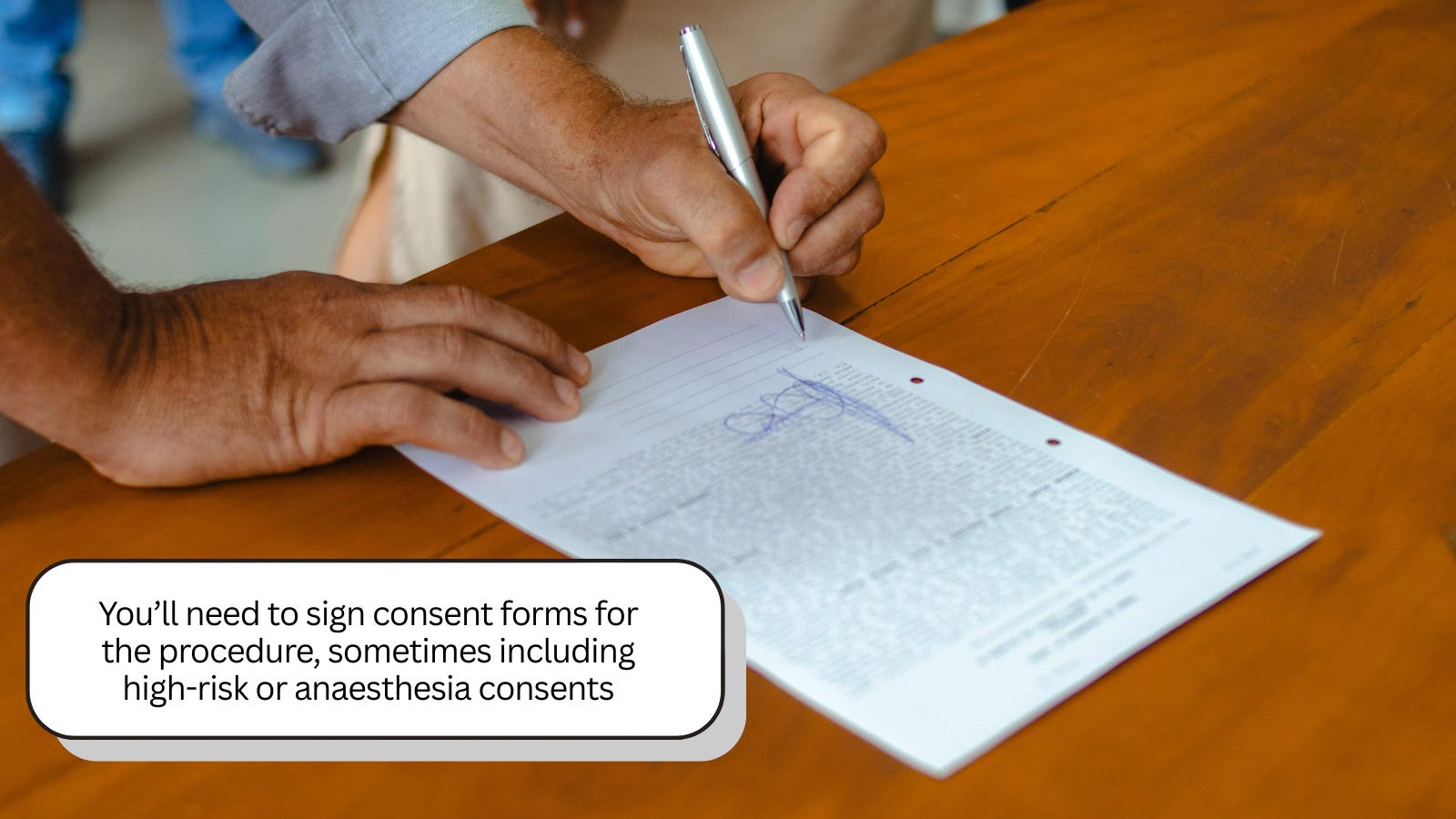
Post-admission, the nurse will verify your identity, check vitals like blood pressure and pulse, and screen for allergies. You’ll need to sign consent forms for the procedure, sometimes including high-risk or anaesthesia consents.
If not done earlier, you’ll meet the anaesthetist before the procedure. They’ll review your pre-op tests, discuss options, and decide the best anaesthesia for you.
It will ensure no pain during the procedure, a comfortable experience, and safe recovery for same-day discharge. Not all types suit everyone, so your anaesthetist will guide you personally.
If anxiety builds up, just ring me with your questions. We’ll clear all doubts well before admission day.
Before fixing the date, confirm you’ve emailed us your blood tests, X-rays, ECG, and echocardiogram. We’ll review them to spot anything that might lead to cancellation.
Once cleared, we’ll guide you to the pre-anaesthetic check. Without comorbidities, you can do it on admission day. But it’s mandatory before anaesthesia.
Post-admission, the nurse will give you a hospital gown to wear to theatre. Remember to use the loo beforehand. I try to avoid unnecessary catheters, though they’re sometimes needed. An empty bladder is crucial for any gynae day care procedure.
Theatre staff are regular folks like us. Chat with them freely. If nerves hit or questions arise, ask away without hesitation. They’ll start a saline drip in your hand to avoid repeated injections.
Through this IV line, you’ll get fluids, antibiotics, and pain relief to keep things comfortable.

If they put you to sleep, simply drift off with peace of mind. The anaesthetist will wake you once done. For spinal or saddle block, you can chat with us during. Experiences vary person to person. You might even listen to music if you wish.
Back in your bed, tummy pain is rare at first. Your throat might feel a bit sore, and tongue numb briefly. It fades gradually. Any discomfort post-surgery? Ring the bell for your nurse. She’ll fetch the resident doctor or me if needed.
I usually pop in to check on you and explain how it went. Anaesthesia fog might blur it though. We’ll cover details at follow-up. For key points, I’ll tell your family clearly. No need to strain remembering in that haze.
Post-procedure, expect four to six hours of observation. It depends on the procedure and anaesthesia type. Before discharge, the nurse checks if you’re passing urine and tolerating drinks or food. She’ll then confirm your exit time.
If insured, after hospital and nursing clearances, papers go to admin for insurance approval. You can leave once approved.
Times vary; insurers claim minutes to two hours, but in my experience, it often takes a bit longer. While waiting, ask sisters freely for food or drinks.
Someone adult must accompany you home. Your car or an app cab works fine. We don’t recommend public transport.
At home, ensure an adult stays with you for 24 hours, plus phone access to reach us or the hospital. Skip driving, cycling, or heavy machinery for at least three days. No cooking over fire.
Avoid big financial decisions, legal signatures, or unfamiliar meds these days. Anaesthesia can cloud judgement. Steer clear of alcohol or recreational drugs. Confirm a responsible adult is around.
Before leaving, read your discharge meds and instructions carefully. Have a friend buy any missing ones en route home. I’ll note procedure-specific advice, as it varies per patient.
Wishing you a smooth surgery.
Wishing you a smooth procedure and a swift return home.
- Dr. Manas Chakrabarti, FRCOG Gynaecological Oncologist, Kolkata
This is an impartial, unsponsored health information. For public awareness and not a replacement of Medical Advice.
No posts
Comments
Nothing yet. Say the first thing.
Sign in to join the conversation.