
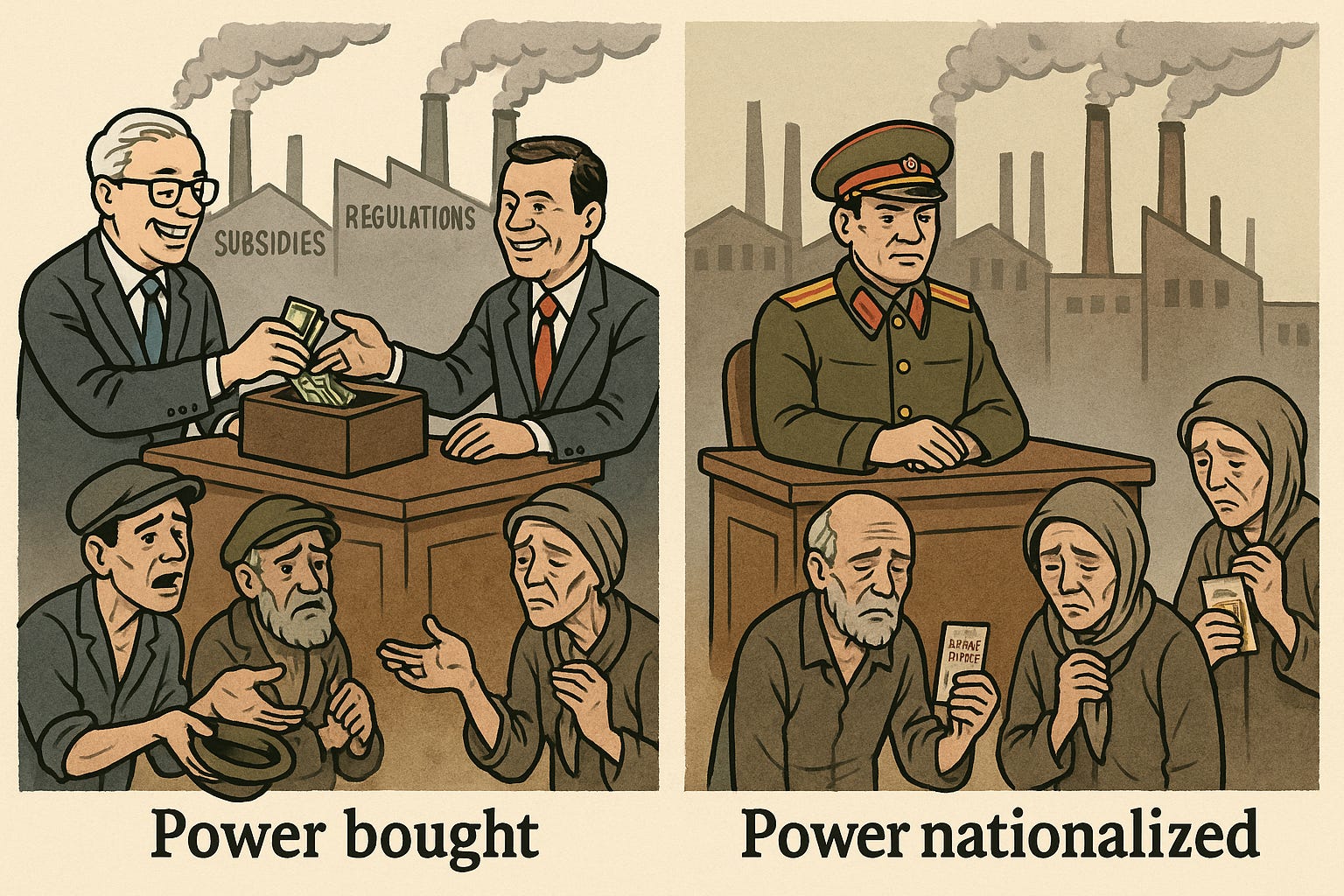
When debating a socialist or leftist about any topic, you can find yourself arguing for hours about every issue under the sun. Each new objection pops up like a roach, one disappears, another scurries in, and before long you are arguing a dozen different things that seem only vaguely related. Nothing seems to connect. Nothing seems to land. The chasm feels too vast to traverse.
Here is why
As my friend Mike Winther used to say, you are on two different branches of the tree. Their premises begin far up the branch of socialism. Your premises begin far up the branch of free markets. So any premise you start with is instantly filtered through their prior, unmentioned convictions that socialism has already given them. They have preestablished assumptions that prevent any progress.
But somewhere earlier in the tree, there is a common branch. A place where you can start. So let’s walk back to that shared branch and take this step by step.
1. What Socialists Claim They’re Fixing
They condemn exploitation and greed, and hate rich people being able to own and control your labor.
They demand living wages.
They insist that all humans need health care, housing, food, and education.
They hate inequality and racism.
They want to protect the environment and stop the oppression of the masses.
They demand dignity for workers, not servitude to bosses.
They say democracy is hollow when the rich can buy influence.
Guess what, WE AGREE. These are noble goals. This IS the common branch. This is the best place for us to start on this topic.
Everyone wants fairness, dignity, opportunity, safety, and justice. The premise is shared; but the cause of the problems is not shared and the solution is not shared.
They say Capitalism is the cause of all those ills and socialism is the cure for all those ills.
But the sad reality is that their proposed solution, i.e. socialism, is a trap
Socialism does not solve the problem. In fact, it makes it dramatically worse. Capital (the money needed for building businesses or factories) still exists in socialism; you can’t get away from that. But in socialism, it is simply held by new masters who wield it with legal barriers and armed force.
Here is the truth socialists don’t seem to know: the system they propose does not end oppression, it merely transfers it from one group of people to the other. It does not eliminate capital or power, it centralizes both in the hands of the government.
The shift is not from oppression to freedom. It is just a shift from crony capitalist tyranny to state tyranny. Not from elites to the people, but from elites to government elites (or as the Russians called them, the Nomenclatura). Not from the greedy with money to the selfless with virtue, but from the greedy with money to the greedy with money and guns.
And once that power is seized, it almost never returns. Ever read Animal Farm, or the history of the Cuba?
Yes, the rich and powerful in capitalism can be corrupt, but they must hide it and they fear exposure. Under socialism, the state hides nothing. It need not. It merely silences critics, jails dissenters, and labels anyone who objects, an enemy of the people.
2. Crony Capitalism: Capitalism’s Trojan Horse
Here is the real shocker. Most leftists think they are angry at capitalism. They are not. They are angry at crony capitalism.
Crony capitalism is a system where business success depends on political favoritism, bailouts, subsidies, special licenses, and regulations that protect insiders. It is capitalism with police protection for the rich who buy favors. It enforces privilege, not competition. It is capitalism for the connected.
Let me clarify:
Capitalism: The people decide freely.
Crony Capitalism: The rich collaborate with the government to maintain power.
Socialism: The rich are the government who maintain power.
3. Monopolies Require Government
Most people believe government is needed to stop monopolies. The raw truth is the opposite: the only way monopolies can exist is if government enforces them.
• In a free market, if one firm raises prices, competitors undercut it.
• Only state privileges—exclusive licenses, tariffs, regulations—can block challengers. • Every cartel hides behind government protection.
• When AT&T had the government arresting or fining people who made cheaper phones, phones were expensive and wired. When AT&T’s monopoly was removed, we got cordless phones and eventually cell phones. AT&T needed to co-opt the government to enforce its monopoly.
Monopolies do not disprove capitalism; they prove government control. Socialism simply turns the government itself into the monopoly.
Let me explain with a clear example.
The Railroad Example: How Crony Capitalism Destroys Competition
Imagine four railroad companies—A, B, C, and D—all running passenger routes from San Francisco to New York on their own lines. One runs through the south, two through the middle, and one through the northern regions.
Company A is the newest and best-funded line. It has modern trains, luxury cars, and top-notch service. Company D is the oldest line in the business. Its trains are worn out, its equipment outdated, and its budget is tight.
When Company D realizes it is about to go bankrupt, it makes one last move to survive: it slashes its ticket prices. The going rate for a cross-country ticket is around $100, but Company D drops its price to $70, barely above cost. It will allow it to survive and if it gets enough riders it’ll be able to grow and repair.
The other lines—A, B, and C—cannot afford to lose passengers, so they lower their prices too. Company A cuts to $69, then B and C follow. But all three have high capital costs: new equipment, expensive maintenance, and loan payments. They start bleeding cash.
Then D drops its price again—to $65. That triggers a classic price war.
The leaders of Companies A, B, and C call a meeting with D. They agree that if prices stay this low, everyone will go bankrupt. So they strike a temporary truce: D agrees to raise rates to $95. For a while, the market stabilizes.
But eventually D gets desperate again and cuts prices. Afterall who is going to pay $95 a ticket on an old dirty train. Another price war erupts. This cycle repeats until A, B, and C realize they need a permanent solution.
They cannot afford to buy D outright and antitrust laws would prevent it. So, they reach for the biggest weapon available: the government.
Through lobbying and campaign donations, they persuade a few senators to “fix the industry.” Soon, new laws and regulations appear:
• Every railroad must carry billions of dollars in insurance.
• Every mile of track must be tested and certified by government inspectors.
• Thousands of new safety and compliance rules are issued.
• Every Railroad must allow a workers union
• Every Railroad must pay a minimum wage (that AB&C decided was the minimum wage)
These regulations sound noble—“safety,” “consumer protection,” “industry standards”, “compassionate to employees”—but in practice, they destroy small competitors. Company D cannot afford the new insurance, higher wages, new certification or equipment upgrades. Its trains were not unsafe, passengers were not dying (or they woudl have been sued) but now D is buried under regulatory expenses it cannot pay.
Within a year, Company D has gone under. The big three—A, B, and C—celebrate quietly. They have achieved through government what they could never have achieved through the market: a monopoly. They now raise prices to $110 a ticket. Their stock holders are elated.
When someone objects, they hide behind compassionate language: “But what about safety?”
But safety was never the motive. And in a free market, if someone is injured, we have civil law and injury attorneys. Justice does not require destroying competition.
The moral? Every time government “helps” the big players regulate an industry “for safety” or “fairness,” it is often just crony capitalism—where regulation becomes a weapon to kill competition and protect the powerful.
Let us now look at how factories begin under crony capitalism, socialism, and true capitalism.
4. How a Factory Starts under Crony Capitalism
Maria wants to start a shoe factory. But in her crony-capitalist country, private ownership is tangled in bureaucracy created by large factory owners protecting themselves from competition.
She must get dozens of permits: zoning, environmental, OSHA, labor, and safety. Each requires consultants, paperwork, and long delays. (California’s CEQA reviews can stall projects for years.)
Big banks will not fund her unless she is politically connected. (During COVID, Shake Shack and the Los Angeles Lakers received “small business” loans before actual small shops.) Sometimes her business will conflict with a large existing company that then ensures laws are passed to stop people like her from competing.
The government picks winners through tax breaks and subsidies. (The 2022 Inflation Reduction Act gave billions to electric vehicle giants like Tesla and GM.) Amazon got tax breaks in New York, but small stores got nothing.
Even when Maria succeeds, she cannot set prices freely. Minimum wage laws, union mandates, and tariffs inflate costs. (Federal steel tariffs significantly increased nationwide input prices.)
Profits are double-taxed and redistributed to politically favored firms. (Lockheed Martin and Boeing receive billions in contracts while small firms drown in compliance costs.) In this environment, it is not the innovators, risk takers, or hard workers who control the capital. It is the political elites, and the wealthy corporations that have figured out how to buy government power.
5. How a Factory Starts under Socialism
Now move Maria to a socialist country.
The state owns or controls the means of production.
The state owns the capital and distributes it only to party insiders and loyalists.
To build a factory, Maria must apply for state approval. She will never own the factory. At best, she will manage it for the state.
Bureaucrats decide whether shoes are a “priority industry.”
The state allocates raw materials, machines, and labor.
Prices and wages are set by central planners.
All profits belong to the state.
If Maria is a nobody with a new idea, she will never get the opportunity. Most people under socialism never try.
The results are predictable: shortages, inefficiency, no competition, and no innovation. The shelves go empty, but politicians keep their positions.
Examples: the Soviet Union’s chronic shortages, Cuba’s failed harvests, Venezuela’s rationed supermarkets.
I remember friends visiting Moscow in the 1980s. When they landed, people immediately asked if they had brought ballpoint pens. Why? Because the central planners had simply forgotten to manufacture ballpoint pens that year. Nobody’s job was on the line, so no one rushed to fix it.
Another example: a Russian technician who once worked for me served in the Soviet Army when he was young. He explained that fused lightbulbs were valuable. If he had a fused bulb, he could take it to any government worker, and they would quietly replace it by swapping it with a good bulb in their facility. Why not just buy one? Because lightbulbs were nearly impossible to find in government stores.
Notice: capital still exists under socialism. It is simply controlled by the ruling party. By the politicians.
6. How a Factory Starts under a True Free Market (Morally Restrained Capitalism)
In a true free market, Maria’s idea can live or die by merit.
She writes a plan, finds private investors, rents a space, hires workers, and begins production. The law protects property—not privilege. She negotiates wages freely. Employees choose whether to work for her. Customers decide whether her shoes succeed.
If she succeeds, she reinvests. If she fails, she and her investors bear the cost. Not taxpayers.
This is how Apple started in a garage, how Nike began in the trunk of Phil Knight’s car, and how countless startups grew into industry leaders. Competition forces efficiency. Innovation thrives because success depends on merit, not permission.
7. The Power Shift: Capital Under the Gun
Here is what still baffles me.
Socialists imagine governments are run by economic geniuses and selfless saints who never lie, never play favorites, and never punish dissent. Those saints do not exist. Governments throughout history have been inefficient, corrupt, and hungry for power.
So ask a socialist this question: if you fear Donald Trump having power, why would you ever give him—or any president—the power to control all capital, banks, schools, media, and industry? Because that’s exactly what socialism does.
Socialism centralizes power. It assumes your political enemy will never gain control. But history guarantees that one day, they will.
Socialism does not remove power; it arms it.
Once a ruler controls capital, history shows exactly what happens:
• Dissenters are silenced.
• Opponents are censored.
• Whole populations are starved, relocated, or imprisoned.
Lenin never stepped down. Castro never privatized. Maduro never surrendered control. Xi Jinping did not empower private innovators—he crushed them when they threatened party rule.
Crony capitalism, as bad as it is, still allows resistance. You can protest, boycott, or run a competing business. Under socialism, there is no exit, no dissent, no appeal.
That is not liberation. That is bondage.
Examples: Stalin’s collectivization caused nationwide famine; Mao’s Great Leap Forward killed tens of millions; Venezuela’s nationalization policies collapsed entire industries; China still imprisons entrepreneurs who challenge the party.
8. Morally Restrained Capitalism: The Only Real Alternative
But can the free market really exist. America is controlled by Crony Capitalists. Yes you could have a true free market, if you have Morally Restrained Capitalism.
Morally Restrained Capitalism (MRC) is the true free market: a system ruled by law, not lobbying. In an MRC Government is severely limited to two things: Punish evil doers and enforce contracts. That’s it.
So Government only punishes theft, fraud, coercion, and violence—but does not own or direct or control the means of production. So when a big rich capitalist goes to his favorite politician and says: We need to pass a law to protect the people, the politicians, says. Sorry we can’t do that because we have an amendment that says I can’t.
When the Crony says, but what about the people who get hurt? The Politician says, “Well, they get to sue the corporations and after a few of those payouts, corporations will learn not to risk it.”
Consumers decide winners. Politicians do not.
Greed is permitted, but only when serving customers. Laws restrain greed by punishing fraud and coercion. That means that greed only helps you, if it benefits everyone else.
Examples: tech industries like early software, biotech, and e-commerce exploded under minimal regulation—Amazon, Microsoft, Apple—all grew because the government was not yet picking winners.
In MRC, wealth is decentralized. If Walmart mistreats customers, they can boycott. If a bank mistreats savers, they move their money. The state holds no monopoly on capital or morality.
MRC does not try to make everyone equal. It demands legal equality and moral restraint. You do not seize your neighbor’s goods—you outwork them, outthink them, or outserve them.
9. Ending Crony Capitalism by Limiting Government Power
Here is the surgical strike:
Cronyism thrives when government can hand out favors—grants, tax breaks, licenses, and monopolies.
Remove that power and cronyism starves.
Without favors to sell, politicians lose leverage. Lobbyists lose influence.
The only way to end crony capitalism is to shrink government’s reach. Otherwise, corruption merely changes uniforms. This is something that you may find leftists can agree on.
10. The Moral and Political Bottom Line
If greed is wrong, why trust bureaucrats to be moral? If you fear private power, why give absolute power to the evil politicians who run the state? If you want equality, why choose coercion over freedom?
Socialism promises fairness but enforces obedience. Crony capitalism breeds inequality but leaves some power to resist. Morally Restrained Capitalism gives freedom with accountability and justice without tyranny.
Yes, you may fail in a free market—but it is your failure, not your ruler’s plan. Under socialism, failure becomes treason.
Socialism does not destroy capitalism—it nationalizes it. It replaces private greed with political greed.
Morally Restrained Capitalism restores freedom, disperses power, and allows customers—not political force—to decide outcomes.
So next time you get into a discussion with a socialist, first agree that you want the same things. Then explain why socialism is still capitalism—but capitalism at the point of a government agent’s gun. And if they still have Trump in their memory, ask them: Do you really want Trump to control all the capital? Because under socialism, that is exactly what you will - get a politician controlling the capital.
Post Script: How to teach kids that socialism is bad
How do you teach youth that socialism is bad? Well here’s how I do it. “OK Madison, are there a group of kids at your school that are jerks? They think they are cooler than anyone else? Or maybe they don’t care what anyone else thinks and are just mean to everyone?”
“Yes.”
“Well, socialism is like giving all the power & money in your entire country to those kids and then hope that they’ll give you a place to stay, food, jobs, and benefits at the same rate as they give their inner circle. Do you think they would suddenly become angels and be fair. Or do you think they’d make sure they and their friends all got wealthy and worse that they never lose power. Well, that’s the actual history of socialism.”
Comments
Nothing yet. Say the first thing.
Sign in to join the conversation.