
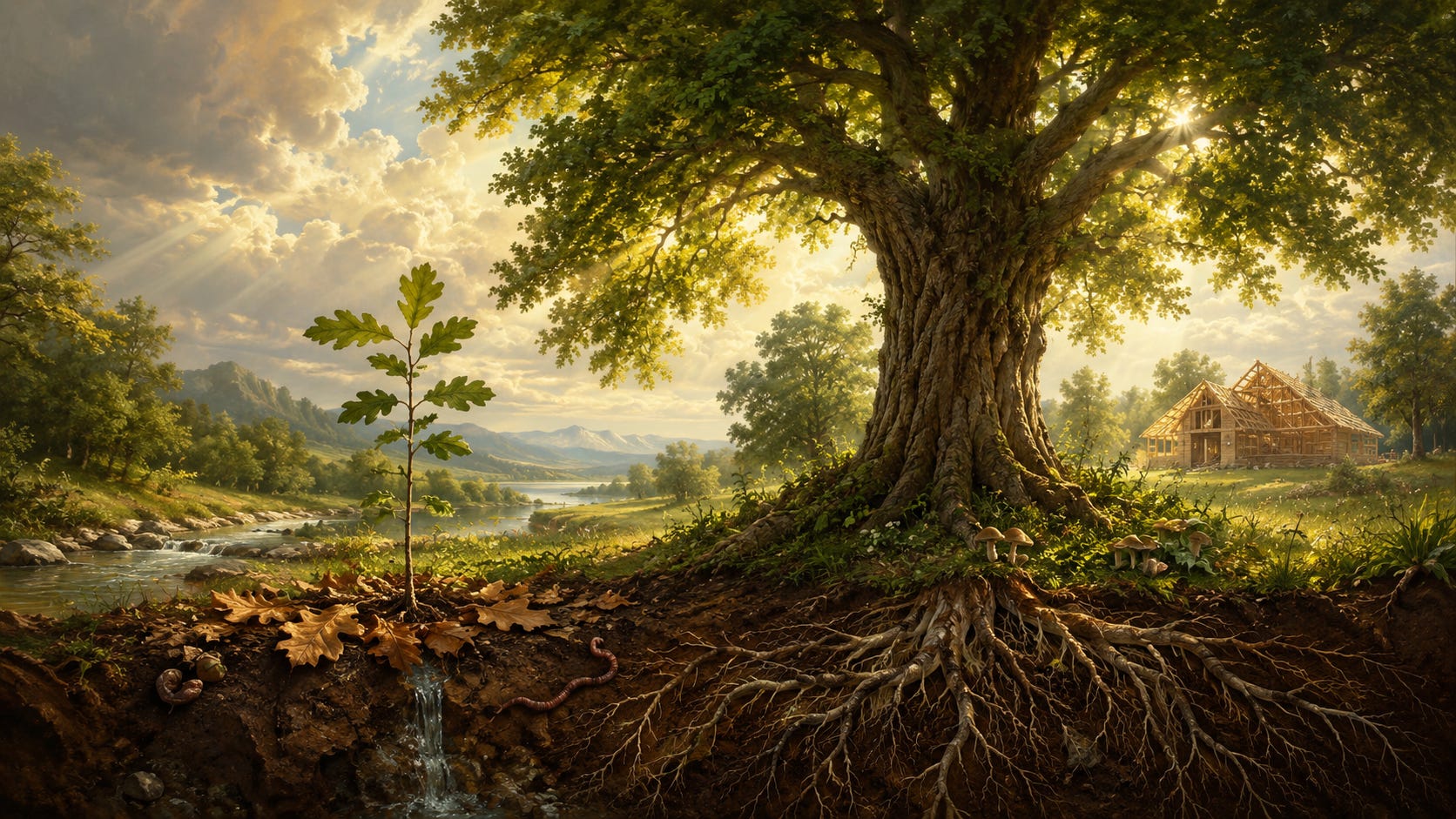
Harvesting the Air, Capturing the Water
Where did the wood come from?
It is the sort of question a child might ask and a grown man might ignore. A seedling is placed in a pot. Years pass. The stem thickens into a trunk. Branches reach outward. Leaves gather light. Fruit appears. If it is in the ground it grows bigger, birds make a home in its limbs. Children sit under its shade. One day that tree may be cut, milled, dried, and turned into a table, a floor, a chair, or the frame of a house.
But pause before walking past the miracle. If that tree gained hundreds or thousands of pounds, did the soil in the pot get converted to wood, does the ground lose thousands of pounds of soil? Did a great hole of missing dirt appear under the roots? Did the earth simply trade itself, pound for pound, into lumber?
No.
Then where did the wood come from?
The answer is almost too simple yet elegant to believe. The tree harvested the air. The wood is hardened air and water.
Its carbon came from carbon dioxide. Its hydrogen came from water. Oxygen was woven through both. Sunlight supplied the energy. Trace amounts of minerals and usable nutrients came through the roots. But the soil did not become the tree, the soil held the tree, fed the tree, watered the tree, and hosted the hidden world of microbes and fungi that make life possible underground. But the great body of the tree was not carved out of dirt like a statue from stone. One could grow an identical tree in a hydroponics setup with no soil anywhere to be seen. The only limitation would be how you stabilized it as it grew.
The tree was assembled from air, water, light, minerals, and the living order of the earth. The invisible became visible. The atmosphere became a trunk. Rain became fruit. Light became sweetness. What looked empty above our heads became weight in our hands.
Plants are, essentially, solar-powered carbon dioxide-to-solid-matter converters that use water.
They take what we cannot hold, air and light, and make it visible, edible, burnable, buildable, and beautiful.
That is a world worth thinking about.
Earth, Not Dirt
Genesis speaks with more precision than modern men often notice. It does not say, “Let the dirt or dust bring forth grass.” It says, “Let the earth bring forth grass.”
And God said, Let the earth bring forth grass, the herb yielding seed, and the fruit tree yielding fruit after his kind, whose seed is in itself, upon the earth: and it was so.
And the earth brought forth grass, and herb yielding seed after his kind, and the tree yielding fruit, whose seed was in itself, after his kind: and God saw that it was good.
That wording matters. The earth is not merely dirt. The earth is land, water, air, light, minerals, seed, seasons, roots, decay, renewal, and the command of God. The earth is not a dead pile of raw material. It is an ordered system made to bring forth life.
This is different from the language Scripture uses about man’s mortal body. Genesis 2:7 says:
“And the LORD God formed man of the dust of the ground, and breathed into his nostrils the breath of life; and man became a living soul.”
Then, after sin, Genesis 3:17-19 says:
“And unto Adam he said, Because thou hast hearkened unto the voice of thy wife, and hast eaten of the tree, of which I commanded thee, saying, Thou shalt not eat of it: cursed is the ground for thy sake, in sorrow shalt thou eat of it all the days of thy life;
Thorns also and thistles shall it bring forth to thee, and thou shalt eat the herb of the field;
In the sweat of thy face shalt thou eat bread, till thou return unto the ground, for out of it wast thou taken: for dust thou art, and unto dust shalt thou return.”
Plants display the fruitfulness of the earth. Man’s body displays the mortality of the flesh. Those truths are related, but they are not the same. The tree is not merely dust becoming wood. The tree is the earth bringing forth under the command of God.
Once a man sees that, the world becomes strange again in the best possible way. A wooden table is captured atmosphere. A house frame is air made solid. A bowl of fruit is sunlight organized into sweetness. A pasture is the earth turning rain and light into food. A cow is not merely eating grass. Inside that cow, unseen microbes break down fibers man cannot digest and help turn pasture into milk, and later those very microbes are absorbed by the cow to create meat, strength, and life.
This is not a poor world. It is a world where seed multiplies seed, fruit carries orchards inside itself, grass feeds cattle, cattle feed families, leaves return minerals to the soil, rain falls from the sky, and trees build their bodies from the air.
So why do men starve? Is it because there is scarcity?
That is the moral question.
The Soil Is the Mineral Bank
To say the tree’s mass comes largely from air and water is not to say the soil is unimportant. That would be the wrong lesson. The soil may not be the main source of the tree’s bulk, but the soil is still the mineral bank, the root house, the microbial workshop, and the receiving place where yesterday’s life becomes tomorrow’s fertility.
The plant still needs minerals. It needs potassium, phosphorus, calcium, magnesium, sulfur, iron, zinc, copper, manganese, boron, molybdenum, and many other trace elements in proper measure. These are not the great bulk of the tree, but without them the tree is sick, weak, barren, or dead. A man may build a house mostly from lumber, but remove the nails, hinges, wiring, fasteners, and foundation, and the house fails. Minerals are not the bulk, but they are not optional.
That is why the farmer must ask another question: when the crop is harvested, where do the minerals go?
If the fruit leaves the farm, some minerals leave with it. If the stalks, husks, leaves, weeds, branches, manure, grass clippings, and roots are all hauled away or destroyed without return, then the land is being slowly mined. Not mined mainly for mass, but mined for minerals, structure, organic matter, and biological life.
The old cycle had wisdom in it. The husks should return. The leaves should return. The grass clippings should return. The wood chips should return. The manure should return. The chopped weeds should return. The dead roots should remain in the ground. The field should be fed by what the field produced.
Even weeds have a lesson to teach. Many weeds are not merely useless intruders. Some drive roots deep into the soil, reaching minerals that shallow crops may not reach. When those weeds are cut and left to rot, the minerals they gathered can be released near the surface. What looked like a nuisance may become part of the soil’s repair, if man does not foolishly remove everything and leave the ground naked.
This is the difference between stewardship and extraction. The foolish man looks at a field and says, “Take the crop, remove the residue, strip the land clean, and call it efficient.” The wise man asks, “What did this crop borrow, and how do I return it?”
Rotting is not failure. A fallen leaf is not trash. A chopped weed is not always a loss. A grass clipping left on the ground is not neglect. These are small deposits back into the earth’s living bank. They return minerals. They feed microbes. They cover the surface. They slow evaporation. They help rain enter instead of run away. They make the topsoil richer, darker, more alive, and more ready to bring forth again.
So yes, the tree came largely from air and water. But if the minerals are never returned, the next tree suffers. If the soil is treated only as a platform, the platform weakens. If the field is constantly robbed and never fed, famine is being prepared long before famine is announced.
God made the earth to bring forth, but He did not make man to be a thief.
Water Is Not Like a Burned Match
The same is true of water. Water is not like a burned match. It does not vanish. If it enters the ground, it is filtered, stored, and returned to the water table. In a sane system, water falls, enters the soil, feeds roots, fills aquifers, rises again through plants, returns through animals, and continues its cycle.
Think of the refrigerant in a closed air conditioner system. It does not disappear after one use. It moves through a cycle, changing state, carrying heat, releasing heat, returning again to do the work. Water is far grander, but the picture helps. It is not destroyed by use. It moves.
The problem is not that water is wasted out of existence. The problem is that men often interrupt the cycle. They pave over the ground, pipe water away from the land that needs recharge, massive cities forcibly centralize sewage into distant systems, pollute what should be returned cleanly, move billions of gallons far away, and then act shocked when wells fall and fields dry.
So the question is not, “Where did the water go?” The question is, “Did we let it return where God designed it to return, or did we exile it from the local system?”
Water poured on the ground is not wasted when it returns to the ground. Watering a lawn is never a waste of water if that water then goes back into the groundwater. The practical waste happens when men capture it, redirect it away from the local life-giving cycle, and force it back to the salty sea where it serves no purpose, as California has so often done. The water still exists, but the field does not receive it. The aquifer does not receive it. The tree does not receive it. The family well does not receive it. That is not stewardship. That is managed scarcity.
Of course, no honest person should pretend that every place can use the same method. A dense city cannot simply use the same system as a rural farm. Bad septic systems can contaminate groundwater. Poorly handled waste can poison wells. Careless engineering can turn blessing into danger. But the principle remains: water should not be treated as garbage. It should be treated as inheritance.
Capture it. Clean it. Store it. Return it. Recharge the ground. Keep it local where possible. Move it where necessary. Do not exile water from the place where life needs it and then call the resulting dryness a natural disaster.
And perhaps dense cities should never be allowed.
Why is it that those who claim to fear the fragility of the earth are always the first to try to sequester all humans in a single dense city?
Did heaven fail, or did man break the cycle?
The World Was Made to Bring Forth
Psalm 104 gives us the picture of God’s generous order:
“He sends the springs into the valleys, which run among the hills.
They give drink to every beast of the field: the wild donkeys quench their thirst.
By them shall the fowls of the heaven have their habitation, which sing among the branches.
He waters the hills from his chambers: the earth is satisfied with the fruit of thy works.
He causes the grass to grow for the cattle, and herb for the service of man: that he may bring forth food out of the earth;
And wine that makes glad the heart of man, and oil to make his face to shine, and bread which strengthens man’s heart.”
That is not a picture of a miserly earth. Springs run through valleys. Beasts drink. Birds sing among branches. Hills are watered. Grass grows for cattle. Herbs grow for the service of man. Food comes out of the earth. Wine, oil, and bread are named not as accidents, but as gifts.
The biblical vision is not famine as normal and abundance as suspicious. It is fruitfulness under God, cultivated by man, received with thanksgiving, and guarded by obedience.
This does not mean the world is painless. Genesis does not flatter us. The ground is cursed. Thorns and thistles grow. Bread comes by sweat. There are droughts, floods, crop diseases, pests, bad seasons, poor soils, and hard places. A dry field does not become green because a man makes a clever argument.
But hardship is not the same as unavoidable famine
A drought does not have to become mass starvation. A failed crop does not have to become national collapse. A dry season does not have to become a graveyard. Men can store grain, move food, dig wells, build reservoirs, preserve harvests, trade, improve soil, manage pasture, return minerals, capture rain, protect farmers, and keep roads open.
So when famine comes, the first question should not be, “Why did God make so little?” The first question should be, “Who interrupted the abundance?”
Who blocked the road between the farmer and the hungry? Who burned the fields? Who stole the grain? Who ruined the money? Who punished the producer? Who destroyed the wells? Who captured the water and exiled it from the local system? Who made it dangerous, illegal, or ruinously expensive for ordinary families to plant seed, raise animals, store food, buy, sell, travel, and trade?
What about floods and droughts?
Well, think about it, with over 100 and sometimes 300 years of history of droughts and floods in any one area, we should never ever have another drought or flood again in that area. We know how big the dam needs to be to both control the flood and feed the worst drought. But why does it keep happening?
These questions matter because famine often wears the mask of nature while carrying the fingerprints of man. Sometimes scarcity is local. Sometimes it is seasonal. Sometimes it is logistical. Sometimes it is caused by the hardship of the fallen world. But much of what men call scarcity is misunderstood, manufactured, or morally created. Much of it is not the earth refusing to bring forth. It is man standing between the hungry and the food God made possible.
War creates famine. Corrupt government creates famine. Theft creates famine. Bad law creates famine. Broken markets create famine. Punishing farmers creates famine. Misdirecting water creates famine. Turning food into a political weapon creates famine. Centralizing control in the hands of fools and tyrants creates famine.
Some famine is not misfortune. It is a crime with a death count.
Dominion Is Not Destruction
Genesis 2:15 says: “And the LORD God took the man, and put him into the garden of Eden to dress it and to keep it.”
That verse is easily overlooked, but it is one of the most important lines in the discussion. Work existed before sin. Cultivation existed before the curse. Man was placed in the garden to dress it and keep it. The curse did not create work. The curse brought frustration, thorns, sweat, futility, and death into work.
This means dominion is not exploitation. Dominion is not greed. Dominion is not stripping the land bare and calling it progress. But neither is dominion paralysis. It is not refusing to build, refusing to harvest, refusing to graze, refusing to dig, refusing to cut, refusing to plant, and then calling that refusal righteousness.
Biblical dominion is fruitful stewardship under God
Use the tree, but plant another, every lumber company knows they must do this if their company is to survive even 30 more years. Build the house, but manage the forest. Graze cattle, but protect the pasture. Harvest crops, but return fertility. Use water, but let it return rightly. Build markets, but punish theft. Govern, but do not strangle the producer. Regulate poison and fraud, but do not turn permission into a weapon against honest work.
A wise civilization does not despise the farmer. It protects him. A wise civilization does not punish the builder. It frees him to build rightly. A wise civilization does not treat water as filth to be expelled. It treats water as a trust to be cleaned, stored, returned, and used again. A wise civilization does not turn food into a political weapon. It moves food from the field to the hungry.
When men govern well, abundance travels. When men govern wickedly, abundance rots behind barricades.
That is why the moral question cannot be avoided. If God made the earth to bring forth, why do men keep creating hunger? Why does food rot in one place while children starve in another? Why does rain fall uncollected while wells sink lower? Why do bureaucrats punish abundance and then demand praise for managing scarcity? Why do men call it compassion to control production, then call it tragedy when production collapses?
Do not blame the seed, the tree, the cow, the rain, or the soil God made fruitful. Blame the sin that turns abundance into scarcity. Blame the greed that hoards what should be traded. Blame the wars that burn what should be harvested. Blame the governments that punish the man with seed in his hand and water under his feet. Blame the systems that make it harder to grow food than to regulate those who grow it.
The earth is not usually the villain. Sin is.
The House Made of Air
Return now to the tree.
Carbon dioxide is not a villain. It is one of the raw materials of food and wood. That is why greenhouses often enrich the air with CO2. . The point is simple and hard to deny: CO2 is not poison to plants. It is part of the plant’s food-making system. It’s the very fabric of life, it’s the very essence of mankind’s body. We feed on it, we live on it, that’s why the microbes, the bugs, the fish, the lesser mammals, the animals we eat all are made of carbon. Once can’t imagine us dining on a lifeform made of silicon.
But let the modern fear of carbon dioxide speak in its own logic for a moment. Let’s answer the cries of those who claim man is the cause of the earth warming. If a tree falls and rots, much of its carbon returns to the air through decay. Some of it may remain in the soil for a time. Its minerals return to the ground. The tree is not annihilated. It is disassembled. God designed it this way before the fall. There is no indication that the curse changed the way carbon dioxide and nutrients are supposed to be released back into the atmosphere with the decaying of matter and the microbial activity. These are all parts of God’s fine-tuned universe and fine-tuned earth.
If the tree burns, the return happens faster. The carbon returns to the air. Hydrogen becomes water vapor. Minerals remain in the ash. Fire is fast return. Decay is slow return. Burning with controls for the released particulate matter, is no worse in terms of carbon dioxide than decay in the long term.
But what if the tree becomes a house?
Then the carbon stays in the beam. It stays in the floor. It stays in the table. It stays in the chair. It stays in the wall. A wooden house is not merely shelter. It is stored atmosphere. The tree pulled carbon from the air, and the builder placed that carbon into a home.
That home may hold it for decades, perhaps generations. Meanwhile, another tree can be planted. Another seedling can begin the same work again. Air becomes wood. Wood becomes shelter. Shelter stores the air. The next tree begins to harvest.
So even if carbon dioxide were as imagined, the great villain, which is wiser: to let every tree fall and rot, or to grow many more trees, harvest responsibly, build beautifully, and replant faithfully?
This is not an argument for waste. It is an argument against foolishness. It is not an argument for stripping ancient forests. It is an argument for stewardship. Grow, harvest, build, replant, restore, repeat. That is not greed. That is dominion under God.
A civilization that understands this will build differently. It will not despise wood, cattle, farmers, wells, reservoirs, orchards, barns, fields, fences, mills, markets, roads, or homes. It will see them as part of the moral architecture of abundance.
A civilization that forgets this will call barrenness wisdom. It will confuse control with compassion. It will make production harder and dependence easier. It will look at a fruitful earth and build systems that make men poor.
God Meant Abundance
Every tree asks a question: where did the wood come from?
Every honest answer should humble us. It came from air, water, abundant and free sunlight, minerals, seed, and the command of God. The invisible became visible. The weightless became weight. The atmosphere became shelter.
The question does not end with the tree.
No one cries, “save the wheat fields, recycle bread!”
Where did the bread come from? Seed, soil, rain, sun, labor, harvest, grinding, fire, and grace. Where did the milk come from? Grass, water, sunlight, cow, microbe, and design. Where did the orchard come from? Fruit carrying seed, seed carrying future, future hidden inside the present. Where did fertility come from? Leaves falling, roots dying, weeds rotting, manure returning, minerals rising, soil living.
This is the genius of the earth.
God did not make a world designed for universal misery. He made an earth that brings forth. He gave man seed, soil, water, cattle, trees, fruit, minerals, lots and lots of sunlight, work, reason, and dominion. He meant man to prosper on the earth, not by greed, theft, or destruction, but by stewardship.
God meant for us to plant, harvest, build, replenish, trade, store, govern justly, protect the producer, feed the hungry, and give thanks. He meant us to use the tree and plant forests for our children. He meant us to return minerals to the soil. He meant us to understand that water is inheritance, not garbage. He meant us to recognize that grass can become cattle, seed can become bread, and air can become wood.
The scarcity that remains should humble us. The scarcity men create should anger us.
Famine should be rare. Needless scarcity should be condemned. Managed decline should be rejected. Men should not be praised for controlling hunger they helped create.
God made the earth abundant. The question is whether man will steward that abundance, or sinfully stand in its way.
There is really nothing stopping us but our sin nature.
Comments
Nothing yet. Say the first thing.
Sign in to join the conversation.