
The algorithm served me a Time article this week titled, Why Learning a Language Still Matters. In the first paragraph, the author, a professor of Cognitive Science and Comparative Literature, argues the challenges of learning a new language are exactly why we need to keep doing it and goes on to describe his French, Italian and Chinese lifetime learning trajectories. I wholeheartedly agree that learning a language still matters, and the challenges are what make it worth it, but there is more nuance to all of this than the article offers.
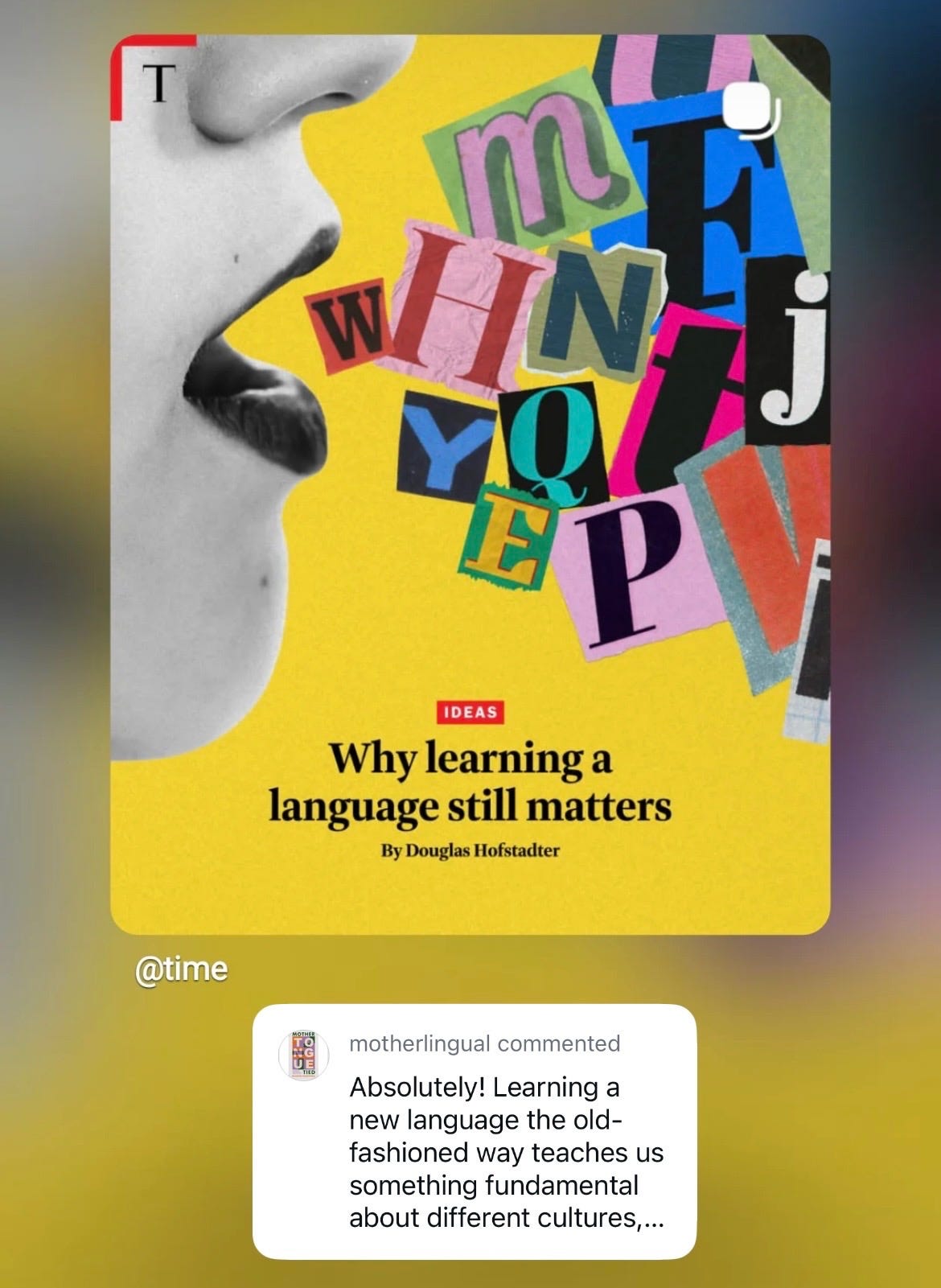
I wrote about the importance of learning languages the old-fashioned way here arguing that the biggest lesson is empathy:
Realising that each language is unique, diverse and of equal importance is a vital life lesson, even if it does not feel like it while you learn complicated grammar structures. It is also something that can help people understand the amazing feats others take on when they have to leave behind the only home and language they know in immigration, migration and asylum contexts. Bottom line: language learning is about empathy.
TheTime article echoes a version of my empathy argument, stating that, “Learning another language is one of the deepest and most human things one can possibly do.” But the nuance comes in when we consider that communication, notably wanting to understand and be understood, is also fundamentally human. Look no further than the author’s repeated mentions of native speaker-ism or “perfect accent”—even in the context of something he does not want or need to achieve.
AI translation programmes are not the only problem, at least not when used as tools rather than something that replaces language-learning altogether. It is the world’s obsession with sounding and speaking a certain way (a.k.a. the “native speaker”) that is at the root of most of this, coupled with people’s fundamentally human hope to be understood in a world that routinely places the burden on one party over another. (Think: people saying others have “thick accents” when the onus in communication is just as much on understanding as it is on being understood.)
And then there is the email translation part in the article, something I have been thinking a lot about lately as I often use AI translation tools to help me with emails to my Polish publisher.
Comments
Nothing yet. Say the first thing.
Sign in to join the conversation.