
Football planning is often discussed through the lens of the weekly microcycle.
Practitioners map out the days before and after the match, identify the main loading opportunities and attempt to prepare players for the next fixture.
However, focusing only on the next match can create a narrow view of the season.
Microcycles help prepare players for an individual fixture. Competition blocks help manage performance across several weeks. This longer planning horizon allows practitioners to consider how development, fatigue, recovery and performance priorities should change as the fixture schedule evolves.
The fixture schedule is usually the most powerful constraint within the planning process.
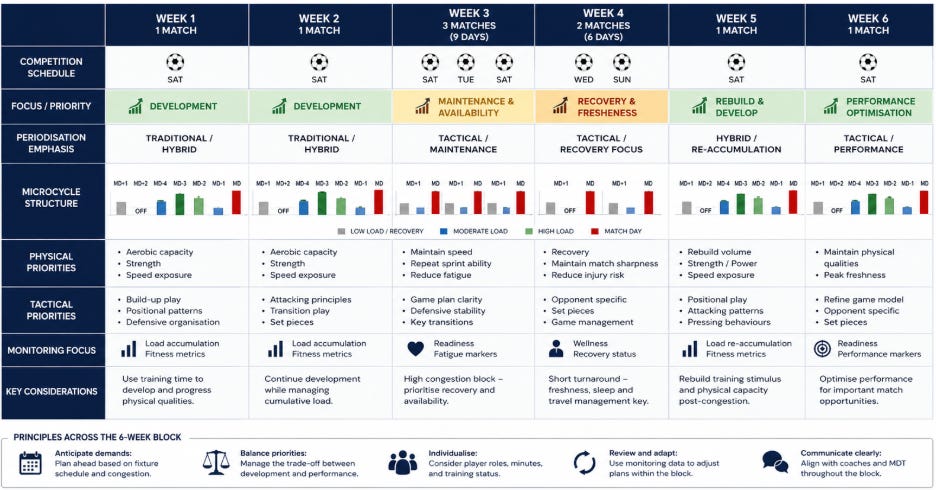
A period containing one match per week may provide opportunities to develop aerobic capacity, strength, speed and tactical principles. A period containing three matches in nine days creates a very different problem.
During congested periods, the emphasis may shift away from physical development towards recovery, player availability and maintaining key qualities. Once the congestion ends, the priority may return to rebuilding training volume and physical capacity.
This means practitioners cannot simply repeat the same weekly structure throughout the season.
The programme must reflect the opportunities created by the competition schedule. Some weeks allow meaningful overload. Other weeks require practitioners to protect freshness and reduce unnecessary fatigue.
Periodisation models offer frameworks for organising training over time.
Traditional periodisation generally progresses from greater volume towards greater intensity. Block periodisation concentrates training around specific physical qualities. Undulating approaches fluctuate volume and intensity across days or weeks.
Football has also developed more specific approaches.
Tactical periodisation integrates physical, technical and tactical development around the team’s game model. Verheijen’s football periodisation model develops football fitness through football actions, with game formats and training demands organised across multi-week blocks.
Each model has strengths, but each also has limitations.
Traditional progression can be difficult to maintain during a long and unpredictable season. Block periodisation may be difficult to implement during fixture congestion. Tactical approaches may integrate performance demands well but can make individual physical development more challenging.
The objective should not be to select one model and follow it rigidly. It should be to understand which principles are useful within your environment.
Adaptation is not always predictable or linear.
In professional football, the original plan is constantly challenged by changes in fixtures, player availability, coaching priorities, travel, injuries and match minutes.
For this reason, a hybrid approach is often more practical.
A team may use tactical periodisation to guide its weekly structure, football-specific sequencing to organise extensive and intensive training days, traditional progression during pre-season and block periodisation during rehabilitation.
The model changes depending on the problem being solved.
Across a six-week competition block, the first two weeks may prioritise physical development. A congested third and fourth week may focus on maintenance, recovery and availability. The final weeks may then rebuild training stimulus before optimising freshness for an important fixture.
The value of the block is not in predicting every detail. It is in anticipating where the priorities are likely to change.
Monitoring becomes useful when it influences decision-making.
At the end of each week, practitioners should consider how much match and training exposure players have accumulated, how they are responding and which physical qualities have received enough stimulus.
Match minutes, sprint exposure, availability trends, neuromuscular status and recovery markers can all help identify whether the next week should prioritise development, maintenance or recovery.
The same competition schedule will not create the same response for every player.
A regular starter may need reduced loading during congestion. A substitute may require additional high-speed running, conditioning or strength work. A returning player may need an individual progression that sits outside the team plan.
Monitoring should therefore support individualisation while keeping the wider competition block in view.
Effective planning extends beyond the next session or match.
Competition blocks give practitioners a wider view of when to develop, maintain or protect physical qualities across the season. The aim is not to follow one periodisation model rigidly, but to use the most relevant principles for the demands of the current schedule.
Monitoring should then help refine those priorities, ensuring the plan continues to reflect player exposure, readiness, availability and the realities of the football environment.
That’s all for today.
See you next Friday.
James
If you’re serious about growing your career in football, join a global community of 90+ physical performance and sport science practitioners inside the Football Performance Network.
As a member, you’ll get:
✅ Direct 1:1 career support and community feedback
✅ Live events with elite-level experts
✅ Practical, research-informed learning you can use immediately
✅ A supportive network that understands your journey
⚽️ Our doors open again in 2027.
🔗 Join the waitlist today to be first in line when applications open.
No posts
Comments
Nothing yet. Say the first thing.
Sign in to join the conversation.