
⚽️ FPN doors close in 5 hours
The Football Performance Network is open for new members, but applications close today at 5pm BST.
After that, doors will not reopen until 2027.
There are currently 3 places remaining for this intake.
If you want direct support, live feedback, expert sessions, and access to a network of football physical performance and sport science practitioners, this is your final opportunity to join.
Join FPN before doors close at 5pm BST.
Fixture congestion is one of the biggest challenges in modern football.
When teams are competing across domestic leagues, cup competitions and international schedules, the normal rhythm of training quickly disappears. Instead of having a clear weekly structure, practitioners are often working from match to match, trying to support recovery, maintain readiness, and keep enough players available to compete.
But managing fixture congestion is not only about reducing load.
It is about understanding what each player needs based on their recent exposure, current role, and the demands that may be placed on them in the coming days or weeks.
Fixture Congestion Changes the Aim
In a normal one-game week, there is usually space to plan recovery, tactical preparation, gym work, speed exposure, conditioning, and physical development.
During congested periods, the aim often changes. The focus shifts towards maintaining availability, protecting freshness, and supporting performance in the next fixture.
This creates a difficult challenge because the squad is rarely experiencing congestion in the same way. A player who has started three matches in seven days has a very different problem to an unused substitute who has travelled, warmed up, and completed limited training, but played no meaningful minutes.
Both are part of the same schedule.
But they do not need the same solution.
Physical Outputs Do Not Tell the Full Story
One of the problems with fixture congestion is that match running outputs may not always show a clear decline.
Players may still maintain total distance, high-speed running, sprint distance, or other physical metrics. From an external load perspective, it can look like they are coping well.
But football performance is not only about whether a player can continue to run.
A player may still cover the same distance but make poorer decisions, arrive slightly late into pressing actions, lose sharpness in possession, or become less influential during key moments.
This is why external load data needs to be interpreted alongside match minutes, wellness, medical status, coach observations, tactical role, and player feedback.
The question is not simply, “Can the player complete the next match?”
A better question is, “Can the player perform their role at the level required?”
Availability and Performance Are Not the Same Thing
Availability is often used as a key marker of success in football clubs.
But a player can be available and still be underperforming.
They can avoid injury, keep playing high minutes, and still experience a gradual decline in sharpness, decision-making, or overall influence.
This is where rotation becomes a performance strategy, not just an injury prevention strategy.
For example, a central midfielder may have played 90 minutes in 11 of the last 12 matches. Their physical outputs may look stable and their wellness scores may only show a small increase in fatigue. But the coaching staff may notice more turnovers, mistimed pressing actions, reduced attacking involvement, and less influence on the game.
In this situation, the decision is not whether the player is injured.
The decision is whether continuing to start them gives the team the best chance of performing across the next series of matches.
Move Beyond Starters and Non-Starters
During congested periods, it is tempting to split the squad into simple groups.
Players who started recover. Players who did not start train.
But this is often too basic.
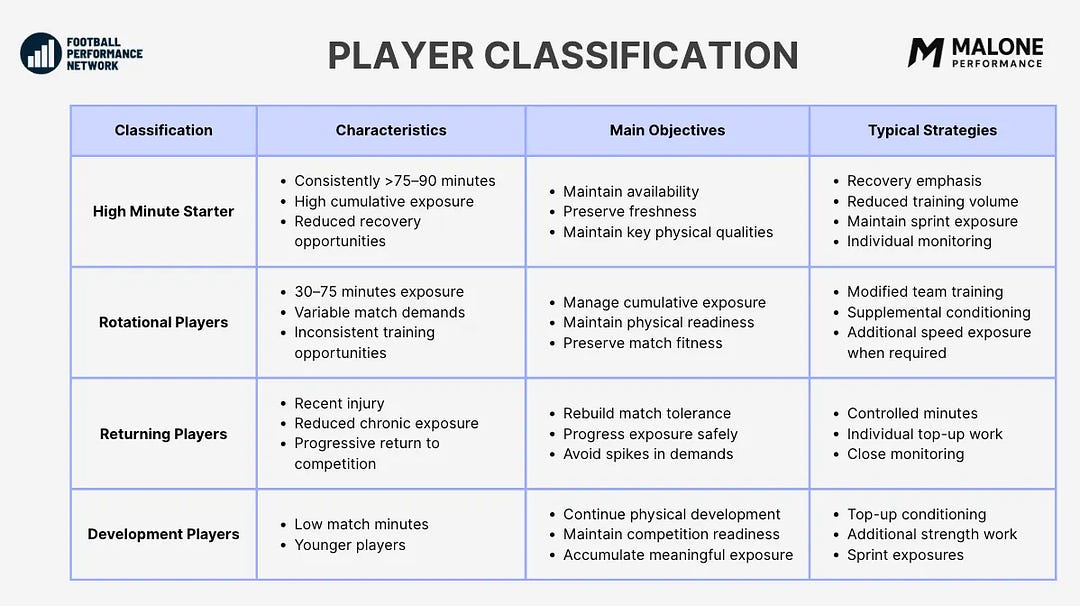
High-minute starters may need reduced training volume, recovery support, individual monitoring, and carefully planned sprint exposure to maintain key physical qualities.
Rotational players may need the opposite. Their issue is not always excessive load, but inconsistent exposure. They may need top-up conditioning, tactical involvement, speed exposure, gym work, or controlled match minutes to stay ready.
Returning players need carefully managed progressions to rebuild match tolerance. Development players may need additional physical work and competitive exposure to continue progressing.
This is why player classification matters. It helps practitioners move from generic squad plans to individualised decisions.
Keeping Rotational Players Ready
Rotational players are often the hardest group to manage well.
They are close enough to the team that they may be needed at any moment, but they may not be getting enough regular match exposure to maintain true match readiness.
Over time, this can create a gap between what they are prepared for and what the game may suddenly demand.
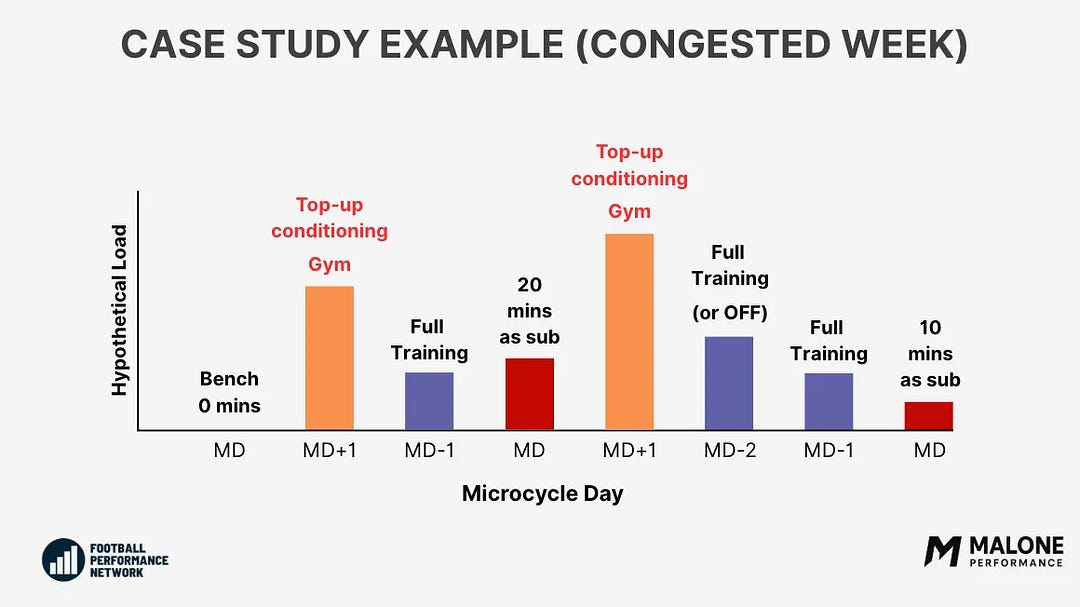
Top-up work should therefore be seen as part of squad readiness, not just extra running. This might include position-specific conditioning, high-intensity intervals, sprint exposures above 90% of maximum velocity, larger-sided games, additional gym work, or controlled minutes in cup, reserve, or under-21 matches.
The key is that readiness should be planned before the player is needed.
Take Home Message
Fixture congestion will always involve compromise.
You cannot fully recover every player, develop every quality, prepare every substitute, and maximise every match performance at the same time.
But you can make better decisions by understanding the needs of each player.
Some need protection. Some need exposure. Some need rhythm. Some need progression.
The role of the practitioner is to connect the data to the football context and help the coaching staff make better decisions.
During congested periods, the aim is not to create the perfect training week.
The aim is to keep the squad available, fresh, prepared, and capable of performing when it matters most.
That’s all for today.
See you next Friday.
James
If you’re serious about growing your career in football, now is the time to join a global community of 70+ physical performance and sport science practitioners inside the Football Performance Network.
Inside FPN, you’ll get direct support, honest feedback, live expert sessions, practical learning, and a network of practitioners who understand the reality of working in football.
Whether you want to sense check your ideas, improve your decision-making, build your confidence, or progress your career, FPN is designed to help you take the next step.
⚽️ Doors are now open, only 3 spaces left to join.
Applications close at 5pm BST today (Friday 3rd July).
No posts
Comments
Nothing yet. Say the first thing.
Sign in to join the conversation.