
When my latest personal essay was published this week, it felt like a hard-won accomplishment. The piece — which looks at why I’m resisting anti-aging efforts now that I have outlived my mother — was rejected by 11 publications over the course of one month. (To clarify, three rejected it and eight never responded. When silence persists, even after follow-ups, I count it as a “no.”)
But one of the publications I pitched later in the process — The Huffington Post — accepted the essay enthusiastically. The only reason I didn’t pitch HuffPost sooner is because I didn’t have contacts there and didn’t know if my essay would be the right fit.
The HuffPost Personal editor asked for just one small edit, which felt validating in the wake of so many rejections. It seemed like proof that my piece wasn’t problematic; it was just in need of something critical: an editor who believed in it.
In keeping with my last two posts, which offered takeaways from recent essays I wrote for Katie Couric Media and Slate, I’m sharing lessons learned from my HuffPost piece.
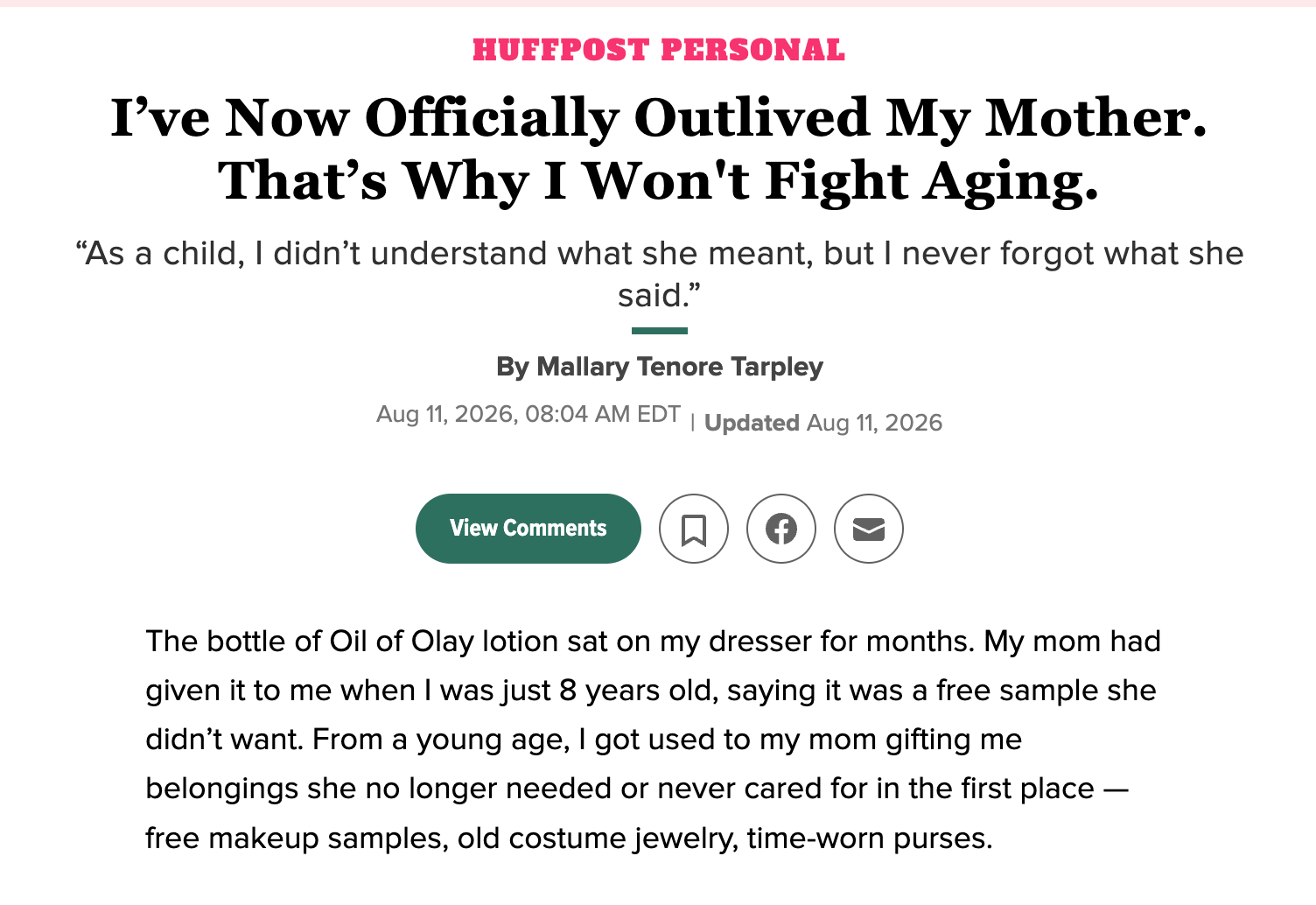
I initially pitched my essay to an editor who asked to see the full piece before determining whether she wanted to publish it. In freelancing, this practice is known as writing “on spec.” It comes from “on speculation,” meaning you’re doing the work speculatively rather than as an assignment.
I much prefer when editors accept pitches without requesting to see the full story first, but I also understand why they opt for the on-spec approach, especially when they’re pitched by writers they haven’t worked with before.
I had pitched the piece during a busy stretch of my spring semester, so I didn’t start writing it until almost three months later, once the semester had ended. During that time, I thought a lot about the piece and also read a (wonderful!) book on aging to broaden my understanding of why some people choose to pursue anti-aging procedures and why others don’t. Once I had written the piece, I sent it to the editor in hopes that she’d want to publish it.
As I tell my students, always follow up! Editors are inundated with pitches these days, and I’ve found that they appreciate when you follow up (within reason). I usually wait a week to follow up on pieces that aren’t time-sensitive. If the piece is especially timely, I’ll do so after a day or two.
After a week of not hearing anything from the editor I had pitched my essay to, I followed up. A few days later, she responded to say she really liked the piece but had to pass because it wasn’t quite the right fit. Passes are always disappointing, but they’re also an invitation to start pitching elsewhere.
Editors don’t typically give detailed explanations about why they’re passing on a particular story (or book, for that matter). Rejection notes tend to be succinct and are usually along the lines of, “I’m going to pass, but thanks for sharing,” or “I’m going to pass because this isn’t the right fit for us.” Try not to read too much into rejections. Instead, spend that time and energy thinking about other outlets that may want to publish your work.
I’ve been a journalist for over 20 years and I still get rejections. They’re painful, but they build resilience. As the late author Sylvia Plath once said: “I love my rejection slips. They show me I try.”
(Read more about my experiences with rejection, and related pointers for navigating them, here.)
After getting that rejection, I started pitching the piece to other outlets. Two of them passed, and eight never responded. If you’ve followed up and still haven’t heard anything, that usually means a no. There are always exceptions, though; when I wrote an essay for The New York Times during the pandemic, it took two follow-ups to get an eventual “yes.” Any more than two follow-ups starts to become overkill.
Don’t take the radio silence personally. I always prefer an acknowledgement of some sort (even if it’s just a confirmation of receipt!), but I’ve learned that sitting with silence is an unavoidable part of the writer’s life. And sometimes that’s a good thing.
When pitching outlets, I attached my full essay. I typically just send a pitch, but since I had already written the piece, I decided to include it in hopes that it might make editors more likely to say yes if they could read it ahead of time. I also included a headline in the essay and the pitch.
I started including headlines after pitching an essay to the Los Angeles Times a few years ago. The editor responded to ask if I would send her some possible headlines, noting that headlines can make or break a piece’s success. I sent her a few, and from there she accepted the pitch.
The headline I proposed in my latest pitch — “I’m about to outlive my mother. That’s why I won’t fight aging” — was the one that HuffPost Personal ended up using.
When considering headlines, keep two acronyms in mind: SEO (search engine optimization) and SVO (subject, verb, object). In other words, put keywords in your headline and consider whether you can start with a subject, followed by a verb and an object so that your headline has action in it. Headlines without verbs tend to lack energy.
For my HuffPost Personal essay, I read a book, interviewed two experts, and quoted a third. I also included some statistics about a concept known as “normative discontent” and about the number of people who are opting for Botox and fillers. (Read the essay to learn more.)
Anytime you can make the case for how you’ll expand your personal narrative beyond your own story, you are more likely to get a “yes” from editors. Of course there are always exceptions. Not all media outlets expect writers to do additional reporting; I’ve written a handful of published essays that are about my story alone. But additional reporting always helps.
I like to follow what I call the 75/25 rule; roughly 75% of the essay should be about your own experiences, and the remaining 25% should be dedicated to related stats and insights from others. I have followed this rule for so long that I now adhere to it almost instinctively. I just counted up the number of paragraphs in my HuffPost essay and saw that of 32 paragraphs, eight (or exactly 25%) were dedicated to reporting.
Some publications work several months ahead, especially those that specialize in personal essays. My HuffPost Personal pitch was accepted in late May and didn’t run until this week. The editor was transparent about the wait time, so I didn’t mind at all. I mentioned that the paperback version of my memoir SLIP would be released on Aug. 11, so the editor timed the essay publication accordingly.
If you’re publishing a book, always see if editors are willing to coordinate on timing. And be sure to link to your book’s landing page in your author bio at the end of your essay.
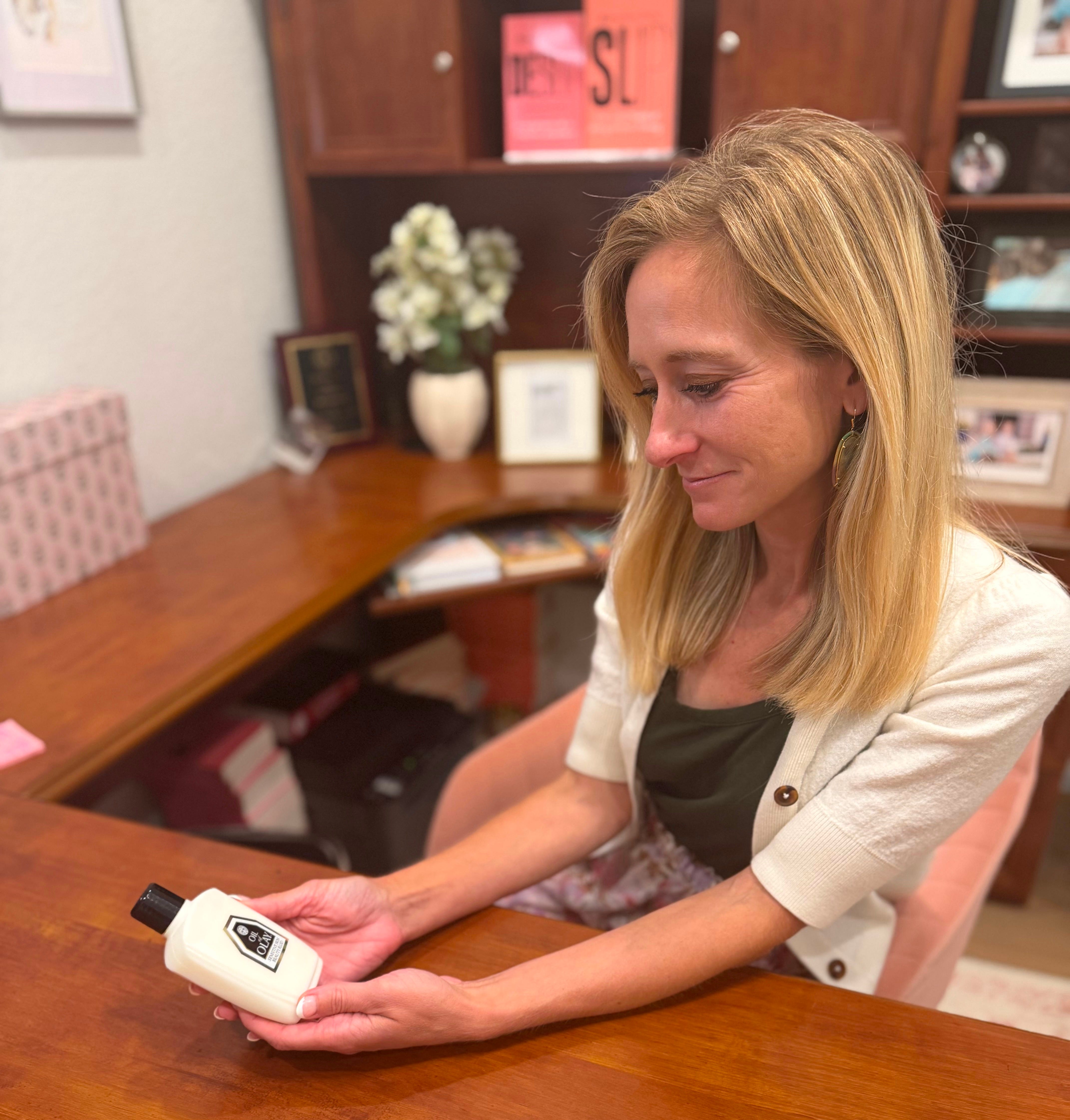
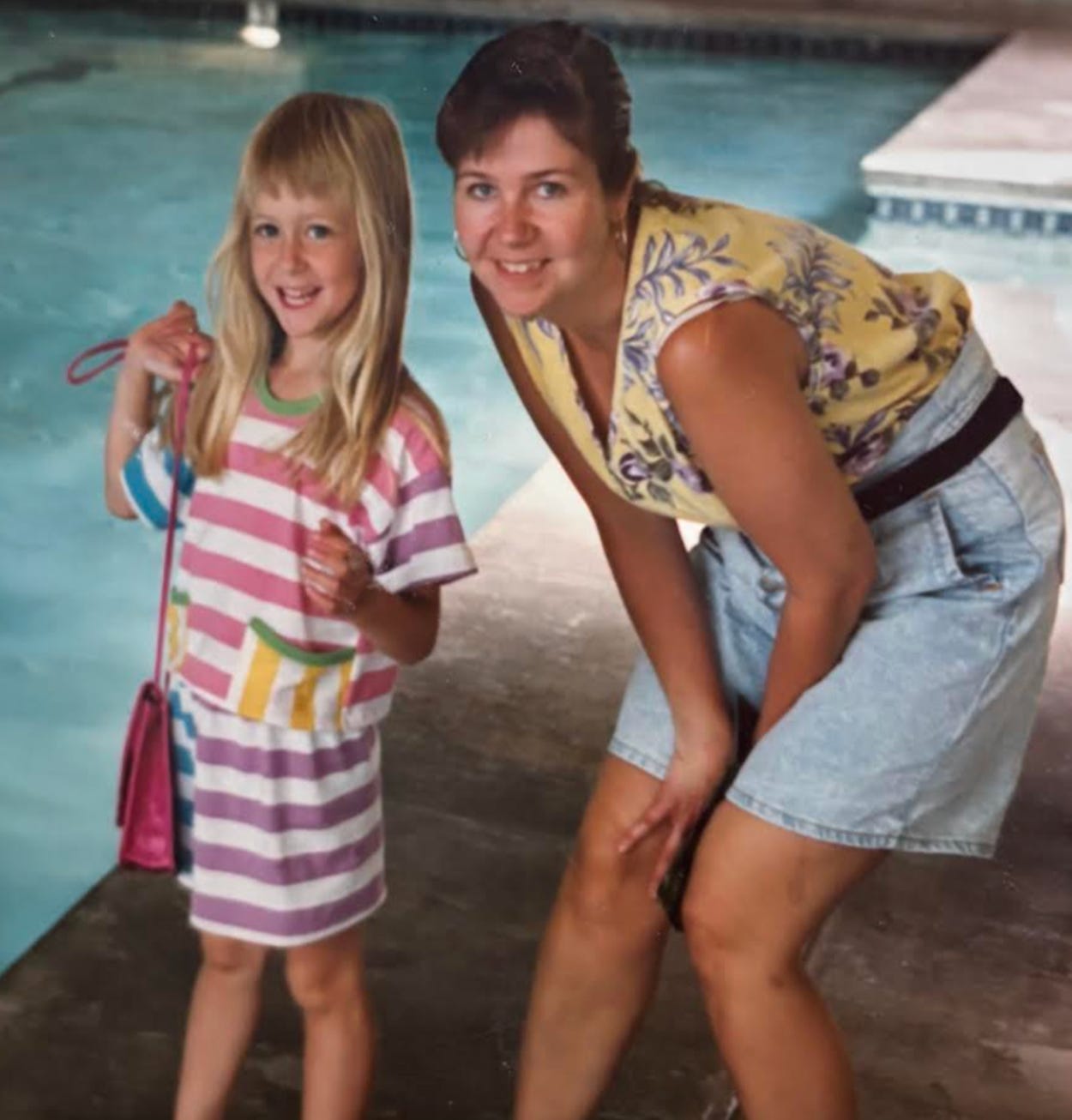
As a writer, I always keep my eyes open for objects that could act as portals into personal essays. Throughout last year, after turning 40, I kept thinking about a bottle of anti-aging Oil of Olay lotion that my mother gave me as a child. It stuck with me to the point where I knew I needed to write about it.
The lotion ended up being the portal into my essay. I used it at the beginning and the end, and I wove it into the middle, too, by citing a 1980s commercial advertising the lotion. I love resurfacing media from decades past, both as a form of nostalgia and as a way to show how much has changed (and, in some cases, remained the same).
Objects can be powerful storytelling and structural devices; they’re also great tools for moving up and down the ladder of abstraction. In other words, you can use concrete objects to illustrate abstract concepts. In this case, the Oil of Olay lotion was symbolic of aging and my mother’s love.
Whenever you get a “yes” for your piece and it’s ultimately published, congratulate yourself. Sit with that victory, however small or large it may seem, and hold space for happiness.
As I write this, I’m reminded of a great passage from Ann Patchett’s book Truth & Beauty, about her friendship with the late author Lucy Grealy. In it, Patchett talks about how she stood on top of the manuscript for her first novel to see how much taller it made her.
I read that passage years ago and never forgot it. To me, it seemed like the perfect combination of humility and pride — an authorial reminder of how writing can help us stand taller, and if we’re lucky, empower others to do the same.
✦ ~~~~~~ ✦ ~~~~~~ ✦ ~~~~~~ ✦ ~~~~~~ ✦
I hope you’ll read my HuffPost Personal essay, which you can access for free here. I’d love to hear your thoughts on the essay and/or this post. I’m happy to answer any related craft questions too.
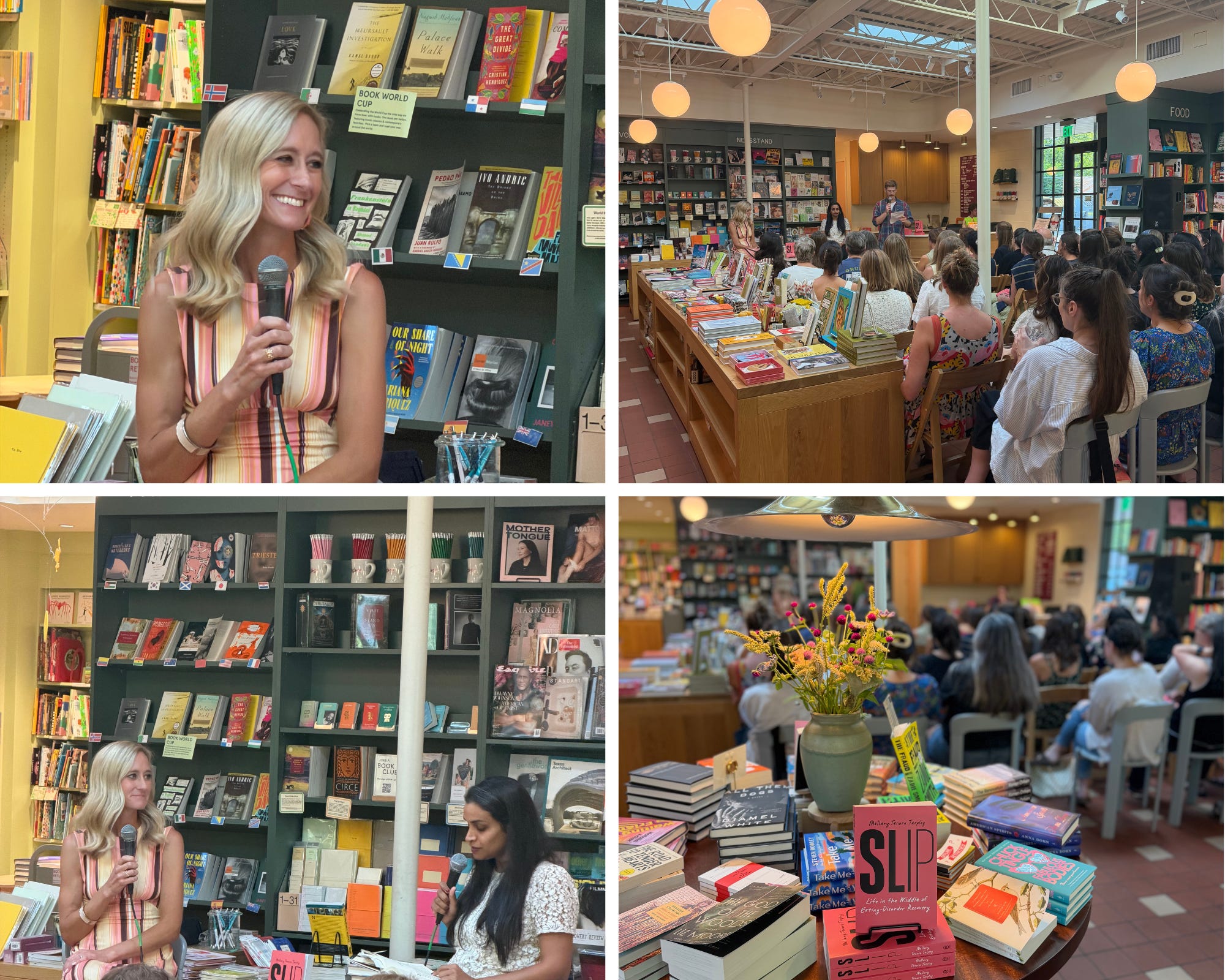
On Tuesday, the paperback version of my memoir SLIP came out! I had a launch event at First Light Books in Austin, where I was in conversation with the wonderful Pooja Lakshmin MD. I’m so grateful to everyone who showed up. The joy on my face says it all. Thank you to everyone who has supported me and the book over this past year. If you haven’t yet purchased a copy, I hope you’ll consider buying the paperback version (or hardcover). The book is also available in Spanish.
No posts
Comments
Nothing yet. Say the first thing.
Sign in to join the conversation.