
How. Did. We. Get. Here?
Following the conclusion of negotiations with Oman about reopening the Strait of Hormuz and joint administration of the Strait going forward, Iran has issued a series of strident, maximalist demands for agreeing to consider reopening the Strait of Hormuz. These demands include references to the terms previously agreed to in the supposedly defunct 17 June Memorandum of Understanding (MOU), signed by the President of the United States. In my view, this alone emphasizes how misguided this MOU was, and why it should never have been signed.
I’ll say it again. How did we get here?
To understand the pickle in which the U.S., and particularly the President, finds itself, we need to admit how we got there in the first place. Truly understand it. I don’t know how else to explain it, so I’m going to use a metaphor, as I see it. Bear with me.
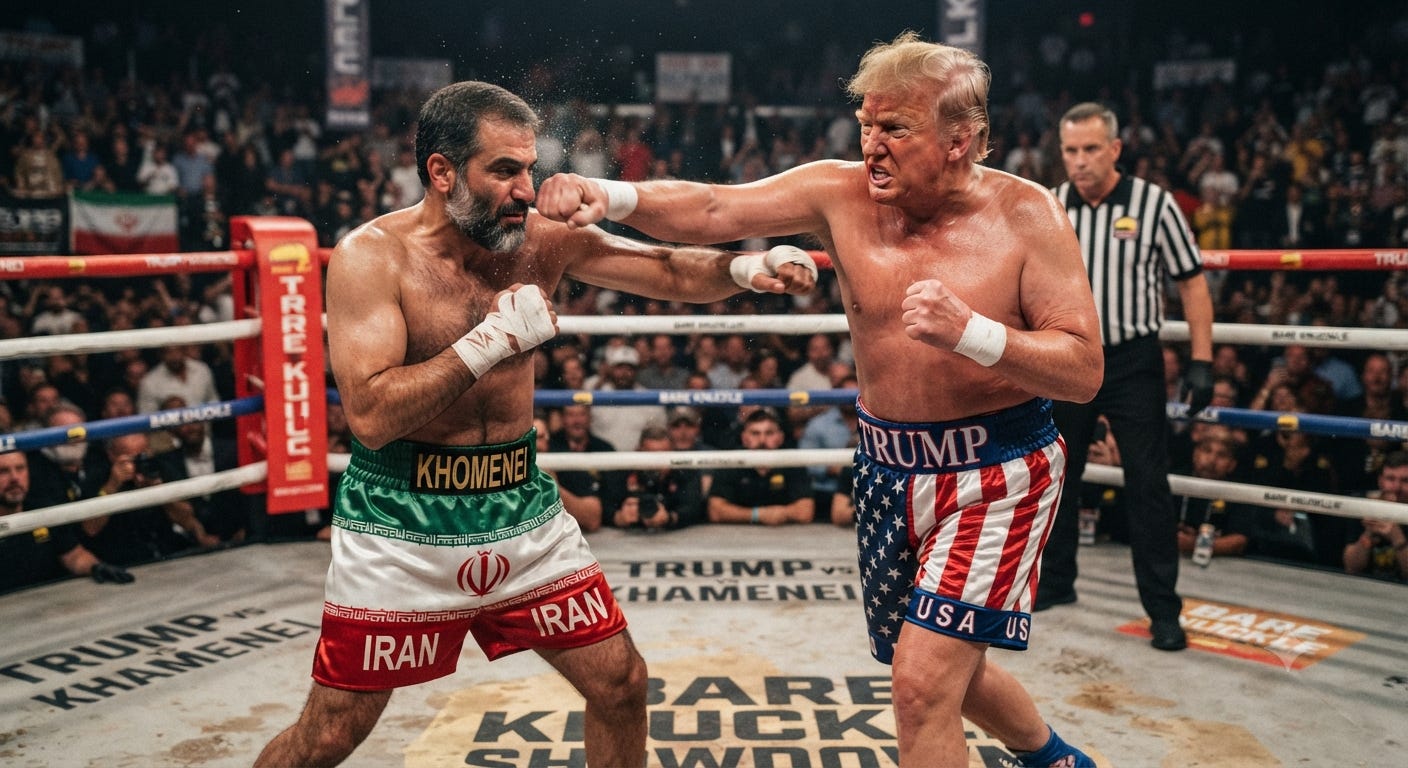
A bare-knuckle challenge fight
The scenario: The champion (the U.S.), after suffering a never-ending stream of taunts and threats from a challenger (Iran), finally agrees to a bare-knuckle challenge fight; a (notional) three round match. The champion goes against the advice of virtually everyone in his corner – his manager, his trainer, and his cut-guy (the champion can be a bit of a bleeder) – and doesn’t even bother to ask his home crowd if they support it.
But he is urged on by several hangers-on to put the challenger in his place, as well as listening to a big-time gambler who has his ear and convinces him it will be an easy fight, and defeating this particular fighter, an aggressive, scrappy little fighter who has been intimidating everyone in the neighborhood, including the gambler, for years and needs to be taken down. He fails to tell the champion that he owes a lot of money from previous poor bets and has placed a huge amount on this fight. He assures the champion that everyone will thank him for this, and it will boost his legacy.
Why did the champion consider, not to mention agree to, this fight? No one really knows.
The terms: As the challenger, Iran only needs to be standing at the end of the three rounds to receive a significant monetary prize, as well as the reputational boost of having survived fighting the champion. The champion also inexplicably agreed to give the challenger control over the terms of a rematch if he wins. According to the agreed upon terms, the challenger need not knock the champion out, or down, nor even score one point against their opponent. They need only to be standing at the bell ending the third round. Everyone bet heavily, of course, on the champion.
Inexplicably, while negotiating the terms, the champion sucker-punched the challenger as he turned away, apparently hoping to end the fight before it began. Shameful, and frankly bad form perhaps, but there are no actual rules in bare-knuckle fighting, so… while the sucker-punch put the challenger on the canvas temporarily, the challenger was able to regain their feet before the bell signaling the beginning of the first round.
The result: So, the bell has just sounded, ending the third round. The challenger got in several quick, surprise jabs, giving the champion a bloody nose, and more than one blow to the body that briefly staggered him. The challenger, on the other hand, is bruised and battered, having taken significant punishment from the champion. The challenger is staggering and has a broken nose, two heavily bruised eyes, and likely several broken ribs. But… the challenger is still standing.
Enough of the metaphor. Iran is still standing. They win. Let’s look at what led us here.
The Predicate:
Let’s examine the elements that contributed to this situation.
The President reportedly ignored good advice (read U.S. intelligence), took poor advice (read Israeli intelligence) and acted on the latter. He did not understand his opponent and entered the war without a thoroughly considered strategy, severely underestimating Iran’s potential to remain standing in the face of overwhelming U.S. military force.
Lastly, the President chose not to consult with or seek Congressional authorization to go to war, nor did he bother to (credibly) explain to the American people the existential threat to U.S. interests posed by Iran, building a durable U.S. government and national consensus in support of military action.
As a result
The U.S. (and Israel) counted on air power alone to first decapitate, then quickly force the Iranian Islamic regime to submit, and/or possibly facilitate regime change. Lacking deep national support for the war, the U.S. administration was unable to commit ground troops to the war and suffer the inevitable casualties that would follow. This blunted the significant military advantage they enjoyed.
Barring a quick and decisive victory, this – it turns out – virtually ensured that munition stocks would see a dramatic drawdown.
In the meantime, the U.S. administration agreed to a negotiated ceasefire agreement – the MOU – signed by the President, that inexplicably contained terms that were overly vague and oddly advantageous to Iran. This appeared to signal to Iran that its newfound control over the Strait of Hormuz provided it with significant leverage and that the U.S. administration was becoming desperate.
After multiple rounds of increasingly dire threats followed by embarrassing walk-backs, the U.S. defaulted to a negotiation between Iran and Oman, the two key regional players on either side of the Strait, to see whether Iran’s leadership was prepared to agree to a deal that the U.S. could accept. Initial results, as reported in the New York Times and other publications, indicate that they are not, or at least will not make it easy, insisting that the President honor the agreement he previously signed.
To the Victor Goes the Spoils
Iran’s maximalist demands show (at a minimum) two things: first, they firmly believe they have an advantage that can be leveraged; control over the Strait of Hormuz. Second, they do not trust the United States to meet its obligations as laid out in the June MOU, or any other agreement, so they are unlikely to surrender control over the Strait until they receive tangible benefits.
Next
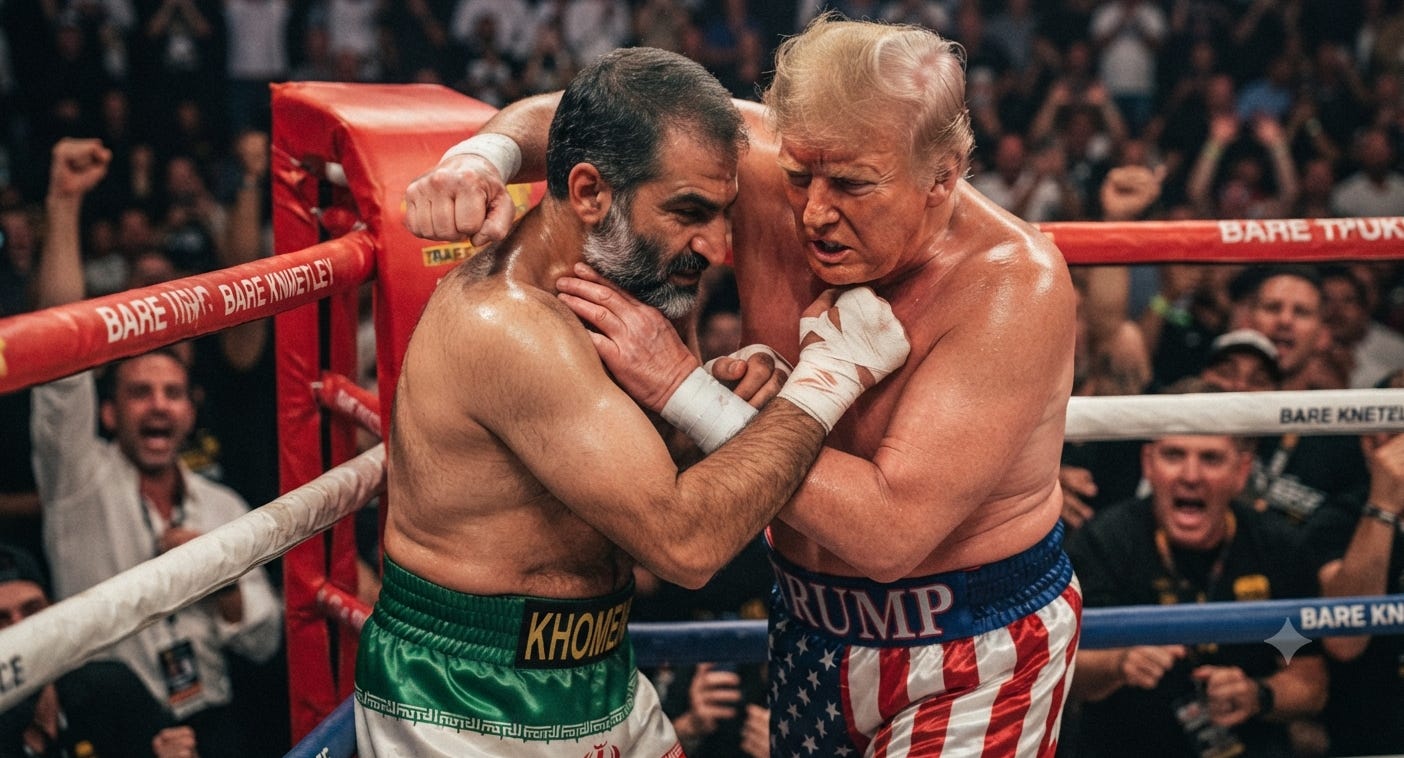
Bottom line? There appears to be a stalemate, with no clear end in sight, and no good options available.
Frankly, I am at a bit of a loss on how to comment, yet again, on what the administration might do now other than settle into some sort of uneasy ceasefire, as it appears to be doing, allowing the economic pressure build on the regime. This will force Iran’s leadership to face the consequences of its appalling, decades-long mismanagement of Iran’s economy and resources, and address the grievances of the disillusioned, angry people of Iran. We are likely to be dealing with this uncertain situation, with this settling into an extended test of wills, for some time. I have discussed some of these options in my recent posts, so if you are interested, please return to “Counting Coup”, or “Is Iran Controlling the Gulf Conflict?”.
While the U.S. may have won the literal exchange of blows, Iran looks to be walking away, at least for now, with both the prize and the glory. If there is a lesson to be learned here, it is that raw military dominance does not always equal strategic victory.
No posts
Comments
Nothing yet. Say the first thing.
Sign in to join the conversation.