
I’m going to be more explicitly political in this post. Why? Because the White House is making a case about U.S. election security by citing intelligence in a way that misleads the public. That matters, and it deserves to be called out.
The point is not that intelligence should be ignored in political decisions. The point is that intelligence only has value when it is presented with its full range of caveats, sourcing, confidence levels, and context intact. Strip those away, and intelligence can be used as a prop—useful for persuasion, but dangerous as evidence.
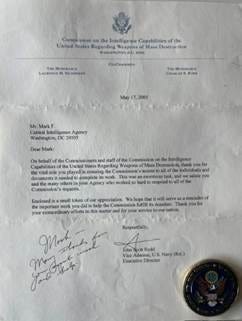
First, some background. This is personal for me. In the summer of 2003, I was the No. 2 officer on Iraq for the CIA. In the spring of 2004, the office of the Deputy Director of Operations asked me to serve as the senior Directorate of Operations representative to the Silberman-Robb Commission, formally known as the Commission on the Intelligence Capabilities of the United States Regarding Weapons of Mass Destruction.
A senior CIA officer explained the need for my assignment with an anecdote from the prior 9/11 Commission review. Staffers had asked CIA Director George Tenet about a cable sent to the field. When Tenet said he did not recall it, they pressed him: how could he not recall a cable addressed from his office, “Director”? Anyone who knows CIA cable traffic knows the answer: all standard cables from headquarters are labeled “From: Director,” regardless of which office originated them. The staff’s lack of context about how the intelligence community operated complicated and impeded the entire process. While arguably well intentioned, they were clearly out of their depth. My role was simply to ensure that operational context was available this time around.
This role is not classified, as the letter and coin below make clear.
I saw first-hand how the intelligence community (IC) can get it catastrophically wrong. This was most clearly exemplified by the infamous case of CURVEBALL, the individual, perhaps more than any other, responsible for providing a justification for going to war against Iraq. He is a quintessential example of how intelligence, when mishandled, can be misused. In his case, not by the political leadership, but by the IC itself. The agency solely responsible for handling the reporting from CURVEBALL was the Defense HUMINT Service, known in this context as DHS. It failed abysmally, neglecting to vet either CURVEBALL himself or his reporting. It also failed to appropriately caveat his reporting. As a result, his reporting on mobile biological weapons labs made it into the IC intelligence repository absent any vetting or context. I was in the room when a senior DHS officer, in response to the Commission’s question on why they failed to vet CURVEBALL’s information, had the gall to answer, “That wasn’t our job!” That answer signaled how out of their depth both he and his organization were. Judge Silberman was appalled and sought the dissolution of DHS; it was subsequently reborn as the Defense Clandestine Service (DCS).
Everyone knows by now the story of CURVEBALL. It’s complicated, and there is plenty of blame to go around. He lied. The IC failed to uncover his lies when it mattered. In the end, political leaders used those lies to justify going to war, relying on his reporting and managed interpretation of other, vague intelligence reporting from the meager stable of unvetted assets the IC was running inside Iraq. Think of warnings such as, “We don’t want the smoking gun to be a mushroom cloud.”
But that was then, and this is now. What we are seeing today is not the same kind of institutional intelligence failure surrounding the CURVEBALL disaster. This time, the misuse is being driven by the senior-most political leadership in the United States.
This matters because the Iraq example shows how intelligence can be damaged at multiple points in the process: collection, vetting, analysis, presentation, and political use. In the current case, the public evidence points less to an IC failure than to political leaders attempting to strip intelligence of the context that would let citizens judge it responsibly.
The keywords for understanding how intelligence can be used to make a political case are cherry-picking, context, and managed interpretation.
Cherry-picking is easily done by politicians by leveraging the closed, classified nature of the intelligence world. It has been done before, specifically in the run-up to the Iraq War. The White House was not satisfied with the IC’s conclusion that there was no credible evidence of an Iraqi relationship to Al Qaeda or the 9/11 attacks. In response, the Pentagon established the Office of Special Plans (OSP) to review intelligence, specifically to build a case for a link between Iraq and Al Qaeda, as a justification for the Iraq War. The OSP process included widespread cherry-picking of individual raw intelligence reports in an attempt to make their case.
So, what is the White House doing now?
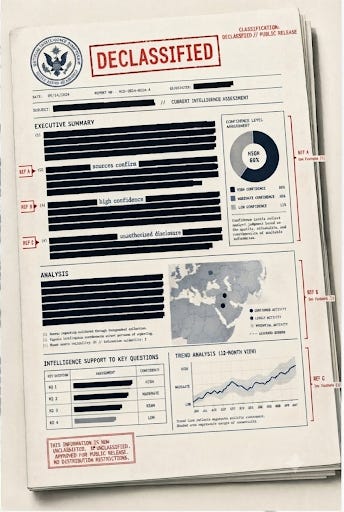
The President’s speech cited heavily redacted intelligence, with little context, purporting to show that China compromised or exploited U.S. voter data and that U.S. election systems faced serious vulnerabilities. He attempted to interpret this as proof that China altered votes, manipulated ballots, and changed the 2020 outcome. It does not prove that. Prior U.S. intelligence assessments concluded China did not interfere in the election result. This is a distinction that matters. But let’s put that aside, as it is being heavily scrutinized and rebutted in the media and the court of public opinion.
It is important to realize that intelligence, particularly raw intelligence reporting, is not created equal. Some reporting comes from highly vetted, well-placed sources whose reporting has been extensively corroborated and validated. Other reporting can come from a onetime walk-in with little to no vetting. But any of it can be subject to cherry-picking, lack of context, and/or managed interpretation. This also applies to all-source assessments, where analysts bring together HUMINT, signals intelligence, satellite imagery and other relevant reporting. When an issue is politically charged, as with election interference, analysts may consider a broad range of intelligence, even that at the lowest thresh-hold of dissemination, to avoid charges of partisanship. Some intelligence will be thoroughly vetted. Some may not. That is why confidence levels—high, medium, or low—matter. These are all safeguards against the misuse of intelligence.
The President was using—excuse me, misusing—intelligence to attempt to prove election interference and justify a political action: intrusive federal oversight of the upcoming mid-term elections. The reports were cherry-picked by his plainly unqualified acting DNI. They were so heavily redacted that they lacked both substance and context. And he assumed, as the senior policymaker in the U.S. government, that his managed interpretation might sway the broad audience he sought. It did not.
The President and his senior intelligence cadre are not merely out of their depth. They have shown they are willing to strip intelligence of the context that makes it meaningful—and use what remains for their own political purposes.
No posts
Comments
Nothing yet. Say the first thing.
Sign in to join the conversation.