
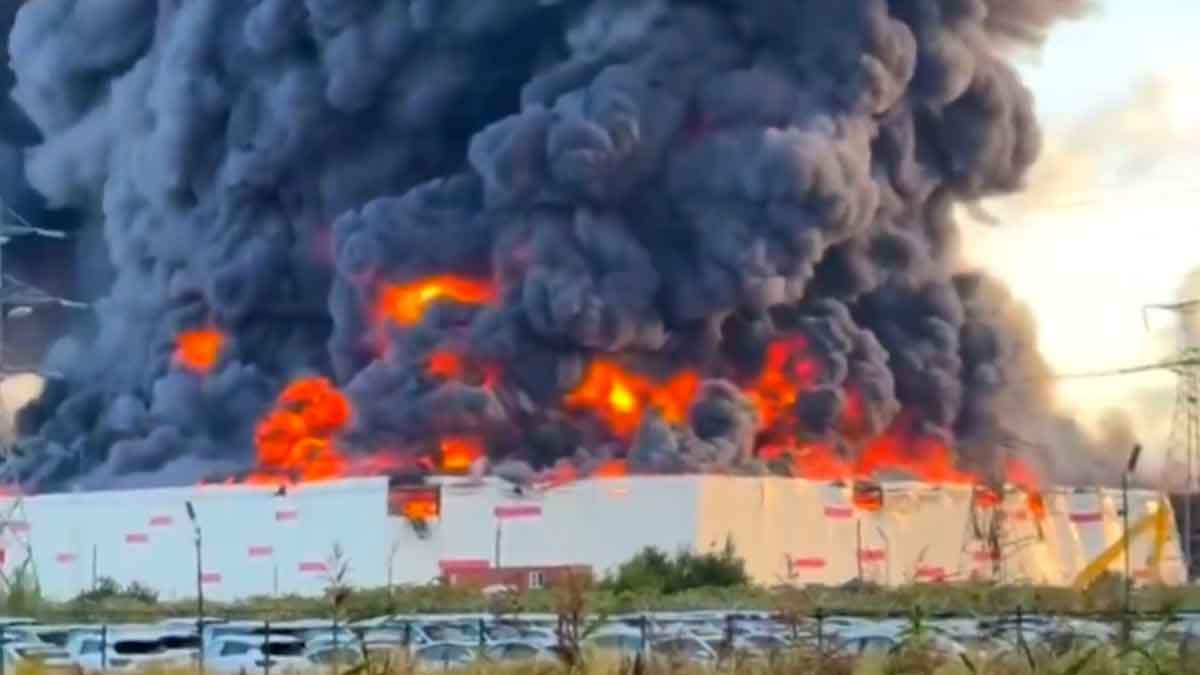
Overnight, Ukraine launched one of the largest drone and missile attacks against Russia on Thursday and Friday morning. Multiple Ukrainian drones struck the Shushary Wildberries Distribution Center (DC) in St. Petersburg. In the Leningrad Oblast, the Wildberries DC in the Utkina Zavod Industrial Park in Novosaratovka was also hit by multiple drones. Local sources reported the Wildberries DC in Tver was successfully attacked. However, at the time of publication, we could not independently verify the claims.
In less than a week, Ukraine has successfully attacked eight of Wildberries’ 20 largest DCs. Economic losses for Wildberries and third-party sellers are in the billions of dollars.
President Zelenskyy said the attacks were carried out because “The aggressor used them to supply sanctioned components for drone production and navigation equipment.”
Wildberries has an online store for the so-called “Special Military Operation,” which sells over 228,000 products such as drones, drone parts, fiber optic cable, electronic warfare equipment, drone jammers, body armor, helmets, and other military equipment.
At least one FP-5 Flamingo cruise missile struck the Avitek Plant in Kirov. The factory produces antiaircraft and cruise missiles and subsystems for the Kh-47M2 Kinzhal air-to-surface ballistic missile. Six defense workers were killed, and 32 were injured.
We assess the following:
1. In our assessment, the replacement of Ukraine’s Commander-in-Chief, Colonel General Oleksandr Syrskyi, with Major General Mykhailo Drapatyi was the right decision due to the evolution of 21st century warfare. We further assess that returning Mykhailo Fedorov to the role of Minister of Defense will provide the least disruption to the Armed Forces of Ukraine.
2. Our skeptism in the shift in tone from Washington was well placed, with Senator Dick Durbin (D-IL) claiming the $400 million in Congressionally mandated funds for Ukraine will be withheld by the Trump administration until at least 2029, and US President Donald Trump calling for additional changes to the Lindsey O. Graham Sanctioning Russian Act of 2026. We continue to advise maintaining caution until agreements and laws are signed, and promised aid is delivered.
3. Unless the Kremlin takes immediate and extreme steps to reduce consumption or improve the supply, Russia’s fuel crisis will become significantly worse by August.
4. Although we maintain there is a moderate chance that Russia will conduct nationwide mobilization in the second half of 2026, if the fuel crisis is not addressed, the Kremlin could face significant unrest.
5. Russia has reached an inflection point signaling the start of a broad national decline due to combined issues of force generation, the fuel and logistics crisis caused by Ukraine’s deep-strike capabilities, domestic arms production limitations, federal and regional budget deficits, financial stress causing socioeconomic decline, systemic government fear of its own population, and shrinking global soft power. We maintain that if left unaddressed, these issues could lead to civil unrest in the most impacted regions.
Today’s downloadable Russia-Ukraine War SITREP No. 1,064, for July 17-23, 2026, is 82 pages long and combat only.
It has been 4,535 days since Russia started the Russia-Ukraine War by invading Crimea, 497 days since Ukraine accepted an unconditional ceasefire, and day 26 of President Zelenskyy’s 40-day campaign to force Russia back to peace talks.
You can visit our interactive Russia-Ukraine War Map for the latest tactical situation in the theatre of war.
From Friday to Sunday, Russian attacks targeting civilians and civilian infrastructure killed 57 and wounded 403.
On 18–19 July, Russia launched 10 Zircon tactical hypersonic missiles and 25 tactical and short-range ballistic missiles (SRBMs) against Kyiv, with 17 intercepted. Over 250,000 books were destroyed at the Knygolav Publishing House, and the windows were blown out of the Embassy of Azerbaijan. The AMTEL logistics complex was also hit, destroying $3.9 million in UNICEF humanitarian aid and over $2.6 million in supplies for HIV prevention. One person was killed and eight wounded.
On Sunday, a missile strike on an amusement park and recreation area in the Odesa region killed a 16-year-old boy and wounded 12.
In the Kharkiv Oblast, three Russian cruise missiles struck the Nova Poshta terminal in Korotych, killing four and wounding 20.
A Russian airstrike on Monday struck a residential area in Zaporizhzhia, killing three and wounding 45. The VKS (Russian Aerospace Forces) conducted 10 airstrikes on Kherson, wounding seven. In the Dnipropetrovsk Oblast, a Russian attack on Pavlohrad killed two and wounded eight.
Do you want to view today’s full report with our analysis, maps, links to videos and pictures, and the rest of our in-depth coverage? Upgrade your subscription to read our premium content. If you’re already a paid subscriber, the download button for today’s report is at the end of the summary report.
The United Nations Human Rights Monitoring Mission reported that in June, 293 civilians were killed and 1,990 wounded, making it the deadliest month since the siege of Mariupol in April 2022.
Russia’s fuel crisis is showing signs of stabilization, but widespread shortages and insufficient fuel to support agriculture continue.
Comments
Nothing yet. Say the first thing.
Sign in to join the conversation.