
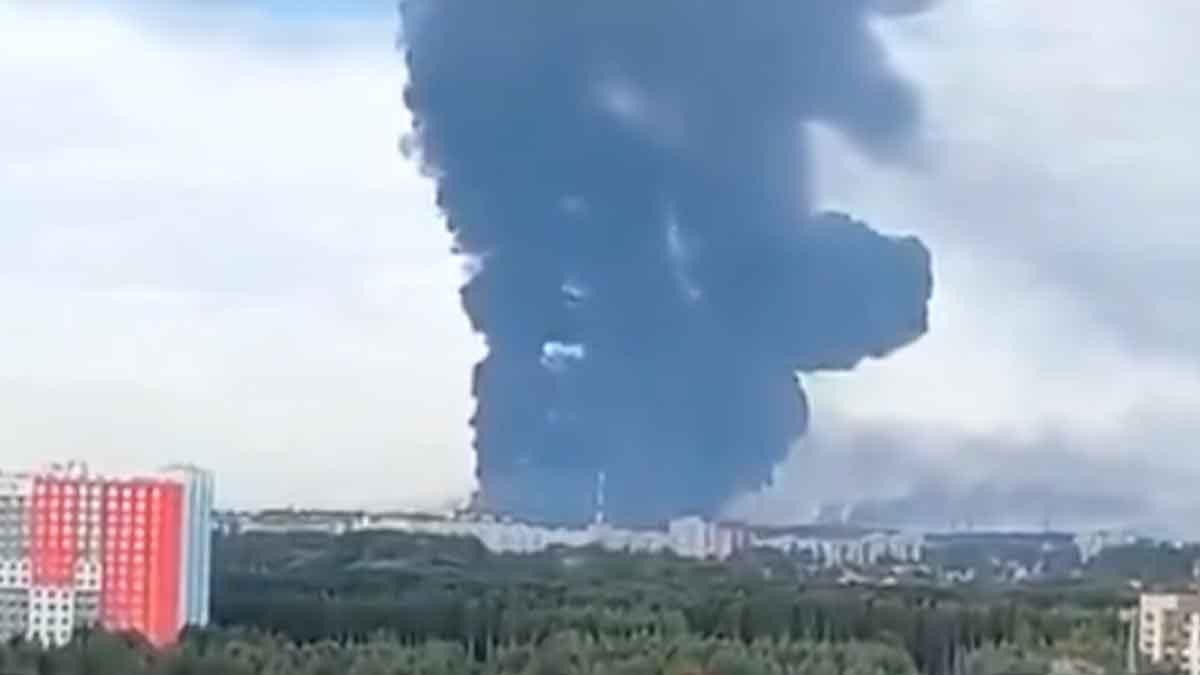
After conducting the largest number of attacks on Russian refineries in June 2026, Ukraine appeared to pause its strikes. In the last week, renewed drone attacks have targeted 72 million tonnes (metric) of annual crude distillation. The pause and the renewed strikes were intentional.
Strikes on running refineries cause more damage because they operate at high pressures and temperatures. Each subsequent attack increases the complexity and creates new logistics challenges to bypass Western sanctions for critical parts.
Since July 29, Ukrainian drones have successfully attacked the Rosneft Saratov Oil Refinery, the Lukoil-Permnefteorgsintez Oil Refinery in the Perm Oblast, the Lukoil-Volgogradnefteperabotka Oil Refinery in the city of Volgograd, and the Bashnefta-UNPZ, Bashnefta-Novoil, and Bashnefta-Ufaneftekhim Oil Refineries in Ufa, and the NPZ JSC Slavneft-YANOS Oil Refinery in Yaroslavl. Five of the seven strikes were follow-up attacks after the refineries recently restarted due to earlier attacks. The Saratov refinery has been closed since August 2, and won’t restart until September.
According to EA Analytics, Russian refinery capacity didn’t recover in July, falling to a daily output of 3.6 million barrels per day. A year ago, it was 5.4 million barrels per day. Russia has been able to prop up its domestic fuel supply by maintaining the export ban on petrol, aviation fuel, and diesel. Petrol and aviation fuel exports are blocked through December 31, while the restart of diesel fuel exports was not given a firm date.
Russia has been able to prop up its domestic market by tapping into national fuel reserves, switching from Euro-5 to Euro-3, and a limited amount of imports. By the end of July, wholesale trading volumes on the St. Petersburg Exchange started to increase, especially for diesel fuel. However, over 80 percent of buy orders for petrol were still unfilled.
The regions east of the Ural Mountains remain the most vulnerable, as Russia has redirected a significant portion of refined fuels to the west. The fuel crisis may have ended in Moscow and St. Petersburg, but regions such as Zabaykalsky Krai remain on the brink of a systemwide fuel distribution collapse.
A growing number of analysts have assessed that the worst of the 2026 fuel crisis has passed. In our assessment, this is a premature conclusion, with Ukraine reintensifying its campaign and a clear pattern of targeting recently repaired refineries.
We assess the following:
1. In our assessment, steps taken by Russia to stabilize its fuel supply, which have been partially successful, will be under increasing stress due to renewed Ukrainian attacks on refineries that were recently repaired.
2. We maintain Ukraine is on the right path to develop its own anti-ballistic missile system in cooperation with European partners, due to the global shortage of PAC-3 interceptors for the Patriot Air Defense System and the inability of US defense companies to meet existing demand for the next 4 to 6 years.
3. Ukrainian society remains dissatisfied with the dismissal of Minister of Defense Mykhailo Fedorov, with protests continuing in multiple cities.
4. Moscow is setting conditions to expand mobilization and preparing society to further extend its war of aggression, despite denials from Kremlin leaders.
5. The number of Russian and Belarusian violations of NATO nations’ airspace and kinetic acts of hybrid warfare will continue to increase due to the tepid response by Ukraine’s allies.
Today’s downloadable Russia-Ukraine War SITREP No. 1,067, for August 5, 2026, is 74 pages long and a full report.
It has been 4,549 days since Russia started the Russia-Ukraine War by invading Crimea, 512 days since Ukraine accepted an unconditional ceasefire, and day 41 of President Zelenskyy’s “40-day campaign” to force Russia back to peace talks.
You can visit our interactive Russia-Ukraine War Map for the latest tactical situation in the theatre of war.
Russian autocrat Vladimir Putin and Defense Minister Andrey Belousov announced a restructing of the Ministry of Defense. The biggest changes are within the Material-Technical Support (MTO) command, which was reformed in 2010. The MTO has been divided, with a Rear Services Command and a Technical Support Systems Command.
Colonel General Valery Solodchuk has been appointed Deputy Minister of Defense for Rear Services Command, and Colonel General Alekandr Sanchik, who was the Deputy Minister of Defense of the MTO, will be responsible for the Technical Support Systems Command. Alexei Krivoruchko, who was appointed Deputy Minister of Defense for Military-Technical Support in 2018, was demoted and will only be responsible for weapons development.
Yury Vaganov, a civilian who was named Russia’s first commander of its Unmanned Systems Forces in 2025, was dismissed and replaced by Colonel General Denis Lyamin.
Do you want to view today’s full report with our analysis, maps, links to videos and pictures, and the rest of our in-depth coverage? Upgrade your subscription to read our premium content. If you’re already a paid subscriber, the download button for today’s report is at the end of the summary report.
Ukraine’s President Volodymyr Zelenskyy dismissed Ukraine’s Ambassador to the United States, Olha Stefanishyna, who was charged by the High Anti-Corruption Court hours later with illicit enrichment in the amount of $310,000 and taken into custody. Bail was set at $130,000.
Comments
Nothing yet. Say the first thing.
Sign in to join the conversation.