
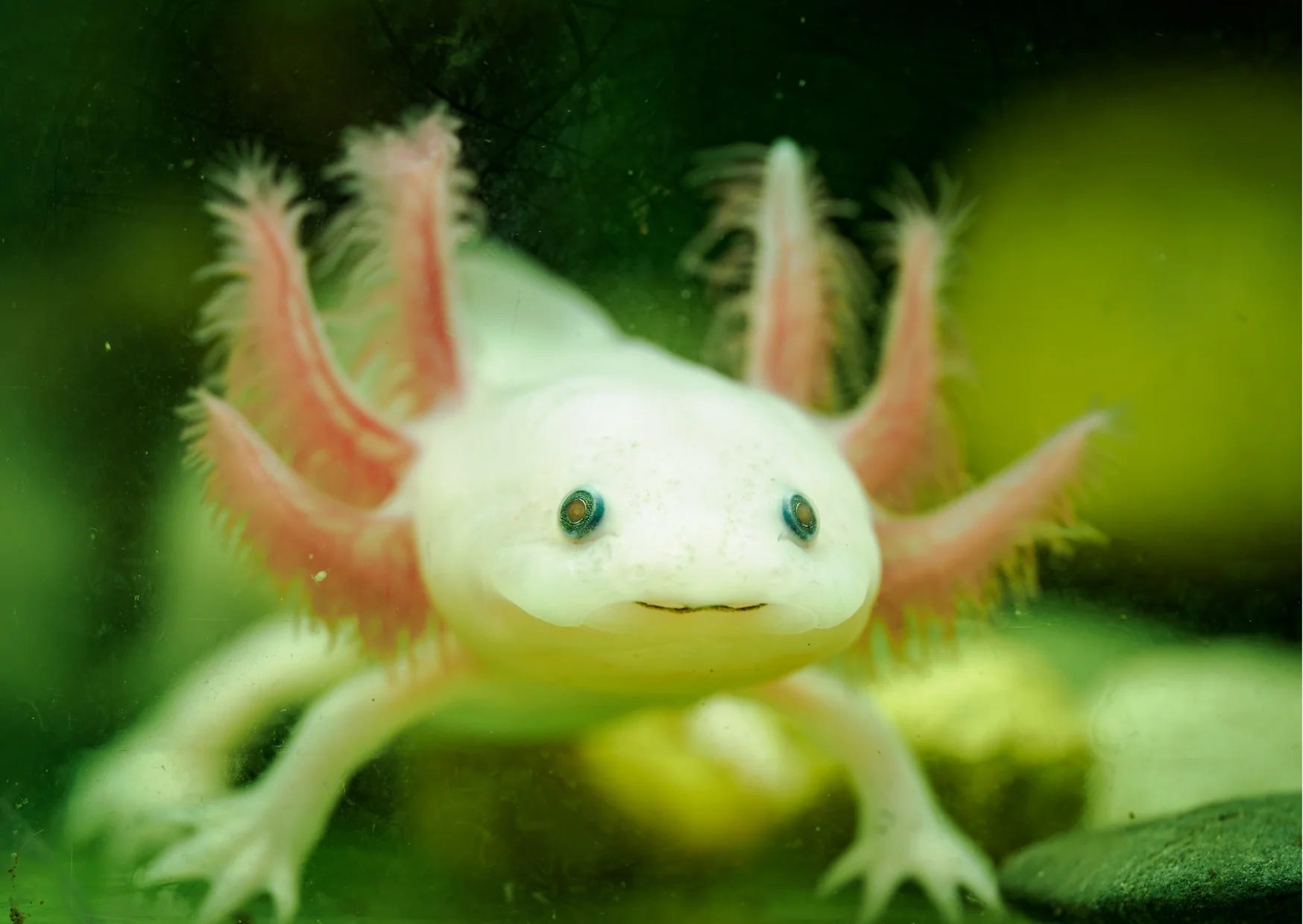
Do you have a tendency to behave recklessly around farm equipment? Or maybe you like to get drunk and hand-feed crocodiles? Or perhaps you’re a recreational ”five finger fillet” player? If so, there’s good news for you on the science front: researchers are reportedly making progress toward training the human body to regrow lost limbs.
I got this information from a recent Washington Post article describing ongoing research into the unique limb-regeneration properties of the axolotl, a species of salamander native to Mexico. With adorable features including feathery gills, wide eyes and a mouth shape that resembles a beatific smile, the axolotl in recent years has become something of an “it” species in popular culture, whether appearing in video games like Minecraft and Fortnite, serving as the model for the lead dragon in the film “How to Train Your Dragon” or getting caught on camera in public openly making out with Pete Davidson.
Unfortunately, axolotls are critically endangered and only survive in the wild in a single lake in Mexico’s Central Valley. Still, it’s hoped that becoming the animal kingdom’s version of an “influencer” will improve the species’ chances of avoiding extinction.
In this regard, axolotls may follow in the, um, paw-steps of other endangered species like pandas, lions and elephants that humans evince a particular interest in by watching their antics in viral videos and giving them starring roles in animated movies. Animal advocates have even coined a term for these large, attention-grabbing mammals, dubbing them “charismatic megafauna.”
All Animals Are Not Created Equal
Of course, if some animals have charisma, that means others inevitably, well, don’t. I can only imagine the folks at World Wildlife Fund going through the audition process to decide which animals to highlight in ad campaigns:
“The monkey-faced eel was OK, but he just didn’t ‘wow’ me, you know?”
“I felt the same way about the naked mole rat. No ‘it’ factor.”
Not that capturing humans’ attention is always great for a species. Oh sure, cats, dogs and other popular pet animals have benefited immensely by adapting to lives as valued human companions. Tougher to make that case for, say, chickens or pigs. “Be Cute, But Not Delicious” might be the best directive for any species looking to use humans to gain an evolutionary leg up.
This “double-edged sword” situation faced by animals that capture human attention is a lot like the experience of any formerly obscure Third World country that suddenly discovers it sits atop a wealth of valuable natural resources.
U.S. Gov’t.: “Hey Paraguay, we hear you recently found massive reserves of untapped oil underground. Congratulations! We’d love to come check it out.”
Paraguayan President: “Oil? Underground? No, not sure where you would have gotten that. Oh, wait — I went to the doctor recently and he discovered a ‘boil’ that was ‘under and around’ my foot. That must be what you heard about. Please don’t come.”
But getting back to the Post story, researchers are reportedly interested in learning how the axolotl’s body figures out precisely which appendage has been lost and needs to be regenerated.
This makes sense. After all, if you’ve just undergone treatment to replace a missing limb, you’d be less than delighted to discover the wrong type of appendage growing in its place. Although there is the chance the new growth could help you become a much sought-after performer in the adult film world...
“I’m Gonna Cut You Off Right There”
Still, I couldn’t help but pause at the part of the story describing how researchers, in order to study the axolotls’ limb regeneration, first have to, well, chop off the axolotls’ limbs. At the very least, not what you want to lead with when talking about your job on a first date.
Date: “So, what do you do for a living?”
Researcher: “You know those adorable salamanders called axolotls?”
Date: “Sure, I love them. They’re so cute!”
Researcher: “Yeah, so, I cut off their limbs for scientific research.”
Of course you’d try to play it off, telling your date, “It doesn’t bother them,” “They barely even notice,” “Oh, so YOU’RE the axolotl expert now?”, etc. But these protestations would come off too much like the grinning dad on a family fishing trip shouting “Don’t worry, it doesn’t feel a thing!” to his mortified kids as he wrestles the hook out of the mouth of a desperately flopping, gasping walleye.
The researchers’ dating woes are only a minor concern, however. From a big picture perspective, we’re looking at a scientific breakthrough that experts say could benefit thousands of Americans, and that’s just counting the nation’s shop teachers.
And perhaps, having recovered limbs they thought were lost forever, recipients of the new treatment could show their appreciation by traveling to Central Mexico to help restore the axolotl’s natural habitat, and in so doing ensure the species’ long-term survival and capacity to help patients well in the future.
And if axolotls also turn out to be tasty, all the better!
No posts
Comments
Nothing yet. Say the first thing.
Sign in to join the conversation.