
Hi friends!
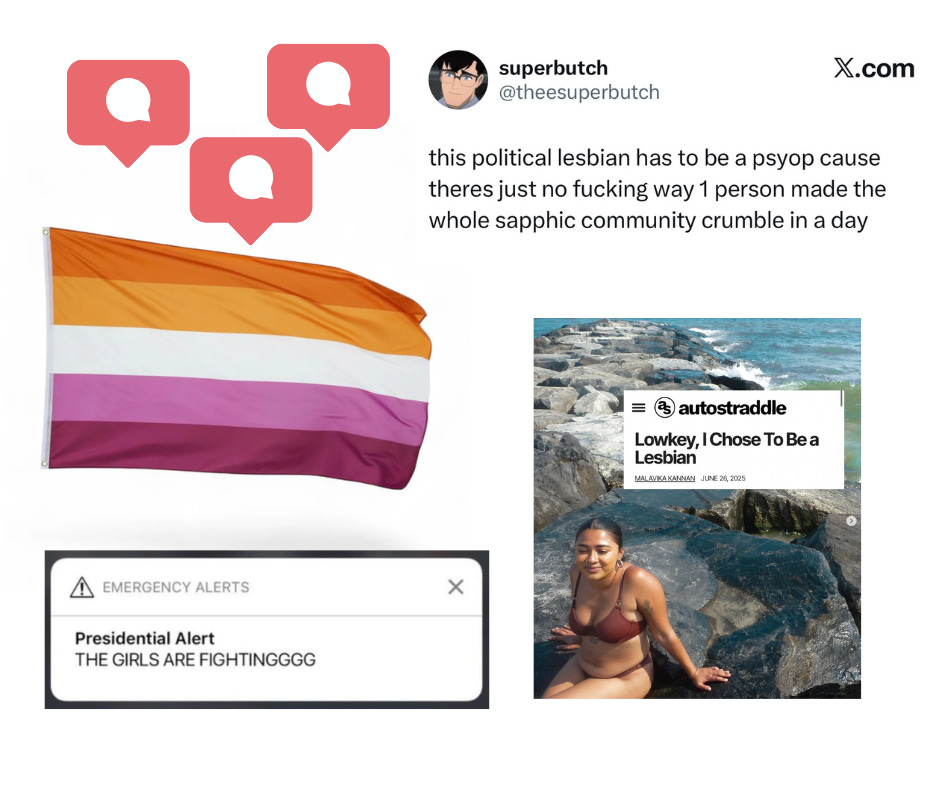
Soooo — my lesbian essay has gone viral again. When I wrote my essay for Autostraddle last June, it was with a heart full of love; I thought my personal journey of rejecting comphet and growing into my lesbian identity might be interesting, helpful, entertaining, or affirming to readers. And it was! I just didn’t expect it to also accidentally cause the worst online war our community has seen in a while. While my essay was met with hope the first time it went viral, the second time it popped a blister of pain. What I heard, loud and clear, from a portion of the sapphic community: people were terrified, offended, and hurt by what the essay could mean.
It is a scary thing to open our identities and desires to political analysis, especially when the queer community stays ruthlessly under attack. It is scary to veer into rhetoric that potentially cedes intellectual ground to homophobes. When each day feels like a new earthquake in America, I empathize with people feeling panic when the ground of lesbian identity beneath them — fiercely guarded by “Born This Way” and labels discourse — seems to shake. When the structural forces oppressing queer life are vast and unresponsive to our critiques, it can feel easier, even cathartic, to take out our pain on strangers online. As a five-foot Tamil woman with the temperament of a twink, it was never my intention to make anyone feel afraid or attacked, but that was the impact, and I pinky-promise I’ve taken time to sit with it.
This newsletter is my attempt to respond to good-faith critiques. I’m writing in rejection of the spectacle of collective internet punishment, including personal harassment, that I have faced; while dogpiling women is perhaps the only thing that unites every faction of the internet, nothing can prepare you for a deluge of strangers telling you there’s blood on your hands, telling you to kill yourself, or threatening to kill themselves (fucking terrifying). I’ve reserved my vulnerability during this period for those who know and love me in real life. I’m not writing this for those who hoped to stress me out, shut me up, or just get something off their chest. But if you are someone who wants the pain and fear my essay sparked acknowledged and addressed, I am writing this as a love letter to you.
I am not a celebrity, important (or rich) enough for a PR team; this was workshopped in conversations with trusted friends and mentors. But how we disagree with each other, one mentor reminded me last week, is a sign of how much we value community. I love and value lesbians, young women, and queer people, and I see this as an opportunity for reflective conversation. Pain demands acknowledgment if it’s to be healed — as a survivor, I know this intimately. I have compiled some of the most common, non-KYS comments into an essay here. I’ve limited my accessibility on socials (which might block some good-faith folks, sorry) and I will not engage with harassment, but if you seek dialogue and repair, this Substack is a place for you.
Okay, here we go!
THE PERSONAL
“You lowkey like men and are trying to deny it. Just call yourself bisexual!”
My essay is not a forum on whether I like men; rather, it’s about my choice to stop engaging with that question altogether. Doing so has opened up wide sunny windows in my mind, allowed new possibilities to grow and flourish. I opened my essay by describing my experiences with compulsory heterosexuality in order to open the door for others who experienced the same. Ultimately I chose to defect from the unwinnable war of making a dignified life in their presence.
The bisexual label does not feel right to me as someone who has always felt ambivalent and alienated around cis men. If I desired to date men, I would not call myself a lesbian. As a rule, when someone says they’re a lesbian, especially given how contentious that identity is, I respect and believe them. The same goes for respecting folks’ pronouns. Healthy queer discourse rests on the shared norm that we respect people for who they say they are.
“You are a political lesbian, and therefore you’re probably transphobic/biphobic/lesbophobic.”
For what it’s worth, I did not identify myself in that essay as a political lesbian, and I remain committed to a vision of queerness that centers and protects trans people above all. I similarly affirm everyone’s individual lesbian and bisexual experience. Political lesbianism is a historical project that tried to apply a political lens to desire, imperfectly so. Transphobia has always been a big blind spot and pain point in a variety of queer political projects, and political lesbianism is no exception. But I am never too angry at people who experiment, publicly and imperfectly, in trying to build livable alternatives to patriarchy. At least, I’m never angrier at them than I am at patriarchy itself!
Okay, now onto the juicy stuff.
THE POLITICAL
“You can’t call yourself a lesbian because lesbianism is a biologically determined condition from birth.”
Let’s get through this one first, because I think if this is a non-starter for you, you probably won’t enjoy the rest of this, and that’s okay.
If you’re still here — hi!
I do not subscribe to this biological argument, sometimes called “born this way,” because there is, to my knowledge, no ‘gene’ that makes you gay. What’s more, all sexualities, including heterosexuality, have looked very different at different points in history. If you were born a lesbian, I’m not denying your identity. I understand why the “born this way” argument is important to some people as a psychological protection against ruthless familial denial, religious homophobia, or state violence. But I think the cost of this rhetorical shield is too high, because it only makes us protectable if we’re totally helpless, “perfect victims,” to borrow Mohammed El-Kurd’s phrase.
I’m also wary of any argument that binds identity to biology because it strips us of agency, humanity, and nuance. The truth is, many baddies who identify as lesbian did not always feel they were born that way; some even identified as (TW) bisexual first. To deny their validity strikes me as cop behavior and — dare I say — boring! Rigid policing of identity, and resistance to the idea that sexualities can evolve, is exactly why comphet is so effective and devastating. I envision lesbian identity as a wide house with many entrances, but insisting on “born this way” is like locking (almost) all the doors.
I was initially shocked by how passionately some lesbians online defended biological determinism, to the point of wishing death for me, but I understand that it highlights some deeper points of pain in our community, which I’ll get into in the next comment.
“Lesbians who previously dealt with comphet, or dated men, do not belong in the same category as lesbians who identified as such from birth, because they’ll never understand our pain.”
All of us who are gender-marginalized suffer under patriarchy in some way. I have deep empathy for people who have always known, in their bones, that the life ahead of them differs dramatically from what society intended. I can imagine the loneliness, trauma, and pain this prompts. For what it’s worth, I, too, laid up in my bed as a fifteen-year-old girl down south when I felt my first twinges of desire, praying to God to make me ‘normal.’ I empathize with out-the-womb lesbians’ desire to protect their experience. But, as a lesbian from the latter category — one who is also a survivor — I know I’m not alone in my truth that comphet has felt corrosive, compromising, and confusing, and cost me something too. It took me years to learn the difference between arousal and fear, validation and genuine attraction. This doesn’t make me less of a lesbian — it just makes me different.
What if our differences allowed us to compare notes, to strategize, to learn from each other, and be better allies to those unlike us, instead of shutting each other down? Could we band around the shared joy of loving as we love? I’ve noticed, happily, that gay men are less dramatic about policing who counts as what, probably because they weren’t socialized to self-scrutinize like ‘women’ are. (One of my favorite parts of lesbianism, besides the obvious of dating baddies, is the possibility for joy, collaboration, and friendship with other sorts of queers — but that’s another essay.) Onwards!
“Your essay made lesbianism all about decentering men, instead of loving and desiring women/queers.”
Truthfully, I think the essay does both, but if you wanted more of the latter, that’s fair. I invite you to check out my wide breadth of writing about lesbianism: my Lesbian Dating Wrapped, my personal essay from Lesbian Oil Wrestling, and my reported profiles on queer elders and trans leaders, which celebrate lovey, gushy, IRL queer joy. I am a fiction writer committed to rendering lesbian tenderness and intimacy, grateful to be among many writers working today. My favorite writers about sapphic desire include Audre Lorde, Kristen Arnett, Sarah Thankam Mathews, Natalie Diaz, Carmen Maria Machado, and more. Send me your recommendations!
THE EXISTENTIAL
“You harm and endanger lesbians by claiming we can choose who we are, and so glibly too.”
I’ve received feedback to the effect of, What if my homophobic parents / men / Republicans / my opps read the essay and use it to justify attacks against me, delegitimize my sexuality, or claim I can be converted? My first instinct was to make a joke, that if the forces of evil are actually influenced by my Substack, I would do something better with that power. (If you can’t tell, humor is my annoying gay vice of choice — at least it’s not ketamine!) But when I sat longer with these accusations of harm, I understood that people were speaking from a place of pain. When people that blamed or equated my essay with violence, it was possibly because it awakened the same fear response in their bodies.
It’s true — the language of choice can be, and is, weaponized to justify conversion therapy. But what I’ve decided, as I’ve grown older, is that I ultimately do not allow fear of homophobes to dictate how I act. I cannot name a single marginalized group in history that has convinced its oppressors to treat them better because they perfectly minded their Ps and Qs. I refuse respectability politics because it serves nobody but our oppressors. People who love and support you will do so in all your messy contradictions; people who are hell-bent on oppressing and denying your self-expression will do so regardless. Conversion therapy is torture, and people who support it cannot be reasoned with, nor should they be cops in our heads telling us what we can say. Trust me, I’ll kick their ass when I see them in hell.
To that end — I understand that a lot of people who would otherwise be somewhat on board with my argument were turned off by the ‘rage bait’ headline, or my irreverent tone online, even though the essay was earnest. (I was twenty-five years old when I learned that hundreds of people hate the sound of my vocal fry!) I have heard this feedback loud and clear, and while social media incentivizes the hottest takes, I am committed, in this essay and others, to writing with nuance and intention.
When you blow up unexpectedly, you can get portrayed out of context, but I want to affirm my commitment to protecting lesbians, to loving us loudly, to writing us into novels and reporting and archiving our joy in magazines and creating in-person spaces for queer community and mutual aid. If you live in NYC and have some mutual aid dollars to spare on a sliding scale, consider this your invitation to let me cook you dinner.
“You should not make lesbian desire political.”
All queer identities have been politicized, and by the very people we should be uniting against. I cannot accept that queerness is not political in the same month that Kansas literally stripped trans people of their IDs.
But more broadly, we live in a politically created matrix of desire. If you think desire is not political, consider a dark-skinned woman who is routinely treated as the last option in the dating pool. Consider any fat, trans, disabled, non-white, or otherwise non-normative person who is excluded from our society’s images of desirability. I would never accept “born this way” apolitical discourse if it were used to justify people with supremacist sexual preferences; that means I have to be comfortable taking political responsibility for my own desire as well.
If that’s a bridge too far for you, that’s okay, but consider that queerness has long been the political house of refuge for people cast-off by society, asking us to push the boundaries of what is imaginable. Feminism, the philosopher Amia Srinivasan has argued, is where you historically turned to find a political critique of desire, sex, everything we take for granted. (I suggest her book The Right to Sex for more!) Marginalized people have launched psychological and political warfare against the narratives that they are undesirable, including internalized self-hatred, from the historic Black is Beautiful campaigns to today’s body positivity.
The question of politicizing desire has historically been the open, flaming wound at the heart of feminism. Political lesbianism, celibacy, and separatism have been extremely divisive, especially when inflamed by trans-exclusive factions. So too, at various points, have been pornography and sex work, because they raise questions about agency, complicity, pragmatism, and desire that are sometimes too painful to confront. I hate that the question of desire consistently turns feminists against each other, makes us sometimes treat each other worse than men. I did ask myself whether it was worth poking this controversy, instead of solely rallying the girls around material causes, such as reproductive access or gender-affirming care. (FWIW, I work professionally on those too.)
To explain why I risked it, let me close on a note of perspective. On the right, young women similar to me — influencers, creators, writers — are also trying to inspire a political project of desire, even if they don’t call it that. But they’re trying to push young women in the opposite direction — towards sexual conservatism, traditionalism, heterosexual marriages that result in the births of as many white babies as possible. Conservative women have been working overtime to subtly influence their followers in the direction of trad-wives, romanticizing boyfriends, financial dependence on men, getting off birth control, and other deeply political stuff. I believe that it is equally important for those of us who believe in feminism and queer liberation to serve up our own counter-offer of life. The role of an artist, Toni Cade Bambara said, is to make revolution irresistible! I viewed my essay about my journey to lesbianism as a contribution to this project, alongside many other experimenters and dreamers, some of whom I agree with, some of whom I’m happier to watch from afar. Being a woman, let alone a queer woman of color, doesn’t come with a guidebook, so I’m always appreciated when other people share their stories vulnerably, because it gives me options for my own life. As a writer, I hope to pay this forward.
It is the forces of evil I hope to make myself enemy to — not deep-feeling, loving, complex queers whom I ultimately know are my comrades, even if we loudly, publicly disagree. To this end, I will continue to write, to love, to strive. I hope you will consider joining me for the ride!
in community,
Mal
Note: If you made it this far, thank you! This is the last I’ll write on the subject for now. For more, I invite you to read my forthcoming book, UNPRECEDENTED TIMES. It uses my preferred medium, fiction, to untangle the nuances of queer Gen Z identity. If you don’t want to buy it, get it from your local library. They, too, are under attack!
No posts
Comments
Nothing yet. Say the first thing.
Sign in to join the conversation.