
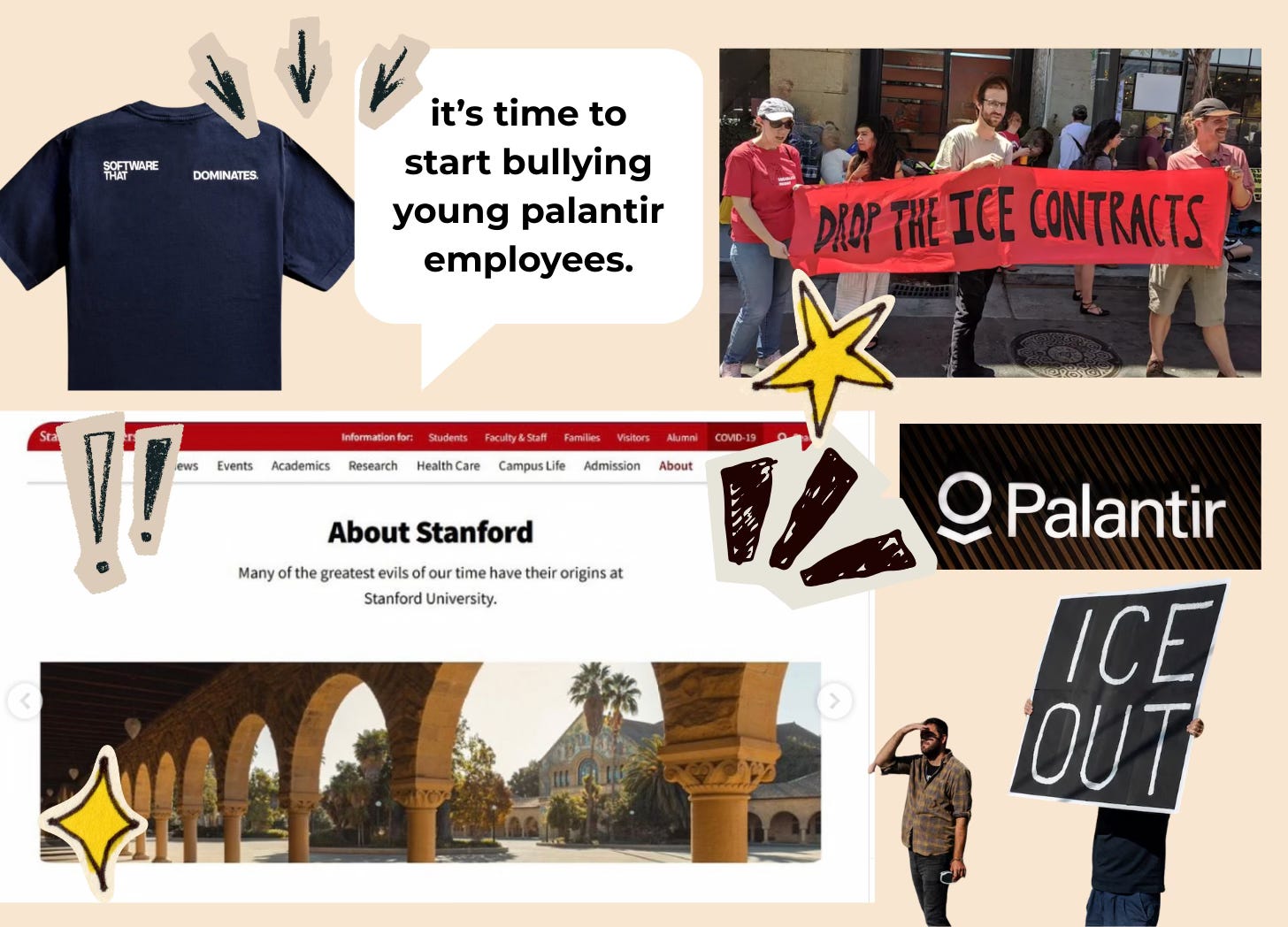
I first looked evil in the eye at the Stanford University student career fair. By this I mean, I encountered firms like Palantir and McKinsey in the fall of my freshman year. Career fairs are vexed, deeply political projects, I’d quickly learn — while the army used to recruit students from my majority-minority public school down South, it’s the CIA who historically recruited at Stanford, a school with a dark history of entanglement with American military operations. But these days government agencies like the CIA, despite their cool matching outfits and sunglasses, cannot compete with the allure of private corporations. That’s the evil beauty of industries like defense tech: if you can get rich off of military contracts, you don’t have to choose between patriotism and profit.
It’s not ground-breaking for me to tell you that most Stanford students care a lot about profit. In 2021, 54 percent of graduates went into careers in the lucrative industries of technology, consulting, and finance. It’s an embarrassing statistic, the result of a decades-long, well-documented project of “career funneling,” wherein evil companies lavish resources on recruiting students from elite colleges, before these nerds have even had a chance to become cool. Stanford was one of the first universities to establish corporate partnership programs — small surprise at a school where buildings are named after entrepreneurs like Hewlett-Packard and Gates. At one point, the most coveted positions for a Stanford graduate were at the companies lovingly referred to as FAANG — the now-archaic pantheon of Facebook, Apple, Amazon, Netflix, and Google. (The newest loser-magnets, I’d say, include Anthropic and OpenAI.) It’s corporations like these that have my Stanford classmates in a chokehold, casting their spell over a campus so blue and bright that people joke Bill Gates controls a weather machine.
But it’s a relatively new phenomenon, I’d argue, that the Stanford student’s pursuit of profit has dovetailed so freakishly with the nefarious aims of the American government — or that these students can warp our internet generation’s language of morality to justify their choice. By far the most notorious tech company recruiting from Stanford right now is Palantir. It’s our very own chicken come home to roost. Founded by deranged libertarian and Stanford alumni Peter Thiel, Palantir has contracted with ICE on surveillance and targeting systems since 2011; its stock exploded after the second inauguration of Thiel’s friend Trump. Palantir has been rightfully subjected to public scrutiny in 2026, as a wave of horrifying ICE escalations have resulted in a record spike in inhumane detainments, a major American city under occupation, and multiple people murdered. Palantir technology has also been used by the Israeli military to target and murder Palestinian journalists. Where imperial evil gathers, Palantir is likely to be found — and the public is catching on. In 2025, The Cut broke the news that the popular Gen Z event app, Partiful, was founded by former Palantir employees, an association so toxic that many quit, or at least stopped trusting, a platform that is suspiciously keen on social surveillance.

Salman Toor, The Joke (2025.) Toor is a queer Pakistani painter I adore!
This isn’t the first time Palantir has gotten smoke for its misdeeds. During my freshman fall, 2019, student organizers across the country launched #NoTechForICE, a concerted movement to oust Palantir from college campuses. That year, Stanford students demanded that the school stop accepting Palantir’s money — the company paid $24,000 a year for access to its talented tech students, including me, who cries if a printer won’t connect — and that Palantir end its ICE contract. There were, to be fair, some small successes: Duke and Yale’s hackathons dropped Palantir as a corporate sponsor, and Palantir had to cancel its recruitment session at Berkeley, the superior Bay Area school. And yet, by the second Trump presidency, the vibes had shifted. In 2025, the SF Standard reported that defense tech was the trendiest up-and-coming field for Stanford grads. Palantir, in particular, is having a resurgence, launching an ominous campus billboard campaign warning that “A moment of reckoning has arrived for the West … We build to dominate. Join us.” Many are heeding the call.
(A note before we proceed — while this essay does not name names, it does critique ex-classmates whose actions are high-impact and/or egregious. I have focused on those who have presented their affiliations openly on their platforms as public figures, citing from their own websites and public statements. I think this is more than fair game, given the stakes.)
Some of Palantir’s recruits, or apologists, include women my age who believe themselves to be progressive, or are at least invested in being seen as such. “My most effective and moral friends are now working for Palantir,” an Indian American student and founder of Stanford Women in National Security told the Standard. “In great power politics, people die. Often more impulsive, less pragmatic men make those decisions, and as a well-educated woman, I’d rather be in the room.” (#Feminism!) This student was rightfully flamed, though she later doubled down in a Stanford Daily op-ed.

She’s not the only young woman I might otherwise relate to whose moral compass has warped beyond legibility in the past half-decade. There’s one Stanford acquaintance I first met in 2018, when we were both teenage girls picked up by a well-meaning funnel of capital-backed fellowships for Gen Z “change-makers,” many of us mobilized into action by the first Trump presidency. (This pre-professional ecosystem has since been critiqued as a Gen Z Youth Activist Industrial complex, but that’s another essay.) At the time, this classmate, a young white woman, had founded a nonprofit dedicated to combatting “cultural intolerance and the exclusion of immigrants and refugees,” citing a spike in post-2016 election hate crimes as her awakening. For this, she was rewarded liberally, from a spot on Forbes 30 Under 30 to partnerships with major clothing brands.
During college, I started to grow disillusioned with that genre of social change — and I wasn’t the only one. Many had become quietly aware of growing rifts in our progressive cohort’s values, which culminated in a 2020 summer of dramatic generational in-fighting online. If you’re lucky not to remember, here’s the summary: the Gen Z activist label forged in the first Trump presidency, applied to or claimed by everyone from shooting survivors to Greta Thunberg-style climate strikers to suburban social entrepreneurs to ambitious influencer-politicians to disgraced nonprofit girlbosses to self-proclaimed Gen Z marketing experts, fell apart as we untangled and staked the differences between diversity and anti-racism, neoliberalism and leftism, self-serving opportunism and solidarity. As I witnessed the vibe shift, there were relationships I chose to let fade, peers I chose to unfollow online — which is why I got totally jumpscared by my immigrant-loving classmate’s post-grad pivot. As of 2026, she works as a Deployment Strategist at Palantir, a company responsible not merely for “intolerance” and “exclusion” against immigrants, but straight-up stalking, targeting, deporting, and sometimes murdering them. I shouldn’t have been surprised, given the vibe shift, but I was. Sometimes you can’t make this shit up.
How did Palantir have such a dramatic character development arc, to the point that progressive young people can declare, with their full chests, their allegiance to its deportation mission? You can declare it on your full chest, too — Substack’s Brendan Holder just reported on Palantir’s latest sold-out merch drop, which includes T-shirts with slogans like “SOFTWARE THAT DOMINATES.” Holder interprets the merch as a PR effort by Palantir to normalize itself as a lifestyle brand, an everyday part of Americanness itself. “By initiating communication with a set of people who share its vision through merchandise, Palantir can limit future reputational damage and build a base of passionate stans rather than a secretive cult,” Holder writes.
Are we going to let them get away with it?
One could argue that the kind of young graduate who goes into defense tech is too morally compromised to save. But while only the truly amoral (or delusional) might openly attach their names to Palantir in 2026, I believe that many of my former Stanford classmates, especially those employed at more benign companies, don’t actually consider themselves evil. (It helps that the margins of evil have been shifted considerably by evil themselves — Palantir’s PR flip is proof of it.) I’ve been reflecting on my recent college education, which was supposed to instill my moral values and prepare me for the real world. Those four short years before the kid gloves came off, and our choices became adult ones, with adult consequences.
It’s fair to say that most colleges do not prepare their students well for post-grad life under capitalism. At Stanford, there was a career center, where I learned how to write cover letters. There were hook-ups for fellowships and internships, including ethical ones. There were my wonderful professors, who patiently and generously pumped out recommendations for me. There were Stanford’s excellent literature and history classes, which helped address my existential questions of being: what do I owe society, and is it necessarily different than what I owe myself? But nobody answered my follow-up question: how does this translate into a job? The anti-war protests ripping across campus my senior spring, 2024, made me think often of the “right side of history.” It’s a phrase bandied about in our unprecedented times: What would you do during XYZ atrocity? How should a person be? What to do with your one wild and precious life?
I had to confront the fact that many of my classmates would choose to become, like, consultants.
✧˖°
This is a well-documented vibe shift taking place in the priorities of elite young Americans, tracing back half a century. Writing about the hated yuppies — the generation of young urban professionals who overtook US cities in the ’80s — historian Tom McGrath notes: “Fifteen years earlier, graduates of the country’s most elite colleges had often been concerned with trying to improve the state of the world. Now, the focus was different: How can I be as financially successful as possible?” McGrath could easily be talking about elite graduates today. Why is it that previous generations were more likely to cite civic heroes and politicians as inspirations, while today’s young people are more likely to name-drop entrepreneurs and CEOs? Many cite the a philosophy known as neoliberalism, the bitch-ass belief that the government and public sector should be as small as possible, and profit-driven companies should rule our lives instead. Under neoliberalism, it falls to corporations to offer and assure a quality of life for Americans, shrinking our expectations for what we can collectively achieve.
We’re not old enough to remember, but history teaches us that neoliberalism didn’t always have such a gorilla grip on youth. In the 20th century, America was far from perfect, but our civic structures worked better, and there were powerful leftist alternatives to capitalism capturing young people’s hearts and minds. In the 1980s, conservative governments launched a full-on attack on the public sector, cutting social safety nets. The Stanford professor Francis Fukuyama wrote a stupid, famous book called The End of History where he claimed that capitalism was the ultimate and logical resolution of human history — the Final Boss. Or as conservative British Prime Minister Margaret Thatcher said in the ‘80s, the decade that capitalist countries beat communists in the Cold War: “There is no alternative.”
Fast-forward to the twenty-first century, where we are “deep in the capitalist matrix,” as historian Naomi Klein puts it in her 2017 book No Is Not Enough. Multiple generations of Americans have had our brains so rotted by neoliberalism that it feels harder to resist it. Think about the 2008 financial crisis, which you might remember from an era of skinny family holiday seasons or your childhood home getting foreclosed. People should’ve revolted — and some did, famously occupying Wall Street — but overall, Klein writes, “utopian imagination had largely atrophied” from the wild and optimistic revolutions of the sixties. “Many people knew the appropriate response to the [2008] crisis was moral outrage,” she writes, “yet generations who had grown up after neoliberalism struggled to picture something, anything, other than what they had always known.”
Rather than bullying the rich people causing inequality, Klein explains that elite liberals have spent decades “looking to the billionaire class to solve the problems we used to address with collective action and a strong public sector.” This is called “philanthrocapitalism” — hoping rich people will help us out of the goodness of their hearts, instead of attacking them with pitchforks. Think of the endless charitable foundations started by squillionaires, including the Bill and Melinda Gates Foundation. (I was in the same graduating class, 2024, as the famous youngest Gates child, who has since gone on to found a VC-backed AI-powered shopping assistant app with her Stanford roommate. Her co-founder is a world-famous climate activist who once publicly partook in a Black Friday strike with Jane Fonda against consumerism in 2019. Again, you cannot make this up!)
Anyway — Melinda Gates gave our commencement speech, small consolation to a class who’d had two consecutive graduations shadowed by cataclysmic world events. (Admittedly I didn’t catch Melinda’s speech because I participated in a mass anti-war walkout to disrupt it — but I doubt I missed much.) That Melinda Gates was chosen to inspire us graduates is proof of how successful our elites are at branding themselves as role models. Not only do corporations get to avoid the consequences of their actions, but they actually look good doing it! And you could look good working for them, too.
It’s a tactic known as “reputation laundering,” a con that writer Anand Giridharadas spelled out in his 2018 book Winners Take All: The Elite Charade of Saving the World. A former McKinsey consultant, Giridhiradas is no stranger to the psychological tactics corporations use to mold idealistic young minds. His opening chapter profiles a 2014 soon-to-be Georgetown graduate who finds herself enchanted by McKinsey, which promises her the opportunity to “change the world.” “She had absorbed the ascendant message, all but unavoidable for the elite American college student, that … best way to bring about meaningful reform was to apprentice in the bowels of the status quo,” Giridharadas reports. “The age-old youthful impulse to reimagine the world was now often molded and guided by one of the reigning ideas of the age that if you really wanted to change the world, you must rely on the techniques, resources, and personnel of capitalism.” When she realizes that the world-changing work amounts to little more than spreadsheet-shuffling and drudgery, she despairs and thinks of becoming a rabbi.
What astounded me, reading Giridharadas’ book a full generation later, is that some corporations seem to have softened, or totally abandoned, their promise to be forces of social justice. It’s more common to promise to be a force of American might, which is the exact opposite of that previous thing. When I looked at the Palantir recruitment site to research this essay, the first several passages focus on the working perks — small team sizes, fellowship opportunities, covered relocation costs — and it takes several scrolls to get to ‘Impact’: “Our technology helps organizations distribute lifesaving food aid and resettle refugees. Palantir platforms are used by governments in the fight to protect democracy, and to help critical military operations succeed.” (So the quiet part is said aloud. But why wouldn’t they say it — who are they trying to fool? We already tried and failed to kick them off campus once.) What’s really ended, I think, is the rosy optimism of a bygone age — maybe the Obama era, Trump 1.0, or a different world entirely — where it was cool to try for collectivesocial change. In the era of Trump 2.0, with our psyches marked so clearly by ‘winners’ and ‘losers,’ what corporations offer my classmates is no more noble than the opportunity to be on the winning team.
Fear of being a loser is a potent thing. Nobody knows this like the companies themselves. You can see it in their recruitment tactics, which prey on young peoples’ fear of post-grad risk and uncertainty — incidentally, the very conditions in which bad bitches are made. Consulting firms often recruit students well over a year in advance of graduation, locking them in with enormous starting salaries and sign-on bonuses, sparing them from — or denying them — the experience of exploring options, weighing choices, and generally fucking around and finding out. They promise a seamless transition into post-grad adulthood, even offering built-in social networks via incoming “classes” of consultants that resemble college cohorts. Uncharitably, it’s a great deal for any young person who lacks a vision for life but is too afraid to seek it themselves. Generously, it’s refuge from an incredibly turbulent economy. That feeling, precarity, is the defining feature of capitalism, where millions live in fear of losing their employment, health insurance, and homes. But it’s also just a feature of being a mortal on earth. Is the fear of precarity a good enough reason for my classmates to sell their souls? Or can they be bullied out of it?
A tweet I laughed at: “Your ancestors’ wildest dreams was not to work at lockheed martin stop lying on them folks.” I can’t presume to know my ancestors’ dreams: I can only speak for mine. My dream, since I was a child, was to become a writer, and I’m happy and grateful to be one now. I know that, in doing so, I am not fulfilling my Shiny Stanford Earning Potential. And yet, in conversations with corporate peers, I’ve found that my career prompts responses of comparison and defensiveness. Like voting habits — and perhaps even more so — career choices reveal our existential values. To be clear, there are degrees of precarity that shape what career paths feel possible to us.
But precarity is often exaggerated by young elites, who misappropriate wokeness to pre-empt criticism. There’s this frequent rhetorical move where people claim that career choices are above rebuke because people’s financial situations are complicated and personal. And it’s true that some young graduates shoulder heavy financial burdens, such as student debt, medical expenses, or supporting family members — the exact reason many advocate for a stronger social safety net. People of color have been barred for generations from accessing the riches of the American imperial pie. (Whether that is something to aspire to, of course, is between you and God.) But it’s worth noting that few low-income students statistically go into fields like consulting. And more often, when my peers speak of accepting certain jobs, and act though the alternative were honest-to-God homelessness, what they actually mean is that they cannot imagine slumming their twenties on less than six figures a year! I have had to physically resist bullying people who have said as much to my face. The reality is that certain jobs don’t merely offer an honest living, just enough to get by without fear — they offers lots of money, enough to ensure elite status.
Palantir employees might be undeniable winners in the game of capitalism and American imperialism, at least for now. (If and when future arbiters ever hold them accountable for their crimes, I blame nobody who wants to bring the popcorn.) In the meantime, what if we reminded them, and ourselves, that by all other metrics — morally, culturally, spiritually — they live like losers?
✧˖°
“The margins of refusal,” Jenny Odell once put it, are closing before our very eyes. Fascism is creeping, its agents are moving out into the open, killing dissenters on camera, and their corporate supporters are not embarrassed of themselves. For now, some of them still do pretend to care what we think. They still hope to make a moral appeal to our hearts. Soon, they will not: American conservatives, for example, quite openly outlined their dystopian plans in Project 2025, even as Trump denied it on the 2024 campaign trail, just as Israeli government officials make no secret of their genocidal intent, even as their accomplices in American media scramble to cover for them. Normalcy is eroded by the day.
When I say we should bully Palantir employees, I mean that it’s worth holding the line against them. (The exact line may be different to different people — could we stand against Amazon? Or Meta? I would happily discuss this for hours! But I do think not harming children is an obvious place to draw our line, for now.) I mean we should vocally and spiritedly resist every narrative attempt they make to legitimize themselves as reasonable, decent people. To refuse to ignore the link between their post-grad paychecks and the little boy turned into human bait by ICE. Not because I care to punish them (I’m not God) or because I think I can change their minds (I can’t), but because I think it’s important to psychologically offer those who remain, including myself, alternatives to normalizing what we know in our bones is unconscionable. Bullying the forces of evil is an act of moral clarity. I will not let them laugh all the way to the bank. If needed, I vow to never close my mouth.

This Substack contains excerpts from my essay collection-in-progress, RAGE BAIT, which is about, among other things, Gen Z, power, language, and complicity, forthcoming from Atria at Some Point Soon (I literally just started writing it!) If anything in this post resonates, I’d be grateful for comments, comradeship, further reading recommendations, conversations.
No posts
Comments
Nothing yet. Say the first thing.
Sign in to join the conversation.