
Hardly had the pandemic begun, and already I saw people wondering, or worrying, about the novels that would emerge from this era: the stories that would serve as cultural artifacts, how we’d make meaning of it all. Shakespeare wrote King Lear during the pandemic, the internet often chirped. But for most of us, the pandemic wasn’t a writing retreat, or even a collective struggle, thus automatically imbued with artistic pathos: in truth, it was isolating, enraging, pathetic. Some of us tore into each other on social media. Some of us despaired. Some people lost loved ones, or became disabled by long Covid —- other people were just fine. Probably the worst people you knew. It didn’t lead to sweeping reform in America or the mending of our social fabric. There was no closure. Suffering was meaningless. We endured it once, and it sucked — so why, by reading about it, would we live through it again?
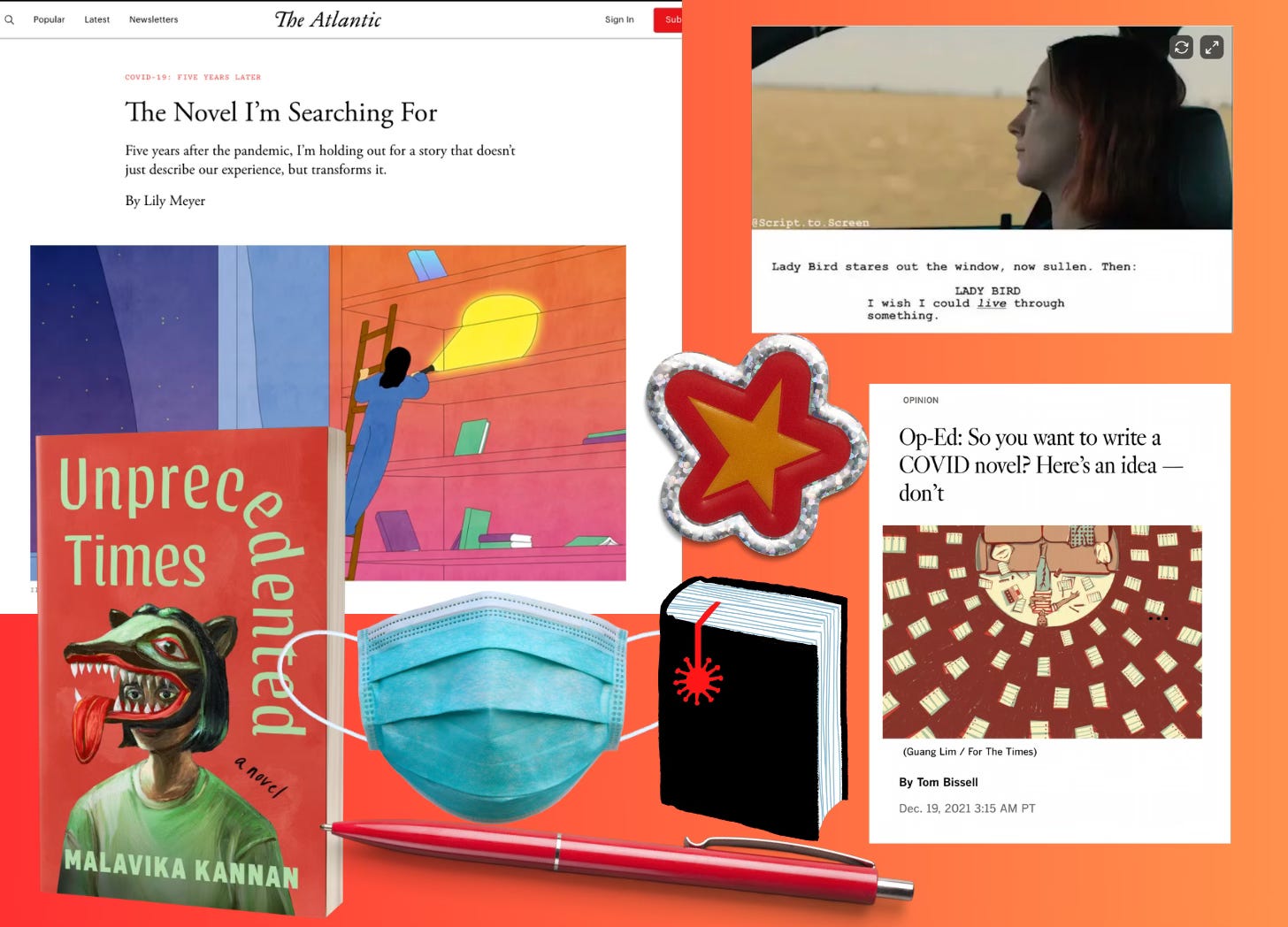
I had ample warning, when writing my debut novel Unprecedented Times, that publishing a pandemic novel would be a tough sell. “So you want to write a COVID novel? Here’s an idea — don’t,” proclaimed the LA Times, citing editors who were already tired of the second-hand suffering. “Publishing a novel about COVID would, at this point, emotionally feel like giving yourself COVID,” one editor claimed. “Which is callous to say, except that I’ve had COVID.” Even when the manuscript was complete, I was encouraged to change the title of Unprecedented Times to not discourage readers. And it certainly seems, based on the general consensus of my Goodreads page that I try not to look at, that many readers are turned off by the pandemic. But I published this novel anyway, and I think you’re ready for it, and it might be exactly what you’ve needed all along.
“What was lockdown like for you?” I started asking friends who I met in postgrad adulthood. The responses are always revelatory. I was an eighteen-year-old freshman when the pandemic began, and twenty when I returned to college afterwards, with no language to account for the void between. In retrospect, I wish my university had hosted some kind of gathering or grief ritual —- corny as college icebreakers can be —- to help us process our grief. University, after all, is a strange stage of in-between-adultness, where adults are responsible for getting young people up to speed on the business of healthy living. My university offered mandatory first- and second-year curriculums, diversity programming, and bonding activities, all meant to foster social cohesion, morale, and belonging (and, in the case of consent education courses, minimize harm) between students from wildly different backgrounds. But they decided, for whatever reason, to skip through the pandemic. The unspeakability of Covid, it turned out, began almost as soon as the pandemic ‘ended’ —- by which I mean, the powers and levers of money and authority in America decided we needed to move on. (As many disability activists remind us, the pandemic never really ended.)
This experience shook me to my core. At an age when I needed reassurance, my sense of perspective returned, there was none: I would have to find it myself. Gen Z had been told to put our lives on hold to protect older generations, simultaneously blamed for being too sanctimonious about masks and for spring-breaking in Florida, asked to sit tight and wait as the world crumbled around us. Young people in the workforce got laid off, or else couldn’t find jobs in a rapidly shrinking economy. Those of us who were in school saw quickly how our universities protected their finances over their students. Some schools even increased tuition. Others invited students back into on-campus residences, but instituted impossible Covid-19 rules, like “snitching” mandates against rule-breakers, to put the safety burden on touch-starved students, and possibly also conceal the fact they’d risked outbreaks in order to collect tuition checks. Unsurprisingly, the mental health toll was horrific. I spent quarantine seeing Instagram tributes to college students who’d died by suicide. Time nicknamed us Generation Pandemic, painting a gloomy portrait of college graduates frozen in childhood homes, predicting a future filled with “permanent disillusionment and widespread despair.”
We’ve seen the downstream effects of this — loneliness, ennui — but we’re strangely reluctant to discuss its source. I wrote Unprecedented Times as a portrait of a young woman raised in the twin hellfires of the pandemic and internet. It historicizes, among other things, the long afterlives of #MeToo and the failed potential of the climate movement. The lazy-river, slow-motion erosion of our psyches at the hands of the tech platforms that ruled our social lives during quarantine. The alienation of realizing that your neighbors, on separate algorithms, might not care if you lived or died. For years since Covid, seemingly alone, I was mourning a life that I had never really known. More specifically, I was mourning a vision of America that probably never existed: one that protects life and liberty, or live, laugh, love, or whatever Thomas Jefferson said. I wanted to write a novel to account for that disillusionment. Covid-19, to me, was the defining experience of my generation. It was Gen Z’s personal 9/11, as the meme goes, except death tolls surpassed that of the terrorist attack on a single pandemic day in winter 2020 — one that was later ranked among the deadliest days in U.S. history. What kind of psychological consciousness is forged in these conditions? I wanted to write a novel of ideas, one that renders, honestly, the seeds of politicization that rooted in me and my friends’ hearts, at an age when we could’ve become anybody at all.
It’s a shameful but understandable literary consensus, that most Covid-19 novels so far aren’t great. The first wave of literature skews towards autofictional diaries from established writers: basically, people who had the know-how to get their novels published first, and fast. These novels tend to stick to a particular milieu and political ethos, which can be less than inspiring. “We Still Haven’t Processed the Pandemic,” argued Current Affairs this year, pointing out, as New Yorker critic Katy Waldman put it, that COVID novels have tended to depict the experiences of the “idle rich,” people retreating to their second homes to ruminate on society’s ills. Two major pandemic novels, Elizabeth Strout’s Lucy by the Sea and Sigrid Nunez’s The Vulnerables, feature cautiously conservative, aging female writer protagonists who find themselves puzzled and threatened by the surging social mores of the younger generations. COVID novels written from the top tend to shy away from uncomfortable topics, a tentativeness I view as a hangover of 2020 wokeness — as if the authors are anticipating Twitter backlash. As if they cannot stand on what they say.
The good thing is, when writing my novel, I felt like I had nothing to lose. Unprecedented Times is a portrait of extremely spoiled and privileged young people —- a group of Stanford freshmen, to be fair —- but also earnest ones, who are seeking to contribute positively to a world that might end before they’ve had the chance to enter it. The title came to me first, an ironic pandemic catchphrase, except to me it rang true on a deeper level. At the age of my protagonists, nothing ever felt precedented to me about growing up in America. I set out to write a time capsule of my friends in college, the first-gen ones, the queer ones, the mouthy ones, all of us fucking around and finding out. Then I read this interview with James Baldwin: “You think that your pain and your heartbreak are unprecedented in the history of the world, but then you read.” In fact, he said, “the things that tormented [him] most were the very things that connected [him] with all the people who were alive.” (Oh shit!)
I love this Baldwin quote because it reminds me that nothing about our experiences are isolated, and that joy lies in finding connections. There are definitely unique things about this book: it’s among the first literary releases by a Gen Z writer, and, as I’ve said, I think it is a good pandemic novel. Readers my age have told me UT is the first place they’ve seen themselves rendered in literary prose, a collective consciousness previously only captured by disquieting doomscrolls on TikTok. But also it’s an attempt, following generations of writers before me, to make render abstract concepts like love, kinship, identity, complicity, and agency in specific social conditions, using the beloved tools of fiction: character, plot, circumstance. It’s a gay romp as much as it is an earnest work of theorizing on what it means to co-exist in the internet age, to overcome historical baggage, to stand tall when shit hits the fan. I’ve written a period piece of an American decade we’ve insisted on calling “unprecedented times” —- now I am ready, as Baldwin put it, to connect with the others who are (still) alive.
Unprecedented Times is out next week, and you can order here!
I really hope you will consider reading it! ✰
No posts
Comments
Nothing yet. Say the first thing.
Sign in to join the conversation.