
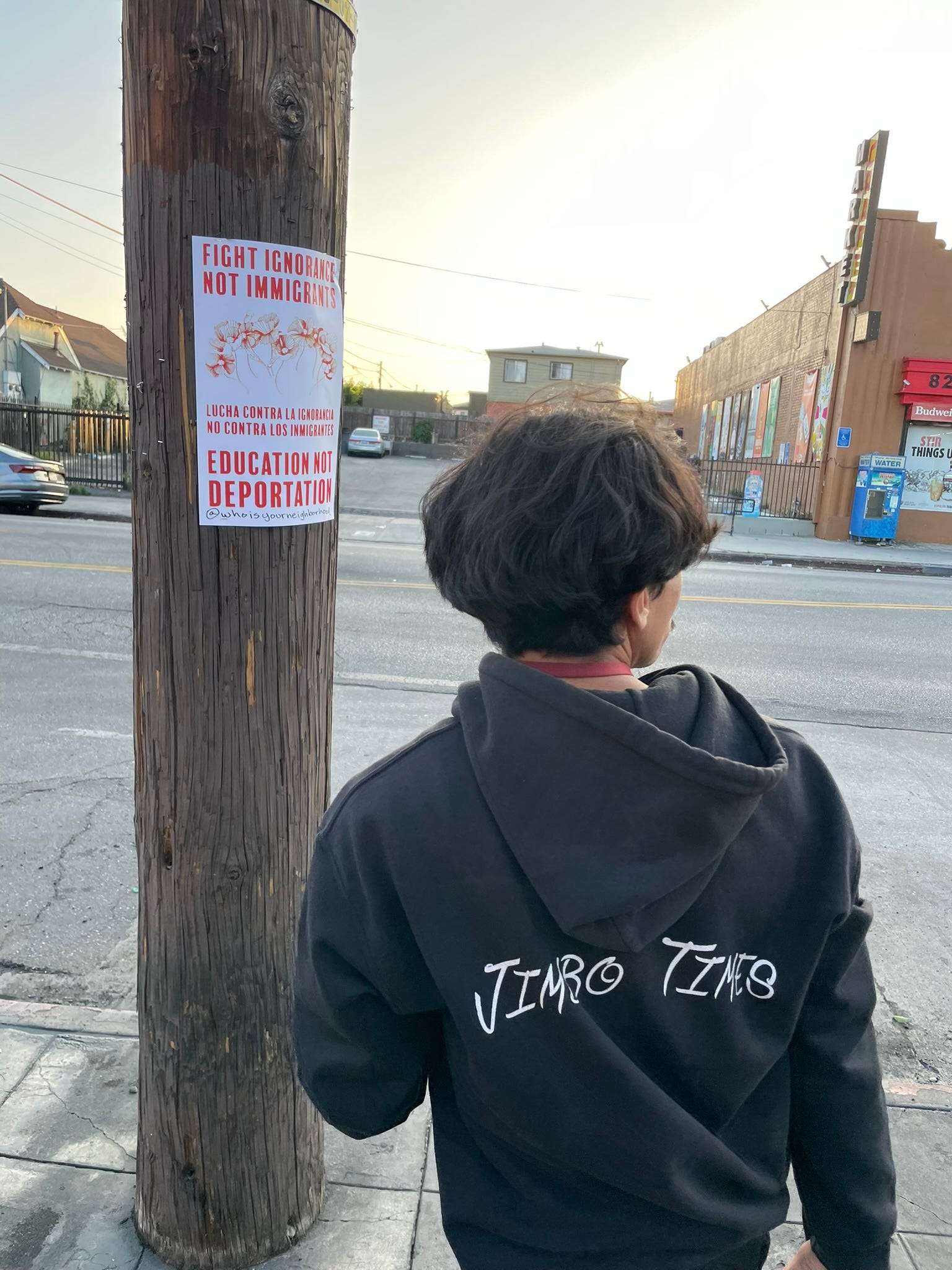
In this NY Times article, which discusses the “tipping point” for public sentiment against ICE, Kurt Streeter argues that what finally broke the wider public’s trust in the agency was the unprovoked murder of two bystanders in Minneapolis, particularly Alex Pretti’s, which went viral on screens all over the U.S. Streeter concedes that both Renee Good’s and Pretti’s deaths were obviously connected, not least of all since they took place in the same city within less than a month of each other. He also acknowledges that in September ICE agents marauding in Chicago also murdered Silverio Villegas González as he attempted to get away from them. González–like Pretti–held no criminal record, but unlike Pretti, González’s completely unjustified death leaves two boys, aged 3 and 7, without their papa for the rest of their lives.
Streeter’s article doesn’t note these facts about González. It also doesn’t mention the tens of thousands of lives–north of 33,000 over the last year–abducted and incarcerated by ICE and Border Patrol from communities across the U.S. to fill the administration’s 100,000 bodies per year quota; the article also fails to cite any polls or surveys of just how many people have shifted in their view of these agencies’ cruel and unusual assault on defenseless civilians. And perhaps it’s given this lack of any hard data that Streeter is also mum about just how “Democrats” can use the shift in public sentiment for this year’s midterm elections.
It’s this last omission that stands out the most, because–at least to yours truly in Los Angeles–the “tipping point” is rather meaningless if it doesn’t lead to a call for action. After all, in just a few months, voters in cities and jurisdictions across the U.S. will find themselves back in the middle of campaign ads, leaflets and a myriad of solicitations for public offices and measures on their ballots, the lot of them arguing that—once again—it’s time for a change.Still, despite the article’s limited scope, through my volunteer work with Quien Es Tu Vecindario, since Pretti’s death I have heard once again from a number of friends about their readiness for new efforts to defend our neighborhoods from the federal government’s criminal intrusions into them. Yet at the same time, I would be remiss if I didn’t acknowledge that despite the U.S.’s acceleration into fascism over the last year, most of the people I knew who were disengaged with politics prior to Trump’s reelection remain as “checked out” as ever. Like many of my peers in the organizing space, then, I can’t help but wonder just what, if anything, will ever jolt enough of them–be they emerging professionals in tech, government or finance, or be they construction workers, line cooks, or other essential workers—to join with those across L.A. fighting daily to halt “business as usual” for the class of January 6th before they abduct or rob another life from our communities altogether.
Of course, it’s also fair to wonder just what would actually unfold if exactly all of us decided to go on strike—not for a day, but for a month and even longer—as the working class who actually feeds and lifts the economy of our imperial capitalist overlords. In a theoretical scenario to settle it once and for all, would we even stand a chance against Peter Thiel and his secret fleet of robocops? I’m not quite sure, but what I can offer for now are just a few notes to keep in mind on whether one can ever actually “do enough” to make the world a better place despite the Thiels and Musks and Zuckerbergs sucking more air out of it than ever.
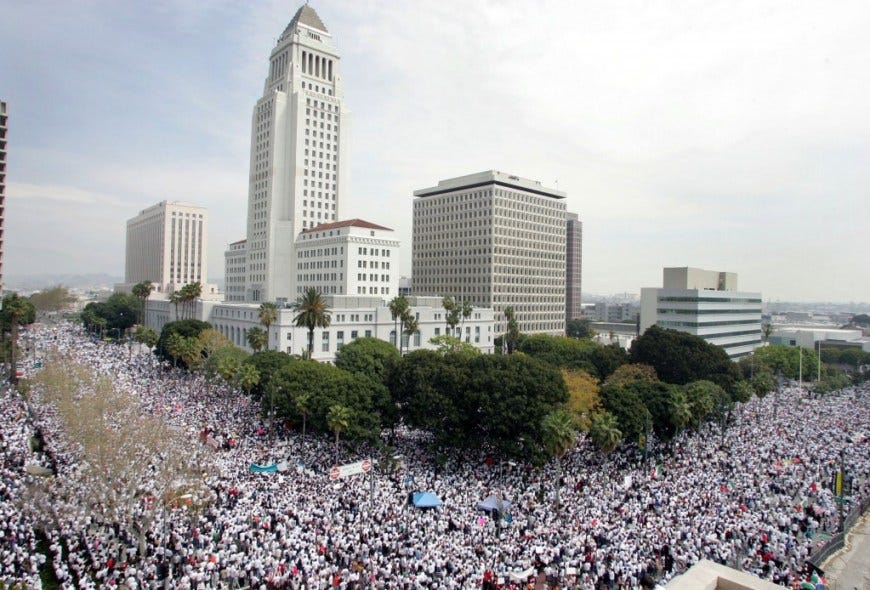
In 2006, when I was 15 years old, I walked out of my high school and rallied my peers to join me on the streets for a “Day Without An Immigrant.” To this day, the walkouts and demonstrations of that year remain the largest L.A. has ever seen. In the short term, it was cathartic and radicalizing, a jolt of energy that could never be bought but only discovered by taking a chance and diving into a sea of resistance. In the end, however, it wasn’t nearly enough to make sure that bills like House Resolution 4437, which catalyzed the action, never saw the light of day again.
In 2011, following the momentum of the “Arab Spring,” the “Occupy Wall Street” movement stormed through public parks and university campuses all over the U.S. It was the largest movement in the country since the anti-war organizing of 2003, with masses of people calling for an end to corporate hegemony at the expense of working families and the rest of us. Yet while there were some key alliances made during that time, and even a number of innovations for activists to hang onto ever after, each and every last “Occupy” encampment would be dismantled, and in many cases prosecuted. Worse yet, in the years which followed, not only did billionaires not cede any ground, but they consolidated more power, as if to say that the last 50 years of “wealth transfer” in their interest were only the start, fools!
In early 2017, the “Women’s March” became the largest demonstration in U.S. history up to that point, giving way to the “Me Too” movement later that fall. But going on nine years later–especially now with the backdrop of the Epstein files—who would argue that these initiatives held just enough abusers in positions of power accountable? The same could be said for the Black Lives Matter movement, which took over streets and spawned chapters from Los Angeles to New York, toppling racist statues not just in the U.S. but even in Europe and bringing a range of officials to their knees; but within just a few years, the DEI initiatives which BLM leaders thrust into the limelight are treated like anathema not just by republicans in power, but even by most mainstream liberals, who no longer view racial justice in the U.S. as a practical approach to “win votes.“
Many people would go a step further and argue that these historic acts of resistance and the legacies they created were not only not enough, but in vain, affirmed most of all by the fact that we now find ourselves deeper than ever in the shadows of the most heinous, hateful “leaders” we’ve seen in our lifetimes.
But given enough time, anyone “just waking up” to the tragedy of our time will see that Trump and Miller and Noem are just more puppets, whose spectacles today are only the result of what they inherited from puppets before them; this is because from the War in Iraq and Afghanistan, to the expansion of “family detention” under Obama, to the suffocation of George Floyd and a trillion other crimes in between, it should be clear to any human being with the capacity to sympathize with those around them that heinousness has been a part of the American story at an intrinsic level. But let this also be clear: For as long as evil has permeated atop the land, so too has the fight for a better way of life, odds be damned.
This past summer, during the height of ICE’s rampage through L.A., two people I’d never met before reached out to me via Quien Es Tu Vecindario with an incredible offer: to feed more than 60 people in our community—67, to be sure—with their delicious chilaquiles and donate the funds raised to local street vendors. I spread the word across my network fast, as did they, and before we knew it our makeshift team raised over $1,000 from the singular event. In the weeks which followed, we disbursed the funds to nearly a dozen vendors in East Hollywood, increasing our reach and impact one stop at a time.
But was it enough? Not even close, since each day we made a donation to one vendor we also came across yet another who could likewise use support but whom we didn’t have enough bandwidth for.
Nevertheless, our efforts did still make an impact, showing support for our people at a time when all the news cycle and social media had to offer was the exact opposite. Our sudden teamwork also spawned a new network of supporters, leaders, and followers in conversation, all in community to one extent or another for the greater well being of everyone. On both a personal and professional level, it was a jolt of motivation—not so different from the one in 2006—to keep fighting, to keep connecting more branches with one another, and to keep my spirit up in order to continue uplifting others when and where I could. Even after the last dollar for the last local vendor was disbursed, then, I knew it wasn’t the end, but only the beginning of yet another chapter in the long, yet also brief history of this resistance.
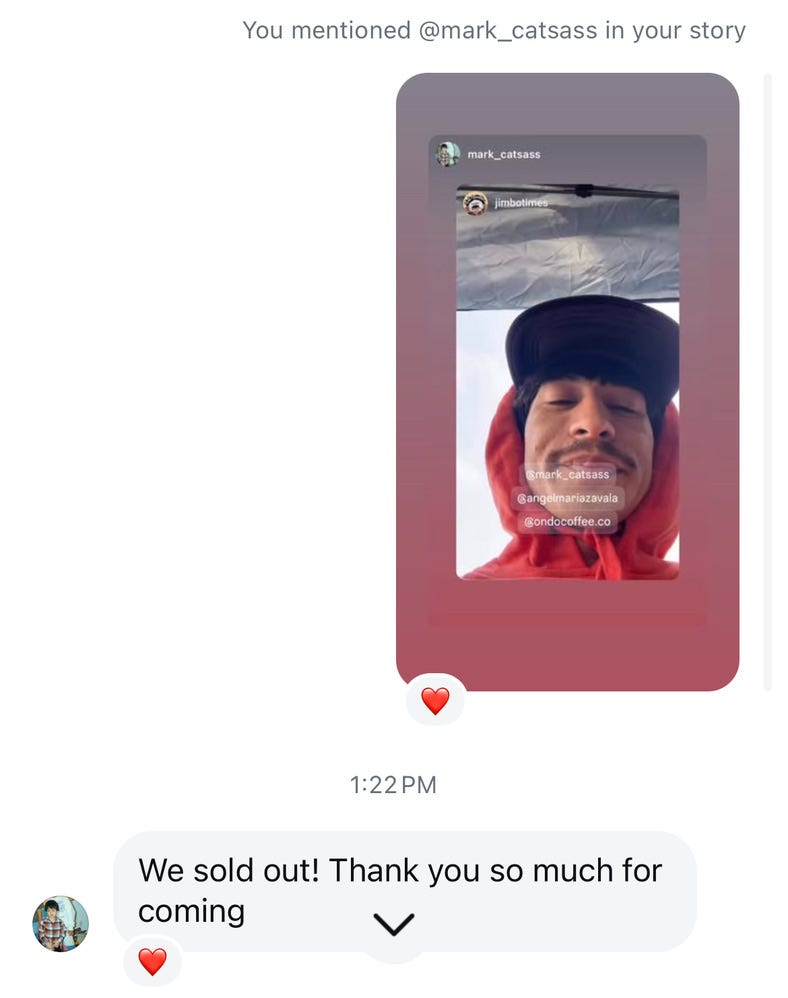
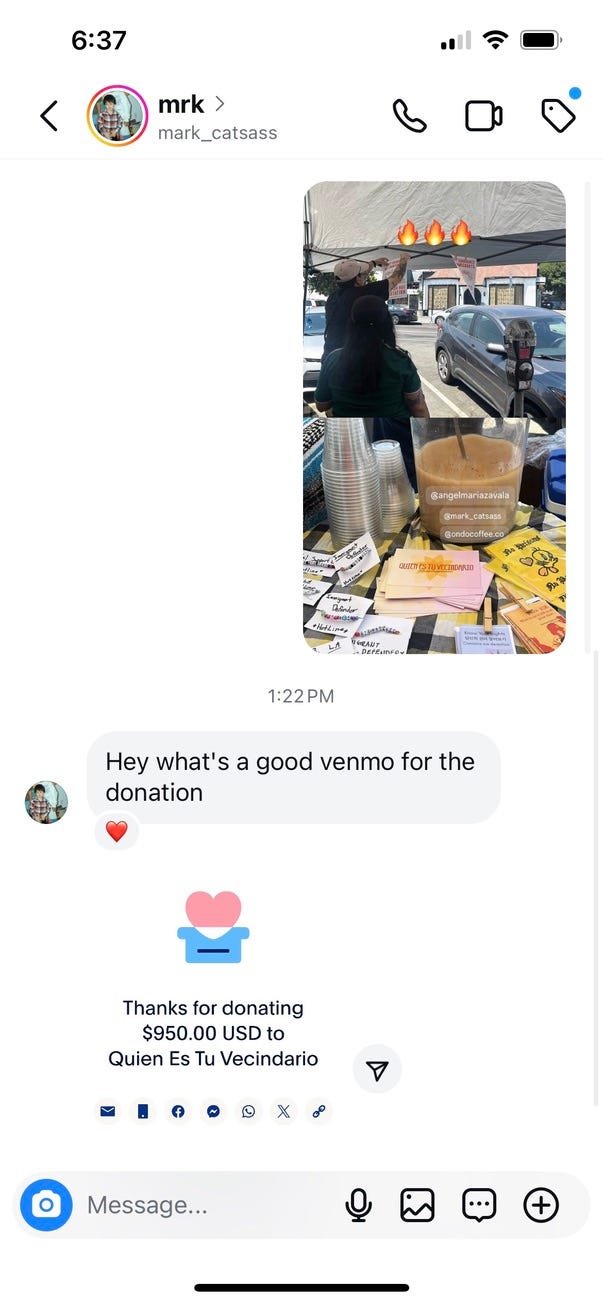
This Saturday night, Quien Es Tu Vecindario will be one of only two organizations benefiting from Casita De La Noche’s Melt The Ice fundraising party in Downtown Los Angeles, the other being the inimitable Ktown For All. To date, over 150 tickets for the event have already been sold, and there will surely be more where that came from in the next couple of days. Quien Es Tu Vecindario will also have a table at the event, and who better to “staff it” than Mark and his partner Angel from last summer with the chilaquiles? Somehow someway, then, I guess our little team will be able to reach more vendors in East Hollywood after all. Isn’t that something?
To donate to our ongoing Vendor Buyout campaign, please do so here. If you’d like to volunteer with us some time, please do so here. Last but not least, please note that Quien Es Tu Vecindario, also known as Who Is Your Neighborhood, is a separate entity from Making a Neighborhood, which I speak for with support from my colleagues but not necessarily their endorsement.
J.T.
Comments
Nothing yet. Say the first thing.
Sign in to join the conversation.