
MakerEd’s May 2026 workshop presenter was Christine Girtain, 2023 New Jersey State Teacher of the Year and 2022 National Genetics Educator of the Year. In her work at Toms Rivers Regional Schools in NJ, she directs an Authentic Science Research program, and serves as Regional Director of the East Coast Space Settlement Design Competition. She also champions invention education and runs a Camp Invention program one week each summer. She is an outstanding educator and has amassed an amazing expertise regarding grant and resource opportunities for educators, which is the focus of her workshop. She has received over $250,000 from a variety of small grants and highlights her resources for you in this video.
My name is Christine Girtain. I’m the 2023 New Jersey State Teacher of the Year, and I teach a three-year science research class in Toms River, New Jersey.
I was born in Brooklyn, New York, and raised at the Jersey Shore. It’s a very blue-collar county where I live—a lot of kids work at the boardwalk or local restaurants.
The major industries here are:
the school district—we’re the largest suburban district in the state and the fifth largest overall,
the military base, Joint Base McGuire-Dix-Lakehurst,
and the local hospital.
That’s most of the industry besides mom-and-pop businesses.
I constantly look for professional development. I love to travel. I love to learn.
I figured I had to train myself to make opportunities for my students because they didn’t have the transportation or access to those opportunities themselves.
Most of my students are from hardworking families. Many are first-generation college students. I want kids to know there are more flavors of ice cream than vanilla and chocolate. It’s my job to show them the different flavors.
I encourage you to look up who’s running STEM ecosystems in your state or region if you’re not already connected.
STEM ecosystems partner K–12 education with:
industries,
government entities like military bases,
higher education institutions,
and nonprofits
The goal is to expose students to careers in science, engineering, technology, and math, while also supporting grants and opportunities for teachers.
I run the Jersey Shore STEM Ecosystem in Ocean County with Jelena Comedas, who is the math and science supervisor for Manalapan High School in the Freehold Regional District.
We work under the New Jersey STEM Pathways Network.
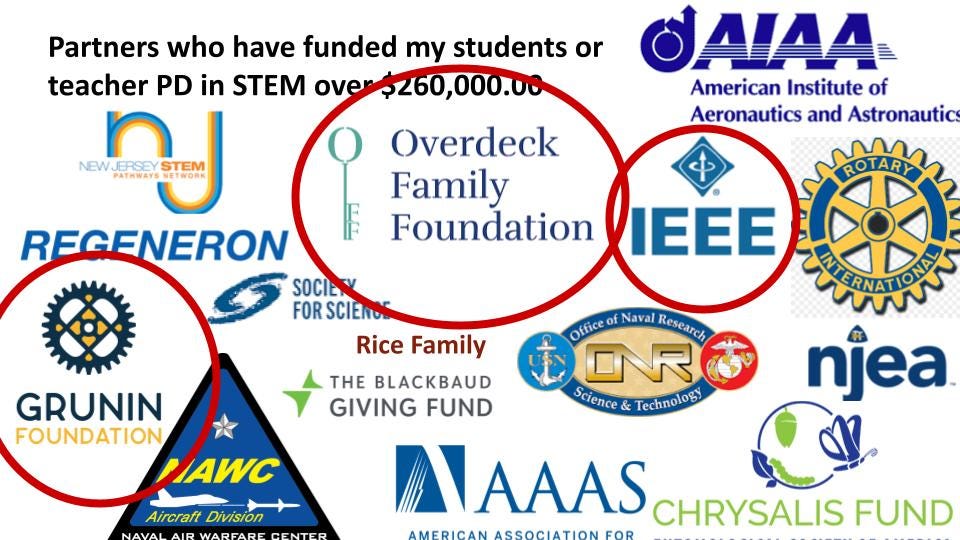
AIA offers teacher grants every year for classroom supplies. I think it is around $500, though it may have increased. They also sponsor teachers to attend national conferences.
Connect with your local Rotary clubs—or Kiwanis clubs—they are incredible partners.
They will:
fund grants,
volunteer at events,
help run logistics,
support student competitions.
For my space design competition, Rotary members run breakfast, lunch, dinner, cleanup, and check-in tables so I can focus on students.
Chrysalis Fund
The Chrysalis Fund offers grants involving insects and entomology-related education.
We used funding for a biotechnology project involving Wolbachia research and partnered with students in Israel.
These are major grants—often:
$250,000 per year,
for three years.
We partnered with a military base and county college and received $750,000 total. Through this grant, we
added a Python teacher,
ran STEM workshops,
brought in presenters from Cold Spring Harbor Labs,
and taught students how to use Python to convert DNA → RNA → protein sequences.
Corporate Matching Donations
One family donates $2,000 annually, and the father’s company matches it through the Blackbaud Giving Fund.
I suggest sending information home to parents about:
employer matching,
nonprofit registration,
and donation pathways.
Impact100 chapters exist around the country.
They offer:
$100,000 grants,
plus smaller grants.
The applications are relatively short and worth pursuing.
IEEE is an engineering society that loves partnering with schools and nonprofits.
Regional IEEE groups often provide:
$2,500 grants,
engineer mentors,
outreach opportunities.
We partnered with:
Bell Labs
AT&T Labs
Students visited AT&T Labs and met engineers including:
Jim West, inventor of the electric microphone,
Victor Lawrence, who helped develop HDTV and internet cable systems.
Teachers pay a small fee and can take unlimited books from a warehouse of donated books. We filled a truck and created free book fairs at high-need elementary schools.
Every state has an Ag in the Classroom coordinator.
They:
visit classrooms,
connect teachers with farmers,
provide agriculture curriculum,
support grants.
These thematic magazines connect agriculture to STEM topics.
Excellent grants for books, outreach, and classroom agriculture projects.
These are free STEM-themed digital reading resources featuring diverse scientists and engineers so students can see themselves reflected in STEM careers.
Camp Invention is the summer program arm of the National Inventors Hall of Fame network. It is a fee based program but this can be appealing to local funders. The National Inventors Hall of Fame has many free resources on their website.
Students:
learn invention education,
explore patents and trademarks,
volunteer as leaders,
earn community service hours,
and build resumes for internships.
Camp Invention can also serve as professional development for teachers because curriculum videos train educators before camp begins.
AT&T Labs and IEEE Day
We hosted an IEEE Day with engineers rotating between small groups of students during lunch.
The students:
toured AT&T Labs,
explored telecommunications history,
and interacted directly with engineers.
Smaller groups worked best—four or five students per engineer—because students spoke more openly.
This project studies a bacterium found in many insect species.
Students investigated:
mosquitoes,
disease transmission,
biotechnology techniques,
DNA extraction,
electrophoresis.
Penn State’s Bordenstein Lab provides:
primers,
extraction kits,
and curriculum support.
We partnered with students in Israel on comparative research.
Students travel to Costa Rica for:
rainforest field research,
leaf-cutter ant studies,
bioinformatics,
sea turtle tagging,
conservation work.
The program combines research with cultural immersion and leadership.
We tracked students who participated in research versus students who did not. There was a statistically significant difference in STEM degree attainment among students exposed to research experiences in high school.
We allow any passionate student into research—not just top-performing students.
Each state has manufacturing extension programs that support:
robotics,
3D printing,
manufacturing career exploration,
STEM outreach.
Many offer grants and traveling demonstrations.
Lectec Electric Skateboards
Students build electric skateboards and scooters while learning:
gears,
wireless communication,
circuitry,
mechanical systems.
Students build plant moisture sensors using:
LEDs,
electrodes,
soldering,
multimeters.
This combines environmental science with electronics.
Teachers can connect students with scientists from around the world.
Students hear directly from professionals in fields like:
plant pathology,
climate science,
microbiology,
engineering.
Cold Spring Harbor’s DNA Learning Center provides:
teacher professional development,
biotech workshops,
DNA barcoding programs,
research opportunities.
Students in our program published mosquito DNA sequences through this work.
Students observe evolution in real time by culturing bacteria and selecting for traits over multiple generations.
Excellent hands-on evolution curriculum.
This nonprofit redirects excess or bycatch seafood to:
food pantries,
culinary programs,
food insecure communities.
Students researched replacing single-use plastics with:
compostable utensils,
corn-based bags,
sugarcane-based products.
MNT-EC Micro Nano Technology Education Center
Provides remote access to advanced scientific equipment like:
scanning electron microscopes,
spectroscopy tools,
nanotechnology labs.
Students can remotely analyze samples with scientists.
Thor Labs travels nationally with a photonics demonstration truck teaching:
fiber optics,
laser transmission,
communication technology.
AviNation organizes aviation career events with:
helicopters,
drones,
pilots,
aerospace professionals,
VR moon landing experiences.
International Space Settlement Design Competition
Students simulate aerospace engineering firms competing for contracts.
They:
organize leadership teams,
design space settlements,
present proposals,
collaborate internationally.
Students from New Jersey helped win the international competition last year.
Professional development program helping teachers integrate agriculture into existing subjects.
Teachers receive:
equipment,
curriculum,
hotel stay,
meals,
free training.
Provides:
paid virtual internships,
mentorship,
industry partnerships.
Students gain professional experience remotely.
National Teachers Climate Retreat
A weeklong retreat in Maine focused on:
climate literacy,
climate curriculum,
environmental education.
Teachers receive stipends to build curriculum around STEM storytelling videos.
One of our projects connected Hawaiian folklore with microbial ecology and nitrogen cycling.
New Jersey Center for Teaching and Learning
Provides:
teacher certification pathways,
alternate route programs,
affordable graduate coursework,
special education endorsements.
https://docs.google.com/document/d/1iW815laWRWqkDOcnrLpTv3A9QugtHIg_s4kI0Dozdyo/edit?usp=sharing
Slides
https://docs.google.com/presentation/d/1AbJv5ZmXs-LXAjhJgNvYaLjksVjQSJpOq_7HGsgsBVQ/edit?usp=sharing
Do you have resources you want to share that are not on this list. Please send any follow up questions, comments or additions to Godwyn@make.co so we can add them to our website.
No posts
Comments
Nothing yet. Say the first thing.
Sign in to join the conversation.