
Lately I’ve been focusing on professional chess here at Good Moves, what with the Candidates and all. (You can find those pieces here and here.) But it’s important not to lose sight of the fact that I myself am also a chess player, and a bad one at that. It is a law of the universe that bad chess players must labor night and day to improve, even if their hopes of improvement are nothing but a grain of sand in a universe filled with beaches. In honor of that law, I wanted to check back in on my own Chess Adventure.
Ever since I started taking chess seriously at the end of 2020, when I was but a humble 1300 in Chess.com rapid, I always thought it would be nice to break 2000. That seemed like both an ambitious and a semi-realistic goal for an old man like myself1 in a way that breaking 2000 USCF was not. Why 2000? Because… it’s 2000! When your chess rating has a 2 at the beginning, it just seems cooler. I always felt like, if I could break 2000, I would have at least validated to myself that all of the time I had spent on playing and thinking about this game had led to some degree of mastery, even if I could never really hope to be an actual master.
For a while, though, this was more or less a pipe dream. I basically didn’t improve ratings-wise over my first three years of trying to learn how to actually play chess. I peaked as high as 1525, but by October of 2023, I was back down in the mid 1300s. But over the last two and a half years, something clicked. My ceiling got higher and my floor got lower. And then in the last six months, I made some sort of quantum leap. I’m not really sure why. I’ve been writing about chess and playing over the board consistently, learning my openings and trying to stick with a few of them, but I’ve been training more or less the same as I always have, which is just playing a lot of rapid games, with the occasional detour into a bit of reading or a bit of tactics. So I don’t know exactly what changed to all of a sudden make me an 1850-1950 rapid player. Whatever it was, though, it seems to have stuck around.
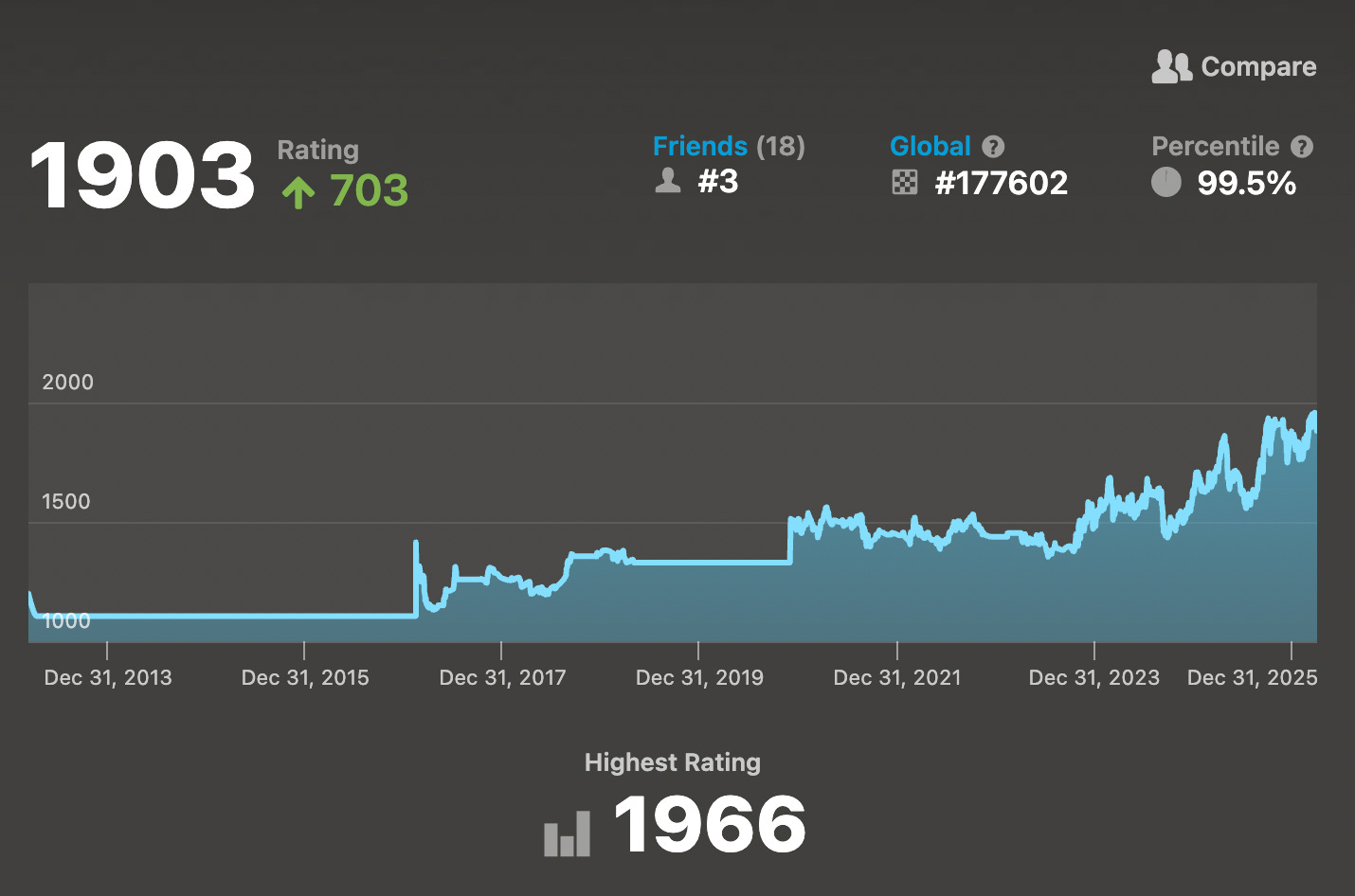
Over the course of this most recent period, I’ve come within arm’s reach of 2000. 1966 is only five wins away. But I have also discovered that, as soon as I get near 1950, I tend to bounce back down. The quality of play ticks upward at that point. Not hugely — I’ve still had some games against 1950s and 2000s where I couldn’t believe how bad they played — but enough that you have to be just a bit stronger consistently to keep winning more than you lose.2
So I’ve decided to be a bit more deliberate about my improvement at this point. If I really care about breaking 2000, then I should have a plan that goes beyond “play a bunch of games and try not to tilt.” However, I also know, from my past experience with making plans, that I need to keep it very simple and actionable: I am, after all, a dad and a person who needs to do things other than chess to make money.
Before I lay out the three pillars of my new, simple plan, let me be clear that this is expressly designed for breaking 2000 in online rapid. It does not prioritize my over the board play, which I’m currently treating as a training tool in and of itself — and also just a fun part of my week! — but not something where I’m super-attached to my rating. If I wanted to improve at OTB, I would do more calculation, strategy, and endgame work. Playing 10+0 rapid games, you don’t have the time to do deep calculation, and I’ve found my endgame play tends to be above-average already, so improving there feels less important for this particular goal.
Here’s what I’ve come up with:
Do simple tactics
Review every game
Study some strategy
Let’s tackle them one by one.
Prioritizing simple tactics is an idea that I picked up originally from GM Jacob Aagaard via Nick Vasquez, and that I came to better grasp when Nate Solon interviewed Aagard about it. The idea as I understand it is that, unless you’re already really, really good — like, master level — then you still need to improve at the most basic tactics. We’re talking fundamental checkmate patterns, forks, pins — the kind of stuff you’d teach a kid after they learned the basic rules.
Sure, you probably know what these look like and how they work… but you want them to be so ingrained that they become automatic. That way, you can both spot them when they appear on the board and sense the possibility of creating them. The latter is really the challenge: we often think of a tactic as a thing that is either there or not, but by the time they’re on the board, your opponent most likely sees it, too. If you can identify the pattern a move or two before it appears and then nudge the game in that direction, that’s when you’re winning. And to do that, you need to have these things drilled into your brain to the point that you can see them before they exist.
There are a few different ways to practice tactics like this. Vasquez, Aagaard, and Solon all mention doing Lichess puzzles on easy. But my method of choice has been to use simple Chessable courses because then the review function is built in. You do the same basic puzzles over and over and over and they start to become second-nature. Solon recommends Susan Polgar’s Learn Chess the Right Way series; I’ve already finished volume 1 and am about to dive into volume 2. I’m also using Benedictine’s Common Chess Patterns course, which was recommended by the Chess Dojo. Basically any simple puzzle book works.
I’m trying to do these daily, for at least 15 minutes — ideally closer to 30. In addition, I’m mixing in sessions of proper Chess.com puzzles, trying to rack up about an hour of more challenging puzzle work each week. The puzzles on Chess.com are rated, so they’re demanding, but not too difficult.
Next up, I’m reviewing every single rapid game I play, as soon as I finish. I do this by pasting the PGN into a Lichess study, running the engine, and then going through the results, explaining in the annotations why each of my mistakes or blunders is bad, and what I should’ve done in the position. I also review my opening to make sure it matched my prep, and if it doesn’t, then I learn the new line. For the most part, I follow Nate Solon’s OBIT method: opening, blunders, interesting moment, and then takeaways.
I’ve written more about this in the past, when I tried to prioritize game review. But what I’ve come to realize since then is that, from a rating perspective, game review might actually be less important for what it teaches you and more important for the fact that it keeps you from tilting.
I can’t tell you how many times I’ve fallen into a tilted rapid session in which I play way more games than I meant to because I’m trying to get my score back up. When you review your games, though, you can’t just immediately click the green button to get another game going, and that allows you to regroup, take stock, and decide whether you really want to play again or not.
Finally, I’m trying to mix in some strategy study as well. It’s debatable just how much strategy matters at this level, particularly online — obviously, it helps to some degree, but based on the number of games I’ve lost to goofballs who were playing so dumb and so fast but spotted tactics as soon as they appeared, I still think it’s less significant in rapid than tactical sharpness is.
Still, I’ve found Jeremy Silman’s How to Reassess Your Chess to be a good one-stop shop for improving every aspect of chess strategy, and I’m trying to work through that at the modest pace of about a chapter a week.
It’s become pretty clear to me that, even as you approach the top 0.1% of players in the online rapid pool, the way to win remains simple: develop your pieces, don’t hang material, and spot tactics when they become arise. Any additional strategic knowledge is icing on the cake, but it’s only valuable insofar as you’re successfully executing those more basic concepts.
There it is — the plan that I hope will get me past 2000. Is it anything groundbreaking? Nope! Is it sophisticated or unique? Not really! But it is, hopefully, something I can stick to, and an approach that should address some of the more significant factors of rating gains online in 10+0 games. I’m planning to stick to this for two or three months; if it’s working, that should be enough time to see if it can get me over the hump.
I will also acknowledge that ratings goals aren’t necessarily the best. That’s part of the purpose of laying out a plan like this. To some extent, the goal is really to do simple tactics, review my games, and study HTRYC, with the idea that the ratings gains will follow.
Let me know what you think about this. Brilliant? Naive? Am I missing something? Any suggestions? I’m all ears!
I was 31 at the end of 2020. In chess-improver terms, this is basically dead. I’m joking, but also sort of not.
I’ve also seem some people theorize that there’s more cheating in the 1900-2000 range because people want to get their ratings above 2000. I can’t speak to that one way or the other, but I have had some games lately that were pretty suspicious… so it wouldn’t shock me.
No posts
Comments
Nothing yet. Say the first thing.
Sign in to join the conversation.