
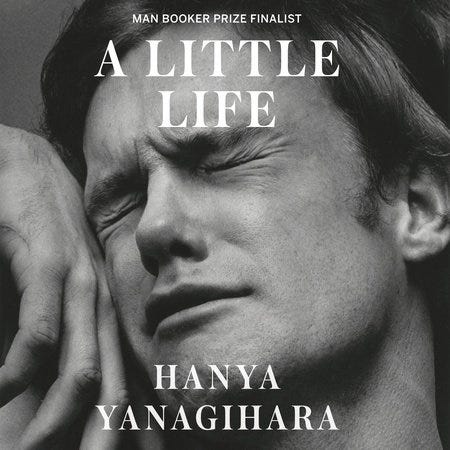
I finished a “little” book called A Little Life last month, and I haven’t been able to stop thinking about it since. It is the saddest book I’ve ever read- besides maybe The Boy in the Striped Pyjamas, though I read that in my early twenties when my brain wasn’t fully developed and I lacked the historical context to truly grasp it (I am a hater of history. Can you blame me?). I’ll revisit that one eventually, but today is about A Little Life.
Let me emphasize: this is an incredibly heartbreaking book. I cried a lot. It is 800 pages of pure pain, punctuated by occasional slivers of light, only to plunge right back into the dark. I’ve found myself wrestling with the ending and the sheer, relentless volume of Jude’s suffering. Why did he have to go through all of that? How can one person handle all these horrors? Can Jude catch a FUCKING break??? And more frustratingly,
How do you help someone who won’t be helped?
I have this habit of going on the internet every time I finish a book that has had an intense effect on me. I realized this book is kind of controversial. People on the internet are calling it a “trauma porn”. But I didn’t find it entirely unrepresentative of reality—I don’t know what that says about me, but I’ve witnessed a fair share of people’s suffering in my short life.
He had looked at Jude, then, and had felt that same sensation he sometimes did when he thought, really thought of Jude and what his life had been: a sadness, he might have called it, but it wasn’t a pitying sadness; it was a larger sadness, one that seemed to encompass all the poor striving people, the billions he didn’t know, all living their lives, a sadness that mingled with a wonder and awe at how hard humans everywhere tried to live, even when their days were so very difficult, even when their circumstances were so wretched. Life is so sad, he would think in those moments. It’s so sad, and yet we all do it.
In processing my own emotional fatigue alongside the profound love I felt for Jude, I realized that the tragedy of A Little Life isn’t just about the trauma itself. It is about how hope, however falsely it is portrayed, is utilized to test the absolute limits of human endurance.
The most painful parts of this book aren’t the moments of active trauma (which Hanya Yanagihara chose to describe in excruciating detail), but the moments right after things seem to be getting better. The novel constantly dangles salvation: through Willem’s love for Jude, Harold’s adoption, and Jude’s brilliant professional success. For a while, the narrative makes you truly believe in the power of that chosen family.
“Wasn’t friendship its own miracle, the finding of another person who made the entire lonely world seem somehow less lonely?”
But this hope is mirage. By constantly presenting the illusion of a happy ending, the narrative forces Jude to keep enduring a life that his trauma has made fundamentally unbearable. We desperately want to believe that love is a cure-all, but Yanagihara had a darker agenda: in a situation of insurmountable pain, the promise of a “normal” life can sometimes act as a cruel mechanism that simply prolongs the suffering.
Are you happy? he once asked Jude.
I don’t think happiness is for me, Jude had said…
Whenever something good happens to me I always find myself thinking: I wonder how long it will be until this turns out badly. And I almost want the worst to happen sooner, sooner rather than later, and if possible straight away, so at least I don’t have to feel anxious about it anymore.
I don’t know if I agree with this fundamentally. There is a reason I love to read romance, there is always a happy ending in those books. I like knowing the pain has a purpose and everything works out. But this damn book actively rejects that comfort. At one point, the novel almost seems self-aware of its own brutality, noting:
What he knew, he knew from books, and books lied, they make things prettier.
Yanagihara refuses to make things prettier for us. She creates a vicious, deeply effective cycle instead: brutal trauma, followed by a glimmer of salvation. We catch our breath, only to experience an even harder fall. We endure reading about Jude’s impossible levels of pain only because we are chasing that same false hope that he will eventually be okay. Hope is the engine that keeps the page turning. When the mirage finally fades, our endurance breaks right alongside his.
And he cries and cries, cries for everything he has been, for everything he might have been, for every old hurt, for every old happiness, cries for the shame and joy…
Which begs the question: What is the point of a story that forces us to ultimately give up hope? What is Yanagihara’s agenda with all this absolute destruction? I’ll admit, part of me resents her for it. I am someone who craves clear resolution and finality in the stories I consume. I want the suffering to lead somewhere purposeful. But Yanagihara seems hell-bent on dismantling the classic narrative of healing—the deeply ingrained idea that with enough therapy, love, and time, anyone can be saved. Her agenda seems to be proving that some people are simply broken beyond repair. And I do not like it one bit. She deliberately strips away the redemption arc to show us that sometimes, survival isn't a triumph; it's just prolonged torture. As a reader, trapping us in a world devoid of hope feels almost sadistic.
I am not entirely sure what my grand intention is with this essay. Mostly, I just needed to put these feelings down in writing. I do not relate to Jude’s lack of will to be alive after Willem. I cannot even fathom it. Is it possible to break a human so much that not even the love of his parents and friends can supply him with the will to go on with life?
It was precisely these scenes he missed the most from his own life with Willem, the forgettable, in-between moments in which nothing seemed to be happening but whose absence was singularly unfillable.
Can the sheer, compounded weight of someone’s past eventually crushed his capacity to endure it?? I do not know. The hardest pill to swallow is the sheer magnitude of the love he did possess. The book spends hundreds of pages convincing us of the profound, life-altering power of his chosen family, capturing it in breathtaking passages like this:
I met people who, for whatever reason decided to be my friends, and they taught me—everything, really. They made me, and make me, into someone better than I am.
You won’t understand what I mean now, but someday you will: the only trick of friendship, I think, is to find people who are better than you are—not smarter, not cooler, but kinder, and more generous, and more forgiving—and then to appreciate them for what they can teach you, and try to listen to them when they tell you something about yourself, no matter how bad—or good—it might be, and to trust them, which is the hardest thing of all. But the best, as well.
But I will leave you with a final line that might be the ultimate lesson of the book:
And so I try to kind to everything I see, and in everything I see, I see him.
Logging off to find a fictional universe with better coping mechanism,
Rebika 🖤
No posts
Comments
Nothing yet. Say the first thing.
Sign in to join the conversation.