
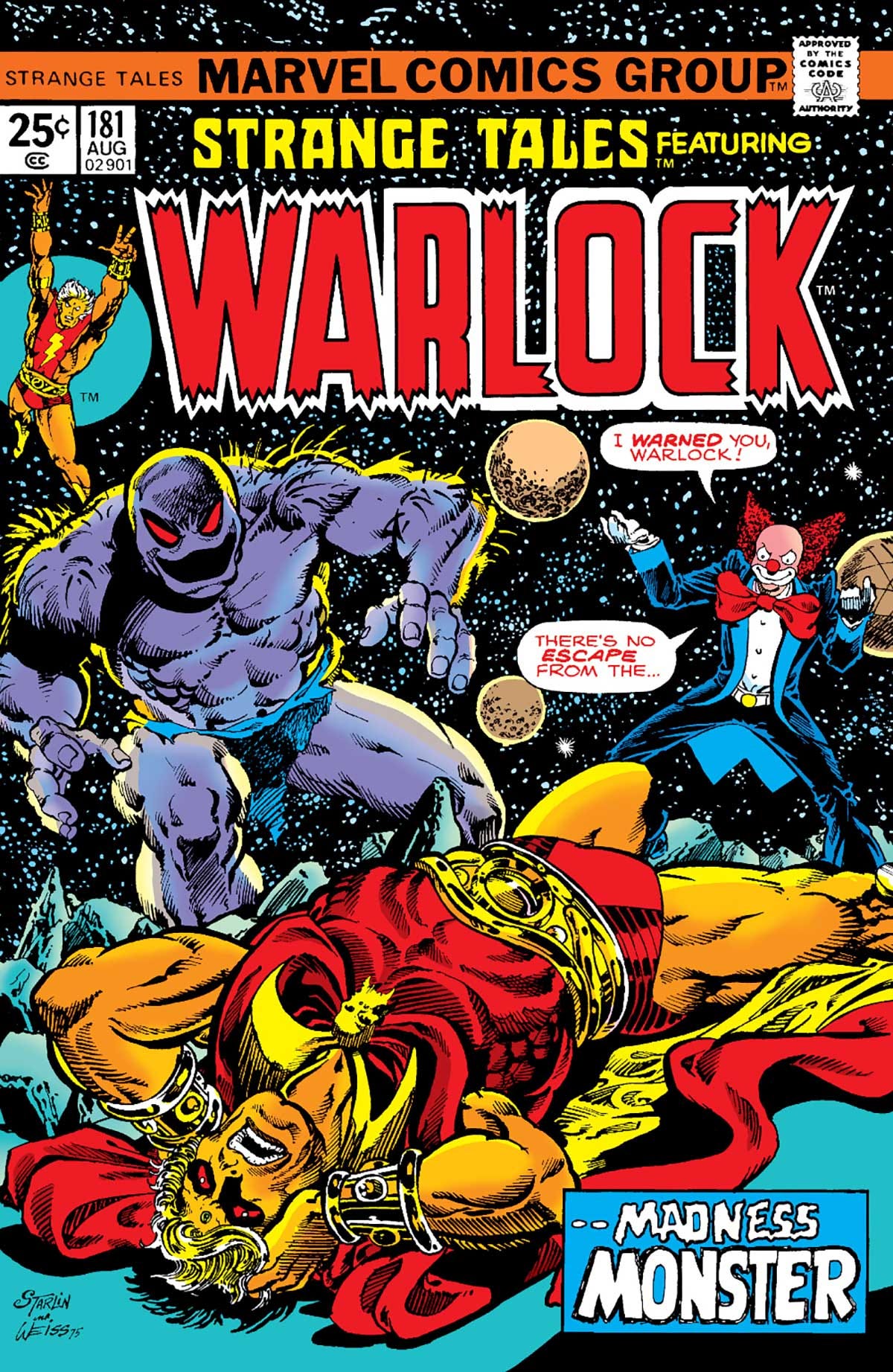
Writer: Jim Starlin
Penciler: Jim Starlin
Inker: Al Milgrom
Colorist: Jim Starlin
Letters: Tom Orzechowski
Editor: Len Wein
Publisher: Marvel Comics
Cover Price: 25 Cents
Current Near-Mint Pricing: $75.00
Release Date: May 27, 1975
Previously in Strange Tales, originally a strange homunculus created by a cadre of immoral researchers known as The Enclave, Adam Warlock was originally known as “Him.” After an existential crisis and a battle with a literal God, Him took to the spaceways in search of answers. Arriving on Counter-Earth (a duplicate Earth on the opposite side of the sun created by the High Evolutionary, a long story in itself), he acquired the Soul Gem, the first of the legendary Infinity Gems. There’s some very Messianic stuff, leaving Warlock to search deep space once more, encountering the Universal Church of Truth, and its mysterious leader, The Magus. That’s where Gamora comes in.
Trained as an assassin for her entire life, Gamora sought revenge against the Universal Church of Truth for the extermination of her people, but what’s not clear is WHY she seems to be targeting Adam Warlock.
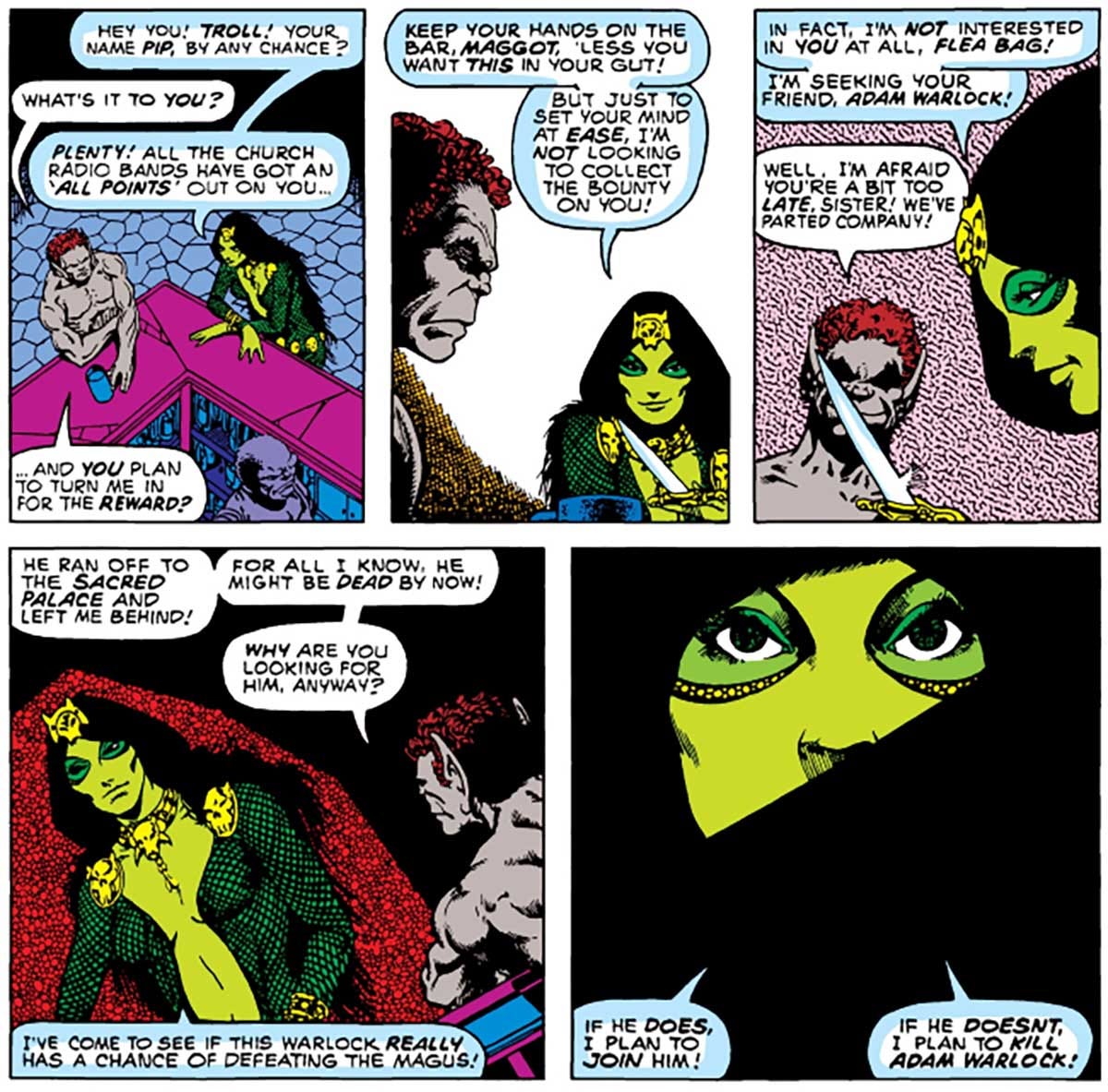
As was so often the case in the Bronze Age, Gamora made her first appearance as a teaser in the pages of Strange Tales #180, which is where this first panel sequence comes from. (See also: Wolverine’s cameo on the final pages of Hulk #180, with him not actually doing anything until the next issue.)
Pip and Gamora travel together to try to find Warlock, who has been trapped by the Universal Church of Truth in a strange, dreamlike reality. As he faces illusionary clowns (one named Lenteans, another Jan Hatrooni, anagrams for “Stan Lee” and “John Romita”, respectively), who are punishing one of their own gone renegade (who looks a heck of a lot like writer Steve Gerber), Pip and Gamora infiltrate the Universal Church of Truth, allowing our green living weapon to show off what kids today would call “aura farming.”
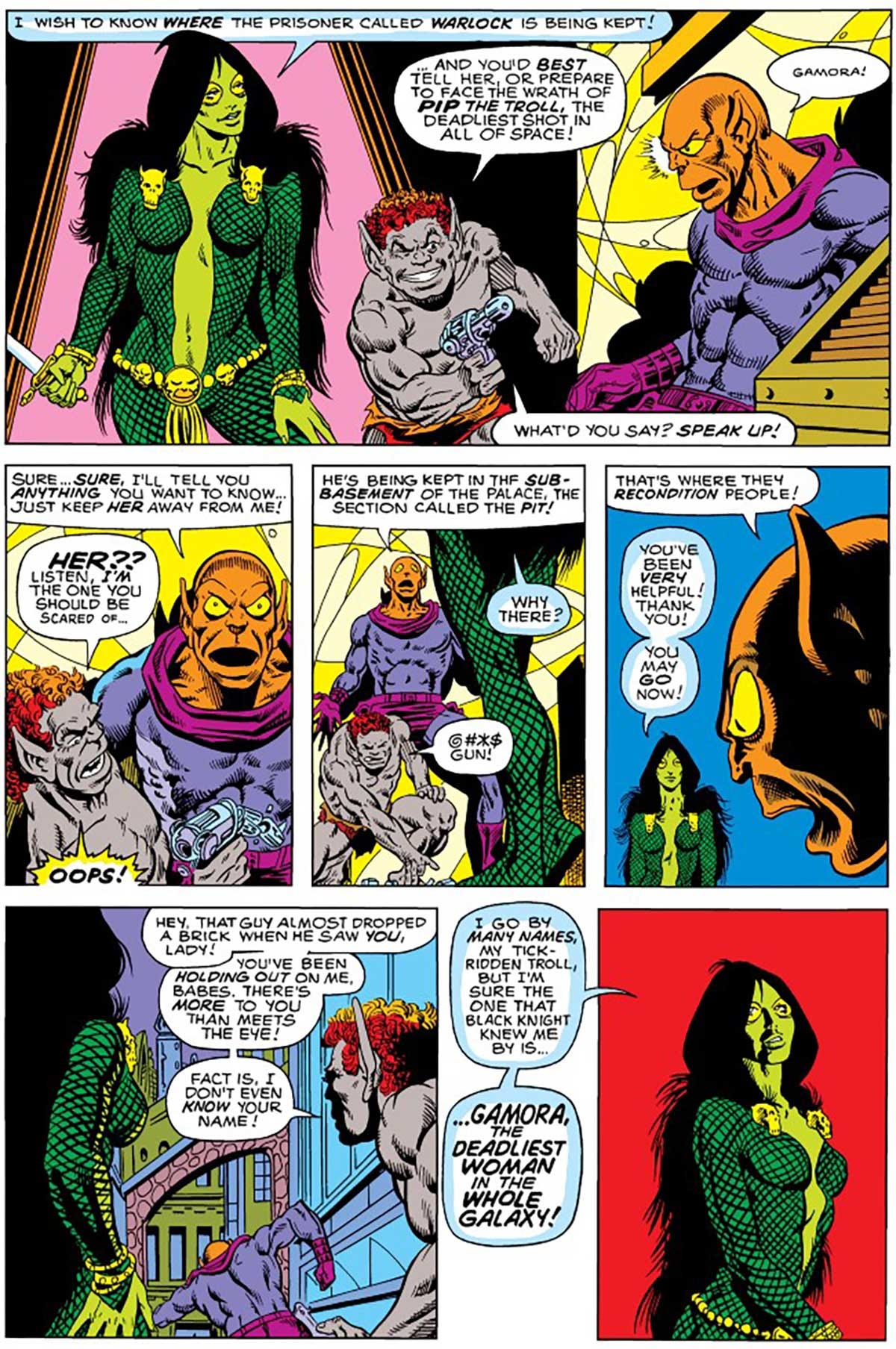
While Starlin faces Warlock with very Ditko-esque pastiches of Marvel’s editorial team, the bizarre thought processes of which drive him to madness, Gamora leads Pip to storm the Holy Palace of the Universal Church of Truth, where she displays both the skills that make her feared by even the Black Knights of the Church and the drafting skills of Jim Starlin in his prime.
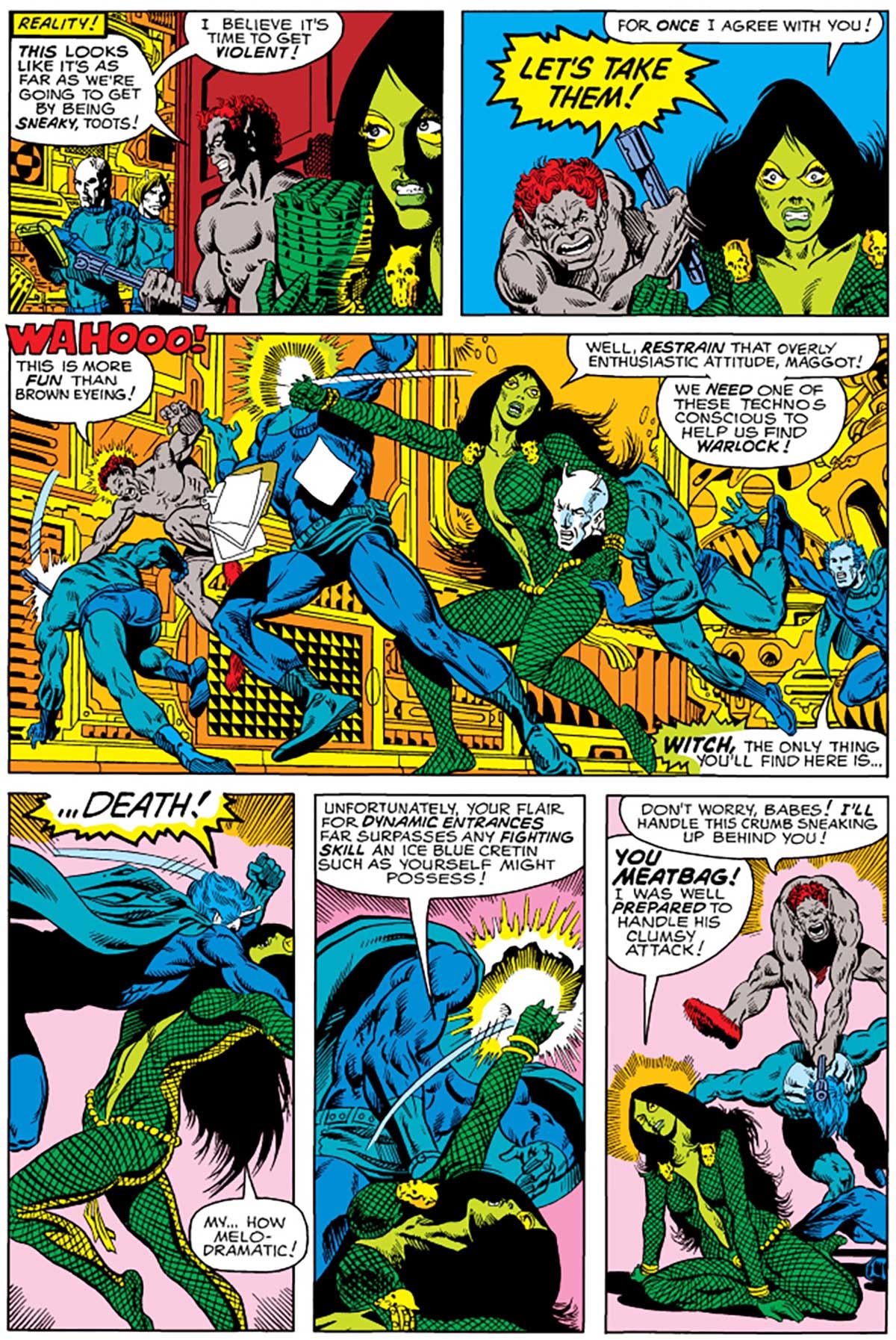
Their physical battle parallels Adam’s psychological one, as he is forced to battle his own neuroses in the form of The Madness Monster. It doesn’t go well for Warlock until he realizes that his madness is just part of who he is, and only by accepting himself as an irrational being can he truly be free.
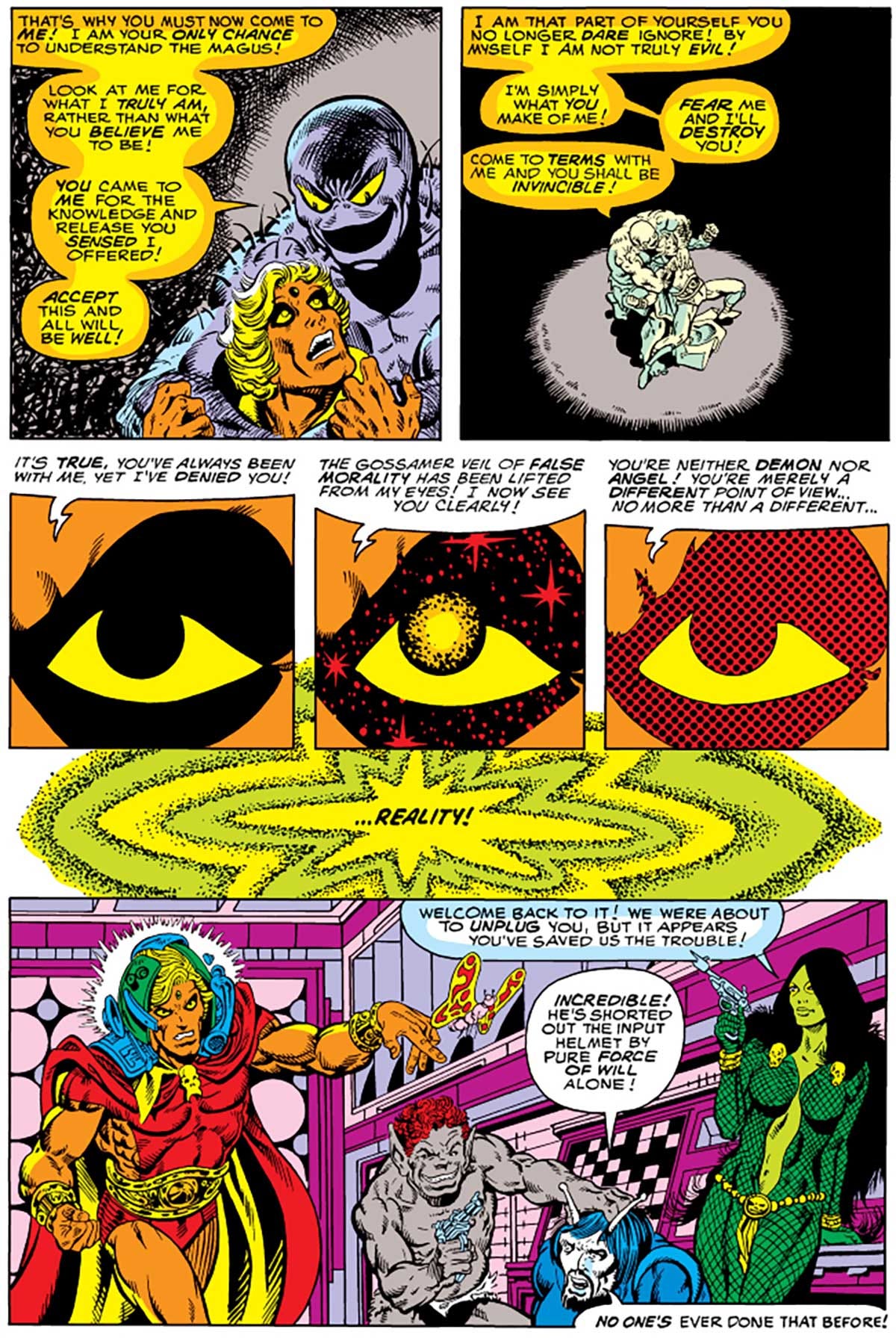
Of course, what that antennaed blue pastiche of Stan Lee doesn’t quite grasp is that, by embracing his madness, Warlock can see the perspective of The Magus more clearly, though he hasn’t fallen prey to megalomania... yet.
Of course, there’s still the matter of The Magus himself, who chooses this moment to reveal himself, explaining why Gamora was ready to murder Warlock.
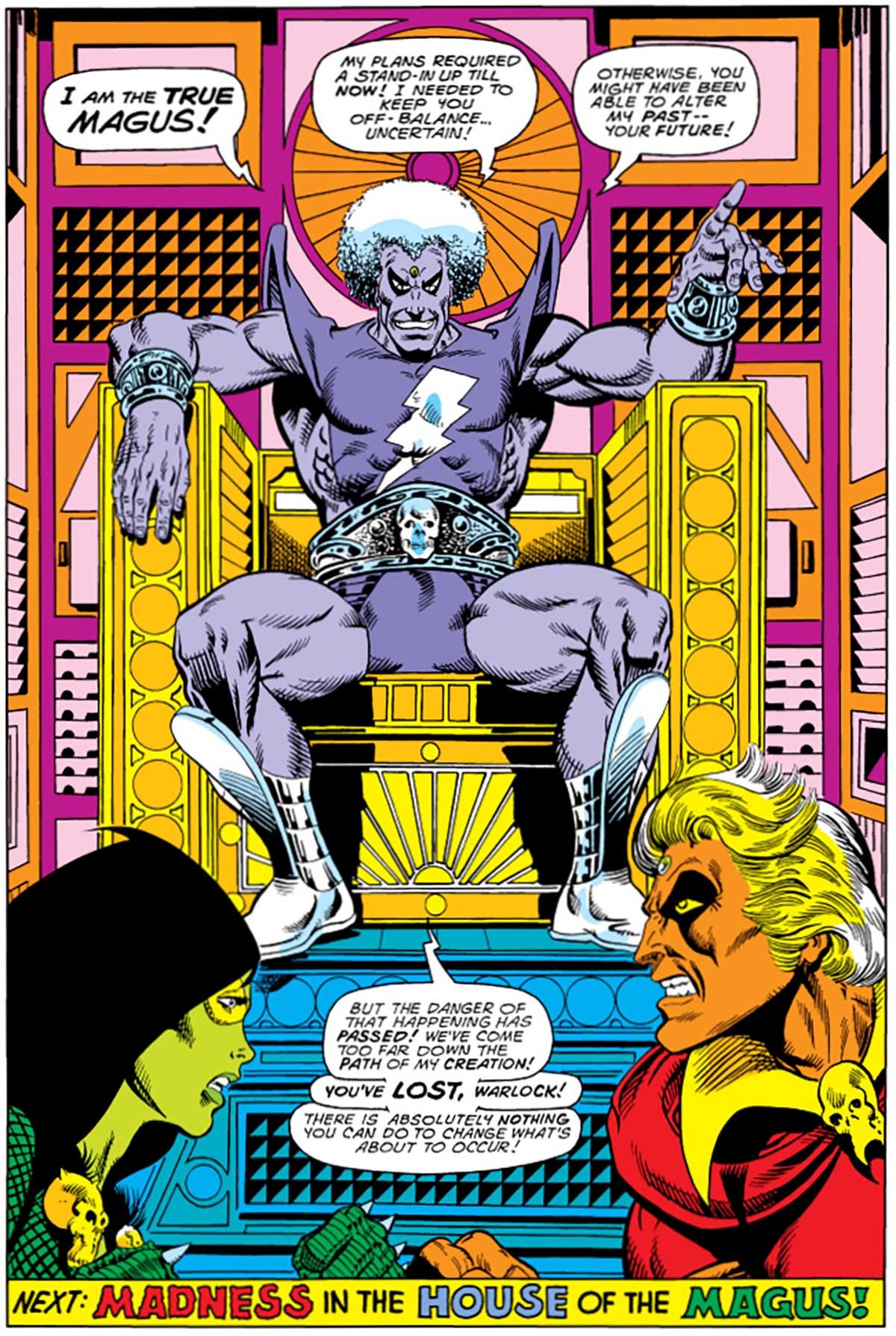
Yes, friends, the path to ultimate insanity is a Mike Brady perm. It is canon.
As for Gamora’s debut, this issue is a perfect example of why she was added to the cast, as Pip’s general laziness and Warlock’s solitary cosmic musings don’t necessarily move the plot forward, but having someone who is laser-focused on vengeance makes for a perfect supporting cast member for their antics. As for Strange Tales #181, it’s a truly excellent chapter of a longer narrative and a large part of why Warlock got his own solo book back after this issue, with wonderful art, big reveals, and Gamora’s (real) debut combining for 5 out of 5 stars overall.
(The meta-commentary on Marvel’s Bronze Age editorial team is just a treat for hardcore comic history nerds.)
Comments
Nothing yet. Say the first thing.
Sign in to join the conversation.