
There’s a moving opinion piece in The New York Times this week called “What American Poverty Looks Like,” written by Brunella Tipismana, a recent Yale graduate who grew up in Lima, Peru. She accompanied columnist Nicholas Kristof on a learning journey through Arkansas, Kentucky, and Oklahoma. She was surprised to find that even though Americans living in poverty had significantly more material wealth than the poor in Peru, they suffered more because they lacked connection to a community. In Peru, she writes, “class solidarity and communal structures can make poverty more endurable, and the Americans who have to live without them end up more isolated and scared than we ever were.”
Peter Block understood this challenge many decades ago. Through countless books, workshops, teaching, and organizing, he has argued that community development needs not just a smart head but a heart and a soul. By making connection the centerpiece of economic development, we have a chance—just a chance—of solving our most vexing problems today. We’re pleased to feature a conversation with Peter in this issue. We hope you enjoy it.
You will also find our latest listings of local investment opportunities across the country.
This will be our last issue until September 10. Jen, Paul, and I need to rekindle our own community connections with a little downtime. See you in a few weeks!
- Michael H. Shuman, Publisher
Publication of The Main Street Journal depends on your support. If we can reach 600 subscribers by the end of this year, we can continue delivering The Main Street Journal in 2027. (Below is a chart of our progress toward this goal.) If you like what you’re reading, please consider becoming a paid subscriber today. Paid subscribers can attend our monthly “Mondays with Michael” and receive a free consult on their projects. Please join the blue line below!
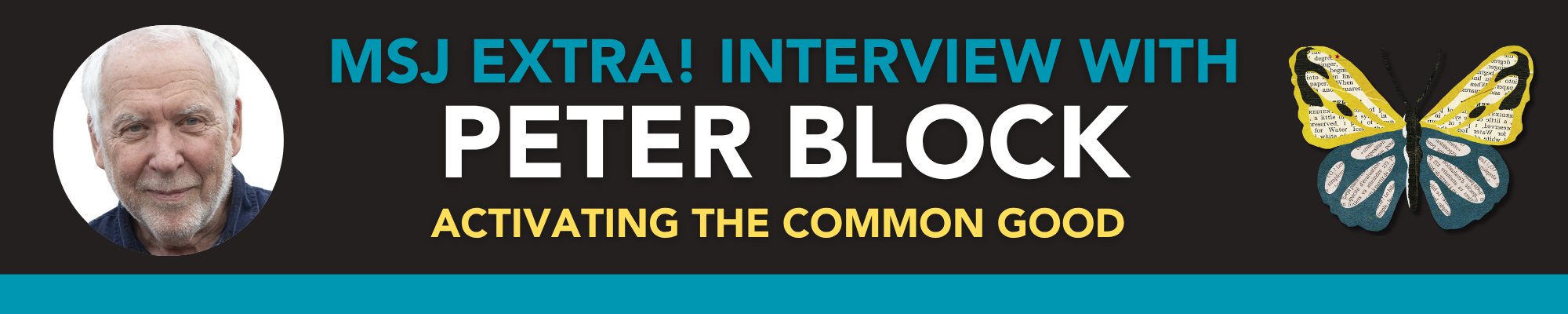
MS: Peter, great to be able to talk with you today. I want to discuss your recent conference in Cincinnati called “Connecting for the Common Good,” but first I think it would be helpful to acquaint our audience with your work. Reading through your Wikipedia entry, you have a remarkable history: as an industrial manager with a degree from Yale, as a consultant to the Fortune 500 including oil companies, and as a collaborator with Werner Erhard on personal development strategies. How did you wind up in the field of community development?
PB: I started in organization development when it was a young field. And for many years, I was attracted to the idea of humanizing institutions and building teams.
In 1995, I was invited to a conference of city managers, and I fell in love with them. I realized they cared about more than streets and keeping the electricity on—they cared about civic engagement. I began wondering whether the work I had done in organizational development could be useful in building community.
When I moved to Cincinnati in 1998, I decided to try deploying these ideas where I lived. I was also lucky to meet John McKnight, one of the founders of the asset-based community development methodology. His work based community development on residents’ gifts instead of deficiencies—what people are good at instead of what they need—and changed my thinking.
That, then, became my work: How can we help people become their own change agents instead of waiting for other institutions? Why wait for police to keep us safe, or doctors to keep us healthy, or schools to raise our children?
My books have elaborated this path through empowerment, neighborhoods, belonging, and activism: How do we become activists for a cause and purpose without waiting for someone else’s transformation?
MS: I encourage our readers to check out your most recent book, Activating the Common Good. In a nutshell, how would you describe your philosophy of strengthening local economies?
PB: It begins with a notion I learned from Werner Erhard: all transformation is linguistic. If I want to transform something, I must begin by changing the narrative and the language I use. And out of new conversations come new outcomes.
Economics is a good example. The conventional model is based on scarcity and a belief in scale, consistency, and predictability. That model can build a strong real estate market and large institutions—but not a local economy.
So what kinds of conversations do build a local economy? How can we have conversations with people we’re not used to talking to, and conversations we’re not used to having?
We can tell people to shop local. We can teach them about the circulation of the dollar. We can tell them what’s working elsewhere. But how do we get them to act on what they know?
That begins with trust. If you want something to be different, you need people in the game with you. When people connect, they become accountable to each other in ways they will never achieve through just the willpower of somebody in charge.
MS: You have been a fixture of community life in Cincinnati, where you have lived for nearly 30 years. You have sat on the board of local foundations, the public radio station, and many civic organizations. What is it about Cincinnati that has drawn so much of your energy? What do you love about your community?
PB: What’s unique about Cincinnati is that I live here. It dawned on me that if I was going to write about community, maybe I should try it. After being here about four years, living as the gypsy I had been most of my life, I decided I better show up. So I started working on projects in Cincinnati.
Wherever you are is the place you learn to love. The more you get to know the backstory of what’s going on, the more compelled you are to care about it and care about the people living there. Every town is a world in itself.
The big challenge in an internet world is to care about a place. For me, it’s been extremely rewarding—and extremely frustrating—to try to be a citizen of Cincinnati instead of a consultant to the world.
Sitting on boards has probably been the least useful thing I’ve done, other than allowing me to know people and build relationships. Over 25 years, I’ve built social capital with people all over Cincinnati. When we’re up to something new, it’s a little easier to call somebody and say, “Could we talk?”
MS: I know you’ve been working with many changemakers like Derek Peebles to move Cincinnati in new, better directions. Which of your projects have you been most proud of, and what did they accomplish?
PB: After the 2001 uprising following the shooting of Timothy Thomas and subsequent conversations about police and demonstrations, a group decided that watching the police wasn’t going to take us anywhere. This group, named Elementz, asked: What do we do with urban youth, ages 14 to 24, to get them more constructively engaged?
So we helped create a hip-hop center. Here’s our simple idea: Find out what youth love and what they’re good at. Don’t begin by asking about school, jail, where they’re sleeping, or the conditions of their lives. And it worked. Young people came in and learned engineering, performing, laying down beats, dance, and graffiti art. Twenty-five years later, thousands of urban youth in Cincinnati have found support and a joyous way into a life.
That same philosophy became the basis of our neighborhood work. I realized the city was too big and waiting for institutions was too slow. So we work directly with neighborhoods around whatever they care about—local economies, land, art, safety, food.
We bring people into small groups and ask questions like: Why was it important for you to be here? What crossroads are you at? What’s your contribution to the problem? What courage is required of you?
Those conversations create agency. People leave thinking, There’s something I can do.
MS: Clearly, there is much work to be done in Cincinnati. If you were king for a day in the city, what are two or three policies or projects you would decree?
PB: I would change the architecture of City Hall. I would create a room where officials could actually have conversations with citizens in small groups around tables.
Second, I would re-examine the tax credits we give. I’d find ways to take land off the market and give credit to local neighborhood projects rather than large commercial projects. I’d put much more attention on the elements of a local economy and focus our public relations efforts on what neighbors and citizens are doing to keep the dollar circulating in their neighborhoods.
My number-one strategy would be to focus where real change can happen. Right now, large-scale impact is mostly about extracting the common good in the name of private profiteering. I would also call a halt to the privatization of public land and public services.
The larger idea is that we have to change what we prioritize. We tend to focus attention and resources on large institutions and large-scale projects. I would redirect that attention toward neighborhoods, residents, and the local initiatives people care about.
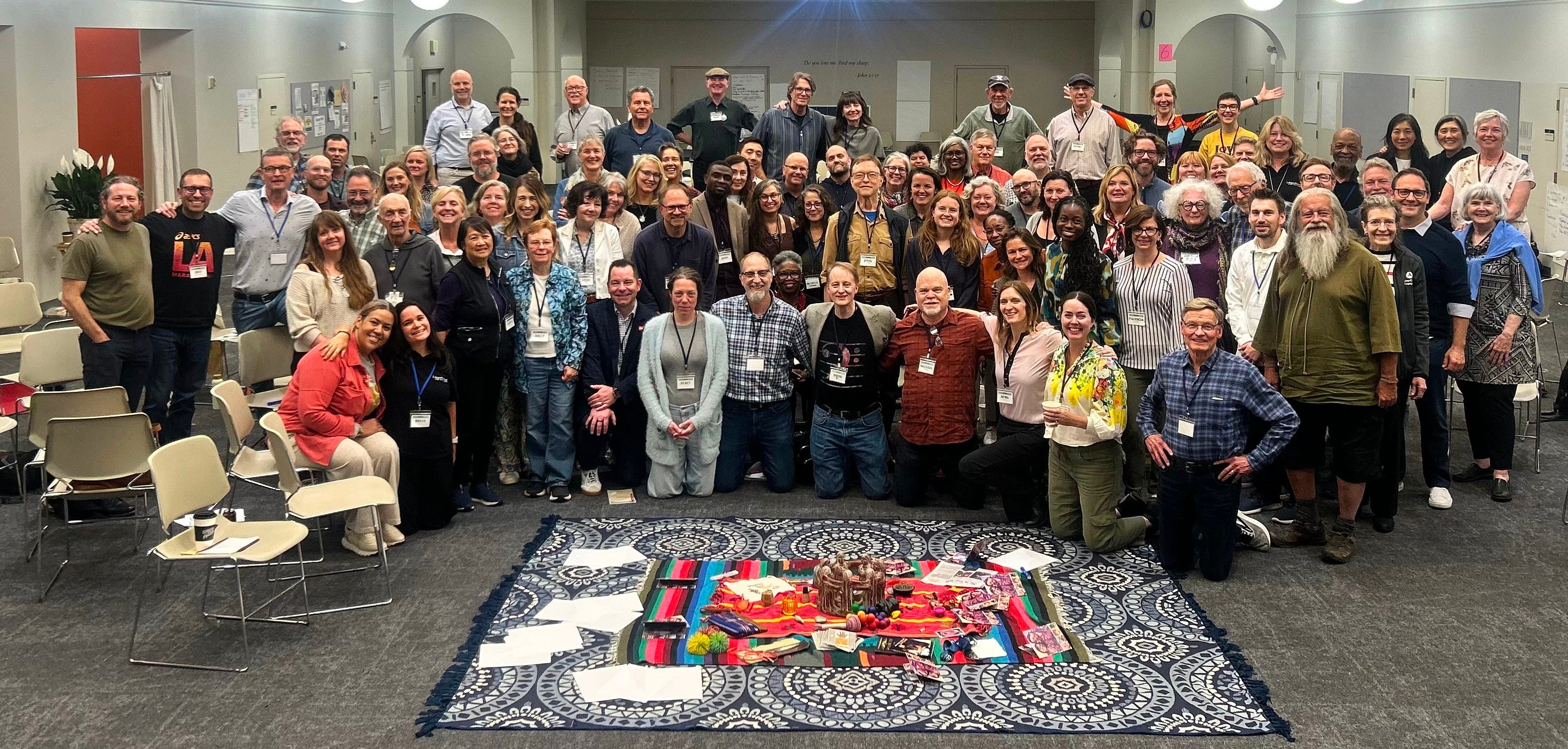
MS: You held a conference last May that was 100% focused on community conversations. There were no keynote speakers, and the agenda was set by participants through Open Space frameworks. What were some of the themes to emerge from the gathering?
PB: One theme was how committed people are. They were focused on all kinds of issues—social services, economics, public safety—but for two and a half days they connected with people and things that matter in their lives. We didn’t teach them anything about connecting. We gave them the experience of asking: What’s the crossroads you’re at in this work? What’s the “no” you keep postponing? What gifts have you not fully brought into the world?
It wasn’t so much about the work they were doing. It was about the meaning of that work. And about the difficulty of trying to reimagine our culture.
I kept wondering whether we needed action steps. But attendees kept saying, “Leave us alone, Peter. We came here for another reason.”
They affirmed that connection is the content. Connection is the point.
If you want action, connection will get you there faster than blueprints and measures. We had 110 people from philanthropy, economics, senior care, and many other fields making those connections. And something magical happened.
MS: So what’s next as a result of the conference?
PB: My hope is that there will be geographical follow-up. Near the end of the gathering, we asked people to find others who lived and worked close to where they did. About 20 people from Cincinnati came together, and within an hour and a half or two hours, they realized how close they were—not only physically, but in how they were thinking about things.
We’ll keep working on this. The idea is to create a network of connectors in Cincinnati so that whenever somebody is doing something, the rest of us can ask: What can we do to support you?
That’s really the question. It’s not: What’s new? Or what innovations are there? It’s: How do we politically and relationally support each other?
It’s a bit like a grassroots Davos. Davos is what the business world does to figure out how to build traditional economies. We need to create something similar around the common good—a global network of changemakers who support one another.
MS: I appreciate that you’re trying to help people transform the despair and anger they feel right now into constructive community action. How would you recommend that readers of The Main Street Journal do this in their own communities?
PB: First, treat that question as very important. Then bring people together around conversations that take them somewhere—not conversations that depend on waiting for the mayor or other people to change their minds.
Whatever you care about, bring people into the room. You’ll eventually get to environmental improvement, circulation of the dollar, support for local businesses, community land trusts and the other things you believe in.
But start by asking: What are the gifts we have? What are the crossroads we’re at? What part do we play in creating the community and the world that is so painful right now?
And end each meeting by asking: What gifts did we get from each other in this session?
It’s not about being optimistic, which I’m not. It’s about being committed to a way of being together. It’s about being mindful of what changes in the room we’re in, about being in the moment, rather than thinking we need to change other people’s minds.
Then we become accountable to each other. My accountability to you is the most powerful response I can make to my despair and sense of helplessness.
Small, slow, and underfunded is the pathway to major transformation.
MS: What keeps you up at night worrying these days? And what gives you hope?
PB: What keeps me up at night is the pain and the suffering and the violence that’s all around me in this world.
But I have faith rather than hope. I believe people will find a way through this, like they’ve found a way through other things. But I can’t wait for the world to change. I have to ask: What’s within reach? How do I express my faith?
Part of our work is with churches, and they’re very interested in how to embody what they believe. I think that’s the question for all of us: How do we embody what we believe where we are, with the people around us?
That’s why I lean toward faith rather than hope or optimism. Hope can put the answer somewhere in the future. Faith asks me what I’m willing to do now.
I don’t have time to wait.
MS: How do you personally invest locally in Cincinnati?
PB: I invest in places that have a powerful intention but are generally ignored by the larger community. And I invest in efforts that document where transformation is happening.
We started a trust where neighbors can invest. That’s what Derek Peebles created along with NC3 and your help, Michael. We’ve created a fund where people can invest locally without having to be accredited, so they can invest in their neighborhood with $100 or $400.
I’m also investing in efforts to take land off the market. I support local businesses and the art community. We opened an art gallery where we don’t have to make a living from it.
To me, that’s the right use of surplus.
The larger principle is that every dollar you put into the world—even when you need a return—can have a local bias.
That’s what I pay attention to: where the money goes, what kind of community it helps create, and whether it supports people and places that the larger market tends to ignore.
MS: Any final words you’d like to share with our readers?
PB: Our efforts in journalism, Michael, are following the model you’ve created with The Main Street Journal. What you’re doing, and what people like Kevin Jones are doing, has wisdom, practicality, and usefulness in it that’s absolutely inspiring.
There’s enormous value in telling the stories of what is already working—the connectors, local projects, and people who are creating change but rarely receive much attention.
That kind of journalism helps us shift our attention away from institutions and toward the places where people are actually creating the common good.
Thank you so much.
MS: We really appreciate that—and all the good work you’re doing.

The National Coalition for Community Capital (NC3) is dedicated to educating, advocating, and activating community capital and serves as MSJ’s fiscal sponsor. Thank you for being a part of a growing movement! Contact NC3 for support in integrating local investing in your work: info@nc3now.org.
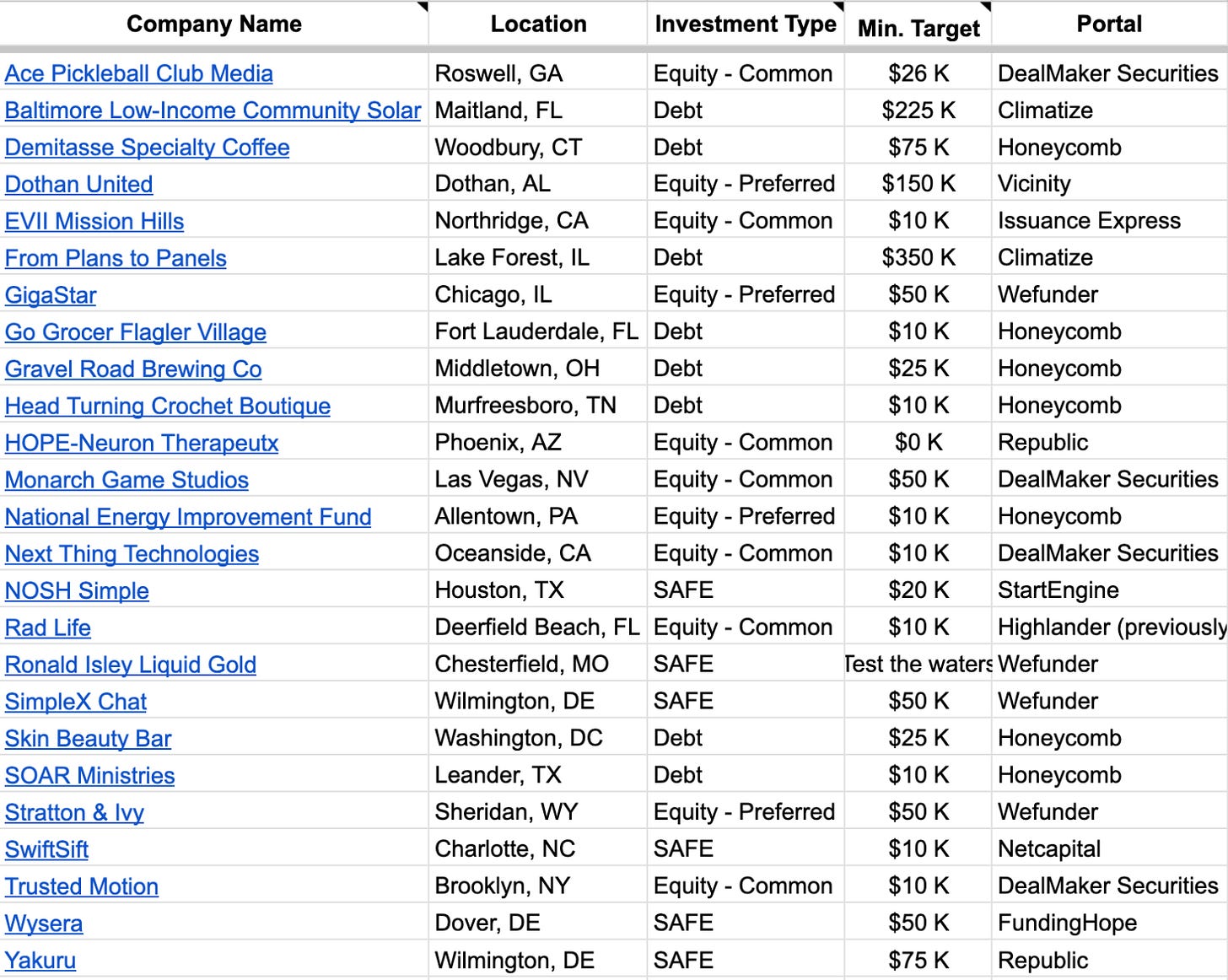
Below is our list of recently posted investment opportunities across the United States. Please note that our listing of these opportunities does not constitute an endorsement. Remember that all investments carry risk. Click on the hyperlinks and read the details carefully before investing.
Use the map below to help you find an investment opportunity near you. Each issue, we’ll highlight about a half dozen active campaigns.
Click the images below to view our comprehensive list of investment opportunities, organized by theme or region.
✔️ Energy 💡
✔️ Food & Farming 🌱
✔️ Housing 🏡
✔️ Great Lakes
✔️ Mid-Atlantic
✔️ Midwest
✔️ New England
✔️ Rocky Mountains
✔️ South
✔️ Southwest
✔️ West
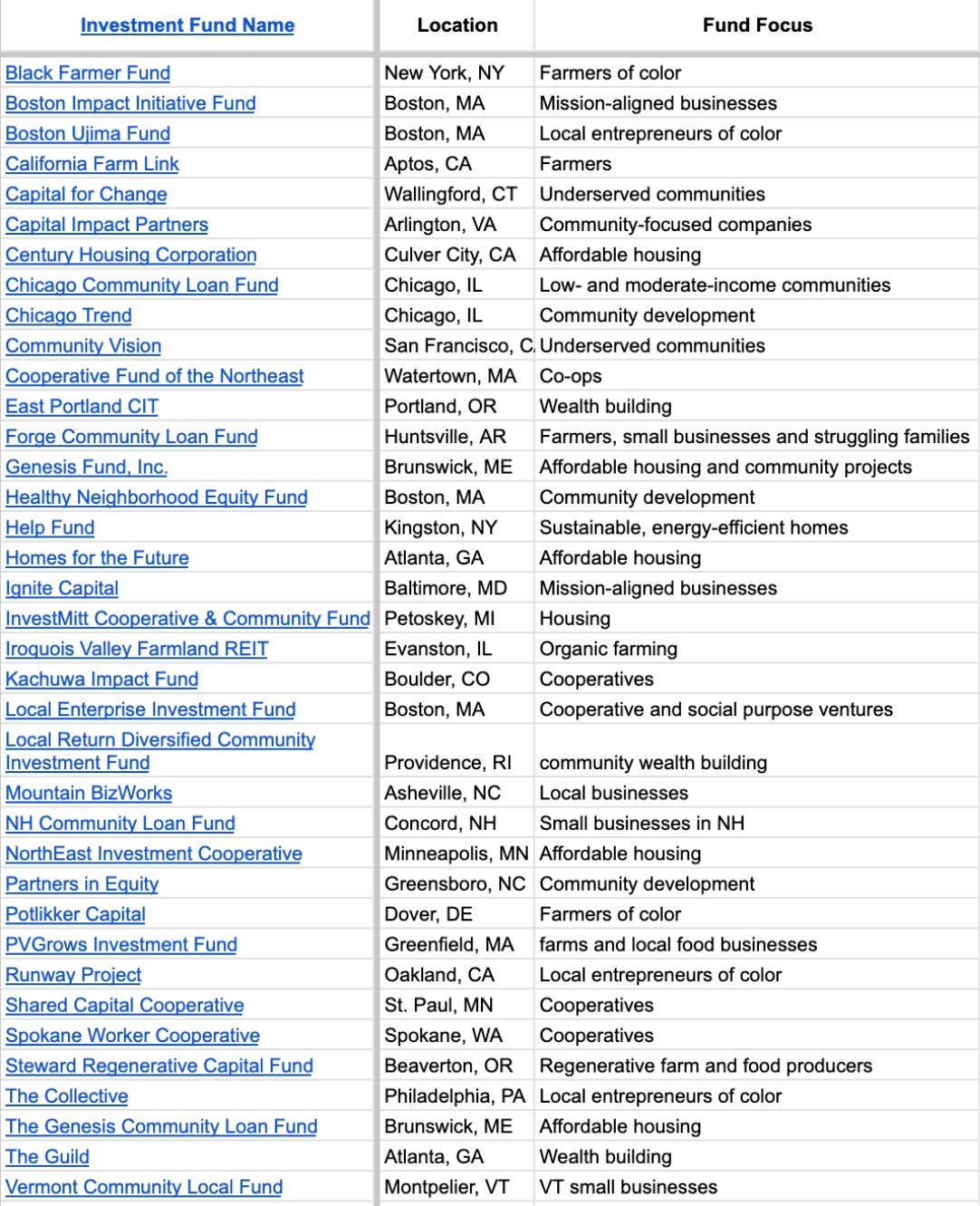
The following is our first draft of funds that invest in local businesses and are open to non-accredited investors. Please help us add to this list!
August 18: The Public Banking Movement in California - Virtual Event
August 19: Capital Ready: Building the Next Generation of Climate Resilience Hubs - Virtual Event
August 21-23: Wisconsin Permaculture Convergence - In-Person Event (Viroqua, WI)
August 25: Beyond Donations: The Real Power of Your Donor Advised Fund is Impact Investing - Virtual Event
August 25 - 27: SuperCrowd26 - Virtual Event
Starts August 31: Money & Banking for a Regenerative Economy - Virtual Course
September 15–16: Neighborhood Economics - In-Person Event (Galveston, TX)
Boston Ujima Project: Finance Director
Boston Impact Initiative: Director of Development and Investor Relations
Whatever your interest or ambition, we invite you to “go public” to help others in your region find you, scheme with you, and start a local investment movement in your community. We aim to identify dozens, then hundreds, then thousands of Main Street Champions like you in every corner of the globe. Together, we can move our hard-earned savings from Wall Street to Main Street, putting them to work in our own communities. Fill out the intake survey below to join this growing cohort!
The Main Street Journal aims to catalyze the movement of $50 trillion from Wall Street to Main Street, facilitating economic development and economic justice. It’s sponsored by the National Coalition for Community Capital. We welcome feedback on all aspects, from our design to our content. Please send your ideas to Jen Risley at jen@main-street-journal.com.
If you would like to support our work, please use the button below. Thank you!
Our Team:
Michael Shuman – MSJ Publisher
Paul Spinrad - Decent Tuesdays Writer & Editor
Jen Risley - MSJ Editor
Wendy Wasserman - Strategic Advisor
Abrams+Angell | American Independent Business Alliance | Candide Group | Capital for Change | Capital Institute |
| Community-Vision Solutions | Cordata Capital | Council Fire | Crowdfund Better | Crowdfund Capital Advisors | Democracy Collaborative | Eleanor LeCain | Exit to Community Collective | Fair Food Network | Garlic and Roses | IMBY | Impact Finance Center | ImpactPHL | Initiative for Local Capital | Institute for Local Self-Reliance | The Kassan Group | Longfellow Health Clubs | Mission Driven Finance | National Coalition for Community Capital | Natural Investments | Neighborhood Associates | Neighborhood Economics | New Majority Capital | Next Egg | Nonprofit Quarterly | Ownership America | Ownership Capital Lab | Ownership Matters | Partnership for Southern Equity | PathLight Law | Project Equity | Project for Public Spaces | Prospera Partners | Raise Green | Revalue | Rising Tide Capital | Schumacher Center for a New Economics | Shelterforce | Slow Money | SOCAP | Sun Valley Institute for Resilience | The Super Crowd Inc. | Sustainable Business Network of MA | Transform Finance | Uwharrie Bank | Village Well | Zebras Unite
We welcome any nonprofit or for-profit entity committed to local investment as a partner. If your organization is interested, please contact Jen Risley at jen@main-street-journal.com.
Comments
Nothing yet. Say the first thing.
Sign in to join the conversation.