
Dr. Zivot’s claim of MAiD “very likely” causing pulmonary edema is the biggest zombie myth about MAiD—It just won’t go away. It seems that no matter the weight of evidence against it, nor pointing out how weak his reasons are, we are going to be seeing this claim for the foreseeable future. So this will be our last post about this, unless someone provides compelling evidence that forces us to reconsider our position. We are trying to spend more time providing MAiD education, and less time continuously refuting the same claims over and over again.
For some time now, Dr. Joel Zivot has argued that the medications used in medical assistance in dying “very likely” causes pulmonary edema — fluid in the lungs — and that this amounts to a death “akin to drowning.” That claim began in the context of American executions by lethal injection, and has since been extended, repeatedly and publicly, to Medical Assistance in Dying (MAiD) in Canada.
We have addressed this claim before. But as it continues to circulate, we think it is worth taking a more careful look at where the claim came from, how it has been applied to MAiD, and whether any of the science or logic actually supports it.
This is the long version of this article. It includes the context, evidence, details, and footnotes we think are necessary to fully explain why we don’t find Dr. Zivot’s claim plausible. Unfortunately, that is often the deal when responding to MAiD misinformation: a harmful claim might take 50 words to state but takes 500 to properly refute.
For readers who want the shorter version, we have linked it below. You will lose some context and detail, but we want to respect your time by making that option available.

For those who have nothing better to do (like us) and want even more detail, we have put additional science, context, and calculations in the footnotes of this version.
Regardless of what version you read, the central point is straightforward: when you trace the steps from autopsy findings in American executions to claims about MAiD deaths in Canada, the argument becomes much weaker than its proponents suggest—actually, it falls apart entirely.
None of this should be necessary. Dr. Zivot made a claim based on bad science, using an extreme leap in basic logic. If he wants his argument to be taken seriously he needs to provide actual evidence, not just make suggestions and unsupported claims.
None of the sections below, on their own, prove that Dr. Zivot’s claim is wrong. That is not the point. The point is that the cumulative weight of the evidence, taken together, gives us every reason to dismiss his concerns outright—especially because, by his own admission, the claim is speculative, and he has not presented any solid evidence to support it.

Dr. Joel Zivot is an anesthesiologist who trained in Canada and now works in the United States. His concern about pulmonary edema began not with MAiD, but with lethal injection in American executions.
Dr. Zivot has long argued that physicians should have no role in capital punishment. It is a coherent concern in the context of executions. But his objection to MAiD does not begin as a neutral scientific inquiry. It appears to begin with his principled objection to physician involvement in causing death via capital punishment, which he then extends to MAiD based on superficial procedural similarities, because in his view, both involve clinicians injecting medication with the intention of ending life.1
That does not make capital punishment and MAiD ethically equivalent.2
That is where the pulmonary edema claim does important work for him. It turns a principled objection into a pragmatic-sounding scientific one. It allows him to move from “physicians should not participate in causing death” to “physicians may be causing a drowning-like death, so should not participate in MAiD.”
The problem is that Dr. Zivot is asking us to discount direct MAiD experience and evidence in favour of an extrapolation from a very different context: American executions.3
The pulmonary edema claim comes from two main sources: an unpublished paper Dr. Zivot co-authored on lethal injection autopsies in the United States, and his testimony to The Standing Senate Committee on Legal and Constitutional Affairs in 2021 on Medical Assistance in Dying.4
Zivot’s paper reviewed autopsy reports from 43 executed prisoners. It found pulmonary edema — fluid in the lungs — in 33 of them, or about 77%. The finding was more common in executions involving midazolam, but was also reported in executions involving pentobarbital.
From there, Dr. Zivot and his co-authors proposed that the drugs used in those executions may have caused acute injury to the lungs, leading to pulmonary edema and possibly making the deaths less peaceful than they appeared.5
Dr. Zivot’s analysis focused on the drugs used in American executions—only one of which is used for MAiD in Canada—administered in the context of capital punishment, often at very high doses and under protocols that are not the same as those used in Canadian MAiD. But after identifying pulmonary edema in autopsies of people executed by lethal injection, Dr. Zivot later applied that finding to MAiD in Canada. He argued that because MAiD also uses injected medications to cause death, the same kind of lung injury may be occurring here as well.6
To apply those findings to MAiD, he has to assume that the same basic phenomenon is occurring in a different setting, with different drugs, different purposes, different protocols, and different clinical observations.7
It’s not the controversial conclusions he makes that we take issue with, but the big leaps in logic he takes to get there. That leap is what we need to examine.
In the sections that follow, we will explore the medications involved in capital punishment in America, what Dr. Zivot believes they are doing in the body, and whether those claims actually translate to medical assistance in dying in Canada.
Dr Zivot’s concern about midazolam is the easiest part of this claim to set aside.
In his lethal injection paper, Dr. Zivot and his co-authors state that “it is intuitive that pulmonary edema in the three-drug midazolam protocol is caused by midazolam itself for several reasons.” They treat midazolam as a the main contributor because it is highly acidic (more on that later) and given in extremely large doses in execution protocols, often 500 milligrams.
That does not translate to MAiD in Canada.
Midazolam is used in Canadian MAiD at much lower doses, typically 10 mg and sometimes up to 20 mg. While this is higher than many routine sedation doses, it remains within the normal range for treatment of some medical conditions.
For example, the parenteral drug manual used by BC Women’s, Providence Health Care, and Vancouver Coastal Health lists midazolam as indicated for palliative sedation and refractory status epilepticus. For refractory status epilepticus, it gives an IV loading dose of 5 to 20 mg, repeatable every 3 to 5 minutes as needed, followed by continuous IV infusion if required.8 It also lists a palliative sedation loading dose of 2.5 to 10 mg IV, followed by continuous infusion, with infusion ranges up to 20 mg/hour.
So if 10 or 20 mg of midazolam caused the kind of acute lung injury Dr. Zivot suggests, we would expect to see that problem consistently in ordinary clinical use — including in seizure treatment and palliative sedation.
Concerns Dr. Zivot may have about the large doses of midazolam used in American executions are simply inapplicable to Canadian MAiD. The doses used in MAiD fall squarely within established clinical practice, where midazolam is routinely administered without causing the kind of lung injury he proposes. There is no credible basis to extrapolate from the extreme, non-therapeutic doses used in executions to the much lower, medically accepted doses used in MAiD.
One of the other medications used in the executions Dr. Zivot examined was pentobarbital, a barbiturate. Although he does not appear to treat pentobarbital as the main culprit in the same way he treats midazolam, his broader argument is that very large doses of highly acidic or basic substances administered intravenously may injure the lungs and cause pulmonary edema.
We can safely set aside concerns about pentobarbital in Canada as it does not appear to be approved for human use in Health Canada’s Drug Product Database, and we cannot find it in any Canadian MAiD protocol.
There is another barbiturate, phenobarbital, that appears in some MAiD medication protocols. But even there, its relevance is limited. In a Canadian study of 3,557 MAiD cases, phenobarbital was used in only 4 cases — about 0.1%.9 So even if someone wanted to argue that phenobarbital should not be used in MAiD, that would not support the much broader claim Zivot is making. It would not apply to the other 99.9% of cases in that study, where no barbiturate was used at all.
That leaves the real question: whether Dr. Zivot’s concern about large-dose barbiturates can reasonably be transferred to the medication most commonly used to induce coma in Canadian MAiD — propofol.
It is important to note that propofol is not a barbiturate, like pentobarbital or phenobarbital, nor a benzodiazepine, like midazolam. It belongs to a completely different class of medication, with a different formulation, pharmacological properties, and mechanism of action. We cannot simply assume that propofol will produce the same effects as either barbiturates or benzodiazepines—that would be bad science.10
Unlike his concerns about midazolam or barbiturates, Dr. Zivot’s implicit concerns about propofol cannot be dismissed as irrelevant to Canadian MAiD as easily. It is the medication most commonly used to induce coma, and it is administered at much higher doses than would normally be used for anesthesia.
For comparison, propofol standard induction dosing for general anesthesia is commonly in the range of about 1 to 2.5 mg/kg, depending on the patient and clinical context. In a 75 kg person, that would be about 75 to 190 mg. In Canadian MAiD, 1,000 mg of propofol is the most common dosage. That is several times higher than a usual anesthetic induction dose. Asking what happens at that dose is not unreasonable.
It is worth pausing on the scale of the comparison. Dr. Zivot is comparing MAiD doses of 10–20 mg of midazolam with execution doses of roughly 500 mg — a 25- to 50-fold increase. By contrast, comparing a typical induction dose of 75–190 mg of propofol with a MAiD dose of 1,000 mg is closer to a 5- to 13-fold increase. Those are not equivalent jumps in dose, and treating them the same exaggerates what can be inferred from the execution data.
But Dr. Zivot’s specific concern is not simply that the dose is high. His argument is about the possible toxicity of injecting very large amounts of highly acidic or basic substances into the bloodstream.11 In his paper, he writes that “injecting heavy overdoses of either acidic or basic solutions into the bloodstream may be directly toxic to pulmonary capillary endothelial cells.” That is the claim we need to examine.
The pH scale measures how acidic or alkaline (basic) a substance is, based on the concentration of free hydrogen ions. A pH of 7 is neutral. Lower numbers are acidic; higher numbers are alkaline. The pH scale is logarithmic, meaning each whole-number change (the difference between a pH of 3 vs 4, or 9 vs 10) represents a tenfold difference in hydrogen ion concentration. Therefore, the difference between a pH of 3 versus 5 represents a 100-fold difference; the three-number difference between a pH of 3 versus 6 represents a 1,000-fold difference; a difference of 4 is a 10,000-fold difference, and so on. The same general principle applies when comparing substances with higher pH values, which have correspondingly lower concentrations of free hydrogen ions and are described as more alkaline (or basic).
Midazolam is highly acidic. Its pH is generally around 3 to 3.6. Pentobarbital, by contrast, is alkaline, with a pH around 9.6.
Propofol is very different. Canadian propofol product information describes propofol injectable as having a pH range between 6 and 8.5. That means propofol is not strongly acidic like midazolam, and it is not strongly alkaline like pentobarbital.
More specifically, propofol’s pH range is far closer to that of blood, which has a normal pH range of 7.35-7.45.
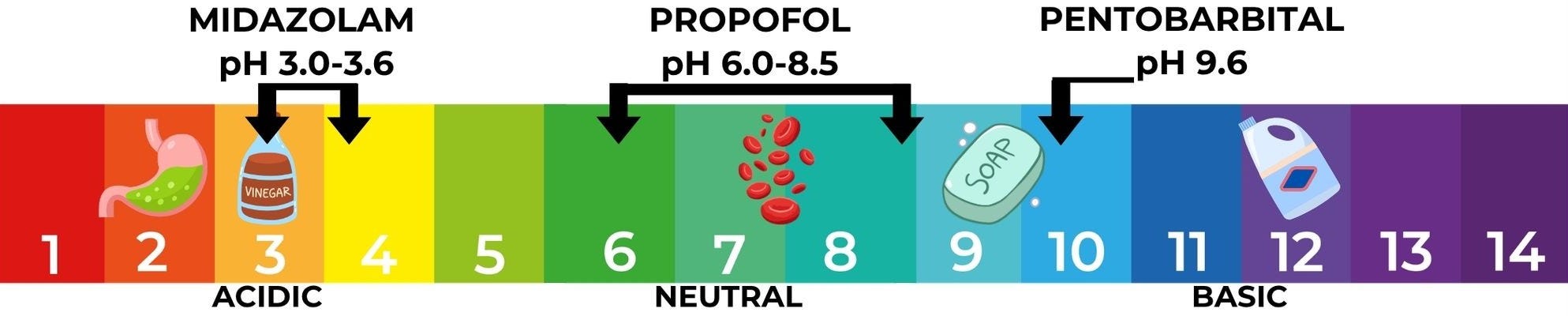
With pH being a logarithmic scale, the differences here are large. At the most extreme comparison, midazolam at pH 3.0-3.6 is far closer to stomach acid (1.5-3.5) or vinegar (1.0-3.5) than blood (7.4). Even using the narrowest comparison of midazolam at pH 3.6 and propofol at pH 6, midazolam is 251 times more acidic as propofol.12
The most favorable comparison with pentobarbital is also significant. Pentobarbital at pH 9.5 is about 10 times more alkaline than propofol at pH 8.5.
So on the face of it, this is not an apples-to-apples comparison. Propofol is used at a high dose in MAiD, and we can have that discussion. But if Dr. Zivot’s concern is specifically about the damage caused by injecting highly acidic or alkaline solutions, then propofol does not resemble the drugs he is relying on—and particularly midazolam, the drug he specifically credits in his pulmonary edema claim. Propofol is neither highly acidic like midazolam nor as alkaline as pentobarbital.13
Dr. Zivot never addresses this difference. For him, it seems enough to simply make the claim and assume it stands on its own. But that is not how science or medicine works.
There is another problem with relying too heavily on pH: pH alone does not tell us how much injury a substance will cause once it enters the bloodstream.
Normal blood pH is tightly regulated, usually around 7.35 to 7.45. That narrow range is important. If blood becomes too acidic or too alkaline, normal bodily functions can be impaired; if the change is severe enough, it can be life-threatening.
That is why the body has powerful buffering systems. These systems help neutralize acids and bases introduced into the blood, keeping blood pH within a safe physiological range. The more acidic or alkaline a substance is, and the more of it that is introduced, the harder the body has to work to buffer it.
But even that is not the whole story.
What matters is not only the pH of the substance or the amount of it injected, but also whether it can continue contributing acid or alkalinity as the body tries to neutralize it. pH tells us how many hydrogen ions are freely available at any given moment. It does not tell us whether the substance has a hidden reserve that can replenish those ions as the initial ones are buffered away.14
One way to think about this is as a warehouse. The pH is like looking at the boxes sitting on the loading dock. It tells you what is immediately available. But it does not tell you whether there is a warehouse behind the dock full of more boxes ready to be moved forward. A substance may have only a certain number of free hydrogen ions available at first, but as those are neutralized, it may be able to release more. That “reserve” is an important part of assessing whether a substance can overwhelm the body’s buffering system and cause significant damage.

This is one of the major gaps in Dr. Zivot’s analysis. That highly acidic or basic substances can cause tissue injury is true in a general sense. But that does not answer the relevant question: whether propofol, with a pH much closer to physiological normal, carries enough total acid or base burden to overwhelm the buffering capacity of blood during MAiD and cause injury.
That cannot be answered by pH alone. It requires comparing the substances themselves—their dose, concentration, formulation, rate of administration, acid or base reserve, and interaction with the buffering capacity of blood.
Dr. Zivot does not appear to do any of that. He moves from the general statement that extreme pH can cause injury to the more specific suggestion that propofol is “very likely” causing pulmonary edema in MAiD. But propofol is not highly acidic like midazolam nor alkaline like pentobarbital. It is a completely different medication, in a different formulation, with different chemical properties.
Making that leap requires far more evidence than Dr. Zivot presents—and it must be evidence about propofol specifically.
One of Dr. Zivot’s more careful arguments is that we cannot infer a person’s internal experience from outward stillness alone. This concern is usually tied to the effectiveness of propofol and the administration of rocuronium, a neuromuscular blocker—a paralytic—used in Canadian MAiD.
In a narrow sense, that is true. Once rocuronium is given, the person cannot move or breathe. A paralyzed person may appear still regardless of what they are experiencing internally.
If rocuronium were given after a sedative such as midazolam alone, that concern would be entirely reasonable.15 Midazolam is not a general anesthetic and is not—and cannot be—relied upon to produce the deep unconsciousness required for procedures like surgery or MAiD. A person given only midazolam and rocuronium could be paralyzed without being fully unconscious.
But that is not how Canadian MAiD is performed. Midazolam is given as a moderate sedative, then propofol is administered to induce a deep coma. Only when the coma is confirmed is rocuronium given.
Propofol is the same medication routinely used to induce general anesthesia for surgery, only at significantly lower doses than for MAiD (5 to 13 times lower). The relevant question is therefore not whether rocuronium on its own can mask distress. Of course it can. The question is whether propofol has already produced a medically induced coma before rocuronium is administered, therefore preventing the person from having any awareness of the rocuronium being administered.
Remember, the onset of propofol is about 30 seconds, and the full 1,000 mg dose for MAiD takes approximately 2 to 3 minutes to administer. Once coma is confirmed — and only then — is rocuronium is administered.
If propofol reliably produces a coma at MAiD doses, then the rest of Zivot’s hidden-suffering claim becomes irrelevant. Even if, for the sake of argument only, pulmonary edema were occurring after propofol administration (which it isn’t), the person would have absolutely no awareness of that once in a medically induced coma.
So for his argument to succeed, Dr. Zivot must keep alive the possibility that propofol at MAiD doses may not reliably induce a coma and the resulting lack of awareness. And that is why his written submission to the Senate committee is so striking. He states that “Propofol may or may not induce a state of lack of awareness when injected as specified in MAID.”
That claim is difficult to reconcile with ordinary anesthetic practice, and especially when an anesthesiologist is stating it. Propofol is routinely used to induce general anesthesia. In that setting, anesthesiologists rely on doses far smaller than those used in MAiD before surgeons cut, dissect, retract, cauterize, and operate on the body.
Yet in the MAiD context, Dr. Zivot suggests that a dose many times larger “may or may not” produce lack of awareness.
That is the contradiction. Dr. Zivot’s professional practice depends on the ability of anesthetic drugs, often propofol, to render people unaware during surgery. Yet when the same drug is used in MAiD at a much larger dose, he presents that effect as uncertain enough to support claims of “very likely” hidden suffering.
Taken seriously, that inconsistency extends well beyond MAiD. If propofol cannot be relied upon to produce unconsciousness in MAiD, then that concern needs to be extended to all other clinical settings. Propofol is used every day to induce general anesthesia for surgery, provide deep procedural sedation, and as an option for palliative sedation at the end of life. Questioning its fundamental ability to render a person unaware in one context ought to raise the same concerns in all of them. Yet Dr. Zivot reserves that skepticism exclusively for capital punishment and MAiD.16
Conversely, if a person remained conscious long enough to experience severe respiratory distress from pulmonary edema before losing awareness, we would expect at least some observable signs of that distress during the administration of propofol, which typically takes 2-3 minutes to administer, and usually another minute before the rocuronium is given. But that is not the experience reported by clinicians who have collectively attended close to 100,000 MAiD provisions.
It appears that, Dr. Zivot has ignored expertise and experiences in favour of his own position seemingly based on nothing more than his intuition and prior beliefs.
This brings us back to where we began. Dr. Zivot appears to hold a principled objection to physician involvement in causing death of any kind. He is entitled to that view. The concern is that he appears to have transformed a principled objection into a practical claim about what happens during MAiD. And when that practical claim is examined against the pharmacology and the available evidence, it simply does not hold.
Even if pharmacology left room for doubt—which is doesn’t seem to—we can look at empirical evidence to refute Dr. Zivot’s hypothesis. When we actually inspect the lungs of people who have died by MAiD, the evidence points in a very different direction.
Side note: If Dr. Zivot truly believes there is a meaningful risk that propofol may fail to produce unconsciousness, that would seem to create a professional and ethical obligation to disclose that risk to his tens of thousands of surgical patients. We are curious whether he does.
Dr. Zivot has argued that the only way to refute his concern about MAiD causing pulmonary edema would be to perform autopsy studies on at least 200 people who died by MAiD. That is an interesting standard, given that his unpublished lethal injection paper reported pulmonary edema in only 33 of 43 autopsies, yet he asks for far more evidence to disprove the concern than was used to raise it in the first place.
Autopsies are not routinely performed after MAiD in Canada. In most cases, there is no reason to do one. The underlying illness is known, the MAiD procedure is witnessed, and the mechanism of death is understood.
But there is another source of evidence that is highly relevant: lung donation after MAiD.
People in Canada have donated lungs after MAiD, and those donations follow the intravenous protocol Dr.Zivot concerned about: midazolam, propofol, and rocuronium. If any of the MAiD drugs were causing severe pulmonary edema or acute destruction of lung tissue, lung donation after MAiD is exactly where we would expect that problem to appear.
In one Canadian study, 33 patients received lungs from MAiD donors between February 2018 and July 2021. Their outcomes were compared with 560 recipients who received lungs from non-MAiD donors. The study found that recipient outcomes using lungs from MAiD donors were excellent, and by some measures resulted in better outcomes.
Quebec data add to this. A CMAJ study of organ donation after MAiD from January 2018 to December 2022 reported 64 actual donors after MAiD and 182 organs transplanted, including 46 lungs.
More recent data from the Toronto Lung Transplant Program further reinforces this point. Between 2018 and 2025, the program performed 126 lung transplants using lungs donated after MAiD, representing 9.1% of all lung transplants performed during that period. Outcomes were comparable to lungs transplanted from other donor pathways, with no difference in short-term mortality or long-term survival.
These figures still do not represent the full Canadian experience. They reflect a limited number of provinces, centres, and time periods. Even so, they show that a substantial number of lungs from MAiD donors have been carefully assessed and deemed suitable for transplantation. While we do not have a single national count, the available data is already approaching the scale Dr. Zivot himself has suggested would be needed to meaningfully evaluate his concern.
Whether he would accept that evidence is another question.
These are not autopsies, but lung transplantation involves close examination of the organ. Donor lungs are assessed for function and suitability, including imaging, weight, bronchoscopy, oxygenation, and in many cases ex vivo lung perfusion.17 A lung filled with fluid or unable to exchange oxygen efficiently would not be found suitable for transplant. In fact, the available study data suggest that lungs from MAiD donors function at least as well as those from non-MAiD donors, and there have been no reports of these lungs being found unsuitable at a higher rate than normal.
Taken together, this evidence substantially weakens the claim that the Canadian MAiD protocol is “very likely” causing severe pulmonary edema. If the lungs were routinely being damaged in the way Dr. Zivot proposes, lung donation after MAiD would be expected to reveal that problem. It has not.
The timing of autopsies and transplantation is also important. The autopsies in Zivot’s execution paper occurred at least one day after death. By contrast, lungs donated after MAiD are recovered and assessed immediately after death is declared. That makes them far more relevant to the question of whether the MAiD medications are causing immediate lung injury or fluid accumulation.
One major failing of Dr. Zivot’s analysis is his failure to ask the obvious question after reviewing his results: how common is pulmonary edema in autopsy results?
This is important, because a result like Dr. Zivot found must be compared to a baseline that will inform us of just how “unexpected” a finding of pulmonary edema really is. He didn’t do that.
It turns out, pulmonary edema is one of the most common autopsy findings in non-MAiD, unexpected deaths. Findings in autopsies after sudden death have found some level of pulmonary edema and congestion in:18
72% (Case count unclear)
The cases above include a number of different causes of death, with the first four predominantly being cardiovascular, and the fifth being exclusively sudden death in epilepsy. The point being, “pulmonary edema is a common finding for most causes of death.”
Pulmonary edema is not a rare or specific autopsy finding. It is reported across a wide variety of natural and unnatural deaths and, by itself, does not establish that a person experienced drowning, suffocation, or severe respiratory distress before death.
The timing of the autopsy is also important. A growing body of forensic literature suggests that fluid accumulation within the lungs becomes increasingly common as the interval between death and examination increases. Some postmortem imaging studies have demonstrated progressive development of dependent pulmonary opacities and edema-like changes over time, consistent with normal postmortem hypostasis rather than injury occurring before or during death.
In a small sample size study (N=3), postmortem CTs (PMCT) were completed immediately after death and again several hours later. They found that “compared with immediate PMCT, delayed PMCT showed advanced dependent opacity and consolidation corresponding to congestive pulmonary edema.” This would suggest that some level of pulmonary edema is a natural postmortem change that develops between the time of death and when a autopsy is conducted.
If you thought, “An n of only 3?” that is a fair concern. Individual cases and small case series can be useful, but they must be interpreted cautiously. However, in this 2014 PMCT/autopsy study of 164 nontraumatic in-hospital deaths, Ishida et al. found that fluid in the airway was common and appeared to increase with the time elapsed after death. Fluid was found in the airways of many patients, including some who had no fluid around their lungs. In those cases, airway fluid was more common when more time had passed between death and the CT scan. The authors suggested that fluid may collect in the lungs after death and gradually move into the airways. In other words, fluid seen on a postmortem scan may have developed or shifted after death. It does not necessarily show what was present—or what the person experienced—while they were dying.
This study, and this study found the same thing: postmortem lung findings change over time. Repeated CT scans showed measurable changes in lung density, texture, and structure as the postmortem interval increased, consistent with progressive congestion, fluid shifts, edema-like change, and consolidation after death.
This raises an important question about the findings reported in Dr. Zivot’s execution paper. Because those autopsies were performed at least one day after death, at least some of the pulmonary edema observed may simply reflect expected postmortem changes rather than evidence that the execution drugs caused severe lung injury before death. It also means we should be cautious about interpreting any finding of pulmonary edema in isolation, whether after MAiD or in any other context. Before anyone could conclude that MAiD caused pulmonary edema, or that the person experienced it while dying, that finding would have to be weighed against all of the other available evidence.
This all points in the same direction: pulmonary edema is not an unusual or self-explanatory autopsy finding. It is common after death, and several postmortem CT studies show that lung fluid, airway fluid, gravity-dependent density, and edema-like changes can increase with time after death. A finding of pulmonary edema hours or days after death cannot be treated as a simple snapshot of what was happening at the moment of death — let alone as proof that a person was consciously drowning or suffering.
It was fair for Dr. Zivot to look at his lethal-injection autopsy findings and ask whether pulmonary edema could be occurring with MAiD. That is a legitimate question. But a question is not evidence. And so far, neither Dr. Zivot nor anyone else has produced any evidence confirming that pulmonary edema is happening with MAiD, or that it even might be.
To get from Dr. Zivot’s unpublished execution autopsy paper to the claim that Canadian MAiD deaths involve pulmonary edema or drowning-like suffering, too many things have to be treated as equivalent that are not equivalent, or outright ignored.
Capital punishment has to be treated as comparable to MAiD.
Massive execution doses of midazolam have to be treated as equivalent to much smaller, clinically accepted MAiD doses.
Pentobarbital executions have to be treated as informative about Canadian MAiD protocols that do not use pentobarbital.
Propofol has to be treated as though it shares the same relevant properties as drugs from entirely different pharmacological classes, despite having a different formulation, different chemical properties, and a different mechanism of action.
Propofol then has to be treated as though its higher MAiD dose creates uncertainty about its effectiveness as an aesthetic, even though propofol is relied upon every day to induce general anesthesia at far lower doses.
And successful lung donation after MAiD has to be treated as somehow less informative than delayed autopsies after American executions.
Those are not small gaps in evidence or logic.
Dr. Zivot is entitled to his ethical objection to medical participation in causing death. But an ethical objection is not evidence that MAiD medications are causing severe pulmonary edema, hidden suffering, or a death akin to drowning.
The evidence we do have — including the differences in drug protocols, the use of high-dose propofol before rocuronium, clinical observations and experiences, organ donation after MAiD and lung transplantation outcomes, etc. — does not support his conclusion. In fact, the evidence points strongly in the opposite direction.
If Dr. Zivot wants this claim to be taken seriously, he needs to produce evidence that can withstand even the most basic scientific scrutiny. He would need evidence that directly contradicts the overwhelming body of clinical, pharmacological, forensic, and transplant evidence we have reviewed and presented here. To date, he seems uninterested or unable to provide that evidence of his claims.
Until further evidence can be produced, we think this concern can be safely dismissed.
The ethical differences between MAiD and capital punishment could hardly be starker. One is imposed by the state as punishment; the other is requested by a capable person in response to intolerable suffering. People may still object to physician or nurse practitioner participation in MAiD, but that objection does not make MAiD ethically comparable to physician participation in an execution. Treating the two as equivalent erases the central facts that distinguish them: consent, capacity, purpose, suffering, and benefit to the person.
We didn’t attempt to contact Dr. Zivot for comment on this article. In a recent post by Colin Brewer on freethinker.co.uk, Brewer outlined a few of the questions we would have asked Dr. Zivot and did reach out to him for comment. Dr. Zivot’s response was “I have no comment.” We felt it was not worth the effort and time attempting to contact Dr. Zivot ourselves.
It is important to note that this is not a peer-reviewed paper published in a standard medical journal. This is, essentially, a self-published pre-print that “has yet to be evaluated and so should not be used to guide clinical practice.” This is not an uncommon practice for papers prior to being submitted for formal review and publication. What is important to know is that since this paper was uploaded in August 2022, it has not been formally published elsewhere, even though it appears to be written in a manner intended for publication in a journal. This would suggest to us that it either did not pass first review or peer-review at whatever journal it was submitted to, or it was voluntarily withdrawn or never submitted at all. Read into that what you will.
In the paper, the proposed mechanism is presented with some uncertainty. In testimony, however, Dr. Zivot’s language becomes much more categorical, stating that the lung fluid seen after pentobarbital executions could only have been a direct consequence of the injected drug. That certainty is difficult to justify from the evidence he had.
You may already see the problem. Dr. Zivot is taking observations from executions that use a fundamentally different drug regimen and extrapolating them to Canadian MAiD. That is pure speculation. As we'll see, the paper provides no direct evidence that the same mechanism occurs during MAiD.
In his Senate testimony, Senator Dupuis put the comparability problem to Dr. Zivot directly, asking whether it was reasonable to compare American executions with MAiD in Canada. Dr. Zivot’s answer was essentially yes: he regarded the protocols as fundamentally similar, despite acknowledging some differences. That is the premise we reject. The similarities he relies on are broad and superficial; the differences he minimizes are the ones that determine whether the comparison has any scientific, clinical, or ethical force.
A “loading dose” is a dose of medication given all at once, usually via an IV injection administered fairly rapidly.
Propofol is recommended as the first-line coma-inducing agent in all Canadian MAiD protocols we can find. Phenobarbital is only recommended when propofol is unavailable, or when there is a known allergy or adverse reaction to propofol.
It’s ok to ask the question, but to declare it to be “very likely” causing the same thing with no evidence is about as bad as scientific reasoning can get.
In testimony, Dr. Zivot moves from the familiar fact that propofol can cause pain at the IV site to the claim that this burning is occurring in the lungs. That is not a small inference. Pain at a peripheral IV site does not establish chemical destruction of pulmonary capillaries. Even Zivot, when pressed, described his claim about propofol as speculation. That matters because his public framing often lands much more strongly than that.
Because the pH scale is logarithmic rather than linear, a difference of 2.4 pH units does not represent a 2.4-fold difference. Instead, each one-unit change in pH corresponds to a tenfold change in hydrogen ion concentration. The difference between pH 3.6 and pH 6.0 is therefore calculated as 10^(2.4), which equals approximately 251. In other words, the pH 3.6 solution contains about 251 times more free hydrogen ions than the pH 6.0 solution.
It is also worth noting what Dr. Zivot is relying on when he writes “intravenous acid is known to cause diffuse lung injury in animal models.” The animal study he cites involved rats infused with hydrochloric acid for up to five hours. The diluted hydrochloric acid in that study had a pH around 3.8. Compared with propofol’s pH range of 6 to 8.5, that means the hydrochloric acid solution is at least 158 times more acidic than propofol, depending on which ends of the ranges are compared. Again, not apples to apples. Also, FIVE HOURS!
This is far more complex that we have room to discuss here, but the general point stands.
This is a point Dr. Zivot concedes himself: that a sedative like midazolam alone is not enough, like they use in American Executions. Good thing we don’t do that here in Canada.
One important limitation of this analysis is that people who die naturally would be expected to have a higher baseline prevalence of underlying pathology, including pulmonary edema, than those who undergo capital punishment. Individuals subjected to capital punishment are generally healthier than people dying from disease, whereas people receiving MAiD, by definition, have a serious and incurable illness, disease, or disability. People receiving MAiD therefore likely fall somewhere between these two groups, although probably closer to the natural-death group than to the capital punishment group. This is simply to illustrate that when people die, pulmonary edema is not an uncommon finding.
Comments
Nothing yet. Say the first thing.
Sign in to join the conversation.