
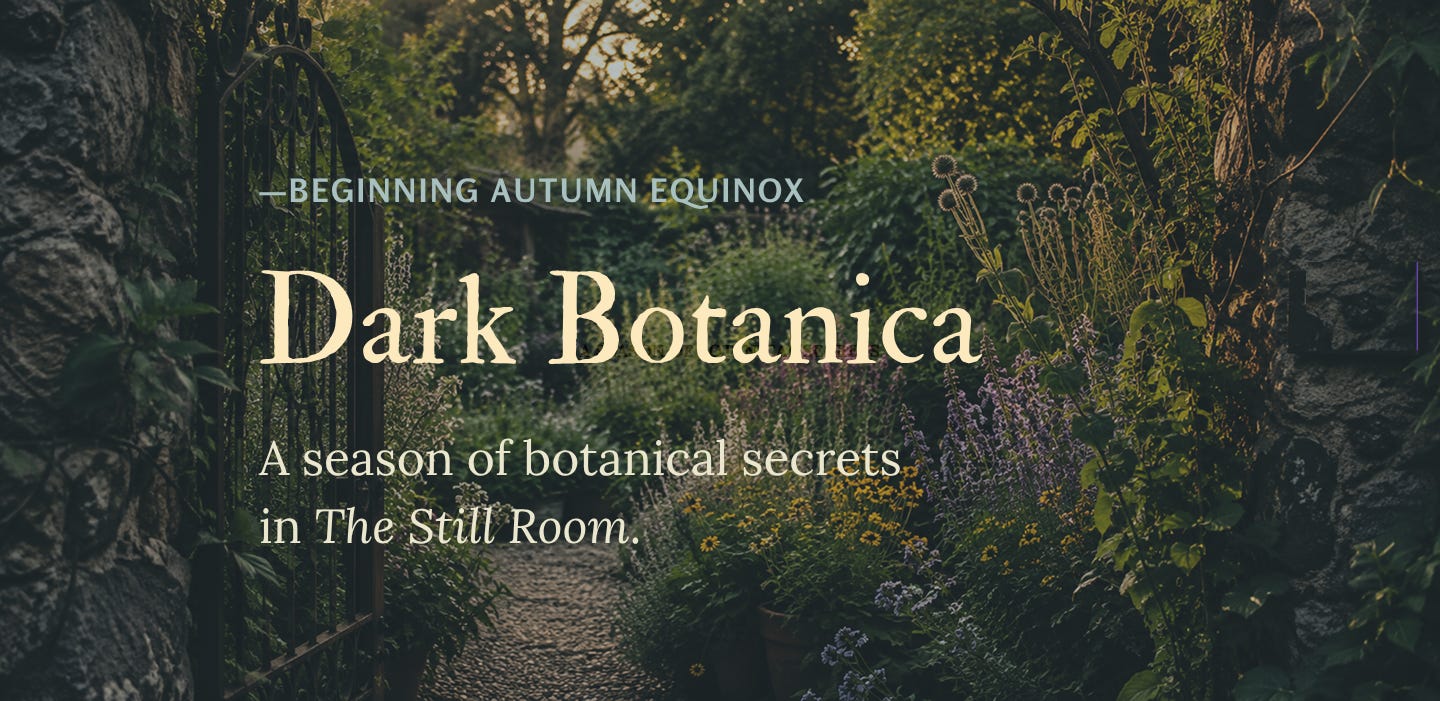
Join me in uncovering the secret stories of the green world! Starting on the autumn equinox, I’ll be sharing writing from a project I’m calling Dark Botanica. This is in support of a novel I’ll be quietly writing in the background. You’ll get a monthly themed essay in your inbox—no need to do anything! By becoming a paid subscriber, you’ll get access to the reading room (my variation on a book club) and get to look over my shoulder as I visit historic gardens and libraries, compiling my research notes.
When I was an apprentice in Ireland my teacher had a little room off the garden: opening the door was like stepping into Narnia.
It was my favorite room in the entire house.
Sometimes I would stand in that tiny alcove with my eyes closed, trying to identify the drying plants by scent: rose and elderberry, clary sage and peppermint. Shelves of tinctures, cordials, honeys, and floral waters lined the walls. Tools were neatly laid out, books alphabetically arranged.
It was a real place, but it was also a liminal space where reality and imagination co-mingled; where recipes whispered of untold stories; and where process was as prized as product.
I have wanted, my whole writing life, to recreate the feeling of working in that room.
Welcome to my attempt. I’m calling it The Still Room, which is the name you’ll now see on the masthead if you read my work on the Substack website.
If you’ve been around for a bit, you know I’ve struggled with the twists and turns of my own publishing career. What’s next? Self-publishing? Opening a bookstore (sooo tempting)? I keep reaching for something that doesn’t quite exist yet.
My mind sometimes goes to Lady Whistledown in Bridgerton. What would it be like to be a writer answerable only to her readers?
A newsletter actually is that. But, through writing this newsletter (and struggling to write this newsletter), I’ve realized I’m not a newsletter writer: I’m an author.
The difference is pacing. A newsletter runs, every week, into infinity, but a book is a project—a thing with a beginning, a middle, and an end.
My challenge this summer has been to find a way to change this writing space from a newsletter into something else… something more project based, a space where fact and fiction comingle. I needed to create a way of working that values process as much as product. Here’s the thing: I know from my previous addiction to Instagram that its fun to watch process. I can’t tell you how many hour I spent watching others renovate their hour or make paper or paint pottery. The final product feels more alive when you know the process.
So The Still Room will be process-based and the pacing will mirror the writing life of an author: a flurry of activity and then the fallow that follows. There will be ebb and flow. And—hallelujah! —there will be projects, little treasure troves of ideas thoroughly excavated, and (let’s be honest) obsessively researched. That’s my happy place.
I’ll announce each project so you can see the shape of my writing season and, hopefully, get excited to read, witness, and perhaps join in.
The first flurry of activity officially starts on the autumn equinox.
It begins with a… mood… one I’ve returned to over and over again, both as a reader and a writer. The mood is a little professorial, a little noir; it sits at the intersection of the garden and the reference room. I call it dark botanica.
Dark botanica is a search for the hidden garden — the histories, poisons, and mysterious stories that travel on underground runners through the green world. Dark botanica is dark academia… gone to the root, and seed, and flower. Its tone is threaded through my first book, The Illustrated Herbiary, and it also runs through the novel I started a few years back which I will be working on quietly in the background during the dark botanica season.
Of course, I’m far from the first to write from this particular mood. I would argue that dark botanica is a literary genre, one that already exists in the world and was just waiting to be named. It encompasses novels about herbal remedies and poisons, perfumes and plant hunters. It’s the stories of the women who illustrated the early herbals and the Victorian medical students who experimented on themselves to learn how botanical medicines work.
So many of my favorite titles touch on these themes. In my next post, I’ll send you my proposed list of dark botanica literary gems, and I’ll ask you for your suggested titles. Paid subscribers will be able to join me in “the reading room,” a monthly discussion of suspected dark botanica books. I’m so looking forward to having a dedicated space for book chats where we can discover the canon of the dark botanica genre together.
I’ll also be sharing my research notes as I craft stories and essays in the dark botanica mode, each month uncovering a bit of lost history, art, or plant lore and sharing it back. Sometimes I’ll write fiction, sometimes fact, often both. The continuous thread for this project will be the plants, the research, and the lost bits of knowledge.
My first Dark Botanica tale will appear on the autumn equinox, I’ll open the reading room in the next post. I’m hoping this will be good fun all around. The once a month essay will land in your inbox, no action needed. But I do hope you’ll join me for the deeper dive—the reading room and the research notes. The cost to join is about that of a hardcover book.
And so it begins!
xx Maia
Comments
Nothing yet. Say the first thing.
Sign in to join the conversation.