
This is a companion to the previous story — a reflection on what sits beneath the humour, and a look at how voice, structure and restraint shape what is revealed.
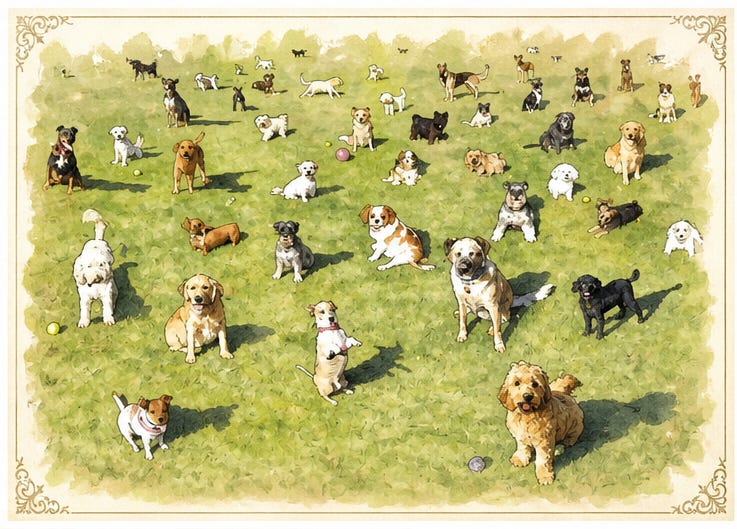
Dog school is, ostensibly, about obedience.
Sit.
Stay.
Heel.
Dominance.
But as Roberta begins to suspect, the dogs are not the only ones under instruction.
There is a particular theatre to these spaces – the tidy hierarchies, the club presidents, the whispered alliances, the subtle competitions. The cups of tea and perfectly loaded scones. The unspoken codes.
Who belongs.
Who is ‘correct’.
Who is a blow-in.
Shingy may be the unruly one, but Roberta is the real disruption.
She laughs at the rules.
She misreads the emails.
She speaks out of turn.
She notices the absurdities.
And she refuses to be shamed – whether by Lady King Charles, Head Trainer John, or the social choreography of the veranda.
What delights me about this story is not simply the humour. It’s the layering.
Ageing women, sexuality, companionship, domestic chaos – all rendered without apology.
Roberta’s brisk views on men and dogs may be outrageous, but they carry a kernel of truth: we are trained – subtly, constantly – to perform acceptability.
And yet here are two women in their sixties and eighties discussing sex, husbands, incompetence, and canine misdemeanours over tea and jam scones.
No blushing.
No shrinking.
No permission requested.
Connection, in this story, is not romantic.
It is conspiratorial.
It is female.
It is the shared glance that says: we see the structure – and we see through it.
Perhaps that is what humans learn at dog school.
That dominance is often a performance.
That obedience is negotiated.
That loyalty can coexist with independence.
And that sometimes, the most radical act is simply refusing to be embarrassed.
What did you notice in this story?
The satire?
The social pecking order?
The sexual candour?
The generational contrast?
Or the fact that, in the end, it’s never really about the dog?
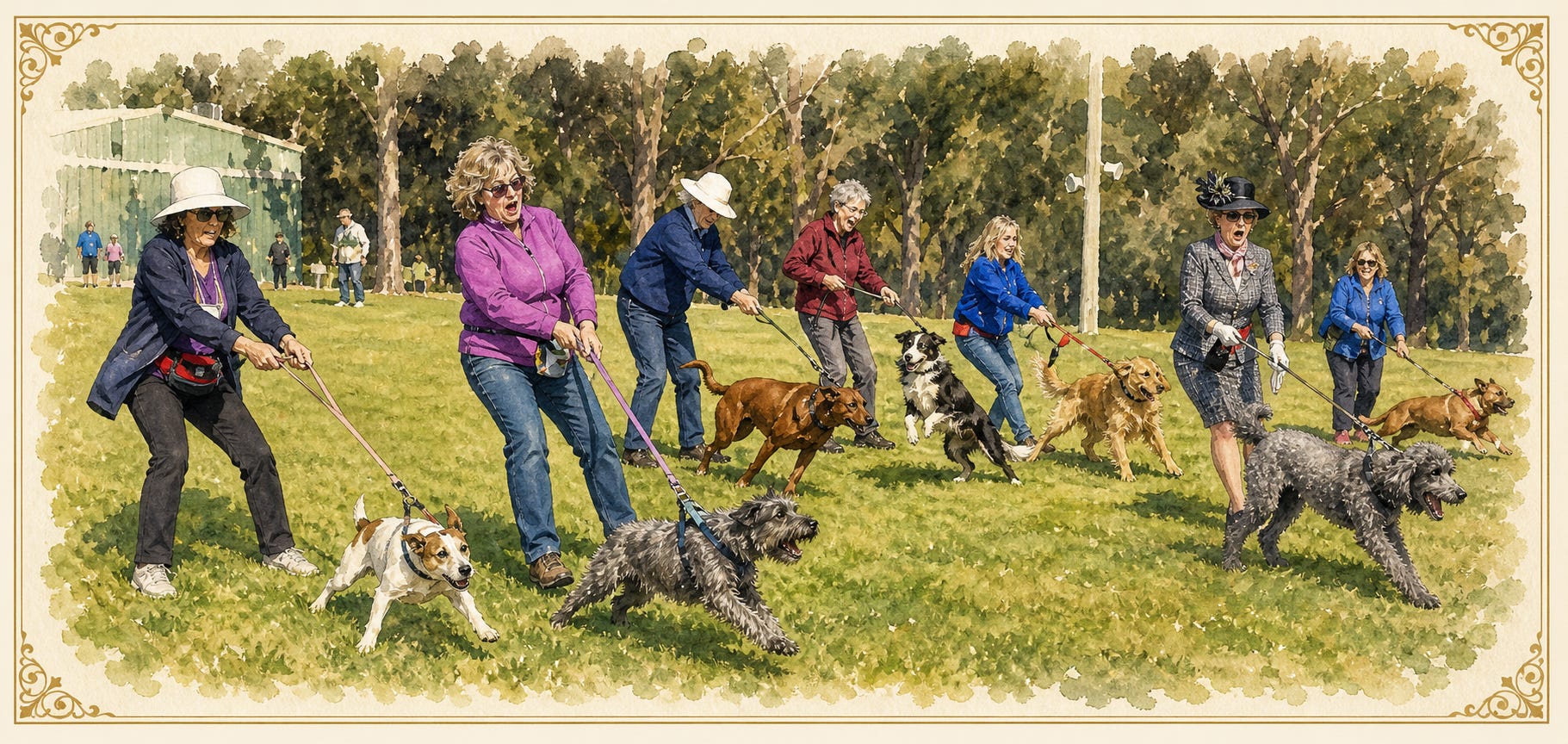
On the surface, What Humans Learn at Dog School is comic.
A Labrador misbehaves.
A president bristles.
Scones are deployed like social weaponry.
Elderly women discuss sex without embarrassment.
But the comedy depends on the structure.
The story is built around control — who has it, who performs it, who pretends to have it.
Dog school itself becomes a stage.
There are uniforms of a different kind: neat trainers, tidy teacups, the choreography of hierarchy. The president. The head trainer. The blow-in. The probationer.
I wanted the setting to feel almost ceremonial.
Order is declared loudly.
Dominance is named.
Whistles blow.
And into this environment strides Roberta — who refuses to take any of it entirely seriously.
Craft-wise, her voice is crucial.
She is observant, irreverent, slightly outrageous. The humour comes not from punchlines, but from collision — between formal structure and human messiness.
Dialogue does much of the work here.
It had to feel brisk and slightly breathless, especially between Roberta and Pamela. Their exchanges carry sexual candour, domestic chaos and conspiratorial warmth — without apology. I pared the dialogue back so that it reveals character rather than explains it.
Timing is everything in comic prose.
The reader must see the dominance display, then immediately see it punctured. The pristine King Charles spaniels topple. The president mutters. The head trainer postures. And the women observe.
Importantly, the story never fully condemns the system.
It simply exposes it.
Roberta is not rebelling in grand gestures. She is laughing. She is noticing. She is refusing to be embarrassed.
That restraint matters.
Satire can turn sharp and bitter very quickly. I wanted this story to remain buoyant. The social choreography is absurd — but recognisable.
And beneath the humour sits a quieter question:
Who is being trained?
The dogs?
The women?
Or all of us, in subtle ways, to conform to structures we barely examine?
If the story feels light, that lightness is deliberate.
It allows ageing, sexuality and female companionship to exist without solemnity.
Sometimes connection is forged not through confession — but through shared amusement.
Comments
Nothing yet. Say the first thing.
Sign in to join the conversation.