
Good morning. Is publication on a Friday evening more or less of a betrayal of the timing originally promised for this weekly notebook than a Saturday morning? No comment. Anyway…
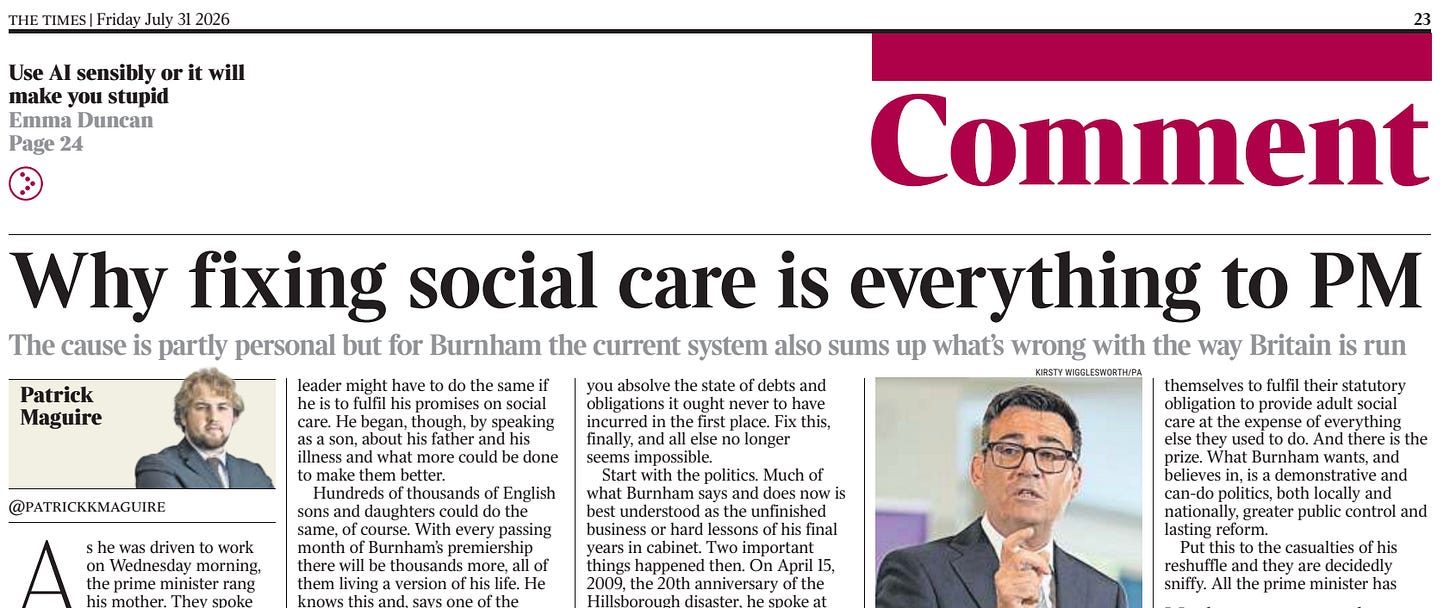
In my Times column this week I explain why Andy Burnham is – in his words – willing to spend so much political capital on social care. Put the abject state of the sector aside for a moment, as governments have done repeatedly for thirty years, and the perverse but powerful incentive for any prime minister is to leave well alone. After all, any meaningful solution will inevitably involve the outlay of actual capital – lots and lots of it – and the process of finding that promises lots and lots of political pain.
So why is Burnham doing it? Part of the reason is personal, though of course his own family’s experience of the care sector is by no means uncommon. That, after all, is why someone, at some point, is going to have to solve this thing once and for all. A couple of weeks ago, when I interviewed him on the eve of his arrival in No 10, he told me of his father’s dementia and the faint shadow of sadness it would cast over the next day’s jubilation.
Roy Burnham is not a Catholic, but he is a Labour man, always — the “most political” of Burnham’s parents. It was he, really, who set him off: on a drive from Culcheth to Chester Zoo, not long after the 1979 election. On the car in front of them, a sticker: “Don’t blame me, I voted Labour.” Burnham asked Roy what the words meant. “Well,” he said, “there’s this woman called Maggie Thatcher…”
Roy cannot now know that his son, as prime minister, was now committed to overturning every wrong he thought Thatcher had done to his native city of Liverpool: to the broken industries and their workers, like the striking miners Burnham passed at Parkside colliery, beside his school in Newton-le-Willows. Roy was always “very much to the left” of his famous son. His illness has denied him the sweetest victory of all — learning that Burnham has converted, if only relatively late in life, to the cause of proportional representation (PR).
His boy says he is relaxed, happy — at last confident and comfortable in his own skin. But even Burnham’s moment of personal triumph, dismissed a thousand times as impossible by the critics he insists do not understand him, will be discoloured a little by sadness. “We were with him last Sunday,” said Burnham. “We were at his care home. My two brothers were there, my mum was there. So, all five of us together, which was a nice thing.” His youngest daughter joined them.
Burnham is less sad than stoical. So many British families will recognise their own story in his. He slows down. “We were talking about it, but I wish I could say whether it was …”
The one thing he says he will not do in office is pretend, or dissemble, or find a neat, expedient phrase for the sake of it. It would be easier to demur now, on this most personal of questions, but he doesn’t. “I don’t think he’s ever realised, because of his condition, that I’ve come round to PR, which is one of his missions — to get me to accept that.”
But this moment will belong to Roy too. “It’s a family achievement … although he doesn’t know it, it still makes me feel that we’ve kind of done something together.”
On his way up from Westminster to Jewish Care in Golders Green on Wednesday morning, Burnham rang his mum. They spoke about his dad, and then he told the country about him too. So, yes, it is to some extent personal – but he won’t be the last middle-aged prime minister to have their own story to tell on this front. But what his decision to prioritise social care reform really reveals – or distils – is his critique of state failure and economic dysfunction.
As I explain in the column:
Policy wonks like to talk about the “housing theory of everything”. Point at a problem with the British economy — stagnant growth, low productivity, wealth inequality, overstated GDP — and the explanation lies in our dysfunctional housing market. If Burnhamism has an equivalent it is surely social care. To the prime minister, it looks like a twisted bundle of original sins: petty partisanship, privatisation and the death of municipal England. Untangle it, the argument goes, and you absolve the state of debts and obligations it ought never to have incurred in the first place. Fix this, finally, and all else no longer seems impossible.
Social care reform allows – requires – him to confront those three original sins head on.
Petty partisanship. So much of what Burnham is saying and doing now, as prime minister, is informed by what he couldn’t do – felt he shouldn’t have done, did too late – as a New Labour cabinet minister. 2009 and 2010 are particularly formative. The heckles of the Kop over Hillsborough, the Tories kicking his “death tax” to bits and wrecking any chance of cross-party care reform: both told him politics as usual was incapable of delivering the change for which people were really desperate. Much of what has followed in Greater Manchester and now Westminster can be traced back to those two episodes. As James Purnell put it in a note to No 10 staff this week, this PM has a real “determination to do politics differently”.
Privatisation. Burnham’s theory of power – which I wrote about in The Times and on here the other week – is that privatisation, austerity and centralisation have created an “unaccountable state”. And what is less accountable, or subject to public control, than whatever our care sector now is? From the column: “What we have now is a mess of patchy and overstretched local authority services, charities and private providers — owned, in many cases, by American venture capital and private equity funds… if Burnham’s vision of England has an opposite, it is surely BlackRock making a handsome profit off your nan.”
The death of municipal England. Simple enough: councils are broke and forced into unpopular, trust-sapping cuts to service provision once taken for granted by residents – and, for that matter, into selling off the things people care about – because their statutory obligations reduce them to little more than adult social care providers.
Former cabinet ministers are grumbling privately that Keir Starmer was doing this anyway, and that, in the end, politics won’t be done differently by a Conservative leader who will surely, surely just attack a Labour government for trying to raise taxes in a very old-fashioned way. We shall see when Louise Casey comes back with her report next year. But if you want to understand Burnham, his politics and priorities, and the emergent rhythm of his premiership, the care sector is a good place to start.
Jonny Ball wrote a great piece in UnHerd the other week. The only mark it lost was for the headline: “Andy Burnham’s potemkin radicalism.” It ought to have just said: “Andy Burnham is a wool”. If you don’t know what that means, it’s what Scousers like Jonny call people like me – from Southport, or Formby, Runcorn, Widnes or anywhere else in Liverpool’s orbit that isn’t actually Liverpool.
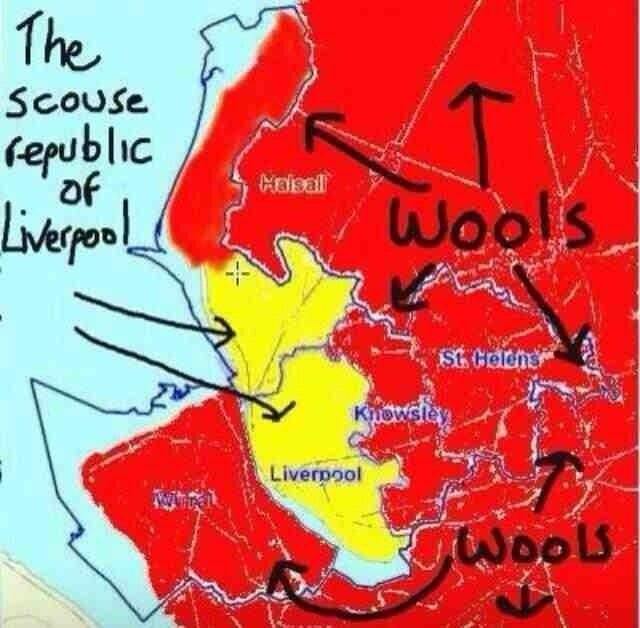
Burnham was born in Liverpool but the standard biography of his life notes he moved to Culcheth, near Warrington, as a boy. He went to school in Newton-le-Willows. I think most Scousers would agree there is no such thing as birthright citizenship so this, I am afraid, is just pure wool. It’s what the godawful impressions of him doing the rounds get wrong. There’s a Liverpudlian inflection to this south Lancashire voice – how strong it is depends what kind of wool you are – but it’s not Scouse. And it’s definitely not Manc either. It’s certainly not the sub-Ringo drawl one comedian is trying to popularise.
I digress but if I don’t call out this pernicious wool erasure, nobody will. Anyway: I was intrigued to see Bill Esterson, Labour MP for Sefton Central, tweet a video on Friday that Burnham had spent some time living in Formby as a kid.
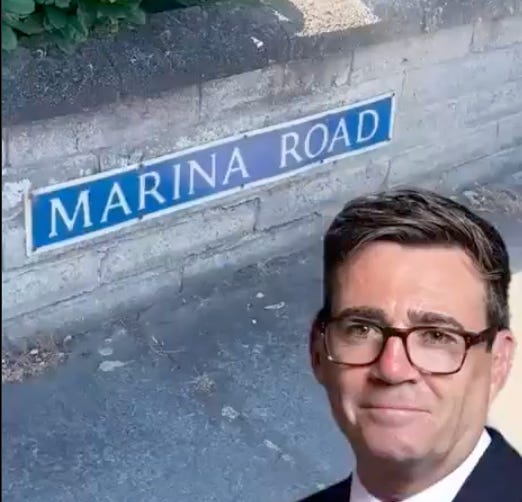
I hadn’t seen any reference to this before. Presumably because it would leave Burnham with no plausible claim to be anything other than a wool. But that’s nothing to be ashamed of.
For one week only, Gabriel Pogrund returned to the State of It on Tuesday. It was just the two of us, with much to discuss. Was this the week – as The Guardian mistakenly said of a Thursday in April 2015 – that the polls turned?
Some of them have, if not that decisively, in Burnham’s favour. I was on the Times news pages on Tuesday morning reporting on a couple of them: YouGov had Labour level-pegging with Reform, More in Common recorded a four-point lead and called the Greater Manchester mayoral contest as a landslide for Bev Craig. Survation has Labour two points ahead of Reform, BMG five. FindOutNow and Deltapoll both have the two parties level.
Labour on the up, and strolling home in Greater Manchester. Reform dipping beneath 25 per cent. The Greens in freefall. All unthinkable six months ago, when Burnham had been blocked from running in Gorton and Denton and allies of Sir Keir Starmer were telling me, sincerely, that the then mayor was willing to “put fascists in charge of Greater Manchester Police” so long as he scratched his parliamentary itch.
Look beneath the bonnet of almost every poll published in the last week and the same story recurs: Burnham is squeezing the Greens and the Lib Dems and reuniting at least some of the electorate’s progressive family. If this is sustained – particularly that Green decline – the really interesting question is what it does to discourse on the right.
Earlier this week I spoke to a Reform strategist who argued that a run in second place needn’t be a bad thing. The optimistic case: less internal pressure from Tory defectors to moderate and cost populist policy, particularly on economics, and a chance to recapture Farage’s old insurgent energy.
Eventually, election results will prove the Conservatives are still a much diminished if not moribund force in most of the country – see the Norfolk police and crime commissioner election earlier this month – and eventually voters on the right will twig that, in all but a few dozen constituencies, the most straightforward way to eject what may yet turn out to be an effective Labour government is to vote Reform.
As I say at greater length in the podcast, I think this argument is worth taking seriously even as Farage continues to endure a noisy, scratchy few months: there are few signs that Reform’s core vote is disappearing. If anything, his closest allies say, the perception of an all-out establishment assault on their man may well lock it down.
But it all depends on them staying in second. The pessimistic case from smart Reformers is that the only guarantee of that is a wholesale change in approach – back towards a catch-all, vibes-led populism. Is it too late?
If you know nothing of the GAA or indeed Ireland, I recommend reading this New Statesman essay on the emigrant’s experience of the All-Ireland final by Luke O’Reilly. Reflective, humane, exquisitely observed. Much for the Irish in Britain – whether you are two generations removed from the boat or none from the plane – to recognise here. This, I thought, was particularly well put:
In the US, Irishness has a habit of surviving the generations. In England it dissolves like salt in water. Given enough time, it disappears, only leaving behind a slightly sharpened aftertaste.
And this paragraph, on the now-broken Mayo curse, reminded me very much of one of the first books I read this year: the 1998 second edition of Moral Monopoly, Tom Inglis’s in-depth study of how Ireland became Catholic and how that Catholicism, in turn, was uniquely Irish. It’s occasionally heavy-going and a little repetitious, as academic books sometimes are, but still very much worth reading if you care to go beyond moralism and cliché. Inglis I mean, not O’Reilly. Anyway:
The version I grew up with mixes the pagan with the Christian, the priest taking a role just as easily filled by a witch. Irish Catholicism has deeper roots than those dug by the monks who first came here. Saints and holidays were plastered over pagan gods and feasts. The same people who prayed the rosary every day would refuse to cut down a whitethorn tree. One of our patron saints, St Brigid, shares the same name, and much of the same story, with a Celtic goddess. Scratch the spiritual and the supernatural lies just beneath the surface. But as the years following the curse passed, the country changed around it. Ireland became richer, more progressive and less inclined to accept stories about broken funeral rites. With the curse’s end, another small piece of old Ireland slips away.
Inglis writes of three kinds of Irish Catholicism: magical-devotional (see above), legalistic-orthodox and individually-principled. It’s the first, as O’Reilly says, that probably left the stickiest cultural residue in rural Ireland: not for nothing did Edna O’Brien call one of her novels on girlhood in the country A Pagan Place. The popular legitimacy of the second took a largely deserved battering in the last couple of decades of the 20th Century. The third, with all the latitude and selectivity implied by the words “individual” and “principle”, is surely most common these days – certainly among the Irish in Britain.
See the prime minister, for one.
This, from William Davies’ Substack, might be the best single-paragraph summary I’ve read on why Starmer failed.
If Starmer offers anything to political theory, it’s as a kind of ‘negative political theology’, an avatar of what happens when politics is denied, refused or relegated. Starmer’s absence could be felt and witnessed across three different aspects of political leadership: appetite, destination, ideology. It wasn’t clear why he wanted to be Prime Minister (appetite), it wasn’t clear what he wanted to do with power (destination) and it wasn’t clear why or with what justification he wanted to get there (ideology). It was this triple vacuum that made him such a bewildering figure, psychologically as much as politically. There weren’t even any significant stories of psychological frailty, sensitivity, rage or rupture, that usually leak out from centres of political power, simply because politicians are such unusual psychological specimens. It felt like there was no there there.
The full piece, which applies this same analysis to other prime ministers, is very much worth your time. See you next week.
Thanks for reading Patrick Maguire Syndrome! This post is public so feel free to share it.
No posts
Comments
Nothing yet. Say the first thing.
Sign in to join the conversation.