
How Time and Capital Can Both Build Retirement Income
Welcome to this week’s MP Market Review, where we demonstrate the real-world application of our dividend growth investing (DGI) process using real money, real positions, and real results.
This week, we look at two investors approaching retirement from very different starting points. One has less capital but more time to compound, while the other has more capital but less time before retirement. We show how both can use the same disciplined dividend growth strategy to build a reliable and growing retirement income.
IN THIS ISSUE DGI Clipboard • DGI Scorecard • DGI News • DGI Updates • Earnings Releases
“My life has been a product of compound interest. Nothing more. Nothing less. And nothing brilliant.”
- Warren Buffett
Time and Capital Can Both Build Retirement Income
Not every investor begins the journey to retirement from the same starting point.
One investor may have relatively little capital but 20 or 30 years to invest. Another may have accumulated substantial savings but plans to retire within the next five years.
Their circumstances differ, but both can use dividend growth investing to build a reliable, growing retirement income.
Less Capital, More Time
For the younger investor, time is the most valuable asset.
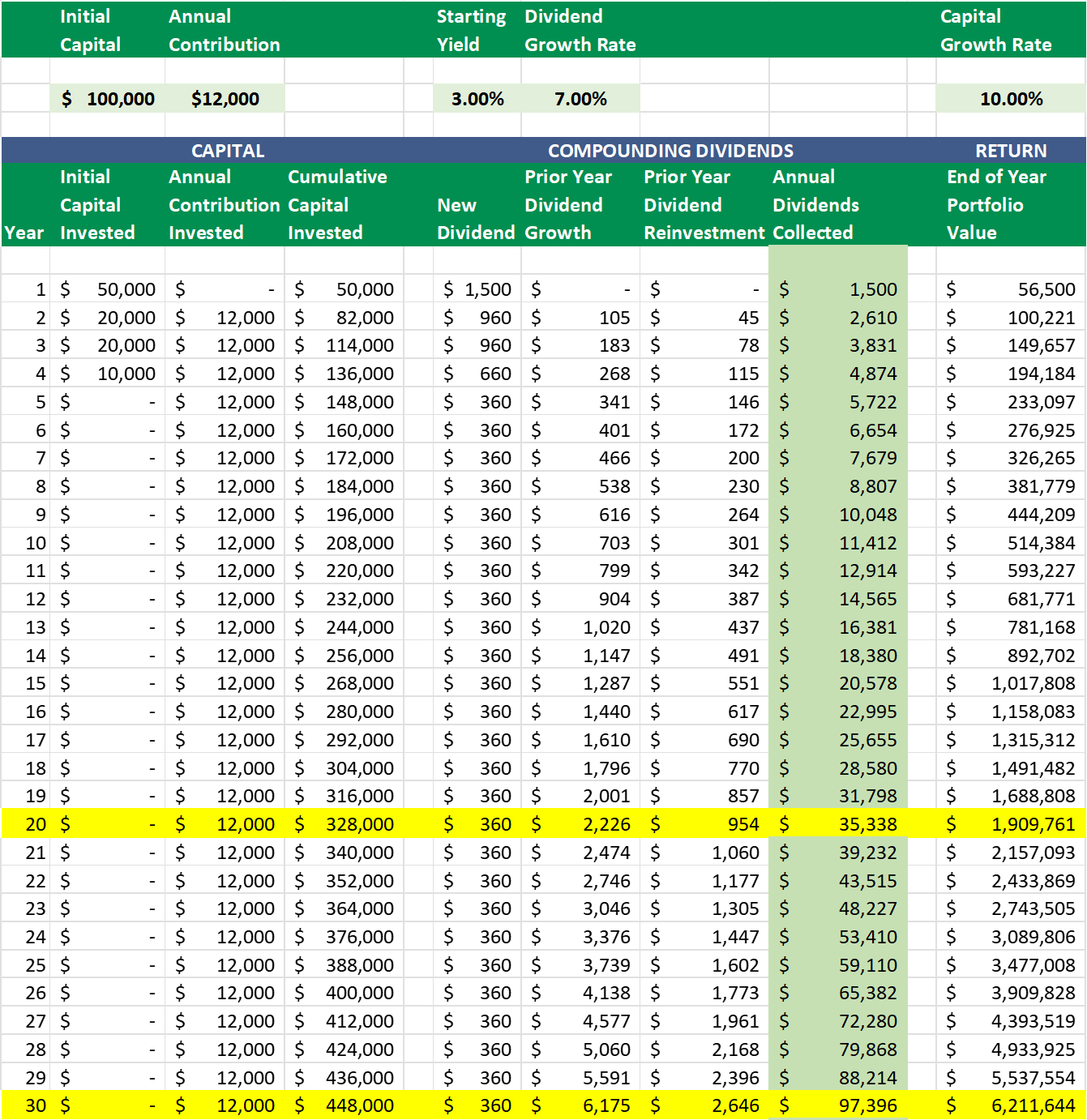
Imagine someone with $100,000 to invest and 30 years until retirement. Their portfolio may not generate substantial income today, but that is not the immediate objective.
The priority is to own high-quality companies that consistently grow their earnings, cash flow, and dividends. New contributions are added regularly, while dividends are reinvested into the most attractively valued companies.
Over time, three powerful forces work together:
New savings increase the capital invested
Growing dividends increase the portfolio’s income
Reinvested dividends purchase additional shares that generate even more income
With enough time, compounding can turn a modest beginning into a meaningful retirement-income machine.
Using the same assumptions applied to our MP Wealth-Builder (CDN) model portfolio, the table below illustrates how the younger investor’s dividend income could grow and compound over time. Increasing their annual contributions could accelerate that progress and bring their retirement goal within reach even sooner.
More Capital, Less Time
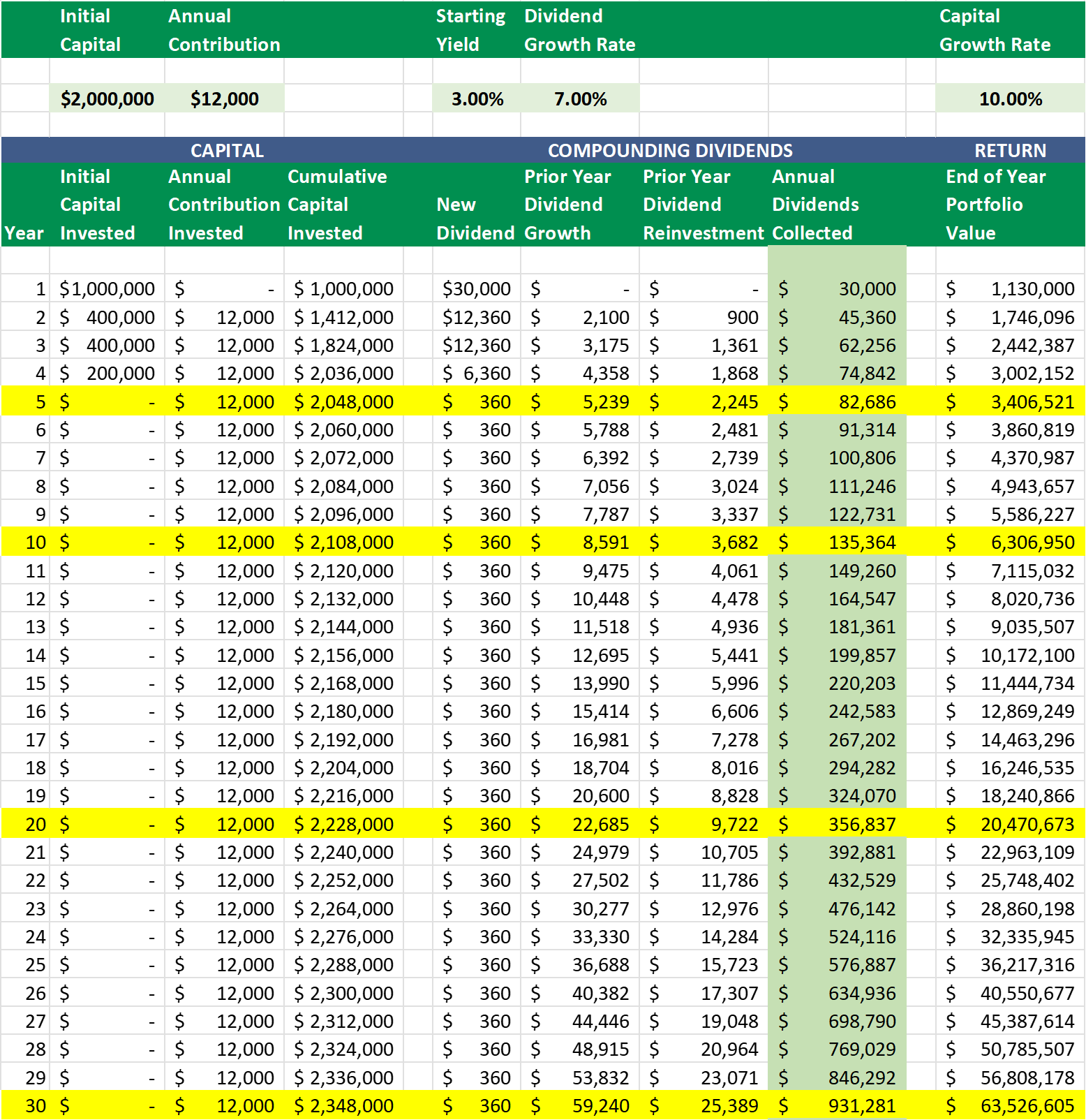
Now consider an investor with $2,000,000 and only five years until retirement.
This investor has less time for compounding, but more capital to put to work. The portfolio can generate significant dividend income almost immediately.
By deploying the capital strategically, reinvesting the dividends, and achieving 7% annual dividend growth, our projection estimates that annual income could reach approximately $82,686 after five years.
For this investor, the balance between current yield, dividend safety, and future dividend growth is especially important. With less time to recover from a poor investment decision, quality, valuation, diversification, and disciplined position sizing must remain at the centre of the process.
Different Starting Points, Same Strategy
The younger investor uses time to compensate for having less capital. The older investor uses accumulated capital to compensate for having less time.
Both benefit from the same disciplined process:
Buy quality dividend growth companies
Purchase them at sensible valuations
Monitor dividend safety and business performance
Reinvest and add new capital intelligently
Allow income to grow and compound
Markets will always be unpredictable, but the investor can control how much they save, what they own, the price they pay, and how consistently they follow the process. That makes their retirement plan less dependent on market timing and more firmly within their control.
Dividend growth investing does not require everyone to follow the same path. It allows each investor to use the resources they have, whether that is more time or more capital, to pursue the same objective.
A reliable, growing income stream that can help fund retirement without constantly selling the assets that produce it.
MP Wealth-Builder Model Portfolio (Canada)
Annualized Total Return: +17.19% since inception (May 1, 2022)
Total Return (includes dividends): +14.85 % year-to-date
Current Yield: 3.2%
The List (Canada)
Dividend Income Growth: +6.6% year-to-date
Capital Appreciation: +6.8% year-to-date
Dividend Announcements Last Week: None
Earnings Reports Last Week: None
Earnings Reports This Week: Two
Top Performers Last Week:
Franco Nevada (FNV-N), up +13.46%.
Canadian Natural Resources (CNQ-T), up +6.63%.
Magna (MGA-N), up +4.0%.
Worst Performer Last Week:
Alimentation Couche-Tard Inc. (ATD-T), down -6.85%.
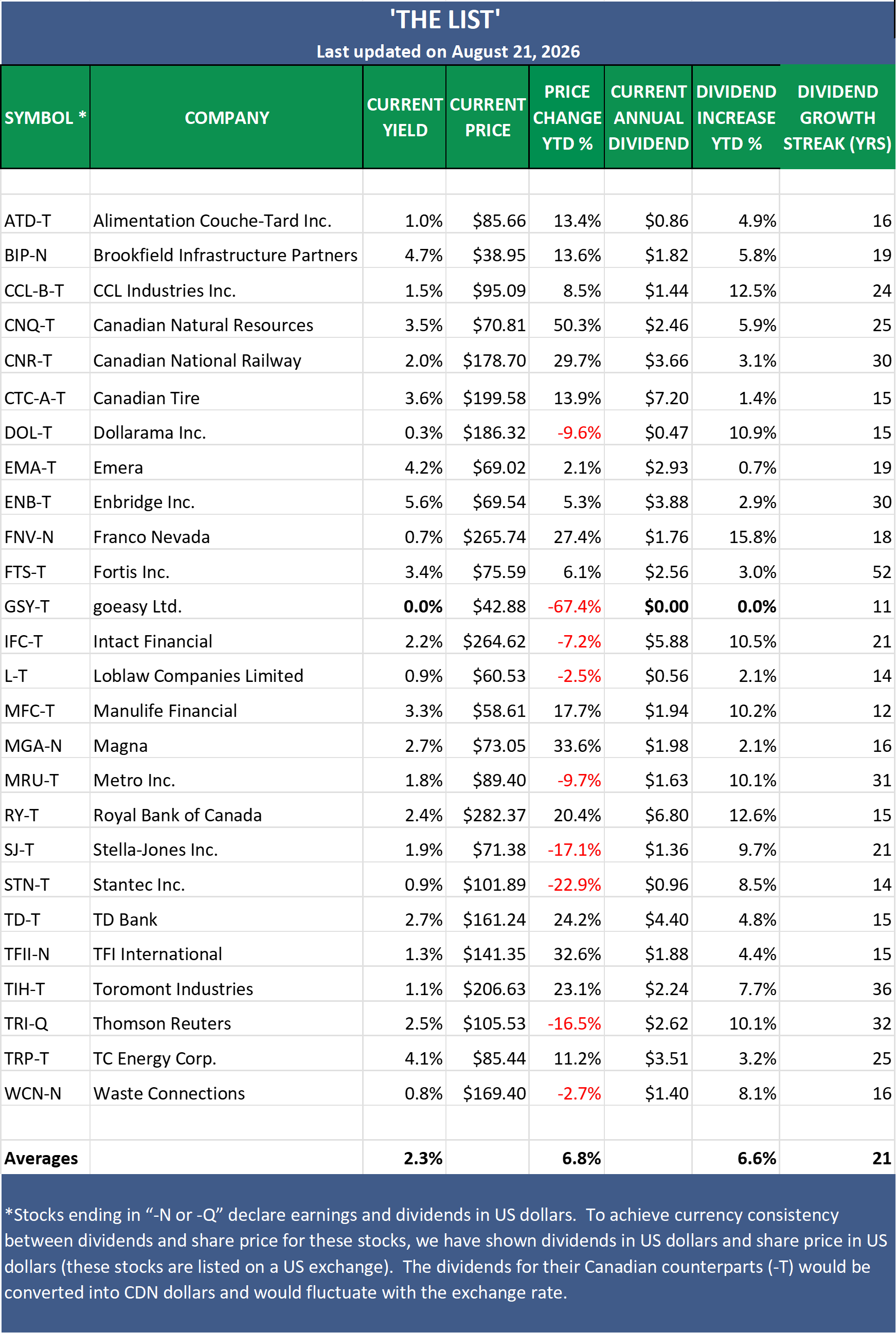
The Magic Pants 2026 list (The List) includes 26 Canadian dividend growth stocks and our new American watchlist (The List-USA) contains 28 companies. Here are the criteria to be considered a candidate on our watchlists:
Dividend growth streak: 10 years or more.
Market cap: Minimum one billion dollars.
Diversification: Limit of five companies per sector, preferably two per industry.
Cyclicality: Exclude REITs and pure-play energy companies due to high cyclicality.
Based on these criteria, companies are added or removed from The List annually on January 1. Prices and dividends are updated weekly.
The watchlists are not a portfolio but a coaching tool that helps us think about ideas and manage risk in our model portfolio. We own some, but not all, of the companies on these watchlists. In other words, we might want to buy these companies when valuation looks attractive.
Our newsletter provides readers with a comprehensive insight into the implementation and advantages of our dividend growth investing strategy. This evidence-based, unbiased approach empowers DIY investors to outperform both actively managed dividend funds and passively managed indexes and dividend ETFs over longer-term horizons.
In the last week of every month, I will show the updated watchlist for our American dividend growers (The List-USA). The watchlist will be shown after the Canadian watchlist above.
Magic Pants Dividend Growth Investing is a behind-the-scenes look at how a dividend growth portfolio is built, maintained, and improved using real money, real positions, and real results.
Our objective is to grow dividend income by 7-10%+ annually while achieving long-term capital appreciation that matches or exceeds the broader market over a full investing cycle.
The name comes from a simple idea: when a quality company pays a dividend, cash moves from the company’s pocket to yours while your ownership stake remains intact. As earnings and dividends grow, the compounding cycle can accelerate. That’s the magic.
Looking for a helping hand in the market? Members of Magic Pants Dividend Growth Investing receive exclusive ideas and guidance designed to help navigate changing market conditions.
The Magic Pants model portfolios (Canadian and American) are real-money, dividend-growth portfolios funded with actual capital and executed in live accounts. Every position shown is owned, sized, and tracked in real time using our disciplined DGI process.
Become a paid subscriber and see exactly how we put the process into practice. You’ll also receive full access to this post and exclusive subscriber-only content.
We do the work. You stay in control.
From breaking news and quarterly earnings to the latest dividend announcements, we highlight what matters most and explain what it means for dividend growth investors.
The 4% withdrawal rule for retirees is dead. Long live the 4.7% rule (Globe & Mail)
“Another fascinating observation is that inflation may be more harmful to finances than recessions. That’s because markets eventually recover, but prices driven higher by inflation don’t fall.”
Withdrawal rates and inflation are two of the biggest concerns facing retirees. I found a way to address both when I discovered dividend growth investing twenty years ago.
By building a portfolio of quality dividend growth companies well before retirement, ideally ten years or more, I was able to create a dependable and growing income stream. Those rising dividends allowed me to ease into retirement without worrying about how much to withdraw from my portfolio each year or whether inflation would gradually erode my purchasing power.
“The growth of dividend-paying ability is of significance in the determination of a stock's quality, or general safety…”
- Arnold Bernhard (the founder of Value Line)
No companies on The List had a dividend announcement last week.
Benjamin Graham once remarked that earnings are the principal factor driving stock prices.
Earnings and dividend growth often go hand in hand, providing insights into future dividend growth for quality companies. Regularly monitoring our dividend growers, starting with quarterly earnings releases, is a key part of the process. ‘The List’ is sorted by reporting date and includes the market’s consensus estimates and actual reported results. Red numbers show earnings below the previous year for the same period.
The Q2 2026 earnings calendar can be found here.
Two companies from The List are due to report their off-cycle Q3 earnings this week.
Royal Bank of Canada (RY-T) will release its third-quarter fiscal 2026 results on Thursday, August 27, 2026, before markets open.
TD Bank (TD-T) will release its third-quarter fiscal 2026 results on Thursday, August 27, 2026, before markets open.
Last week, no companies from The List reported earnings.
Thank you for reading Magic Pants Dividend Growth Investing-MP Market Review. This post is public, so feel free to share it.
Comments
Nothing yet. Say the first thing.
Sign in to join the conversation.