
“How long does it take you to draft a novel?” the moderator asks.
Picture the scene: a festival panel with a veritable cheese tray selection of author types. A graphic novel memoirist. A comic writer. A romantasy writer. A YA novelist. Whatever the heck I am these days. For the past thirty minutes, we have been discussing tropes, marketing trends, AI, and social media. All of the nouns and verbs we have used to answer these questions have been different, but, until now, we have sounded fairly cohesive in our opinions.
Now the conversation has taken a turn for the practical. The answers come down the line.
“Two months.”
“Four months.”
“Two weeks.”
“Three months.”
“A week, sometimes!”
I am at the end of the table. I pensively trace my palm. According to palmistry, my broken fate line predicts challenges for me. I say, “Two years.”
I am aware that this is the life span of the American Possum. It is an Associates Degree. It is enough time to build a small subdivision, if you have already scouted the land.
It also didn’t used to be my answer. I drafted most of my early published YA novels in four months. The Scorpio Races, which went on to win an award which meant that something in the goddamn process must have worked, was done in a blistering 90 days. I began to slow as I wrote The Raven Cycle, with drafts taking 8 months and then a year and then 14 months, and with every one of those, I found myself wishing for more time.
In the adult publishing world, I am allowed this time, and my last two projects have grown to the length of time it takes toddlers to develop the coordination to kick a ball. On the product side, I’m not complaining. THE LISTENERS, set securely in a real historical moment, had so much research that any less time would have left me feeling like I had written something thin, with the aesthetic of history rather than the reality. And my latest one (you guys will get it next year) involved so much creative problem-solving when it came to voice and structure that I simply could have never written it on a tighter deadline; I needed all those months for continuous iterative work, carving it into an ever more specific creature.
But.
That is a long time to be Maggie-the-Writer.
The problem is that I have always been a somewhat decorative human, and when I am writing, this tendency goes through the roof. When I am drafting, really drafting, I don’t exist. The sweet spot to meet me is at the beginning of a novel, when I’m not really putting words down. I’m researching. I’m kicking around structure. I'm maybe scratching some sample-voice into cave walls. I sit down to work at 4 or 5 am and by the time you wake up, I’m already done for the day, we can go for a nice walk with the dogs or maybe go read the last pages of some novels at the local bookstore. Don’t worry, I’m making dinner. I actually already made some bread. Do you like what I did in the garden? Great, I made you this playlist. We can go see that movie just as soon as I finish teaching myself how to play the banjo.
God, I’m delightful when I’m not writing! I’m fully present in the world. Every hobby is my hobby. I’m deeply interested in what you have to say. My phone lights up. My synaptic connections are shaking hands like tech bros; I’m learning new stuff at the speed of Lucy.

Unfortunately, this all goes away once the novel moves in.
Maggie-the-Writer isn’t really looking at you. She is running the numbers, thinking over the secret reveals, ironing out inconsistent characters. She’s interrogating her metaphor, she’s rejecting a magic system, she’s rehearsing the same four lines of dialog to find out if the pacing of the page feels better with the dialog tag before or after the come back. The midpoint is wrong, the build is incorrect, she knows she needs to be more specific in that long paragraph in the final act. She has read a piece of research that needs to go somewhere, she can feel it, but she just doesn’t know where.
Maggie-the-Writer is nodding and she is smiling and she may even be telling you an anecdote or chopping up some onions or folding laundry, but she isn’t there. She has automated her body and sent it out into the world to placehold for her until the drafting is done.
Sometimes she blinks up and realizes that she is in, say, a completely different state, appearing at a festival, and she sure is glad her host body thought to take a photo of her hotel room number so that she can get back to it.
Like I said, I’m decorative when I’m drafting.
This is all very well and good when my drafting used to be a few months, especially since this existence of Maggie-the-Writer really only appears later in the process, when stuff starts falling into place in the novel. Of the four months it took to write Shiver, for instance, I think I was only really imaginary for one of them, and then I returned to my normal self in time for eight months of editing. Being imaginary for one month of the year feels like a completely acceptable amount of time for a creative. We’re “quirky.”
Fast forward to now, though. Two years of imaginary Maggie. I think I had a grace period of about four months at the beginning of this project, and then obsession took hold. I had constructed it to be such a catnip of twisty structure and thematic batshittery and sly character tricks that I didn’t want to do anything else. Maggie-the-Writer was driving the car. Literally! Often, I can tell people don’t really believe me when I say I’m not really there when I’m really in a novel, but I’ll give you an example: apparently, my car has a moon roof.
This is notable for three reasons.
Once upon a time, people paid me cash money to notice things about cars.
I drove this car something like ten thousand miles before I noticed.
No, seriously, I have a thing about cars, people know this about me.
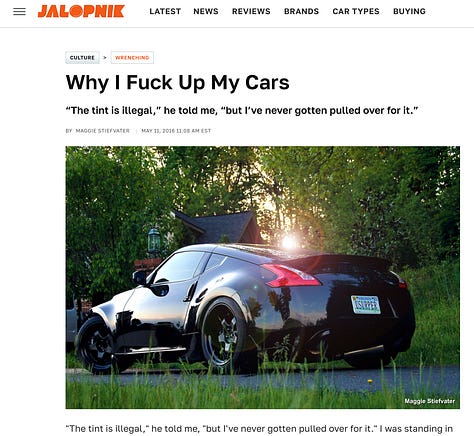


But I bought this car during the height of Maggie-the-Writerdom, my mind fully in the Otherworld. The book was real; life was the dream. It was this dreamwalking Maggie who thought to herself, you’re a grown-up, you can’t keep breaking down by the side of the road in the Evo; get a daily driver; ok, not that daily driver; get a daily driver that goes 0-60 in 3 seconds or less. Dreamwalking Maggie, in between chapters, traded her daily driver for a used orange sedan that does indeed go 0-60 in 3 seconds or less, and dreamwalking Maggie, because she could not stand to leave the world of the book long enough to even car shop, ordered it online from Carvana*. Dreamwalking Maggie picked it up, test drove it, and then put thousands of miles on it going to various book clubs and festivals.

*by the way, can we talk about this experience? A book-drunk person was able to orchestrate the trade of a used car for more than blue book and the purchase of another one for less than blue book inside an hour, and then pick it up a few days later. I could spokesperson for them. It was a good time.
Very, very recently, I turned in that novel, and, full of Maggie-the-Human presence of mind, I strode out to my car. Grocery run time. I was going to make a feast and then teach myself how to play the harpsichord or something. But I couldn’t help but notice something when I lowered myself into the car.
It had developed a moon roof.
I sat there in the driver’s seat with my head tilted back, just looking and looking at the ceiling. I couldn’t really believe it. But there it was, a little bit of sun peeking through the headliner. I prodded the fabric with a finger, then traced a line back to my windshield. There were the controls. One button, tilt. Slider: open.
Now, look. I was fully aware that no car, even a pretty solid lil orange BMW, could grow a moon roof, even with a lot of sunlight and rain. I knew it had been there all along. This feature would have been on the list. My eyes would have seen it as I compared models. It would have been there when I picked it up from the Carvana-Tower-Thing. I had sat beneath this moon roof before. The button had always been there. The moon roof had always been there.
Maggie-the-Writer just hadn’t noticed.
Maggie-the-Human marveled. Now that I was capable of practical thought and consolidating memories, I investigated the rest of the car. What else had Maggie-the-Writer been keeping from me? For starters, a very weird set of organic granola bars in the glove box; vaguely, I recalled ordering them from a start up in California. There were two novels beneath the passenger seat; one of them was completely unfamiliar to me, but the back of the other one provoked something like a flashback. I must have read at least part of it. I found a note from a reader with a list of recommended songs. I plugged them into my iTunes, but discovered that Maggie-the-Writer had already downloaded them. I found a scrolled receipt of my library check outs; luckily for me, Maggie-the-Writer had returned these books on time, and, it turned out, when I looked them up, actually read them (she’s into nunneries now, it seems).

I have not yet peered around the rest of my house to see what other moon-roof-sized revelations await me there. What am I trying to say here, guys? I’m saying this: the novel better be good. Two years solid of Maggie-the-Writer. Let me know when it comes out: was it worth it?
I’m throwing out these granola bars.
Also, what the hell do you actually do with a moon roof?
• I’m listening: “Dog Prophecies” by Josie Edwards and “The Waves” by Giant Rooks feat Solann. and “Twizzler” by Cigarettes After Sex and “Outro” by AnnenMayKantereit.
• I’m reading: THEY FLEW, by Carlos Eire.

• I’m watching: Richard Pryor’s early standup.
• I’m doing: just announced my full tour slate for THE DREAM THIEVES, as well as a workshop only for teen writers (13-18 years old) and another UK appearance this summer. And . . . I’ve started planning my next novel.
No posts
Comments
Nothing yet. Say the first thing.
Sign in to join the conversation.