
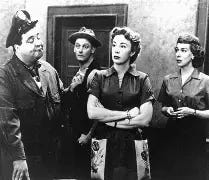
To understand the difference between the working poor and the lower middle class, just watch an episode of The Honeymooners. There’s Ralph and Norton, both with city jobs, roughly making the same salary. Ralph’s apartment, even with the checkered tablecloth faking a non-existent merriment, is clearly a Spartan affair. His wife, Alice, looks bedraggled and bemoaned. He comes home from a day driving a bus around the city, puts his hat on the side table, and asks what’s for dinner. Invariably, Alice is fixedly in the middle of one thing or another – though how much can she be cleaning this one room apartment? – and says, from her depth of seeming endless regret – “Sit down, it’ll be right out.” Clearly they only have the one room and a vague suggestion of ‘the other room’ or a bedroom. Somewhere in the never-seen other rooms, some part of their lives is lived. But the only life they are living out loud is in the kitchen.
No offense, Ralph. You married an unimaginative bore. She doesn’t work, she has a face as long as a horse, and she is the epitome of a beleaguered, disappointed housewife. Could she put a freaken plant on that depressing windowsill? Or maybe buy a two-dollar curtain with some color in it? Is it possible for her to turn the table at a different angle, place the chairs winsomely around the room, put a book or a deck of cards on the buffet table?
Yeah, yeah, we get it. Ralph’s a tightwad. He balks at a phone, accounts for every nickel of his hard-earned dough, but do you have to surround yourself in misery to be working class? Absolutely not. Look at the Nortons’ apartment:
They have an actual dining room table, curtains, a sofa! There are pastoral reproductions on the walls. A candle is lit somewhere. Trixie has on a bright apron, Norton’s got a well-maintained house vest on. It is the same exact apartment as the one the Kramdens live in downstairs; it’s just that this one has some inspiration in it.
How did Norton afford all this? Credit. In the 1950s, even though the Kramdens were living the life of post-Depression 1930s, the United States economy ushered in the mentality of put it on my tab because I’m good for it. That’s how Norton is able to get the comforts of a well-stocked home. For all his apparent dopiness, Norton knows what he wants and he gets it. They have no children, no obvious needy relatives, no overhead.
So, it is apparent that they can pay their rent, buy a steak now and then, and put their little bit of disposable income toward financing some niceties. It’s true that whenever Ralph has a scheme in which he’d like Norton to invest, Norton never has any money. Good thing, because he’d be investing it with Ralph, who is 10-for-10 in terms of losses on harebrained ideas. For all his penny-pinching, it’s Ralph who is the big gambler, the one who will shoot the wad, not Norton.
Norton never has money. Yet, every day, he comes home to a nice place and eats a good meal. Plus, he has a membership in the Raccoon Lodge. Seriously, whose got it better than him?
The show evolved out of a sketch from The Jackie Gleason Show, and was already a hit. It was a domestic comedy that reflected working class struggles and dreams. It was about bickering, love, and survival in a cramped apartment. Surrounded as it was by the golden age of television’s nuclear family idealization in every other show, The Honeymooners carved out a unique space that reflected real working class life. The two apartments shown – Ralph’s and Ed’s – showed how marriage, class, ambition, and a little imagination presented itself entirely differently from one floor to another. One floor has the working poor (always working, never getting ahead), the other has the lower middle class (making ends meet, but fragile).
Before credit cards, there was layaway and store charge accounts. That’s most likely how Trixie and Ed furnished their place. This type of debt ushered in the birth of the modern credit card until the explosion of debt in the late 1970s and 80s. Credit cards became standard in the 1990s and 2000s. By the early 2000s, US households held hundreds of billions in revolving credit debt. In 2023, the debt hit over one trillion dollars. Today, many consumers pay interest rates above 20-25% on multiple credit cards. This snowballing effect of debt is complicated by multiple factors: cultural optimism, consumerism, aggressive marketing. Where’s an economist when you need one?
I wonder if The Honeymooners – particularly Ralph and Alice – would have been caught up in the “financial freedom” offered by this credit card empowerment? How would they have fixed their place up? Or would they have moved out of the tenement to a tonier place. And surely, Ed and Trixie moved to Levittown or somewhere on Long Island in a planned community for the working class.
I write this as I’m about to pay my monthly credit card bills. That’s plural. That’s right. Forget the economist. Where’s the 1950s when you need them?
Enter Bernie Sanders. This year, Bernie Sanders introduced a bill to Congress – The 10 Percent Interest Rate Cap Act. This bill temporarily caps credit card interest rates at 10%. The bill is co-sponsored by a Republican from Missouri, and a Democrat from Oregon. It went to the Senate Committee on Banking, Housing, and Urban Affairs in February. Basically, this action, if passed, would allow only a 10% interest rate until 2031. This would obviously give consumers a respite from egregiously high interest rates because their balances are not paid in full.
That means, if you carry anywhere from 5,000 to 10,000 on your credit card – you basically pay prime rate plus the interest is compounded daily. Sure, it’s a good idea to pay off your credit card balance fully every month. But the purpose of a credit card, for most working class people, is to enable purchases they can’t pay for in cash right now. Hey, we’re good for it. We’ll gladly pay the interest – but we didn’t realize that our interest rate would go from a manageable, say 14% all the way up to 28% due to the math involved in the daily periodic rate times the average daily balance times number of days in the billing cycle times factors influencing the rates.
So, a minimum payment of, say, $350 now becomes a minimum payment of $740. You don’t need to be a mathematician to realize that means the card balance isn’t getting paid off any time soon – because how much is actually going to the balance? Most of it is going to the interest.
It’s a bind, and we’re in it. Most of us are just keeping our heads down, not using the credit cards, doing our best to pay down the ever-stagnant balance. Well, I’m done being guilty about it, quiet about it, kind of ashamed about it. I’ve been paying my bills and taking care of business in an upstanding, right action way for more than 50 years. I never saw anything like this – and I never experienced the absolute juggernaut of such high interest rates preventing a reasonable time frame to pay down debt.
I’ll be backing Bernie’s bill. Not just for me, but for all the good working people who are caught in this mire that has nothing to do with our good credit scores, or history, or work ethic. As I learn about it, I’ll report back.
No posts
Comments
Nothing yet. Say the first thing.
Sign in to join the conversation.