
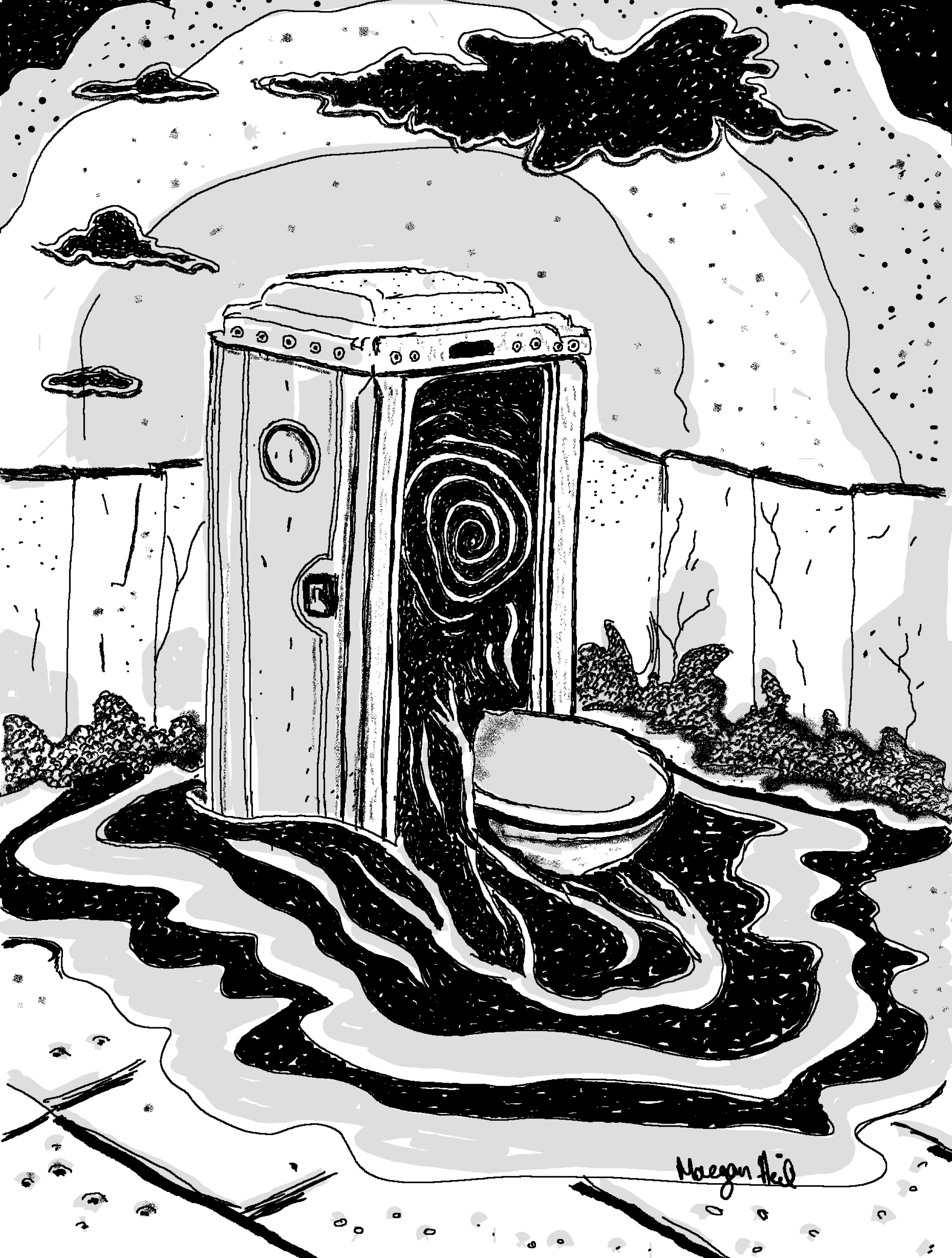
Occupied. Occupied. In Use. Thank heaven—vacant! She swung open the door. Stepped inside and turned the lock behind her. She fumbled apart her belt, unbuttoned her jeans, slid them below her knees. From somewhere down beneath, a voice gurgled, and she paused midstream and parted her thighs to see a face looking up. The lips spouted out a cheekful of yellow, the throat ahemed, then said, “Come down to where I am, swim out the bottom, and find yourself at the place of your heart’s deepest desire.” She knew exactly the place—the upstairs bedroom of her first boyfriend, the one whom she had given her virginity; she could picture herself beneath him, back in that moment just before, when desire still pumped through her veins, when her hips still bucked with want as his lips skimmed the skin along her jawline.
She let out the rest of her stream, wiped and stood and brought back up her jeans, fastened the button, the belt, pinched her nose closed and—(deep breath!) squeezed through the seat, headfirst. Brown soup sloshed against her shoulders, crept up her neck, leaked into the corners of her shut eyes, matted her hair. She felt for the bottom, scratched her nails against the tank’s hard plastic. Dots swam inside her eyelids; her nose tickled. She came up for air. A man’s face. His hand. “Hello?” “Hell—
Well, hello there, FRESH MEATers!
And thank you for reading my short short story!
Churning out a micro-fiction nugget like this helps ease the constipation of writer’s block while I’m waiting for the next log regular length short story (which typically takes me 1-3 months!!!) to marinate (marinade?) plop.
Also, micro-fiction often utilizes constraints, which for me, often acts as a laxative for the creative side of my brain.
What I mean by constraints is that when I am given a set of parameters or rules, then convince my brain that it must follow those rules (or else!), the writing often flows more easily1.
For example, the story above was created using a Fibonacci sequence word count constraint I learned in one of Meg Pokrass’s very fun and pressure-free workshops.
Line 1 = 1 word
Line 2 = 1 word
Line 3 = 2 words
Line 4 = 3 words
Line 5 = 5 words
Line 6 = 8 words
Line 7 = 13 words
Do you see the pattern?
For Portal Potty, the longest sentence was 55 words, then the second paragraph started with one sequence less at 34 words and worked its way back down to 1.
To learn more about how to write a Fibonacci Sonnet Story, check out Meg Pokrass’s Microfiction Workshops, or her prompts Substack, Pokrass Prompts for Creatives!
For my Writer-Readers out there, What about you? Do you like to write using constraints? What do you think about the Fibonacci sequence constraint? Care to pinch a loaf of your own? If so, drop your motherload deuce yule logs turtle head anchor brown load sprinkler head2 Fibonacci Sonnet Story in the comments!
Until we MEAT again,
🥩Maegan

Just like sitting on the toilet with a magazine.
Comments
Nothing yet. Say the first thing.
Sign in to join the conversation.