
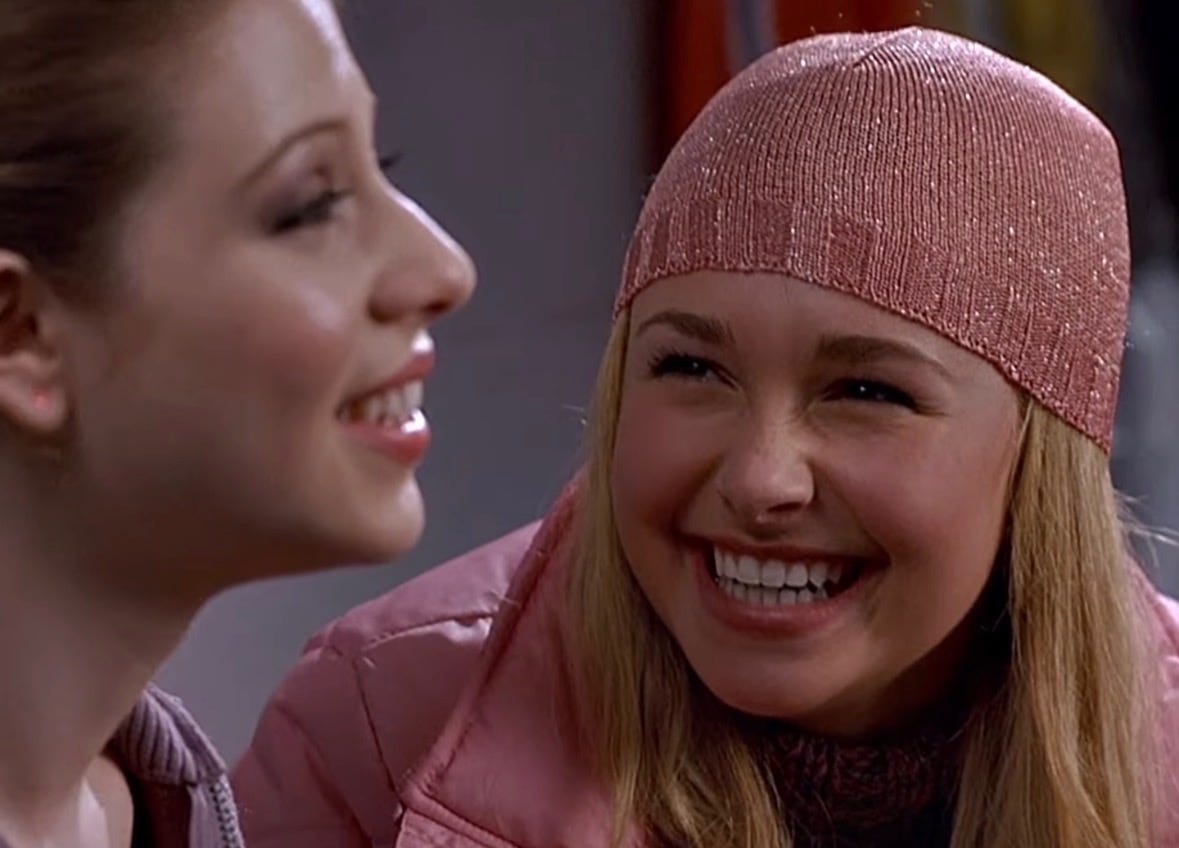
Last Sunday, before going to bed, I learned via a film fan account that I don’t follow on Instagram that actress Hayden Panettiere had passed away at age 36. As someone who grew up in the early 2000s, Panettiere’s face graced the DVD cases of many of my favorite childhood movies, including the 2005 children’s classics Racing Stripes and Ice Princess. Ice Princess is a movie that made an especially big mark on me, as it portrays competitive girls reconciling their differences and an adorkable nerd successfully combining her artistic and academic pursuits, themes I readily identified with as a scholastic ballet dancer and burgeoning pedant.
The film follows Casey Carlyle, played by Michelle Trachtenberg, a high school student struggling to choose between her promising academic future and her budding dream of becoming a professional figure skater. While embarking on a summer project using physics concepts to perfect skating technique, Carlyle is introduced to fellow junior skater Gen, played by fifteen-year-old Hayden Panettiere, who is initially cold toward her. But over the course of the movie, they settle their petty differences and help one another achieve their mutual goals of advancing in the skating world and, in Gen’s case, quitting skating altogether.
Trachtenberg, who was also known for her iconic role as villain Georgina Sparks in Gossip Girl, died last year at age 39 from natural causes related to diabetes complications. Allegedly, Trachtenberg struggled with drugs, alcohol, and depression in the years leading up to her death. After she passed, the official HBO Max Instagram posted a clip of Sparks’ iconic “You can tell Jesus, that the bitch is back” scene, along with a red heart emoji.
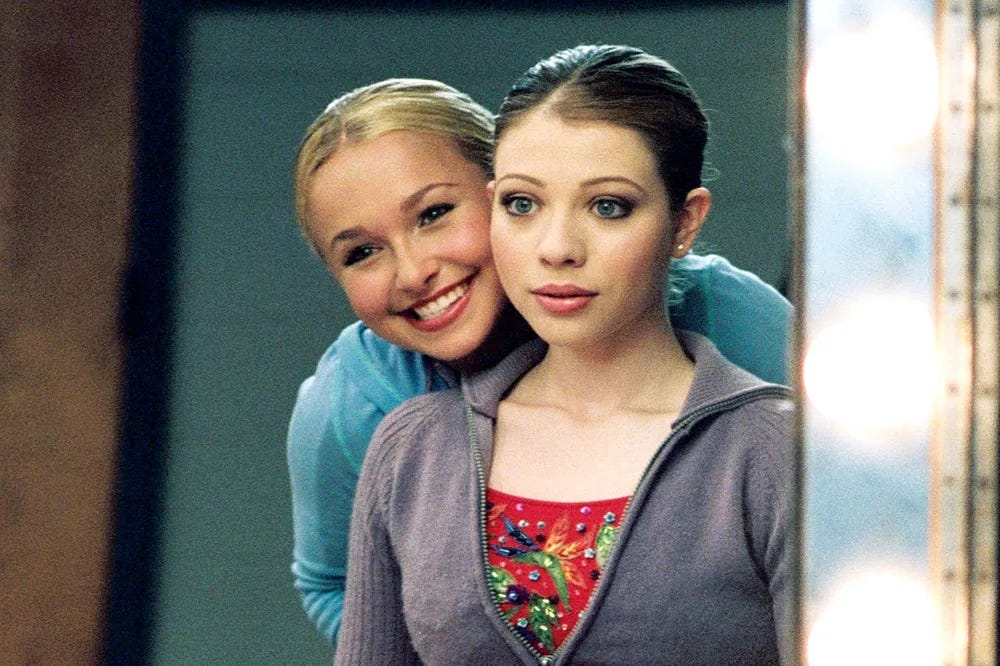
It’s pretty bleak that when I learned of Panettiere’s untimely passing, my automatic assumption was that it was an overdose. I hadn’t read her name in nearly a decade, but this is, unfortunately, the way that so many young actresses go; it wasn’t so big a jump to make. I scanned the People article that had come out just twenty minutes earlier, and it had no details about the cause of death yet. I turned my phone off and set it on the counter. Time for bed, I guess.
At the time of writing, People has reported that Panettiere may have suffered from an overdose and was found in a state of cardiac arrest before being pronounced dead. Panettiere had previously opened up about her struggles with drugs and alcohol, being introduced to “happy pills,” which she thinks were Adderall, by someone in her inner circle when she was just sixteen. In her memoir This Is Me: A Reckoning, she discussed the painful decision of signing full custody of her daughter over to her ex-fiancé in 2018 after self-medicating with alcohol and battling post-partum depression. Four years ago, she told ABC News that she was sober and gearing up for a career reboot.
As The Serratore Report writes, this has become an all-too-typical song-and-dance for unprotected child actors. In her memoir, Panettiere shares that she had been in about fifty commercials by the time she was five years old, and suffered sexual harassment from older men in Hollywood as a teenager. Recent media like Jeanette McCurdy’s I’m Glad My Mom Died and Hulu’s Quiet on Set doc have made us all too aware of the dangers of children working in Hollywood.
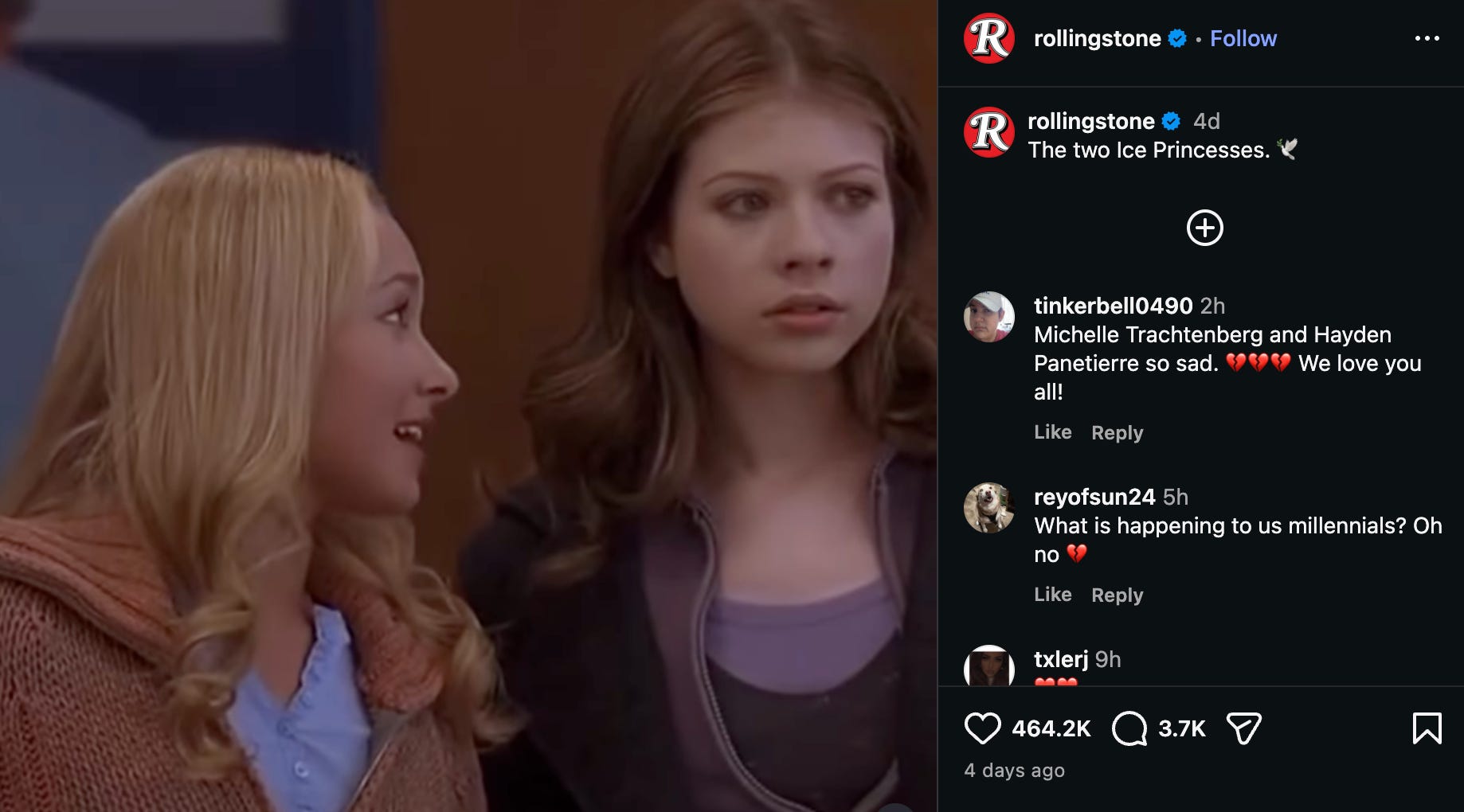
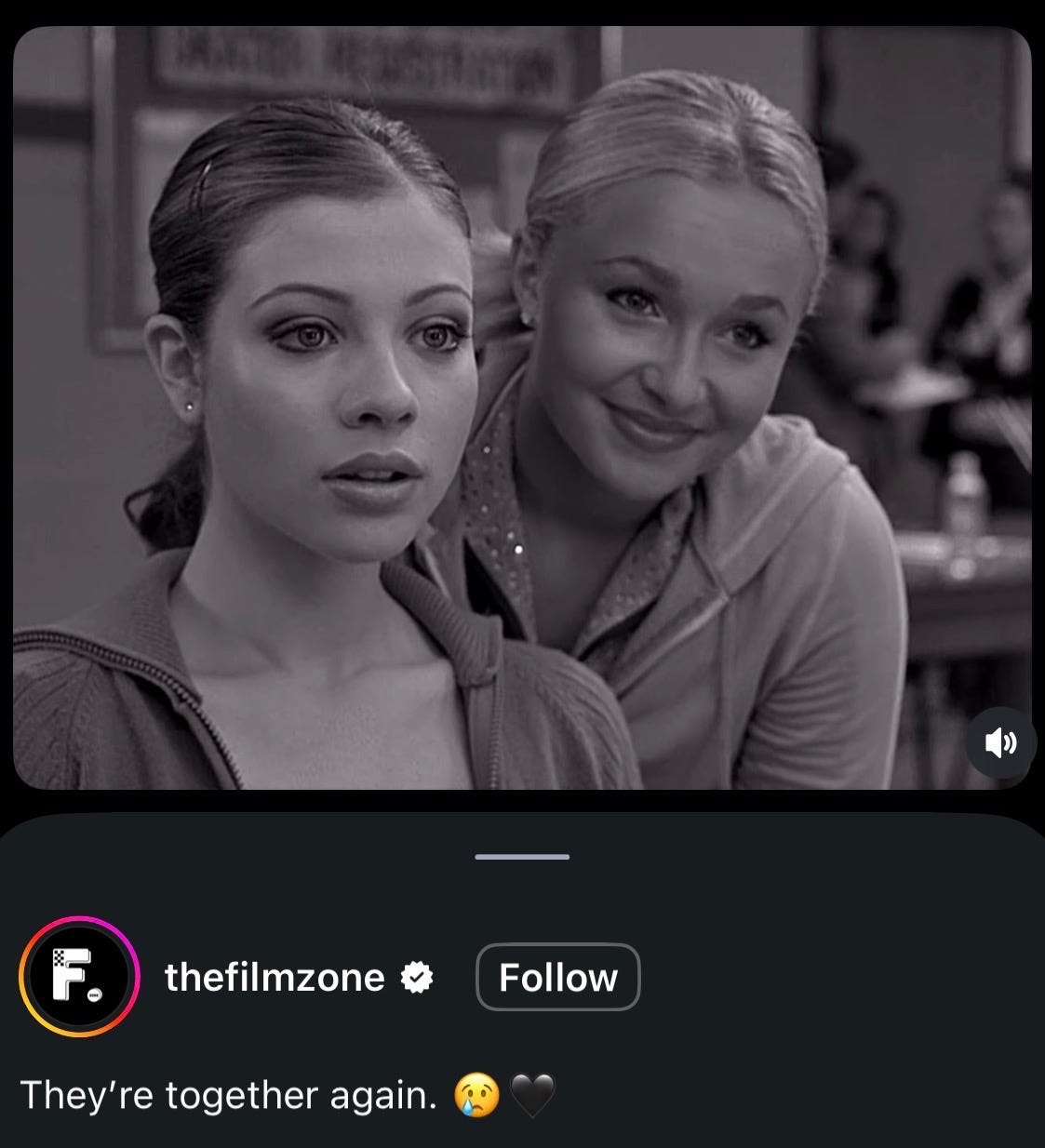
But what’s also become an all-too-typical song-and-dance is the uncanny, sickly saccharine way these starlets are immortalized on social media following the end of their short lives. Since Panettiere’s death, my Instagram feed has been flooded with Ice Princess edits, featuring spliced clips of Trachtenberg and Panettiere’s characters set to Aly & AJ’s “No One.” Rolling Stone’s Instagram shared one of these edits with the caption “The two Ice Princesses,” with a dove emoji. Another edit of the two late actresses is captioned “They’re together again,” with a teary emoji and a black heart, featuring the bridge of Prince’s “Purple Rain,” an image of the young girls’ faces fading to black in the end.
What’s perhaps more disturbing than these is the amount of in memoriam clips of Panettiere as a child. The Academy’s official Instagram posted a clip of ten-year-old Panettiere in Remember the Titans (2000). And Entertainment Tonight posted a red carpet clip of her as an eight-year-old at the premiere of A Bug’s Life, her cheeks as plump and rosy as a cherub. “We’re remembering Hayden Panettiere with a look back at the bright young star who voiced Princess Dot and stole our hearts at the 1998 ‘A Bug’s Life’ premiere,” the caption reads, the comments section littered with “This one hurts!” White heart emojis, broken heart emojis, angel emojis.
The young girl in these videos, thrilled to hear her voice and see her likeness on a big screen, as any other young kid who grew up in front of a television set would, was likely still memorizing her times tables. When you ask a kid if they want to be famous, they will undoubtedly say yes. Elementary-aged children care about little else besides the approval of the adults in their lives, and later the peers in their lives. Their still-developing brains, underbaked and crooked by this extreme desire for outside approval, are not equipped to consent to being professional actors. But their parents, who pocket their earnings, jump at the chance to consent for them.
Panettiere being put into child acting undoubtedly set her on a well-trodden, unsteady path. The number of former child performers who struggled with addiction and/or mental health issues that we can identify with one name is too long to list (Britney, Lindsay, Demi, and so on). As such, I find it disturbing that so many people feel compelled to share clips of Panettiere as a child in their in memoriam posts. While I understand that the intention behind many of these posts is to remember a joyous period of the actress’ life, watching these clips is like watching a little girl walk unknowingly into the basement of a haunted house with no ability to stop her. This shouldn’t elicit pleasure in people. It should elicit an impulse to scream “No! Turn around!!”
But when you sign up to be an entertainer in a culture that is addicted to entertainment, your likeness becomes symbolically co-owned by each member of the public. You become a creature of public comfort, a site of projection, where people can replace the plain image of a young girl working a grown-up job with a more titillating image of a talented, beautiful, wise-beyond-her-years ingenue, figuratively protected by the suffocating blanket of public affection, but never actually guarded from harm. We see and remember in her only what we want to. We never actually knew Hayden Panettiere, so all we have to remember her by are the characters she played onscreen, many of which were children and teenagers. We are not mourning a person; we’re mourning a co-constructed projection.
When the public owns you, it’s not enough to feel entertained by your entertainment, or your life, which was made into entertainment by entertainment publications. No, we have to make entertainment out of your death too, which is how you get these perverted, self-serving fan edits, getting off on a fictional universe in which you and a co-star you worked with two decades ago are reunited in heaven. Glossy images of you in a cheerleader uniform and a velour Juicy jacket are somehow even more destined for a Y2K mood board now that you’re dead than if you were alive. We’re obsessed with women who lead short lives because we never have to see their image sour with old age. We can live in our projection eternally.
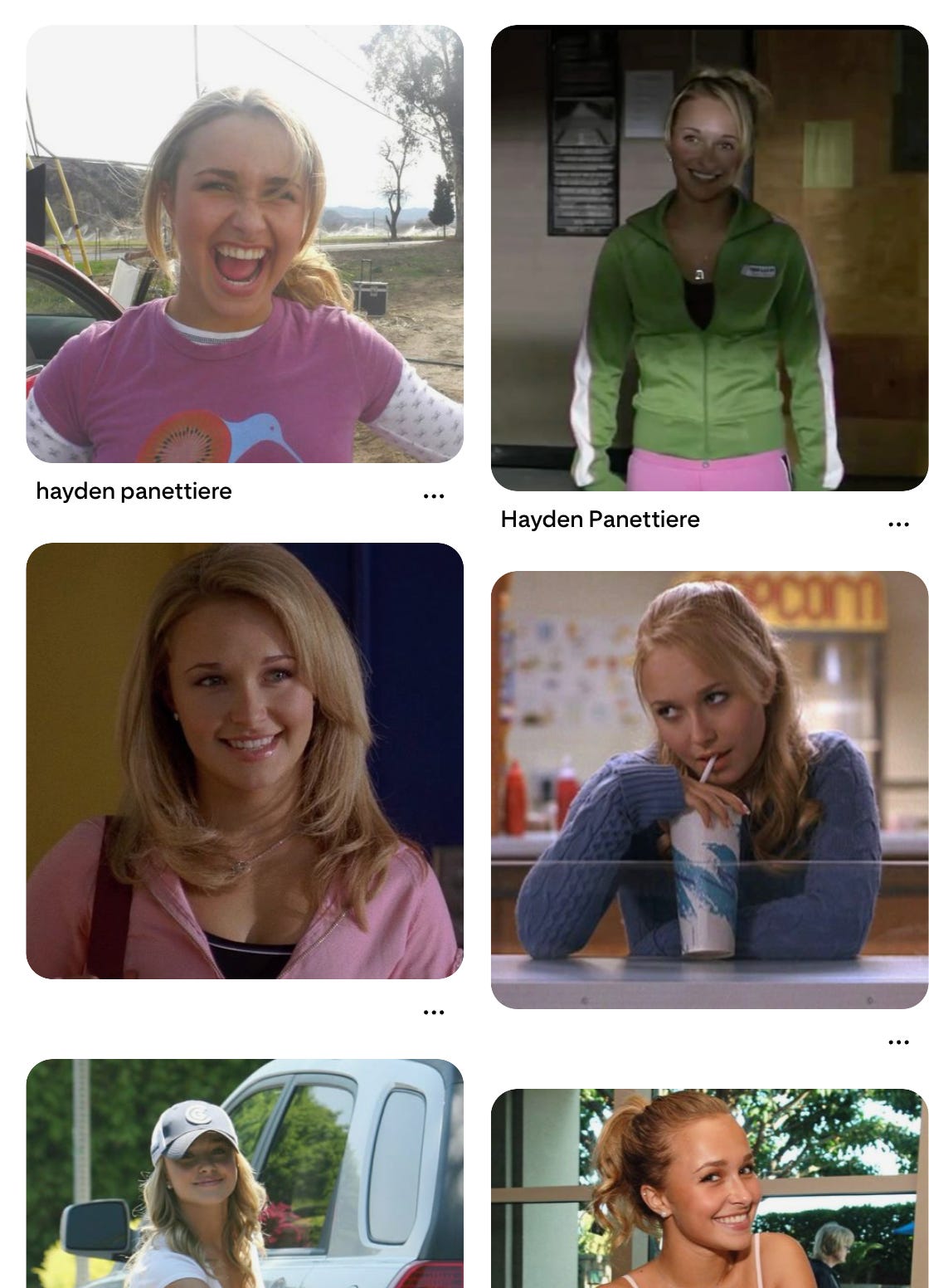
I understand that the passing of ubiquitously loved figures inevitably calls for a state of public, widespread mourning; there’s nothing that can stop that, and nothing inherently wrong with honoring a cultural treasure. People have long had strong parasocial ties to celebrities. Every white, American Gen X mom I know can recall the place they were when Princess Diana died. But I once again have to wonder whether being flooded with hyper-stylized reality content on social media has caused young people to struggle to discern fiction and non-fiction, and is thus causing them to feel a heightened sense of closeness with people they don’t know, famous or not. The convergence of celebrities and influencers, who are a middle-class of celebrity, and normal people on one feed is perhaps muddying the lines delineating relationships in many minds.
We should remember, at the end of the day, that we are grieving a person we had a parasocial bond with. This person had actual friends and family, legitimate close ties. Similar to the masturbatory nature of true crime media, which projects all kinds of constructions onto the perpetrators and victims of violent crime for the gratification of the detached producers and viewers, we should be careful not to be self-indulgent when grieving people we only know as ideas and not as people.
Something about the phrasing of “This one hurts!” implies the inevitability of subsequent tragic, untimely celebrity deaths, which are peppered into our social media feeds every year, sandwiched between clips of fashion influencers body-checking and videos of near and distant parts of the world on fire. Just as we feel a detachment and numbness towards these clips, we too feel a detachment from child actors careening towards catastrophe. If we get too caught up in making entertainment out of everything, we may forget to actually feel the feelings we’ve become so good at conveying via fan edit.
No posts
Comments
Nothing yet. Say the first thing.
Sign in to join the conversation.