
Earlier this year I published two articles (here and here) on Cancer and our meager results in treating it despite hundreds of billions of dollars spent each year on research and pharmaceuticals. In summary, the medical establishment continues to focus treatment on a genetic etiology of cancer, the Somatic Mutation Theory (SMT), despite obvious clues that cancer is more a metabolic phenomenon than anything else.
I became interested in this topic several years ago when I become aware of several simple, elegant and reproducible experiments conducted decades ago which clearly indicated that the primary driver of cancer was in the cytoplasm of the cell, not the nucleus.
When the nucleus of a cancerous animal cell line was transplanted into a healthy cell, the new hybrid cell remained healthy. When the nucleus of a cancerous cell was removed and replaced by the nucleus of a healthy cell, the cell remained cancerous. The obvious and logical conclusion was that the driver of cancer, what ever it is, resides in the cytoplasm of the cell, not the nucleus.
Why then was the medical establishment focused on agents that targeted the nucleus?
Yes, yes, I know, follow the money. But why aren’t more oncologists interested in these basic findings?
I know some readers will not be pleased when I assert that these doctors aren’t intentionally doing things that don’t work in order to make a living. I simply don’t believe that because some of my best friends from medical school are oncologists. They are great human beings and care deeply about their profession and their patients. I understand that they have been living and practicing in echo chambers, but these folks have always been curious about everything.
Only one of my three oncologist buddies had heard of the competing theory behind cancer: dysregulated cellular metabolism. In his own personal experience, one of his patients chose to treat his cancer with diet modification (not chemo) and succumbed quickly to his disease. Why look any further?
I can think of at least two reasons beyond the simple experiments which hint that the problem is not in the nucleus of the cell.
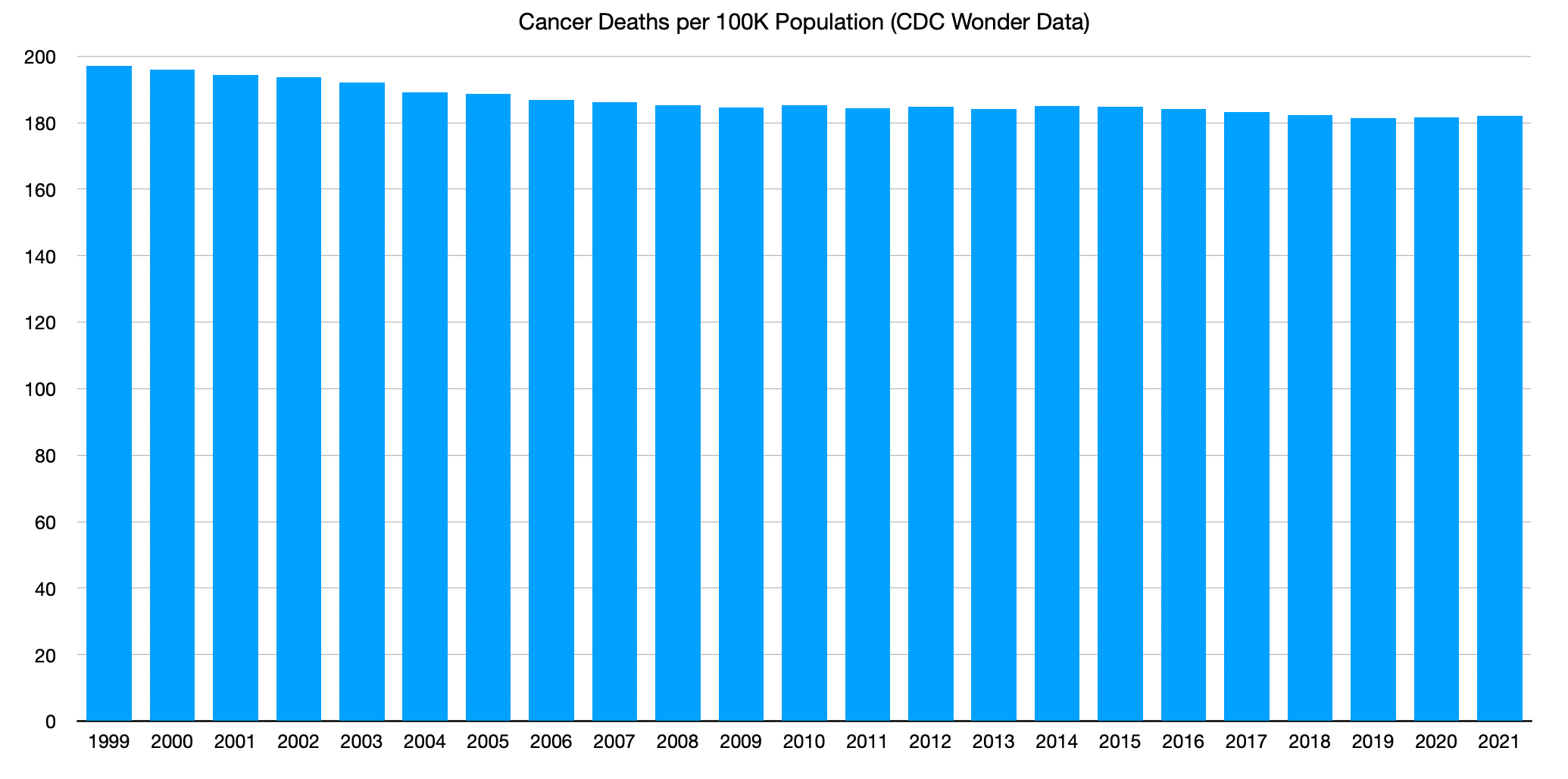
The first is in the graph above. That is the crude mortality rates of cancer over 22 of the last twenty six years. There are two important things to note from the graph:
The number of people per 100k who die of cancer each year has barely budged downward despite the fact that smoking has declined and screening for cancer has been aggressive during this time frame. It is thus very likely that the modest improvement (about 8% over 22 years) is due largely to those reasons and not from any significant improvement in treatment effectiveness.
The data in that graph has not been age adjusted. When we examine the number of people per 100K who die from cancer at a given age, there has been a 23% improvement. In other words, people with cancer are surviving longer. That is generally how the field self-assesses. What interests me was how challenging it was to find this data. I had to query the CDC’s cancer database to produce that graph. We are half way through 2026 and the CDC has not populated its database with numbers after 2021? How odd (more about this below).
The second is that advances in genetic tumor mapping, including deep sequencing of tumors from a single patient show a wide range of genetic mutations. This suggests that the gene mutations are either an incidental finding or the result of a different process that drives tumor growth.
The point is that progress in cancer treatment is demonstrably meager and that breakthroughs in genetic sequencing which were expected to lead to the identification of oncogenes hasn’t panned out.
Here are some opinions from people who know more about this than I do.
Last month I attended a Brownstone “Supper Club” talk by one of the most informed researchers of the metabolic theory of cancer, Thomas Seyfried. The audience were mostly laypersons and Seyfried offered no more than general comments about what he has discovered through his research:
Cancer cells have defective mitochondria and must rely heavily on the fermentation of glucose to meet their large demands for energy to divide frequently. It is this markedly increased glucose demand which allows the use of PET scans to find “hot spots” in the body of patients suspected of having metastatic disease.
This defect can be utilized by therapy regimens which use strict control of glucose intake through ketogenic diets. Seyfried claims that this approach is more effective in managing cancer than conventional methods. He is not a medical doctor and to my knowledge has not published large case series and results of his approach.
Seyfried’s research has also identified a problem with cancer cells’ ability to use glutamine. This explains the recent interest in anti-parasitic drugs like mebendezole, which is thought to interfere with this pathway as well as glucose uptake.
And of course, he continues his research solely on private donations. NIH does not want to fund work that seeks cancer treatment in the form of diet modification and cheap repurposed medicines.
Paul Marik, MD is a doctor’s doctor. His clinical experience treating patients in medical crises is unsurpassed. He has published over 500 peer-reviewed articles. I was in my third year of residency doing rotations in the Surgical ICU at UPENN when his “Handbook of Evidence Based Critical Care”, a goldmine of information and insights for residents learning to manage ICU patients, was published. I consider him to be one of my teachers.
Briefly,
From 2002 to 2006, Marik was on the Editorial Board of the reputable medical journal Chest.
In 2005, Marik was named Director of Pulmonary and Critical Care at Jefferson Medical College (JMC) and Thomas Jefferson University Hospital.
In 2009, Marik became a professor and Chief of Pulmonary and Critical Care Medicine at Eastern Virginia Medical School.
In 2012, an international committee updated guidelines for the management of severe sepsis and septic shock. In its section of supportive therapy recommendations, the committee based its concept on blood product administrations partly on research performed by Marik and W. Sibbald in 1993.
In 2017, Marik won the American College of Physicians award for outstanding educator of residents and fellows.
Marik is a co-founder of the Front Line COVID-19 Critical Care Alliance (FLCCC).
Marik held Board Certifications in four fields: Internal Medicine, Critical Care Medicine, Nutrition Science and Neurocritical Care. In 2024 the American Board of Internal Medicine revoked all of his Board Certifications because of his outspoken view that Covid-19 could be successfully treated with repurposed drugs.
A highly regarded physician scientist and clinical instructor with an impeccable record who pioneered breakthroughs gets defrocked for breaking ranks. His story is perhaps the best evidence that the system is BROKEN. It is not being led by science; it’s led by scientism. I invite you to read his story in his own words here:
Dr. Marik was recently interviewed by Dr. Meryl Nass on CHD TV where he explained the basics around the etiology and management of cancer using diet and habit modification, repurposed drugs, exercise, sunshine and nutraceuticals here:
Drs. Marik and Nass talk cancer
Marik agrees with Thomas Seyfried. Cancer is primarily a metabolic condition. Marik writes extensively on his approach on his substack newsletter, “Cancer and Metabolic Healing”.
Dr. Stan Burzinsky was a physician and biochemist and stumbled upon a family of peptides that were present in healthy individuals and suspiciously absent in folks with cancer.
After ensuring he was not breaking any Texas laws at that time, he began treating patients in Houston in the 1980’s--patients who had exhausted all forms of treatment, typically for highly aggressive brain cancers. He had remarkable success using these peptides which he was able to synthesize and purify.
A documentary of his successes and tribulations can be found on YouTube here (thank you to the reader who alerted me to this story):
While the documentary does not delve into the biochemistry of these peptides which he called antineoplastons, the story is more about the ridiculous and irrational efforts the FDA and NCI (National Cancer Institute) made to discredit him.
The film does an excellent job of documenting the wide support this doctor had from his patients and ranking members of Congressional investigatory subcommittees while the USG (FDA) continued to convene multiple grand juries even though not a single indictment ever resulted. Burzynski even made it on to the national talk show circuit at the time.
There is very credible testimony given by NCI scientists and cancer researchers from different countries who validate the effectiveness and safety of his protocol. Eventually, the FDA decided to conduct Phase II trials with only a subset of his cocktail, under-dosed the participants and “proved” no benefit.
Coincidentally, the intense law fare waged against him was peaking in Houston, TX when and where I was a medical student at Baylor College of Medicine. I was unaware of it at the time.
I asked Thomas Seyfried about Burzynski and antineoplastons. Seyfried believes these peptides also exert their effect by interfering with glutamine synthesis.
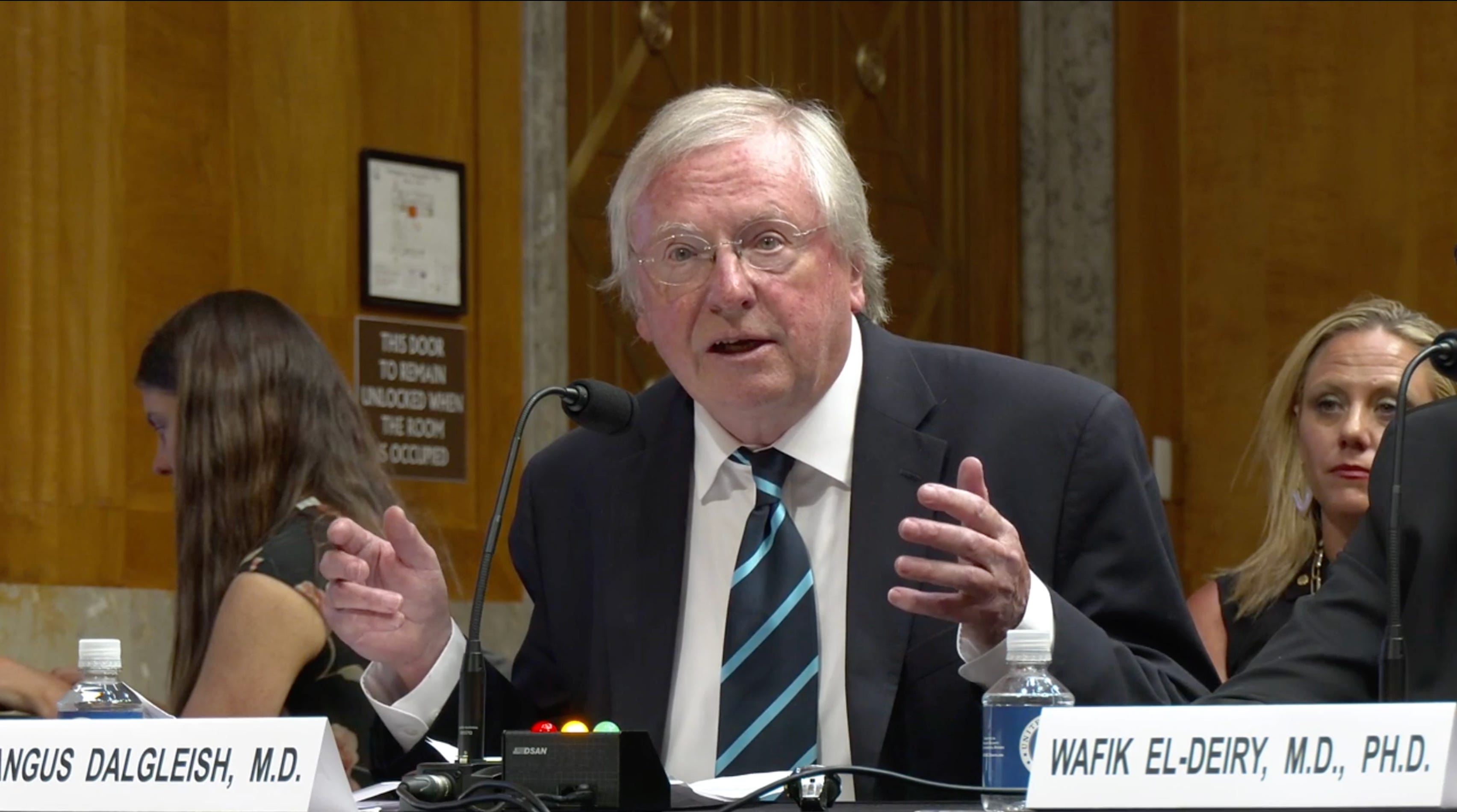
Dr. Dalgleish was elected a Fellow of the Academy of Medical Sciences in 2001 and is also a Fellow of the Royal College of Physicians, the Royal College of Pathologists and a Fellow of the Royal Australasian College of Physicians.
Though not opining on the metabolic theory of cancer, Dalgleish appeared in front of a Senate Subcommittee last week investigating the evidence tying Covid modRNA vaccines to cancer. He offered his observations in sworn testimony.
He first noted that his melanoma patients who had been in remission for years had a resurgence of their cancers following inoculation with the modRNA boosters. Knowing that melanoma is fought off by T-Cells, he hypothesized that the boosters were suppressing them.
Then a paper published in 2022, “Evidence of exhausted lymphocytes after the third anti-SARS-CoV-2 vaccine dose in cancer patients” confirmed his suspicions. Although T-Cell activity increased after the primary series, the boosters had the opposite effect. Moreover, it then became apparent that the “vaccine” resulted in immunoglobulin “switching” making the immune system “tolerant” of infection, rather than responsive to it.
Soon after he was notified by several medical colleagues, colorectal surgeons, that they were seeing young patients (in their 20’s and 30’s) with late stage colorectal cancer. The common finding: all had received modRNA boosters.
He has since discovered that there are multiple plausible mechanisms by which the modRNA products could be carcinogenic. Moreover, the spike protein is “80% homologous to human epitopes”. In other words, an immune response to the spike can result in an attack on our own tissues. He had predicted early on that the shots would result in an autoimmune response in some people. He believes that this technology is extremely dangerous and emphatically concluded:
“There is no way you can control this technology, and its use for further vaccines should be banned and the Covid ones stopped now.”
On the other hand…
The subcommittee also heard from Dr. Julie R. Gralow. Gralow is the Chief Medical Officer and Executive Vice President of the American Society of Clinical Oncology (ASCO). She is also the founder of the Women's Empowerment Cancer Advocacy Network (WE CAN), and a co-founder of Team Survivor Northwest. She was formerly the Jill Bennett Endowed Professor of Breast Medical Oncology at the University of Washington.
Dr. Gralow referred to observational studies which showed oncology patients fared better after the modRNA shots. She further opined that the technology offers a promising platform for future cancer treatment by training the immune system to recognize tumor markers.
Gralow, despite her credentials, then demonstrated a stunning lack of understanding of the basics. Subcommittee Chair, Senator Ron Johnson (R-WI), asked her if she thought that the modRNA in the shots was the same as endogenous messenger RNA in our cells. Her response:
“That is my understanding.”
Johnson informed her that it wasn’t. A pseudouridine substitution in the Covid mRNA prevents its rapid degradation. This discovery was, in fact, the basis for awarding two researchers the 2023 Nobel Prize in Physiology or Medicine.
This “breakthrough” is also the source of the technology’s inherent danger. Cells respond to their environment and needs by translating messenger RNA into proteins which in turn drive chemical reactions. The product of these reactions in turn shut down the reaction. It is a negative feedback loop. This ensures that a cellular response will be rapid and sensitive to a changing environment. This sensitivity is dependent on the rapid degradation of the mRNA. The modified RNA in the Covid shots which do not degrade immediately drive spike protein synthesis indefinitely. There is no “off switch”. This, as Senator Johnson made clear, was not widely known at the time that the public was urged to get them.
Was Dr. Gralow under the impression that the modRNA infused lipid nanoparticles remain at the injection site?
“I cannot reliably comment on that.”
Was she aware of the biodistribution studies which demonstrated that the LNPs migrated throughout the bodies of rats?
Says Gralow: “What happens in mice doesn’t necessarily happen in humans.” Quite the dispositive statement from a person who cannot reliably comment on the matter.
Who do you believe has it right?
I highly recommend watching the subcommittee hearing from last week here.
Please leave your comments.
Comments
Nothing yet. Say the first thing.
Sign in to join the conversation.