
Hello, readers! This story (from the archives) was inspired by wondering what might happen if humans were to communicate with aliens whose primary language consisted of scents. I was tickled by the findings of some Japanese scientists (which I learned about after I wrote this story) that seem to support this idea.
I hope you enjoy this little story and, as always, feel free to leave a comment and let me know what you think, of this or any other story.
Enjoy!
Lactose Intolerance
It was all going smoothly, incredibly well, in fact- the Visashi were agreeable to all our demands and were willing to cede territory. We were all due to travel back to Earth to inform the governments there of the developments, and then Will farted.
I have to backtrack a lot to explain. The Visashi are plant-based alien lifeforms- their planet is covered in what we would call greenery, which is a gestalt organism created from numerous individual Visashi connected together by roots and mycelial hyphae (or what look like Earth-type fungal connections between root systems). They have one huge interconnected nervous system that operates by serial pulses of electrolytes, a lot like how our nervous system works but on a larger, slower scale. They “speak” with chemicals secreted from their upper bodies from structures that look a lot like leaves, and the airborne assortments of scents are collected by us in a gas chromatograph, periodically, as their secretions are decoded into language we can decipher, and our language translated back into scents we puff back at them from the blowing device constructed precisely for this purpose. If we hadn’t had an AI translator, and if the attendant insect-like organisms that are symbiotes of the Visashi hadn’t seemed sentient at first, we might have accidentally farmed all the Visashi for lumber. As it is, we made terrible inroads on their population at first, causing swarms of their symbiotes to attack us in turn. We had to leave the planet, but our xenobiologists kept studying the life on the planet, and discovered the electrical waves traversing the Visashi’s bodies, and the different scents they would produce, and figured it out. With the help of an AI translator, we figured out their language and have been negotiating a truce.
The planet is covered mostly with Visashi, who are immobile, so we can’t really displace them. However, we have access to the aquatic areas of the planet (it doesn’t really have a name, the Visashi call it Planet and we call it RSH911), and we’ve been given permission to create floating islands that we are allowed to live and operate from. We can farm the oceans and mine the sediments for minerals, which is what brought us to RSH911 in the first place.
The peace treaty was pretty much agreed upon, with our negotiators patiently waiting for Visashi scent-language to be translated and back again, a process which for each statement would take upwards of 12 hours. We waited in the shuttle landing pod. We had found a bare piece of rock to land on, and stayed in the pod, terrified of setting foot on the planet due to the abundant, and apparently sentient, vegetation that we may inadvertently offend with each footfall. Negotiations were important- the Visashi could kill us with their insect symbionts, which could become more or less venomous depending on the chemicals secreted in Visashi flower nectars. It might take a while for the whole planet to get the message, but if they wanted us gone, or dead, they could very easily kill us- and we couldn’t really kill them, since so much of the Visashi body lay below the surface of the ground, possibly going down an incredibly long way. Our xenobotanists hypothesized that the brain-equivalents the Visashi may have were in their root systems.
So all was going according to plan. The Visashi didn’t care about the ocean, they were happy to let us use the space, and interested in our culture and language and biology.
Will was new to our group- it was his first time on RSH911 and he was kind of our “intern”, despite having multiple degrees from prestigious universities. He was prone to anxiety, and in the confines of the shuttle pod, his gastrointestinal tract would make noises that were fairly foreboding.
Will, Rebecca and I were out on the shuttle landing bay, facing the Visashi directly and breathing in the Earthlike, clean, sort of pine-scented air. We had removed all scented hygiene products and made sure to wash in soap that would be inoffensive to the Visashi. We had been sure to use similarly scented toothpastes, and all of us had been flossing and brushing four times a day, and taking chlorophyll supplements so we would have no body odor. We all thought there was no chance of an accidental, unwarranted scent getting through to the Visashi and potentially destroying all the slow, gradual progress we had made in creating a truce.
I typed into the AI English-to-Visashi scent generator: WE THANK YOU FOR A PRODUCTIVE CONVERSATION. WE WILL RETURN TO EARTH AND ABIDE BY THE TRUCE WE HAVE NEGOTIATED. MANY PROFOUND THANKS.
As the scent generator whirred into gear, mixing and synthesizing scented compounds that the Visashi could understand, I saw Will’s face.
He was grimacing.
“What is it?” I whispered. Visashi could pick up vibration as well and we didn’t know how that would be interpreted, so we didn’t want to speak too loudly.
“I gotta go inside,” said Will.
“Why?”
“I gotta-” Will said, and then let loose with a very loud, very pungent fart.
Rebecca looked aghast; I am certain I looked the same way. All three of us swivelled and looked at the lumpy, misshapen bulk of the Visashi in front of us, our de facto gateway to the planetwide consciousness that was the Visashi community, and the many sensitive, scent-imbibing leaflike structures, shaded a greenish teal colour, that shook in the slight breeze.
“Inside,” I hissed and all three of us went into the pod.
“Will, what happened?”
Will looked abashed.
“I had a cookie,” he said, and Rebecca and I looked at each other.
“The white chocolate chip ones?” she asked. “That were made with milk you have an allergy to?”
“It’s not an allergy exactly, more like an intolerance,” said Will.
“It doesn’t matter! We don’t know what you just said to them!”
“Do it again,” I said, “only this time in front of the Visashi-to-English translator.”
Will cringed some more.
“I can’t fart on command,” he said.
“Why did you eat cookies with milk in them if you knew it would disagree with you?”
Will looked a little mulish.
“I was anxious and cookies help me relax.”
“Well,” I said, “What’s done is done. Help me put on a suit and relay the Visashi-to-English monitoring system to the pod computer, so we can track it inside, here. Might not be safe in a few hours to be outside."
Rebecca, looking disgusted, started putting on a space suit.
Will reached for his and I stayed his hands.
“You’ve done enough for one day,” I said. Will looked abashed, and retreated.
Rebecca and I made the necessary adjustments to our equipment, and waited tensely in the main cabin of our shuttle pod. Will, still farting occasionally, stayed in his sleeping pod, but since that was only separated from the main cabin with a thin fabric curtain, it was fairly awkward still. Rebecca and I played cards, and I tried to get Will to join us after a while, but the tension remained.
Finally, the system pinged, flagging the first part of the Visashi’s slow reply.
LAUGHTER YOU ARE VERY FUNNY WE APPRECIATE YOUR HUMOR
Rebecca and I looked at each other.
“Will, you might want to see this,” I said.
“What happened, did I doom the mission?”
“Not exactly.”
In about 30 minutes, another response:
PLEASE TELL US MORE OF YOUR JOKES
Rebecca and I looked at Will.
“We’re all out of cookies, but maybe we can find some beans in the stores,” I said.
For the rest of that week, Will kept eating milk- or fiber-containing foods and going outside to fart, and the Visashi loved it. We had to leave by the end of the week to make our launch window back to Earth, but for the majority of the time, Will was outside, trying to make himself fart.
“Who would have thought our first unscripted communication would be a comedy act,” I murmured, watching through the pod bay doors as Will, bent over and straining, let loose with yet another fart.
It took three weeks to get back home, and lucky for Rebecca and I, no one farted once on the journey back. By the time we arrived, news of the Visashi’s penchant for literal fart jokes had preceded us, and Will was an instant celebrity. In fact, he was invited to the White House to talk to the President about Visashi culture. There was talk that he would get a Congressional Medal of Honor.
Rebecca and I, sitting together in a cafeteria at NASA, watched this on the news and I sighed. Both of us were busy with the scientific end of unpacking Visashi communications, and helping to design and test seaworthy shuttle pods that could tolerate an aquatic landing and stay afloat. We knew there was weather on RSH911 but not how extreme it would get. There would be many, many years of tests and studies before we could go back with a larger contingent of humans.
In the meantime, the last message the Visashi had given to us remained vividly in my head:
WE ARE PLEASED YOU HAVE CHOSEN TO SHARE SUCH AN IMPORTANT PART OF YOUR CULTURE WITH US. THE ENTITY ‘WILL’ SHALL BE REMEMBERED ON PLANET FOR MANY GENERATIONS. MAY YOU STAY INTACT AND REMAIN SUNLIT.
I recited the message to Rebecca.
“It’s amazing,” she said. “He didn’t follow protocol and screwed up, and now he’s a cultural hero to the Visashi.”
“If only all of us could be as lactose intolerant,” I said, and then bit into my grilled cheese sandwich.
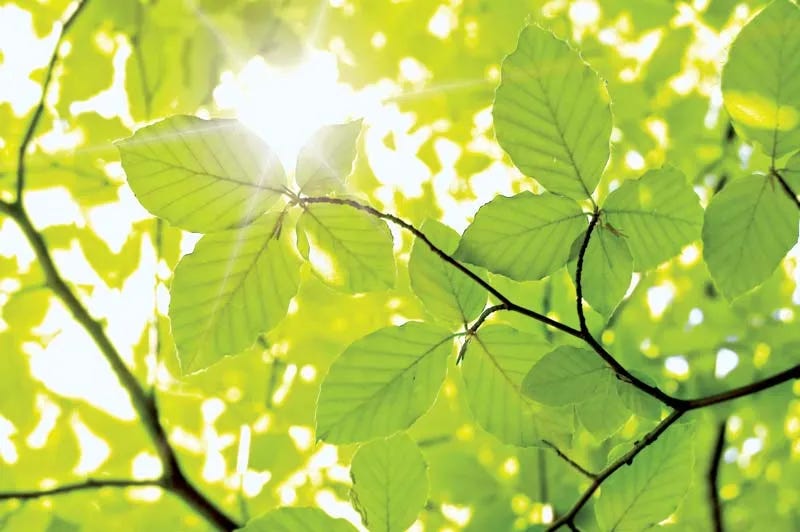
Sunlit beech leaves from the Encyclopedia Britannica. Would humans recognize sentient aliens, and are we recognizing all the sentient creatures currently on Earth?
No posts
Comments
Nothing yet. Say the first thing.
Sign in to join the conversation.