
Untraceable. No paper trail. Non-fancy lives. Caught in a wave of mass immigration from rural farm communities. Likely toilers of fields who never saw a telephone or ventured far from our hometowns. You won’t find royalty or daredevils within these branches, but rather a distinct group of average persons — ones who gave up everything for the chance at a better life.
“Russia” from whence we came was incorrect. The geographic claim on my ancestral towns now lie in modern-day Ukraine, Belarus, and Lithuania. That imperial and Soviet mindset endured through the 2010s!
I’ve spent the last 10 years researching everyone else’s families. Much of my published work covers soldier narratives, as well as biographical data within prison and hospital ledgers. My own family tree remained undiscovered for decades. The Ancestry “hints” bobbed in my notifications corner, but often led me to some other person’s “Yaakov” or “-sky” derived surname.
Family trees can unlock a treasure trove of data. Early on in my genealogical journey, I practiced on friends’ trees — since, clearly, mine was not very helpful. I basked in locating a famous historical relative or connections to a critical event in history (Mayflower descendant, anyone?). And then I handed over that information. There was a crushing reality that my people could not even be associated with such occurrences, but they were still important, right?
There was just no way that successive generations of my family were left unrecorded. My dealings in 17th-19th Century ship manifests, federal censuses, prison admission registers, and military muster rolls equipped me with a special set of skills (Liam Neeson voice optional).
I paid for that knowledge, literally. I upgraded my database subscriptions, added several new ones, and spent many nights corroborating facts on my silly little Ancestry profiles.
The only true fact from the elders’ hazy stories was that my earliest family member arrived in America in 1877, and the last one in 1931. We were not “Russians” who lived in remote villages. Most of us were intellectuals and professionals from larger cities. Although, my grandfather maintained his entire life and on his deathbed that our money is buried under the Kremlin. Maybe there’s some truth to it?
My great-great grandfather was the first to set foot on American soil in 1877, but it was not with my great-great grandmother. Completely innocently, Moses Feuerstein (original spelling) had several children with his first wife before her death, and an additional bundle of children that eventually led to me. Takeaway: Passenger list and federal census records can introduce you to family members you didn’t even know you had.
My great-uncle Sam Finkle was KIA at the age of 21 in World War I France just days before the Meuse-Argonne Offensive (September 1918). He immigrated from Zhytomyr, Ukraine at the age of six, became a shirt presser in Boston, then enlisted in the 82nd Division AEF. Through extensive paper trailing, I discovered that his body did not return to the United States until 1922. Takeaway: Military narratives are not limited to battlefield actions, postwar movement and direction add wonders to a tale.
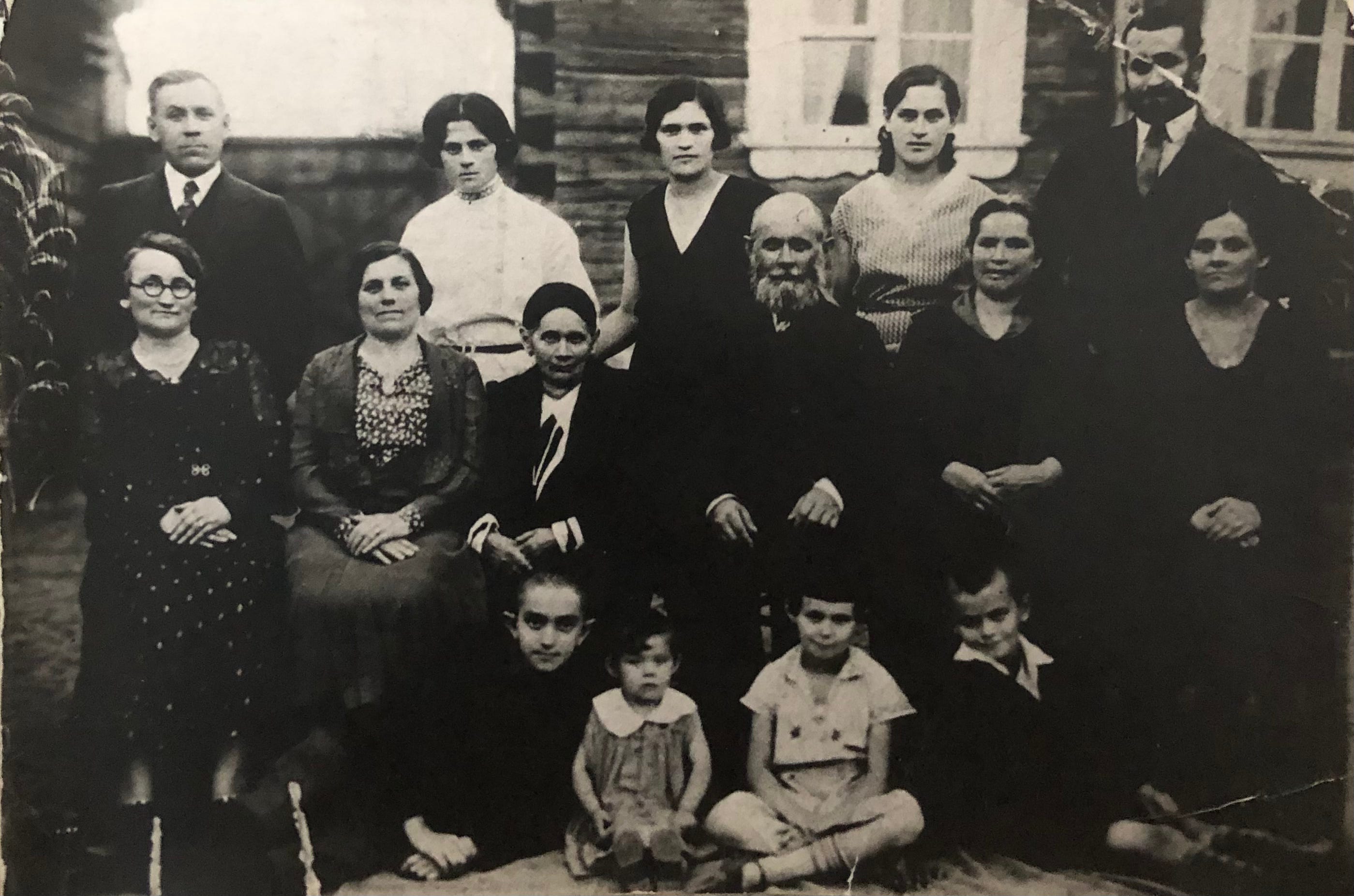
An eerie photograph sat on the piano at my grandparent’s home in Boston for over 50 years (see photo at the top). Three rows of that “peasant stock” smiled back at me in black-and-white, many of the children had dirty faces and the elders appeared grim. “Merkine 1931” was penciled in on the back. Recently, it was disclosed that this was the final family photo taken prior to World War II and the destruction of my family’s way of life in Lithuania. One of those women, Sarah Abelow, emigrated to Brazil shortly after posing. She was unable to obtain an American visa due to the restrictions of the devastating 1924 Johnson-Reed Act. Through DNA analysis, I learned that her descendants — my third cousins — still live in Brazil. Takeaway: There is always more than meets the eye, and always a reason for an ancestor’s actions.
Great-uncle Morris Hoffman was a thrice-convicted criminal. I noticed that he disappeared from the 1920 census, which was odd considering that he was the third eldest and all the other siblings still lived at home. Well, I found him in the admission register for Eastern State Penitentiary. Between 1909-1910 and 1914-1916, Morris served time for grand larceny and highway robbery (how vintage!). A third sentence was handed down in 1938 for continued gang activity, this penance was served at the Allegheny County Workhouse. Takeaway: Just because you can’t find someone, doesn’t mean they didn’t exist. They could be in prison!
Many other genetic gems laid hidden on my tree for what seems like eternity. Someone had to come along and manually brush the dust off. Would you like it if your Substack, Instagram, or published articles stayed dormant in a digital archive — waiting for anyone to peek interest?
Alright, you found the heroes, the weirdos, and everyone in between. Now what?
The stories of our ancestors and roots do not exist in a vacuum. I’ve gained incredible insight into how entire systems, wars, governments, and cultures functioned based on the personal experiences of the average folks living them. Since discovering these obscured tales within my own family tree, I’ve become more well-versed in soldier burials, immigration history, and 1920s crime (to name a few). And all of it was right in front of me all along and in my DNA.
Morris’s drama of incarceration will be a book one day. I embrace his story not as a spectacle, but as an educational tool.
What inspiration lies in your tree?
No posts
Comments
Nothing yet. Say the first thing.
Sign in to join the conversation.