
1924 was a consequential year globally: Lenin died, Hitler was sentenced for the Beer Hall Putsch, more territory was absorbed into the Union of Soviet Socialist Republics, and the Chinese Civil War broke out. In America, as the “Roaring ‘20s” were heating up: J. Edgar Hoover assumed leadership over the FBI, Little Orphan Annie debuted in the comics, the first political convention was broadcasted by radio, and two future presidents were born.
We count the number of ideas, silent film productions, and new-fangled inventions created in our post-World War economy. We obsess over the Gatsby aesthetic and speakeasy atmosphere, but an impactful piece of legislation passed in 1924 fails to reach our modern eyes and ears. The “Roaring ‘20s” is often relegated as a decade of indulgence, luxury, and rising pop culture. At this tail-end of the Progressive Era, we come to understand that “progressive” does not necessarily mean “positive.” We should be more concerned with how the 1920s, instead, denied America to millions of people.
To understand anti-immigration laws today, we must venture to the glossed-over world of 1910s eugenics, which culminated in one of the most aggressive and devastating laws of the 20th Century: the Johnson-Reed Act.
Eugenics is a pseudoscience — a “fake” science, one that isn’t proven by the scientific method or isn’t widely-accepted by the scientific community. It emerged from the pretend laboratories of White supremacist politicians. Eugenics aimed to rationalize racial and ethnic differences from a largely White, Anglo-Saxon, and Protestant perspective. Its goals were simple: to reverse the effects of mass immigration to the United States.
This racial science bled into all areas of American society and impacted White citizens, as well. Eugenics incorrectly stipulated that “undesirable” traits, such as alcoholism, idiocy, or laziness, were not only inherited parent-to-child, but passed through specific ethnic groups. In order to remedy this, eugenicists argued, certain demographics must be barred from entering the country or reproducing. From this crazed and deluded thinking emerged controversial frameworks, like the 1914 Model Eugenical Sterilization Law and Virginia’s 1924 Racial Integrity Act.

Efforts to reverse the “new face” of America go back as far as our first decade as a nation, the 1790s, when President John Adams passed the inflammatory Alien & Seditions Act to remove, in part, “foreign aliens” who criticized Adams’ government.1 The 1840s saw the rise of the abolitionist movement to new heights, with many arguing that the enslaved should be liberated but deported to the African continent. Those campaigning for temperance (early form of Prohibition) frequently took on a racial lens, supporting the removal of liquors from certain groups (i.e., Irish & Germans).
While, yes, there have been historic attempts at controlling immigration, prior legislative amendments targeted consistent processing. Before a standard federal system, immigrant visas and arrivals were handled by the receiving states. Immigration stations emerged at the ports of big “hubs,” such as Boston, Philadelphia, and Baltimore. The system we more typically think of — like Ellis Island — spurred at the turn of the century to streamline the process.
The most infamous immigration laws prior to 1924 were few and far between, but no less concerning. The 1790 Naturalization Act restricted citizenship to “free white persons of good character,” while the 1875 Page Act prevented Asian laborers from entering the country, now that the Trans-Continental Railroad was completed. Other notable early immigration laws include: 1819 Steerage Act (mandatory ship manifests), Immigration Act of 1882 (lunacy tax), and the 1885 Alien Contract Labor Law (banning companies from “importing” employees).
The 1924 Johnson-Reed Act, also known as the Immigration Quota Act, put not only a limit on the number of immigrants admitted into the country yearly, but also amended and restricted the immigration process.2 In 1917, a predecessor act during wartime bolstered national security against raging communists, spies, and anarchists, as well as enacting a literacy test for applicants to prove language comprehension.3 Only select nations were considered as “quota” countries (click here to view an enumerated list). Among the ever-so-lucky ones to be labeled as such, there were two common themes: limitation for those from poorer nations in Eastern & Southern Europe and an “Asiatic Barred Zone.” It favored the Western Hemisphere, particularly Northern Europeans, whose visa limits actually increased due to the new law. The Caribbean, Central, and South America were relatively unaffected by the Act and qualified as “non-quota” nations (see Footnote #2, Section 4c).
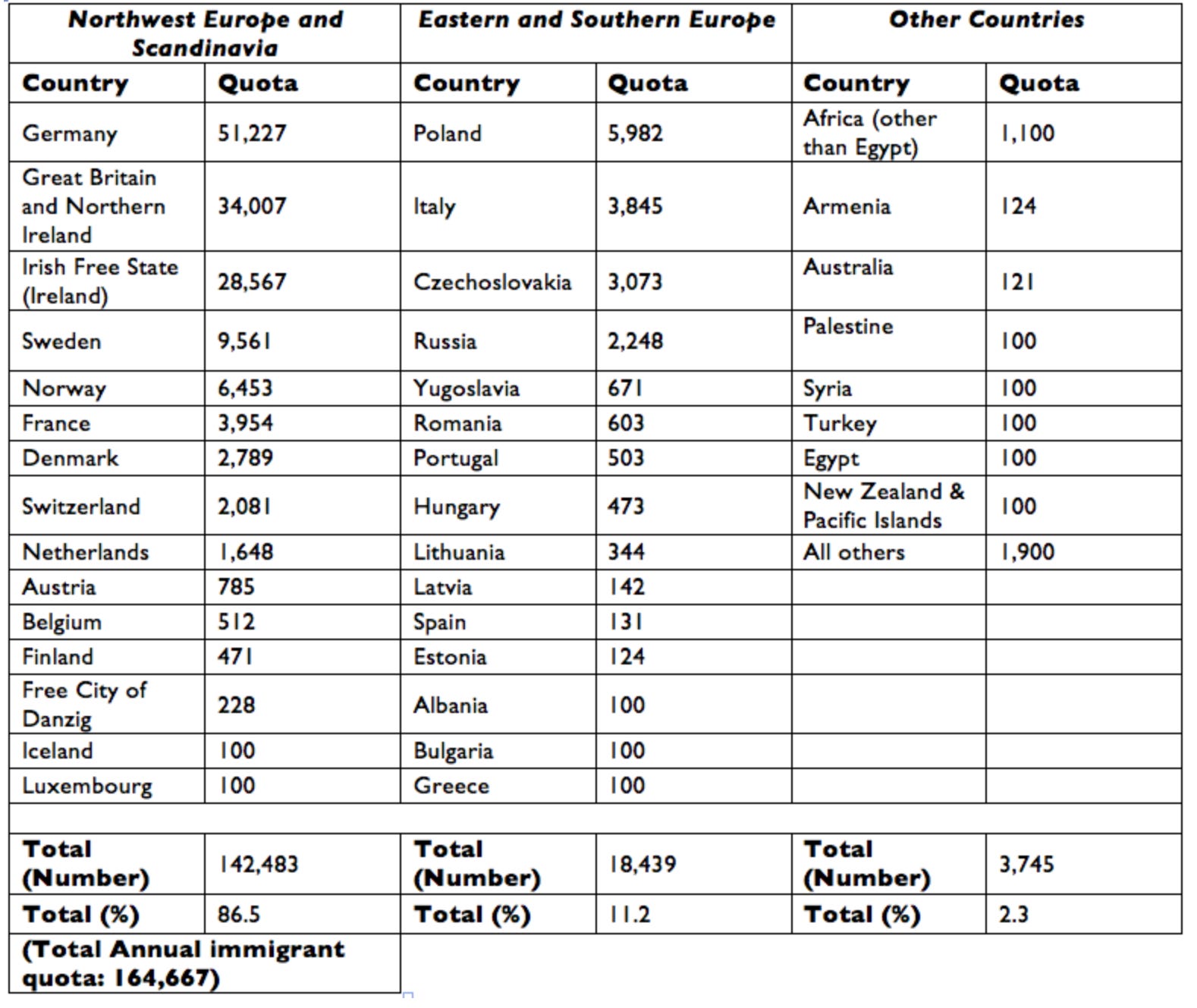
By a vote of 323 to 71, the bill intended to end the United States’s history of asylum. After passage of this edited 1917 law in 1922 (and ratification in 1924), according to the U.S. House of Representatives, it reduced the number of immigrants down to 2% of each representative nationality currently residing in the country. It used data from “before waves of Slavic and Italian immigrants arrived in America,” thus reflecting a targeted legislative motivation.4
This “Asiatic Barred Zone” is also referred to as the Japanese Exclusion Act, since it purposefully prevented Japanese nationals from entering the United States or being eligible for citizenship.5 It rode on the “success” of the 1882 Chinese Exclusion Act in keeping even American-born Chinese from becoming true American citizens. The Quota Act seized centuries-old prejudice based on race and nationality, openly barring entire groups because of racism. The Department of State determined its most basic purpose was to “preserve the ideal of U.S. homogeneity.”
Among the changes were several unrealistic ones, designed to thwart potential arrivals in their home countries and depriving them of the opportunity to apply (see Footnote #2 for details):
(2b) The immigrant shall furnish two copies of his photograph to the consular office.
Photography could be expensive for a poor family and inaccessible to them depending on where they lived.
(2c) The validity of an immigration visa shall expire at the end of such period [four months]…In the case of an immigrant arriving by water….or on a continuous voyage to the United States…the validity of his immigration visa shall not be considered expired.
While kind to extend visas which may expire at sea, as the length of a voyage was often at the mercy of the wind and waves, it does not reflect how most migrants came to America. “Direct” transport was offered from ports like Hamburg, Belfast, or Dover. Immigrants from the targeted quota countries often went through at least two different arrival ports before sailing for the United States.
(2h) A fee of $9 shall be charged for the issuance of each immigrant visa
Naturally, this fee was not attainable for many immigrants — especially those with large families, non-working children, elderly members, or whose life savings went toward just arriving at the consular office.
Even so, the Act specified who from quota nations were preferred candidates. Section 6 of H.R. 7995 would more likely issue a visa to someone married to a U.S. citizen, skilled in agriculture, or is the unmarried child of an American.
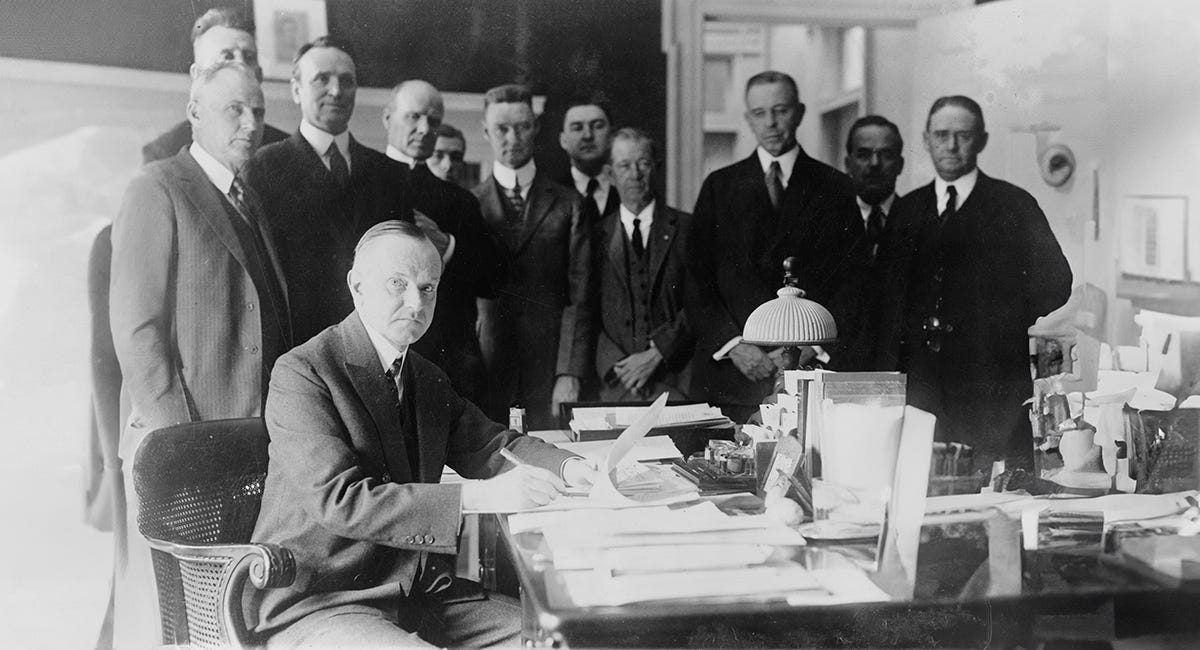
President Calvin Coolidge succumbed to the influence and charm of the eugenics campaign. Signing into law an act that restricted immigration to only 150,000 lucky souls annually, he played into rising nationalism in the United States.
After the Great War and Woodrow Wilson’s failed attempt to make America a leader in global diplomacy, the Coolidge Administration appealed to constituents’ desire for a “whiter,” isolationist nation. Most blamed the overcrowding in growing cities like New York and Boston on the new arrivals. Immigrants, some of whom fought in the recent Civil War, Spanish-American War, Philippine-American War, or First World War, now found their adopted nation hostile to their presence.
When Coolidge remarked that “America must remain American,” he was not just referring to newcomers on our shores, but also the millions of foreign-born who contributed to the American economy and culture daily.
The Johnson-Reed Act, coupled with the discriminatory rationale behind Prohibition,6 was never intended to be lifted. White Americans truly thought that with enough time, fertility restrictions, and intimidation, the United States would no longer be an attractive or viable option for minorities.
The 1930s proved that the Quota Act was a terrible, horrible idea. In hindsight, we look back on the immigration restrictions placed in 1924 as one of the catalysts for the high number of direct or collateral victims of World War II. Blaming the established law, President Franklin D. Roosevelt “did not take significant action to aid German Jews, either by ordering a diplomatic protest or by publicly supporting increased immigration.”7 As many of us are aware, American eugenics and immigration restrictions inspired the horrific crimes of Hitler and the Nazi Party.
The quota system was finally lifted in 1968 under President Lyndon B. Johnson. It was phased-out through the 1965 Immigration and Nationality Act, which removed the racial bias and restrictiveness based on country of origin from our federal immigration process.8 Johnson wanted to “strengthen family reunification” and faced growing pressure to admit refugees from Asian nations in the wake of the Korean and Vietnam Wars.
The 1924 Act may be overridden, but its legacy left a permanent stain on the American conscience. May it be a historical lesson in tolerance, acceptance, and grace.
Sixty-Eighth Congress. Session I. Chapter 190 — An Act To limit the immigration of aliens into the United States, and for other purposes. [H.R. 7995] May 26, 1924. Access here.
The literacy test did not mandate that reading or writing skills be demonstrated in English, however, many applicants from poorer regions or nations with education inequality suffered for this new requirement — oftentimes a reason for wanting to come to America in the first place.
Office of the Historian & Office of Art & Archives. U.S. House of Representatives. Access here.
Office of the Historian, U.S. Department of State. Access here.
While the Volstead Act (1919) had many reasons behind its passage, one of the most controversial was the anti-immigrant sentiments around Irish and German alcohol-culture (i.e., German breweries or Irish whiskey). Eugenicists pushed that alcoholism was more common among ethnic groups with alcohol-making or partaking as part of their culture. As we know, temperance workers and dry-state advocates exaggerated the role that alcohol played within such broadly-defined groups.
No posts
Comments
Nothing yet. Say the first thing.
Sign in to join the conversation.