
Disclaimer: The content on this website is for informational and educational purposes only and is not created to meet your personal financial situation. Nothing should be considered as investment advice or as a guarantee of profit. You are advised to consult with your financial advisors to discuss your investment options and whether it would be a suitable investment for your personal needs. The information used in this publication is from sources that are believed to be reliable but the accuracy cannot be guaranteed. It may include some errors, please make sure to do your due diligence. The opinions expressed are those of the author and the author only. These opinions are subject to change without prior notice.
Disclosure: The author may own shares in companies mentioned in this article as of 5 August 2026. The security could be sold at any point in time without prior notice
Well well well, it didn’t take too long for one of my ‘watchlist’ ideas become a full position for me. I’m going to be talking about PhotoSynth, which I wrote about briefly on Japan Idea Radar #4.
The more I looked at it the more the thesis made sense where I like it both as a business and a stock. and now I’m at a point where I think this could potentially have significant upside and the downside quite limited making this opportunity highly highly asymmetric. So I put my money where my mouth is and started a decent sized position. I expect this investment to be somewhere between a 2-3x depending on how well it goes.
There is really nothing too complicated here and the thesis is relatively simple:
I don’t think the market is pricing in any acceleration at these prices… at all.
What I like is that to get to this conclusion it’s more simply recognising a pattern, lets call this “Applied Hikari Sciences” in that my main interest in the investment broadly rest in understanding how Hikari works as both an operator and investor.
It had all the ingredients that I typically would like to see: a catalyst (revenue re-acceleration, margin inflection); a favorable incremental buyer thats directly influences the topline; operates in a hated segment of the market (SaaS); high revenue visibility and improving churn; negtive working capital; improving quality of revenue; structural change in the market; overlooked by most; downside protection via the Balance Sheet (more on this later).
The company has been de-rating as topline decelerates and the stock has been thrown out with the rest of SaaS because… AI
Which makes little sense as this business is hardware driven and now, the company is at the precipice of a re-acceleration from their core Akerun biz as they focus on enterprise clients. The market seems to be overlooking that the competitive landscape has become favorable for PhotoSynth in recent years.
A second major lever to acceleration is that Hikari is becoming a distributor for PhotoSynth and the market is failing to recognise the significance of this (nor is it reflected in PhotoSynth’s MT plan).
Importantly Hikari is a 16%+ owner of PhotoSynth so their interests are very much aligned.
Additionally the company is now focused on profitability and is at an inflection point in terms of margins - I expect the businesses margin to expand significantly in the coming years as operating leverage starts to kick in potentially to the upside if they are able to grow faster than expected.
Overall what you have is an incredibly aligned external shareholder that is also an operating partner that is considered to be one of the best sales agenct in Japan. This is a rare case where you don’t just have Hikari as a ‘passive’ shareholder as is usually the case, but actively working to unock the value by operationally engaging with the company. It couldn’t get any better.
PhotoSynth’s main business Akerun has been focused on selling smart locks to corporate customers. It’s revenue is based on subscription of software + leasing of hardware. A large majority of their revenues therefore is recurring revenue with limited churn. (sub 1% monthly churn now). 83% of revenue is recurring and monthly churn is 0.92%. The neat part here is that these locks can be retrofitted.
Furthermore they have other small segments like Akerun MIWA which focuses on residential smart locks, Migakun which is a platform to hire facility cleaners on demand and Fix-U which is a membership management software platform use in facilities like coworking spaces. These are all currently subscale requiring some investment to become future drivers of growth.
The drivers are simple in that they look to expand Akerun (80-90% of sales apparently) and on the back of that they’re going to try and cross-sell other solutions and services namely Migakun and Fix-U.
Thus growth lever here is:
# of customers
ARPU (which combines sales of all services not just Akerun).
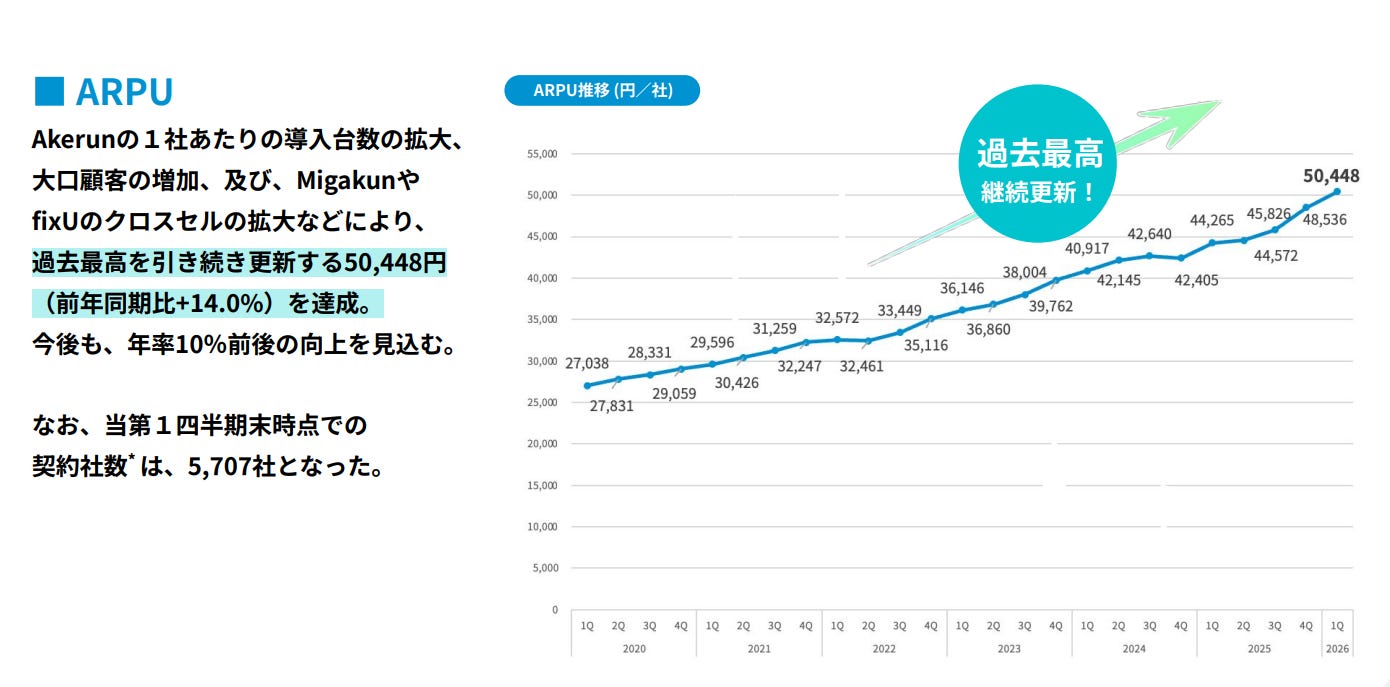
What I find interesting and potentially something of a change that is not being noticed by the market is that the industry in which Akerun seems to be operating is at a structural turning point. Many competitors are exiting the business or shifting towards B2C i.e. residential smart locks. Thus competition is declining and this puts Akerun as the leading player in a highly favorable position.
One of the main reasons this is happening is also a barrier to entry for this market, which is that corporate customers have much stricter needs when it comes to integration with their existing systems, security/quality standards, high need for customer support. In short it’s more mission critical than the B2C market. PhotoSynth has been working on this early and has created an ecosystem with native connectivity to other B2B software solutions businesses are using. For example, attendance management software which can be linked to the smart locks. So Akerun fits nicely in the complex customer workflow needs. As a result, today they’re seeing less competition in an RFP. One thing that is perhaps also indicative of this is that despite their products being priced at a premium compared to peers, their revenue seem to be accelerating.
Importantly another key component is that the company is now gaining traction among larger scale enterprise customers. Whereas the company was selling primarily to SMEs previously and this lead to the topline deceleration. The opposite is starting as they win more enterprise clients. Note that in a typical SME they may need 2-3 smart locks at most, the need for enterprise which often have several office locations or stores may be in the hundreds. Thus incremental revenues from each new customer can be significantly larger. Incremental profitability is also better. This is not an ‘if’ and is already happening as your can see with their press releases. They’ve been announcing new customers like golf ranges, gyms etc. The company also commented in the IR slides that they have a pipeline of entrprise clients they’re onboarding.
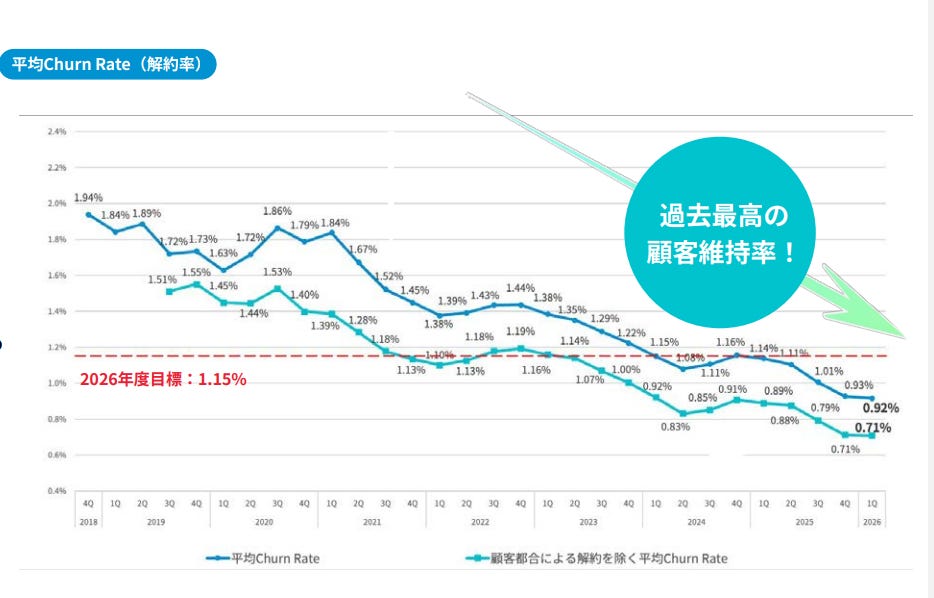
Enteprise clients are generally much larger in ARPU and as they tend to integrate many more locations over one platform, switching costs are higher and therefore churn lower. This is the main reason why Churn has been declining over the last few years in addition to cross-selling going well. ARPU as a result has been growing double digits as is also expected to continue.
I therefore consider Enterprise clients to be higher quality source of revenues and this I think, also deserves a premium.
The second and maybe most important part of the topline story is Hikari Tsushin. I have mentioned in the past, if Hikari knows one thing, it’s how to sell products. Their sales oriented, meritocratic organisation has created a incredible sales engine that enables various goods and services to scale. PhotoSynth is now directly plugged into Hikari’s sales network which consists of 1000+ sales agencies and more than 1.3 million corporate customers.
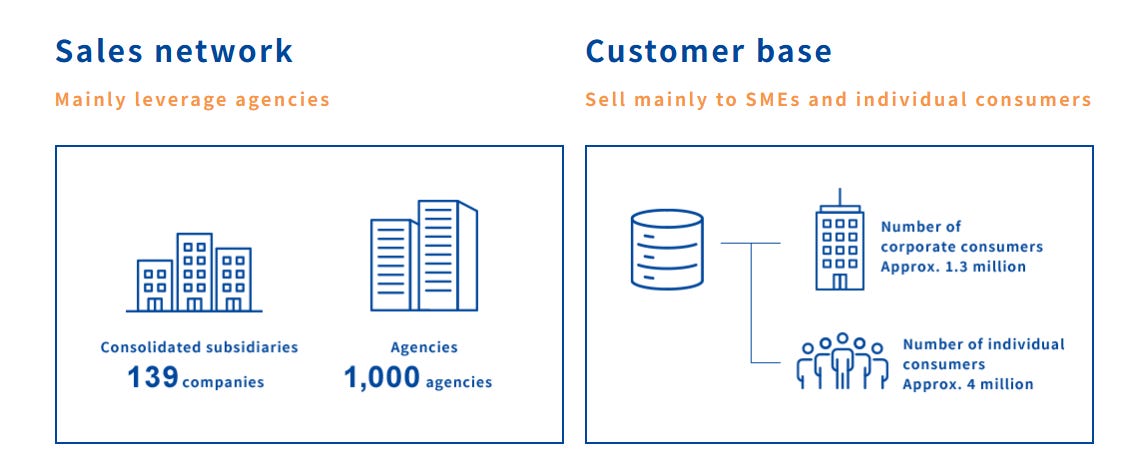
This is the crux of the thesis as it was announced that Hikari is now a distribution partner whilst they have also become a 16% owner of Photosynth. It’s almost like a PIPE transaction.
It’s rare for Hikari to intervene in this way but there is precedence for this in the public markets. Hikari became a major shareholder in a company called Premium Water Holdings back in 2015 and since then it’s become a wholely owned subsidiary. (Though still listed, ticker: 2588). What’s important to understand here though is since Hikari became its shareholder, they’ve helped Premium Water reach the leading position in their market. And since first investing, the stock was up 6x in the preceding 5 years (admittedly it’s been more flat in recent years). What is fascinating is that PhotoSynth is in an extremely similar position to Premium Water where revenues are growing 20%+ and they’re at the early stage of margin inflection.
So this is the playbook I see potentially playing out for PhotoSynth as well.
Their involvement in Hikari is preeetty clear, based on their IR material but the fact that they’ve built a team within PhotoSynth specifically to build out this partnership.
What I’ve also found is that there are a few ex-Hikari employees that have already been working at PhotoSynth for a number of years. In fact, I got to confirm that the head of sales at PhotoSynth is a former Hikari employee. Bingo.
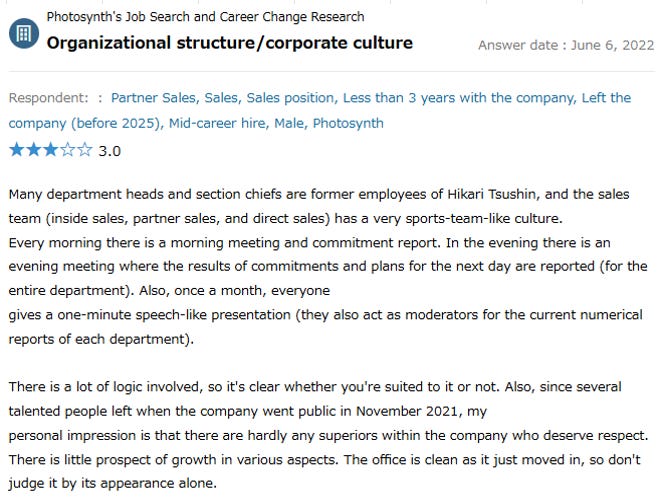
So Hikari’s potential involvement with Photosynth is much more than meets the eye, and my feeling is that they have every intention to make money from this business (and trade.)
Importantly, given that this is a relatively new partnership, contributions from Hikari isn’t reflected in the mid-term plan. Meaning that it could accelerate beyond it’s 20-30% revenue CAGR target. Now be mindful that this was only announced 6 months ago, and sales people require education on the product before they can sell.
The added component, and this is important, is that I expect this to be profitable growth. The company has shifted to profitability in 2024 and they seem to be at an inflection point in terms of margins. I like this because one of the main things I look for in an investment is operating leverage. The company, as indicated by their Mid-Term plan have every intention to do that.
One thing to keep in mind though is that their Adj. EBITDA isn’t that useful given depreciation costs are real (leasing hardware), as are SBCs and R&D into Physical AI. Having said that the SBC costs incurred this FY is more a one off and should be minimal by the final year FY28. Depreciation cost should also moderate as they now have well stocked inventory and expect capex to moderate. Also keep in mind SBC dilustes shares by 6% or so.
Segments like Migakun are lower margin (i.e. dilutive) and everything non Akerun is currently loss making, but this should also lead to breakeven and this also should be less dilutive margin in the next 2-3 years.
Overall considering all this, reaching an EBIT margin of ~14% by FY28 does not feel unrealistic. (They have an Adj EBITDA target of 22% by FY28) That’s basically a 3x in profits over the next 3 years. With that I also expect Free Cashflow to expect significantly.
My base assumption is that revenue can reaccelerate and sustain at least 20% over the next few years whilst margins expand from 5.9% expected this year to ~14% by FY28, implying a 50%+ CAGR in EBIT. This would imply an FY28 forward multiple of 3.4x EV/EBIT at which point I think there’ll still be significant room for topline growth and operating leverage.
So at a headline EV/EBIT of 18x where’s my margin of safety?
A kicker to this investment opp for me, and what makes me think this opportunity is so asymmetric is on the downside where I think there is several components that most probably don’t realise but I think would add meaningful downside protection:
Comments
Nothing yet. Say the first thing.
Sign in to join the conversation.