
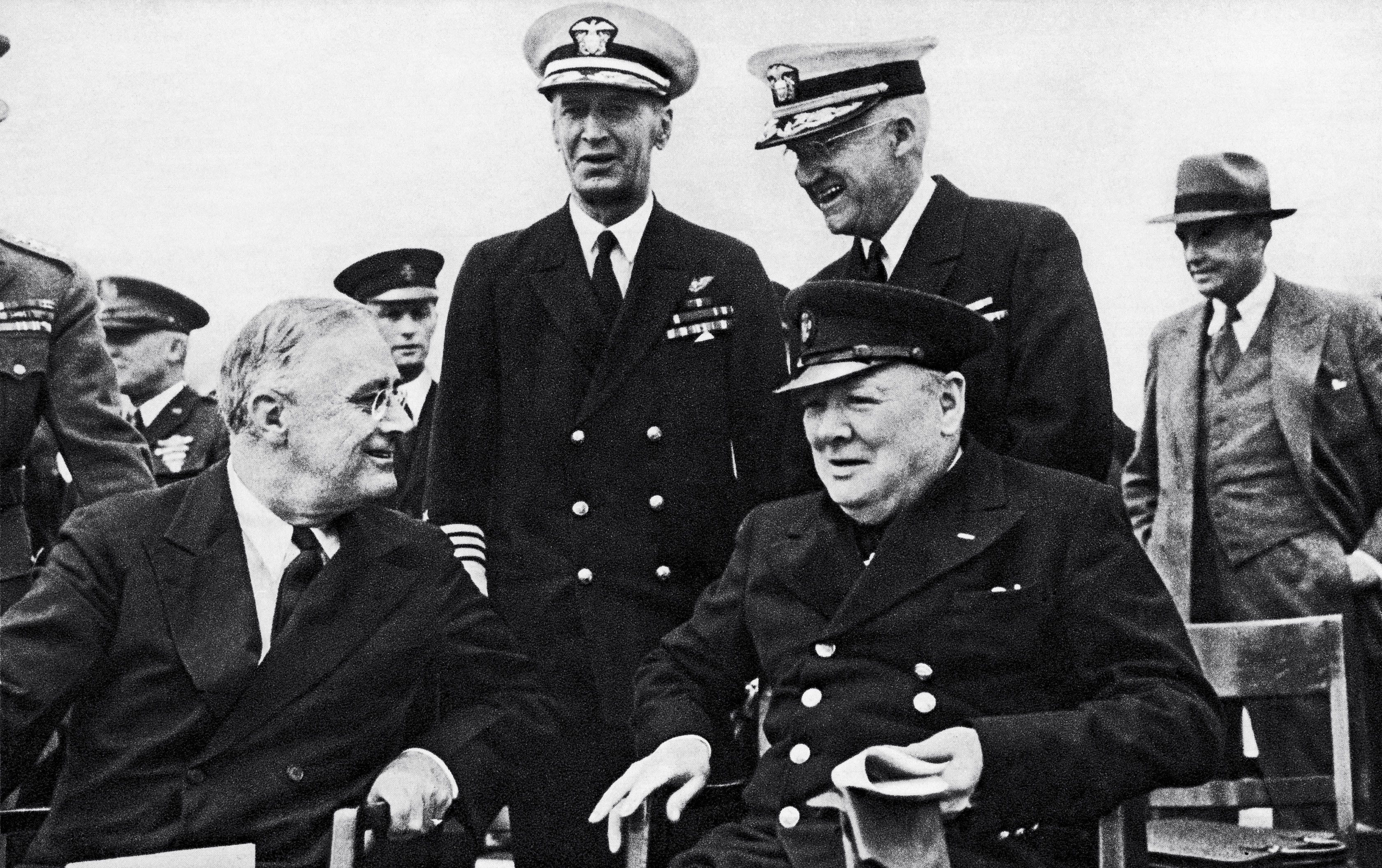
‘We are just off,’ wrote Winston Churchill to President Franklin D. Roosevelt on 4 August 1941 as he set sail across the Atlantic. ‘It is twenty-seven years ago today that the Huns began their last war. We must make a good job of it this time. Twice ought to be enough. Look forward so much to our meeting. Kindest regards.’ Churchill was writing from spacious quarters at the stern of the battleship, HMS Prince of Wales, which, although only commissioned in January that year, was already a veteran of the epic chase over the Atlantic and subsequent sinking of the mighty German warship, the Bismarck, back at the end of May.
Churchill was thrilled to be aboard this massive new warship and eagerly anticipated this trip to Newfoundland, for there he was to meet Roosevelt. Although they had crossed paths very briefly twenty years earlier, this was to be their first face-to-face meeting as political leaders of their respective countries.
Out at sea, a storm soon whipped up, forcing Churchill to move to a smaller but more comfortable cabin near the battleship’s bridge. It was too rough for the escorting and much smaller destroyers, so it was agreed the Prince of Wales should steam on at full speed alone. What a tasty target this giant ship would have been for any skulking U-boat – yet thanks to decrypted German Enigma traffic, known as ‘Ultra’, to high-frequency direction finding – HF/DF, or ‘Huff-Duff’ – and to the 29-knot speed of the ship, it was about as safe a means of travel as any in the summer of 1941. Nonetheless, in order to dodge lurking U-boats, absolute radio silence was maintained, although messages could be received. ‘Thus, there was a lull in my daily routine,’ noted Churchill, ‘and a strange sense of leisure which I had not known since the war began.’ He even had time to read a book for pleasure.
The Prince of Wales safely reached Placentia Bay in Newfoundland, and the British contingent made their rendezvous with the Americans on the morning of Saturday, 9 August. For Churchill, this was a big moment. He had been striving to draw ever-closer co-operation from the United States since his time at the Admiralty and was equally eager to forge a sense of common purpose and even friendship. ‘He is excited as a schoolboy on the last day of the term,’ noted Churchill’s secretary Jock Colville before the PM left. Should President and Prime Minister forge a firm bond of friendship and understanding, Churchill knew, the alliance of their two nations could prove a war-winning one; the stakes, then, could hardly have been higher.
The sides began gently. There was a dinner and discussions on the USS Augusta, anchored nearby, then, the following day, a church service and lunch on the Prince of Wales. Finally, on Monday 11th, by which time Lord Beaverbrook, the Minister of Production and close confidant of the Prime Minister, had joined them, Churchill and Roosevelt had a more intimate, less formal lunch. Much of the discussion was about the growing aggression of Japan, but it was also reaffirmed that if the US entered the war, then together with Britain, they would focus on the defeat of Nazi Germany before Imperial Japan. US naval participation in the Battle of the Atlantic was also reaffirmed, and it was agreed there would be a three-way conference between Britain, the US and the Soviet Union in September, while a pledge of aims, which became known as the Atlantic Charter, was also drawn up and signed. In it, Churchill and Roosevelt declared to the world eight common principles. They sought ‘no aggrandisement, territorial or other’. They also respected the rights of all peoples ‘to choose the form of government under which they will live’. The sixth point dealt directly with Germany: ‘after the final destruction of Nazi tyranny, they hope to see established a peace which will afford to all nations the means of dwelling in safety within their own boundaries, and which will afford assurance that all the men in all the lands may live out their lives in freedom from fear and want.’
It was heady, utopian stuff, and back in Britain caused some embarrassment for Churchill; India, for example, had been on the cusp of independence before the war, but there were many there who believed they were not being given the chance to choose their own government. The Atlantic Charter hardly endorsed empire. Nonetheless, the charter was significant and placed the war firmly on a moral footing in the eyes of Britain and the United States. This alone set the current conflict apart from those that had come before. Just as importantly, Roosevelt and Churchill had finally had the chance to meet one another properly and, while neither forgot that theirs was a professional relationship, they liked one another and got on well. Roosevelt was a head of state, Churchill was a chief minister – and there was a difference – but both were global military-politico leaders speaking the same language and with the same essential aims.
The importance of this meeting in Placentia Bay has often been played down. But it should not be because the coalition of Britain and the United States really did pave the way for victory, and at its heart lay the relationship between Roosevelt and Churchill, begun by letter but affirmed at Placentia Bay. Britain may be diminished as a world power today, but the Atlantic Meeting proved the importance of political leaders sitting down together and establishing bonds of mutual respect. The personal touch still counts, and it was this vital first wartime meeting that began what would become known as the ‘special relationship’: two nations, with similar aspirations to preserve democracy and peace, with a shared language and many of the same ideals and whose mutual support during the war ensured both countries became brothers in arms.
President Trump is a very different man from FDR, and the new prime minister-in-waiting, Andy Burnham, shares little with Churchill. Even so, on this 250th anniversary of the United States’ birth, there remains much that still binds the two countries. History is always here to help, and this first, critical meeting of the Second World War reminds us of how much can be achieved when both the will and the personal connections are there to smooth over disagreements and encourage common aims, hopes and aspirations.
Comments
Nothing yet. Say the first thing.
Sign in to join the conversation.