
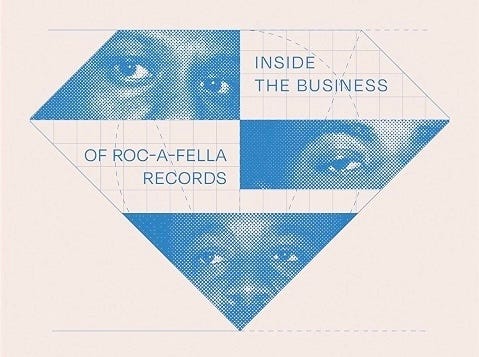
UpRising: What made the business of Roc-a-Fella Records a subject captivating enough for you to want to write a book about it?
Sowmya Krishnamurthy: I grew up with Roc-a-Fella Records. Jay-Z’s Vol. 2: Hard Knock Life was one of the first CDs I bought with my own money back in 1998. As a kid, I was obsessed with the industry. With Jay-Z, so many people understood Roc-a-Fella was this integral brand that was shouted out as much as he was. We knew he started independently, which he wore with pride. As the brand evolved, it went into lifestyle, whether it’s Rocawear or Armadale or films like Paid in Full. We’re over 20 years since the business officially dissolved, and this company still fascinates, intrigues, and confounds a lot of us.
As somebody who went to business school, I always wondered: What about looking at this company through the same lens that we look at other great entrepreneurs? There have been so many deep dives into Meta and Google. We uphold those founders as visionaries. But it’s not the same in hip-hop. So many of the same tenets — the drive, grit, and resourcefulness that you need to be a great founder — are seen in the Roc-a-Fella story. Why is this the greatest hip-hop label of all time? What can we learn from the founders, their business decisions, their lessons, and the blueprint that they created?
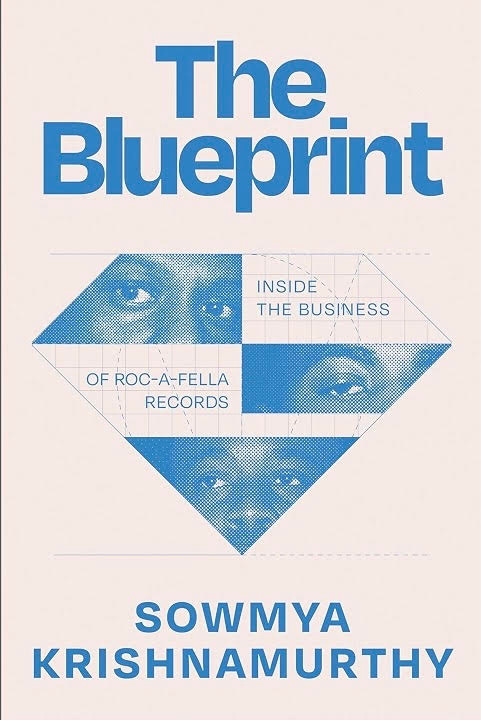
Look at hip-hop now; artists want to be bosses, entrepreneurs. They take pride in having their own companies, whether it’s Kendrick Lamar and pgLang, Drake and OVO, or J. Cole with Dreamville. I believe it’s because, whether consciously or subconsciously, they’ve been following this blueprint of Jay-Z, Dame, and Biggs. So this book truly is a celebration of Roc-a-Fella Records and the individuals who made this such a blue-chip brand. With this year being the 30th anniversary of Reasonable Doubt as well as the 25th anniversary of The Blueprint, it’s really the perfect time.
Jay-Z was known for incorporating his business dealings in his lyrics, which added to his appeal as an entrepreneur and the lore of Roc-a-Fella Records as a creative house and a business unit.
Absolutely. A lot of fans focus on the music, but once you contextualize Jay’s story, it becomes clear that music was a business decision for Jay-Z. It really went into his own risk assessment of whether he wanted to keep doing what he was doing in the streets or come into the world of hip-hop. He said numerous times that it always concerned him that rappers weren’t making the kind of money that he was used to. He’s an excellent rapper, but for him, the decision to start this company is very much a business decision more so than creative.
We all know Jay-Z was rejected by every major label for a variety of reasons. And it makes sense in retrospect because he was coming to the table with a different sense of negotiation. This wasn’t somebody desperate to get a deal and get that advance that was going to help him economically. He was coming in with money. If the deal happened, that would be great for his music career. But that wasn’t paying his bills. That’s a very unique-but-important mindset.
This is someone who saw himself as a businessman from day one. That mindset shifted the paradigm in hip-hop because it’s something you see young artists want to emulate. That comes from Jay-Z, hip-hop’s first billionaire.
How did you go about reporting for The Blueprint? Where did you start, and what was your process?
I have to give a lot of credit and appreciation to the late DJ Clark Kent. For those who don’t know, he brought Jay-Z and Dame Dash together. He tells a great story about their first interaction. Clark had worked with Dame on another business venture prior that’s also discussed in the book. He is such an important pillar in this story. He was able to make some key introductions and get some of the day ones who were part of this story. He passed away shortly after, which is incredibly sad and a huge loss to hip-hop. Having him be a part of this, I’m just incredibly honored.
Outside of that, so much of the Roc-a-Fella discussion is being played in real time. Turn on any hip-hop podcast on any given day, and someone is discussing this. While I was writing this, Memphis Bleek launched his own podcast. So I had a plethora of additional research; I spent a lot of time listening to podcasts, watching interviews, going through the archives of old magazine articles. It’s really just a combination of all of those things while also talking to business school professors and entrepreneurial experts. There’s a very strong hip-hop core, because that’s what I know and love. But there is also a lot of music business foundations about ownership, intellectual property, property rights, and things of that nature.
Does The Blueprint conclude with the ending of Roc-a-Fella in 2004?
The label’s official timeline is 1994 to 2004. But I start the story earlier to go into the biographical origin stories of the three founders, as well as a company called Dash Entertainment, which was the precursor to Roc-a-Fella. The story doesn’t end with the ending of the partnership of the three founders. As I was writing the book, Reasonable Doubt, which is the sole asset of Roc-a-Fella Records Inc., was in contention, with the three founders essentially fighting over its ownership. So I include that story as well. As of when the book was put to bed, that had not been resolved. That one asset was very much the bedrock of the original company. It was fascinating to me how 20 years later, we were still talking about it as something not just culturally important, but also a business asset that was tethering the founders together.
As you learned more about the genesis and dissolution of Roc-a-Fella Records, did your view of Jay-Z and Damon Dash’s shift change?
There’s a lot of conversation now about Jay-Z, Dame Dash, and what they each brought to Jay’s career and Roc-a-Fella. So by doing this book, I was able to really distill what each of the founders’ strengths were. And I truly believe you needed Jay-Z, Dame, and Biggs to create Roc-a-Fella. You have the artist, who was the product. Biggs as the silent partner — everyone knows if you’re starting a company, you need access to capital. And then you have Dame Dash, who is incredibly polarizing, but I’ve always been steadfast in that he is a visionary and a genius. When you read this book, you’ll just see his passion. It was so imperative to make this label great, and it also aligns with other great founders. I did a very intentional job of maintaining a level of fairness. That was very important to me. I spoke to people very close to all three of the founders, both on and off the record.
That makes sense. The 2000 documentary Backstage, which chronicled the historic Hard Knock Life tour, shows just how passionate Damon Dash was about fighting for his artists and his label.
Someone like Dame Dash, when he’s in your corner, there’s nothing like it. You want a Dame Dash to fight for you. Now, when you’re on the other side of the negotiation table, that’s where things get a bit tricky. And to your point about the Hard Knock Life Tour, that was a seminal moment. For those who didn’t watch Backstage, there was a big blowout between Dame Dash and Kevin Liles, an executive at Def Jam. The fight was over Dame not wanting his artists wearing Def Jam jackets. From a fashion perspective, who wouldn’t want a Def Jam jacket? It was an iconic label to wear across your back. But if we now look at that same situation through the lens of branding, it makes complete sense what Dame said, because branding was integral for hip-hop labels. That signified something not just to artists, but to consumers. So imagine that confusion if Roc-a-Fella artists are now wearing Def Jam. So it makes complete sense. But in the moment, there were probably other ways he could have communicated that. I actually interviewed somebody who was right there listening to this happening. It was a pivotal moment in showcasing where there were starting to be fissures within the label and a difference in perspectives of one of the founders versus the others.
We all know these moments as fans, whether it’s the backstage fight over the jackets or Cam’ron becoming vice president of Roc-a-Fella. But what did that mean for this as a company, for the founders, and the employees who worked there? How does that affect morale or chain of command?
Looking at Jay-Z’s business moves in the two decades after The Roc shut down, do you see a distinction between the business of Roc-a-Fella and the business of Jay-Z?
Jay-Z is one of the most successful hip-hop business people of all time. To get to the Jay-Z that we know now — the guy at the top of the Forbes list, the person who founded Roc Nation and forged all of these historic partnerships — Roc-a-Fella was the foundation. Because he had that experience and the mindset and also the lessons of what it meant [for Roc-a-Fella] to partner with Def Jam in a 50/50 deal. He was able to see what it’s like being truly independent and what it’s like being part of the machine. As you read the book, you see Jay-Z evolving, where he starts to take an interest in being an executive, in learning from individuals who are already established in that space.
Once Roc-a-Fella dissolved in ’04, Jay-Z took a position as president of Def Jam shortly thereafter. That was a very high-profile position. It was in many ways monumental to see someone who was an artist now being at the top of the definitive hip-hop record label, sitting right next to all of the C-suite music industry execs. After a few years, he wanted something of his own. And that goes back to that entrepreneurial pull and brings us into Roc Nation, which showcases an expansion of Jay-Z from the Roc-a-Fella era.
No matter what Jay-Z does, he views himself as a boss and a leader. He never really worked for someone, minus that very brief stint at Def Jam. So he doesn’t have the mindset of working for other people. He’ll work with them. We see that with his myriad of partnerships and business deals. I know many of them are in the public discourse; some can be polarizing or controversial. But once you understand his business-focused mentality, that just gives a lot more appreciation and understanding for who he is now.
Kanye West worked closely with Roc-a-Fella artists as a producer during the label’s heyday, but his emergence as an artist came just as Roc-a-Fella was being dissolved. Do you think being signed to the label influenced how he went on to build his own empire?
Roc-a-Fella Records is the only hip-hop label to produce two billionaires: Jay-Z and Kanye. This is the kid who was just sending beats and hanging out at Baseline Studios wanting to be discovered. I believe just being around that entrepreneurial energy propelled Kanye into thinking that way — wanting to be not just a rapper, but somebody who influenced culture as a whole. He was wearing Rocawear, so it doesn’t surprise me that he wants to design and wear his own line years later. Listen to “Big Brother.” He looked up to Jay-Z immensely, wanting his respect, wanting to be like him. That also connects to wanting to be seen as successful, the master of their own domain. Kanye, Jay-Z, Cam’ron, State Property, Amil, these are all individuals whose stories are spotlighted for various reasons in the book.
What do you want readers to take away from The Blueprint?
One thing about me as an author in the hip-hop space is I really want to highlight not just unsung voices, but also narratives that otherwise we may not see. Chronicling that history is very important. My hope truly is that this book gets taught in business school classes, turned into something cinematic for the big screen, and is just really treasured by those fans of hip-hop, the music industry, or entrepreneurialism.
— John Kennedy
—————
The Blueprint: Inside the Business of Roc-a-Fella Records is available for preorder ahead of its December 1 debut. Krishnamurthy is also the author of Fashion Killa: How Hip-Hop Revolutionized High Fashion.
Comments
Nothing yet. Say the first thing.
Sign in to join the conversation.