
For the past several weeks, I have written extensively about AI infrastructure.
Today, I want to step away from data centers and semiconductors to examine a different kind of infrastructure, one that could allow physicians to detect cancer when conventional scans still see nothing.
We previously explored the investment thesis around GLP-1 drugs. It attracted enormous attention for a simple reason: obesity affects an exceptionally large population. Approximately 40.3% of American adults are living with obesity, and the commercial opportunity became large enough to help turn Eli Lilly into the first pharmaceutical company valued at more than $1 trillion.
The thesis we are examining today addresses a different problem.
Cancer does not create the same kind of mass-market opportunity as obesity treatments, but the cost and complexity of treating each patient can be much greater. Direct cancer-care costs in the European Union reached an estimated €120 billion in 2023, representing approximately 6.9% of total healthcare spending.
But the most interesting part of this thesis begins with a much more personal problem.
A patient can undergo surgery to remove a tumor.
The operation appears successful, and the scans performed afterward show no visible sign of cancer.
Unfortunately, that does not always mean every cancer cell has disappeared.
A small number of cells can remain somewhere in the body, in quantities too low to appear on a CT scan or MRI. They may remain invisible for months before multiplying enough to produce a detectable recurrence.
This is why someone can be treated successfully, declared free of visible disease, and later discover that the cancer has returned.
After surgery, physicians must decide what comes next.
Should the patient receive chemotherapy or immunotherapy? Or should the medical team avoid an unnecessary treatment and continue monitoring?
These decisions still frequently depend on imperfect indicators: the size and location of the original tumor, whether it reached the lymph nodes, and the recurrence rates observed in patients with similar characteristics.
As a result, some patients may receive aggressive treatment even though their cancer has already been eliminated.
Others may receive no additional treatment because nothing remains visible, despite a small number of cancer cells still being present.
The problem is not always that we lack an effective treatment.
Sometimes, the problem is that we cannot measure precisely what remains to be treated.
This is where liquid biopsies enter the picture.
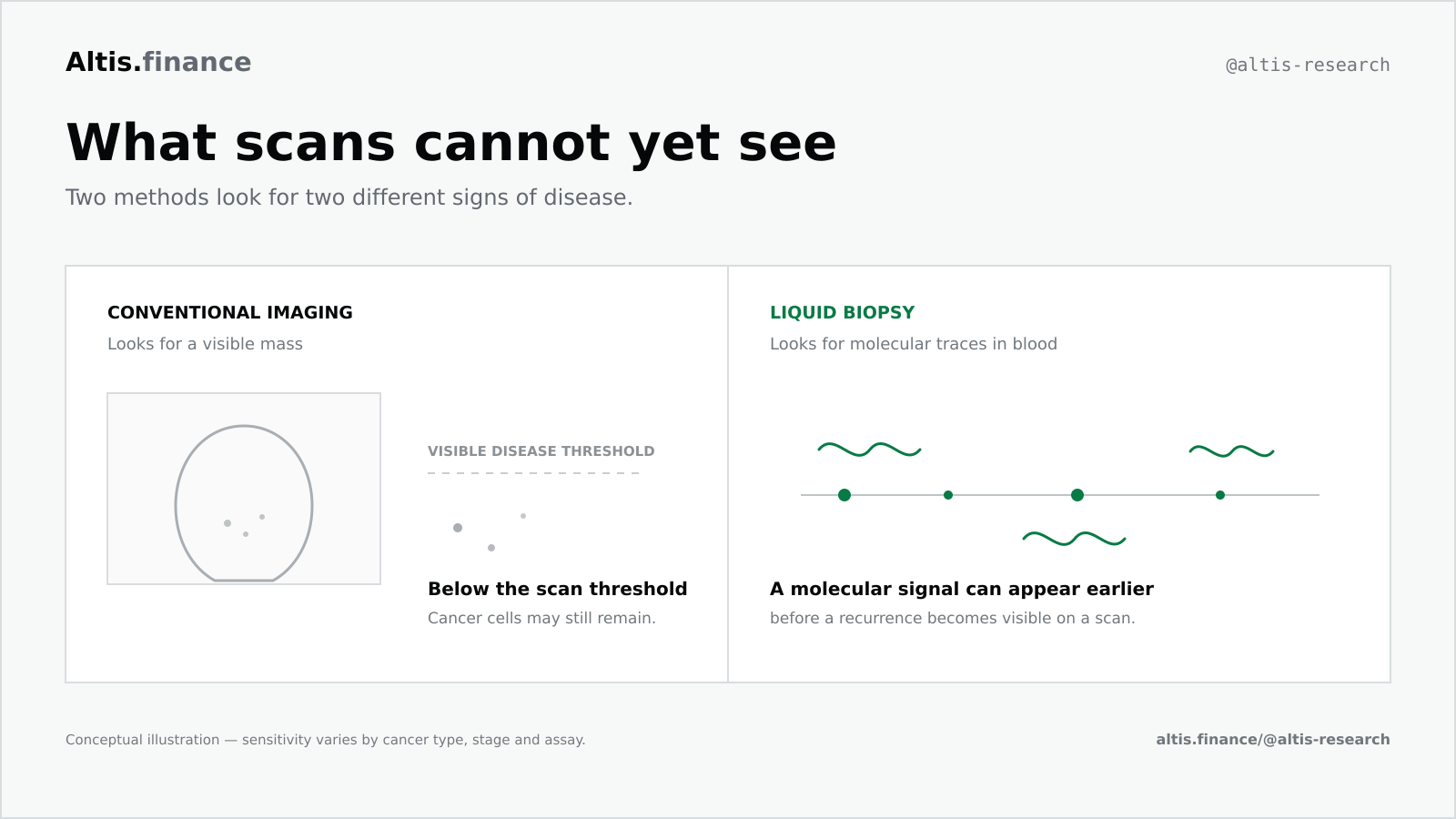
Cancer cells can release small fragments of their DNA into the bloodstream.
By analyzing a blood sample, physicians can search for these fragments and potentially detect cancer activity that remains invisible through conventional imaging.
This is known as circulating tumor DNA, or ctDNA.
The science becomes extremely complex very quickly. But from an investment perspective, the central idea is relatively simple:
Instead of waiting for a tumor to become large enough to appear on a scan, physicians can search for the molecular traces left by cancer cells.
This technology can potentially be used at several stages of the disease.
Before a patient has been diagnosed, it may help screen for certain cancers in people who do not yet have symptoms.
Once cancer has been identified, it can reveal some of the mutations driving the tumor and help physicians select a more appropriate treatment.
After surgery, it can search for molecular residual disease—the microscopic traces of cancer that may still remain in the body.
During treatment and in the years that follow, repeated blood tests can then show whether the molecular signal is falling, remaining stable or beginning to rise again.
This is the investment thesis we are going to examine today.
Cancer care is beginning to move from occasionally observing a tumor to measuring its molecular signal over time.
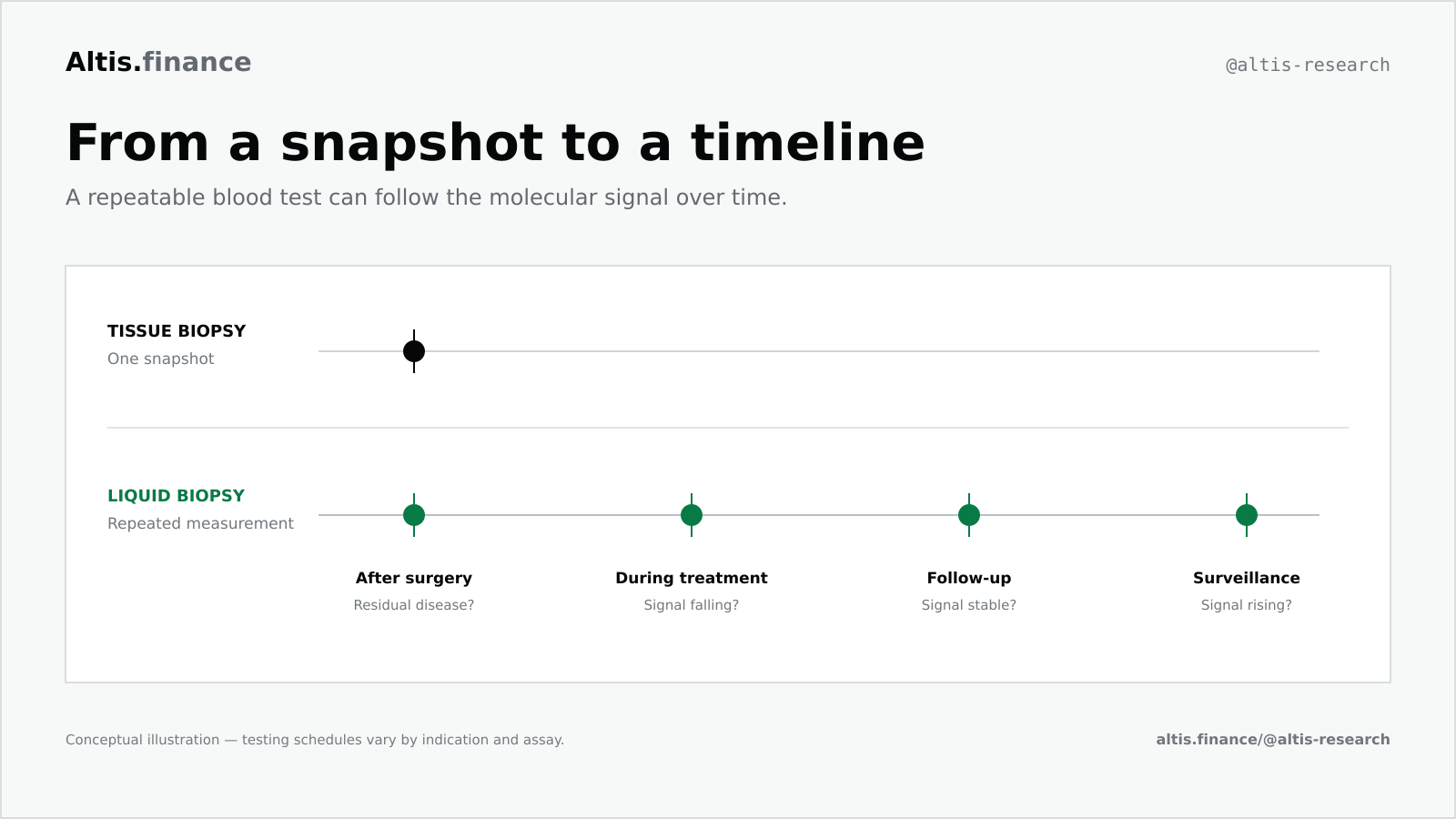
A traditional tissue biopsy provides an extremely valuable snapshot of a tumor at a particular moment.
A liquid biopsy offers something different.
Because a blood draw is easier to repeat than a tissue biopsy, it can potentially create a timeline showing how the disease is evolving.
A first test could be completed after surgery.
Another could follow several months later.
Additional tests could then monitor for recurrence or determine whether a treatment is reducing the molecular signal.
The business model therefore becomes potentially recurring.
This is where the medical thesis becomes economically interesting.
A sequencing machine is sold to a laboratory or hospital. Its manufacturer can continue selling consumables and services, but it remains primarily an infrastructure provider.
The company that owns the diagnostic test operates closer to the medical decision.
It develops the assay, processes the sample, interprets the result, obtains reimbursement, builds relationships with physicians and insurers, and accumulates clinical data over time.
The same test can also be used repeatedly for the same patient.
The economic value could therefore migrate from the companies manufacturing the sequencing machines toward those controlling the tests, the clinical evidence, the data and the reimbursement relationships.
This distinction became one of the most important lessons from our Precision Oncology portfolio.
For several years, studies have shown that the presence of tumor DNA in the blood after surgery is associated with a substantially higher risk of recurrence.
But identifying a high-risk patient is only the first step.
The more important question is whether the result can change a medical decision and improve the treatment that patient receives.
In May 2026, the FDA crossed an important threshold.
For certain patients with muscle-invasive bladder cancer, the agency approved an immunotherapy after surgery specifically for patients whose blood still showed molecular residual disease, as determined by an authorized test.
This is important because the blood test is no longer being used only to estimate whether a patient faces a higher risk of recurrence.
It can help determine whether that patient should receive a specific treatment.
The test is beginning to move from prediction to action.
If this model expands into colorectal, breast, lung and other cancers, the treatment pathway could gradually become:
Remove the tumor
        ↓
Search for molecular residual disease
        ↓
Treat patients who remain positive
        ↓
Continue monitoring the molecular signal
This could allow physicians to direct aggressive treatments toward the patients most likely to benefit, while potentially sparing others from unnecessary side effects.
It also places the companies controlling these tests at one of the most important points in the cancer-care process: the moment when a physician decides what to do next.
In August 2024, we created a locked Precision Oncology portfolio to follow this transition.
The objective was not simply to select a group of healthcare stocks. It was to identify which companies were capturing the most value as cancer care moved toward blood-based screening, treatment selection and molecular residual disease monitoring.
Since its creation, the portfolio has generated a total return of 142.7%.
More importantly, the composition of the portfolio changed as our understanding of the market evolved.
We began with exposure to both the companies developing the diagnostic tests and the infrastructure used to sequence DNA.
We later concluded that the strongest economic value was moving toward the owners of the assays rather than the manufacturers of the machines.
That led us to exit one part of the portfolio and reallocate the proceeds toward a company operating closer to the patient and the medical decision.
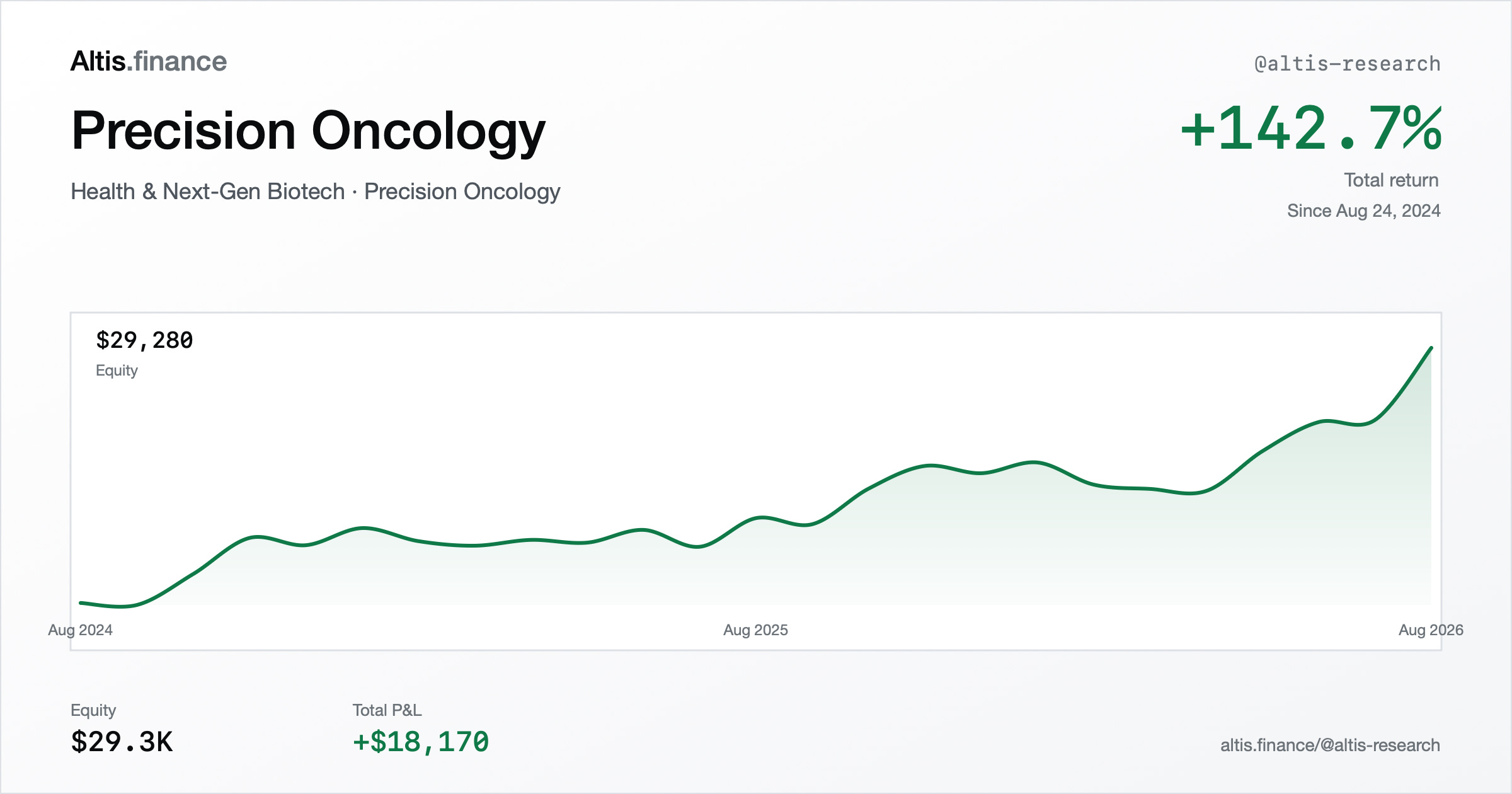
The Precision Oncology portfolio is available live on Altis Terminal.
You can review the documented trade history, follow how the thesis evolves and receive email alerts whenever a new trade is recorded or an important portfolio update is published.
Macro Notes Premium also includes access to more than 100 live portfolios covering some of the most promising investment themes we are currently following.
Altis Terminal normally costs $499 per year when purchased separately. It is included at no additional cost with Macro Notes Premium, alongside access to all our past and future premium research, for $300 per year.
The price of Macro Notes Premium will be updated soon. Subscribers who join today can secure the current $300 annual rate before the increase.
Subscribe to Macro Notes Premium
The clinical thesis is now stronger than it was in 2024. Test volumes are growing rapidly, reimbursement is expanding, and liquid-biopsy results are beginning to influence actual treatment decisions.
But the share prices have also appreciated substantially.
We therefore need to separate two questions:
Are liquid biopsies becoming an important part of cancer care?
Are the companies exposed to this market still attractive at their current valuations?
The answer to the first question can be positive without automatically making the second one true.
In the premium section, I will open the complete portfolio and examine:
every position and transaction since August 2024;
how much each company contributed to the 142.7% return;
why we exited our sequencing-infrastructure position;
the companies controlling the most valuable tests;
the importance of clinical evidence, reimbursement and patient data;
the medical, competitive and regulatory risks;
current valuations following the rally;
the catalysts we are monitoring next;
and, most importantly, whether I would still initiate or add to these positions today.
Comments
Nothing yet. Say the first thing.
Sign in to join the conversation.