
As you know, on Macro Notes we don’t just focus on the big investment themes like AI infrastructure or the trendy stories everyone is talking about, such as the GLP-1 and Ozempic thesis.
Sometimes we look for investment opportunities that receive much less attention, like the Polish banking thesis I covered in a previous edition.
Today we’re going to look at a very similar idea.
We’re going to focus on a country that rarely makes international headlines, especially compared to its neighbor Ukraine.
We’re going to talk about Romania... and banks.
In other words, two topics that sound about as unexciting as it gets.
The name of the thesis is Romanian Banking Compounding.
At first, it doesn’t sound particularly interesting.
But once you start digging into the data, you realize it’s much more fascinating than it appears.
The first reason is that Romania has long been, and probably still is today, an underbanked economy.
In other words, the country’s financial intermediation ratio was only 22.2% in the first quarter of 2026, meaning that the amount of bank credit relative to the size of the economy remains remarkably low.
That means Romanian banks are not dependent only on:
gaining market share,
cutting costs,
or buying back their own shares.
They can still benefit from something much more powerful: the structural growth of credit as the country continues to develop financially.
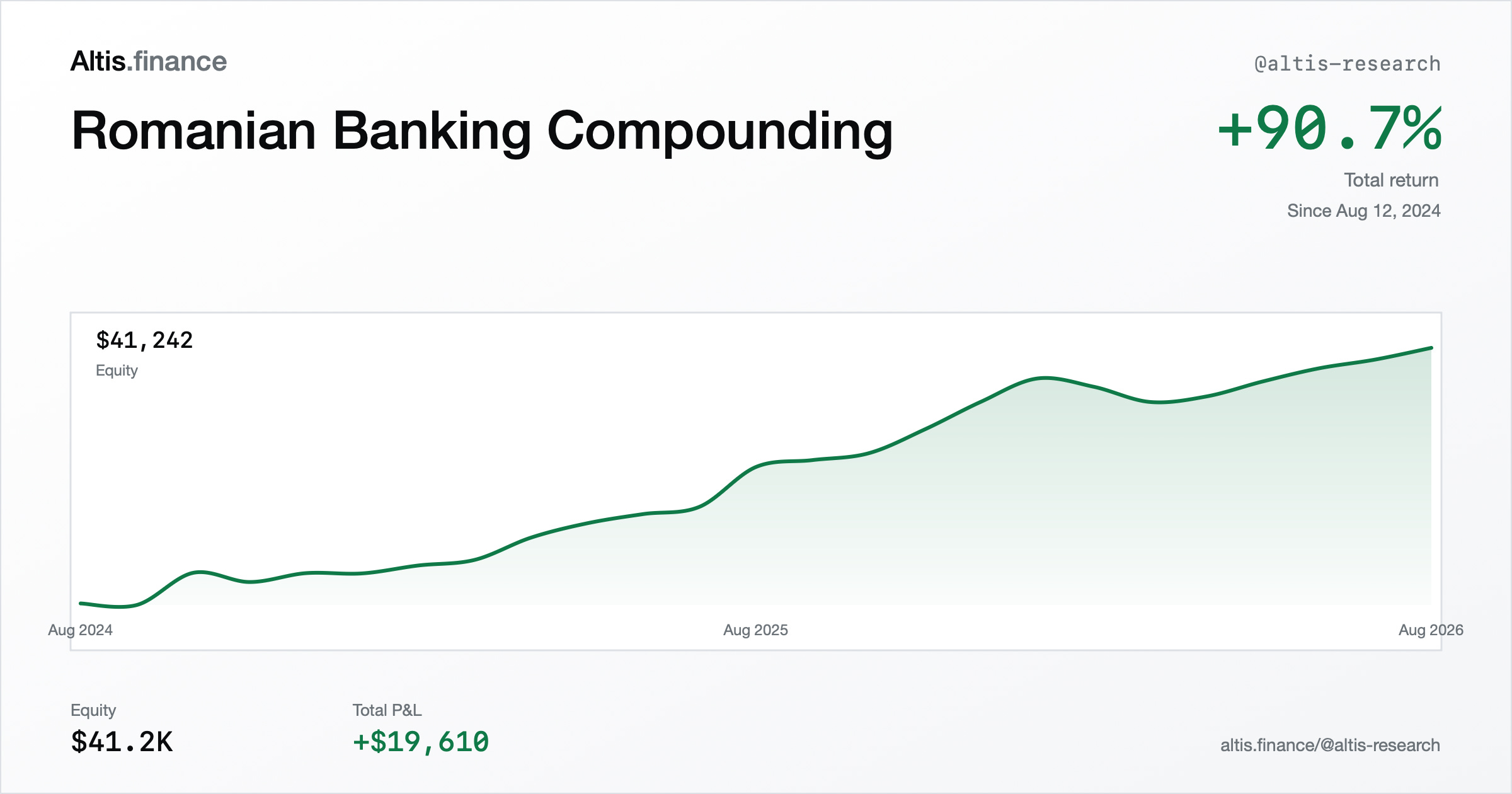
That’s the first reason why Romania became an interesting market for us and why the portfolio we built at Altis Research around this thesis has now returned 90.7%.
The second reason is that Banca Transilvania reported a gross loan-to-deposit ratio of just 63.5% in the first quarter of 2026.
In simple terms, the bank had far more deposits than it needed to fund its loan portfolio.
When interest rates are high, those low-cost deposits become incredibly valuable.
The bank can lend or invest that capital at much higher yields without relying heavily on wholesale funding or bond markets.
The third reason that strengthened the thesis this year is profitability.
Banca Transilvania generated a return on equity of 19.54% in the first quarter of 2026.
That’s probably one of the most important numbers in this entire thesis.
A bank capable of generating nearly a 20% return on equity while maintaining a relatively liquid balance sheet can compound its book value surprisingly quickly while continuing to distribute dividends.
The market didn’t need to assign these banks aggressive valuation multiples.
Their earnings and book value simply had to keep growing.
The fourth reason is Banca Transilvania’s history as a consolidator.
The bank became the country’s largest lender by acquiring and integrating other banking businesses, then using its scale, deposit base and technology across a much larger customer network.
In other words, the market often viewed Romania as a simple macroeconomic story, while much of the value creation actually came from very specific microeconomic drivers:
economies of scale,
improving operating efficiency,
a growing customer base,
stronger distribution,
and the ability to spread technology investments across a much larger business.
The fifth reason is the combination of earnings growth, dividends and valuation expansion, which I’ll explain in much more detail later in this edition.
So to summarize, these are the five reasons why I think this thesis is worth understanding:
An economy that is still underbanked.
An abundant deposit base with an attractive funding structure.
Returns on equity approaching 20%.
A consolidating banking industry.
The combination of earnings growth, dividends and valuation re-rating.
We’ll go through each of these in much more detail.
But the main takeaway I’d like you to remember is this:
Ordinary businesses can produce extraordinary returns when you understand them correctly.
The biggest opportunities are not always hidden inside futuristic technologies.
Sometimes they’re found in traditional businesses operating in markets that very few investors are paying attention to.
Today I’ll introduce the foundations of this thesis.
As always, you’ll also be able to follow it live on Altis Terminal, where the portfolio is published and updated in real time.
Every time we add a new portfolio, it requires additional integrations behind the scenes.
We connect our event-monitoring engine, AI-powered insights and signal generation system to the most reliable data sources available for that specific market.
That means adding new financial data providers, exchange-specific data feeds and specialized sources depending on the country and industry we’re covering.
Subscribe to Macro Notes Premium for $300/year and receive full access to Altis Terminal.
We’ve already started inviting Premium members into the beta ahead of the official launch on August 14.
Altis Terminal will normally cost $499/year and will include hundreds of investment portfolios published by dozens of Substack publishers.
But if you’re a Macro Notes Premium subscriber, your access is included at no additional cost.
Subscribe to Macro Notes Premium
In the premium section, we’ll go far beyond the headline return and rebuild the investment thesis from the ground up.
We’ll start by looking at the complete portfolio, every position, every trade and the role each bank played in generating the +90.7% return.
More importantly, we’ll answer the question that really matters:
Why did this work?
We’ll break down the five structural drivers behind the thesis, explain why Romania’s banking industry was different from most European markets, and show how an ordinary-looking sector quietly became one of the strongest-performing investment opportunities of the past two years.
We’ll also examine each company individually—including Banca Transilvania, BRD, Erste/BCR and the other holdings—to understand why they were selected, how they contributed to the portfolio and what has changed since the original investment thesis.
Finally, we’ll look ahead.
Has the market already priced in the opportunity?
Or do Romanian banks still offer attractive long-term returns?
We’ll review today’s valuations, the main macroeconomic risks, the impact of lower interest rates, and whether I would still be buying these companies today—or whether it’s time to reduce exposure and look for the next overlooked market.
Comments
Nothing yet. Say the first thing.
Sign in to join the conversation.