
It is not easy being a central banker in a world plagued by supply shocks. These disturbances push economic activity and inflation in opposite directions, forcing difficult tradeoffs between full employment and price stability.
Fed officials now face such a challenge with the war in the Middle East. The resulting reduction in oil production could dampen economic activity while temporarily raising inflation. In this environment, it may be tempting to ease monetary policy to cushion the blow. But doing so would risk further stoking inflation. And if the public were already sensitive to inflation, such easing could unanchor expectations and make matters worse.
The conventional wisdom, therefore, is to “look through” supply shocks. Monetary policy cannot fix oil shortages, but it can worsen inflation. Better to stay out of the way and do no harm. Yet even this approach may prove insufficient. If households and firms are already on edge about inflation, even a temporary price spike could unmoor expectations. In that case, the Fed may be forced to tighten policy in an already weakened economy.
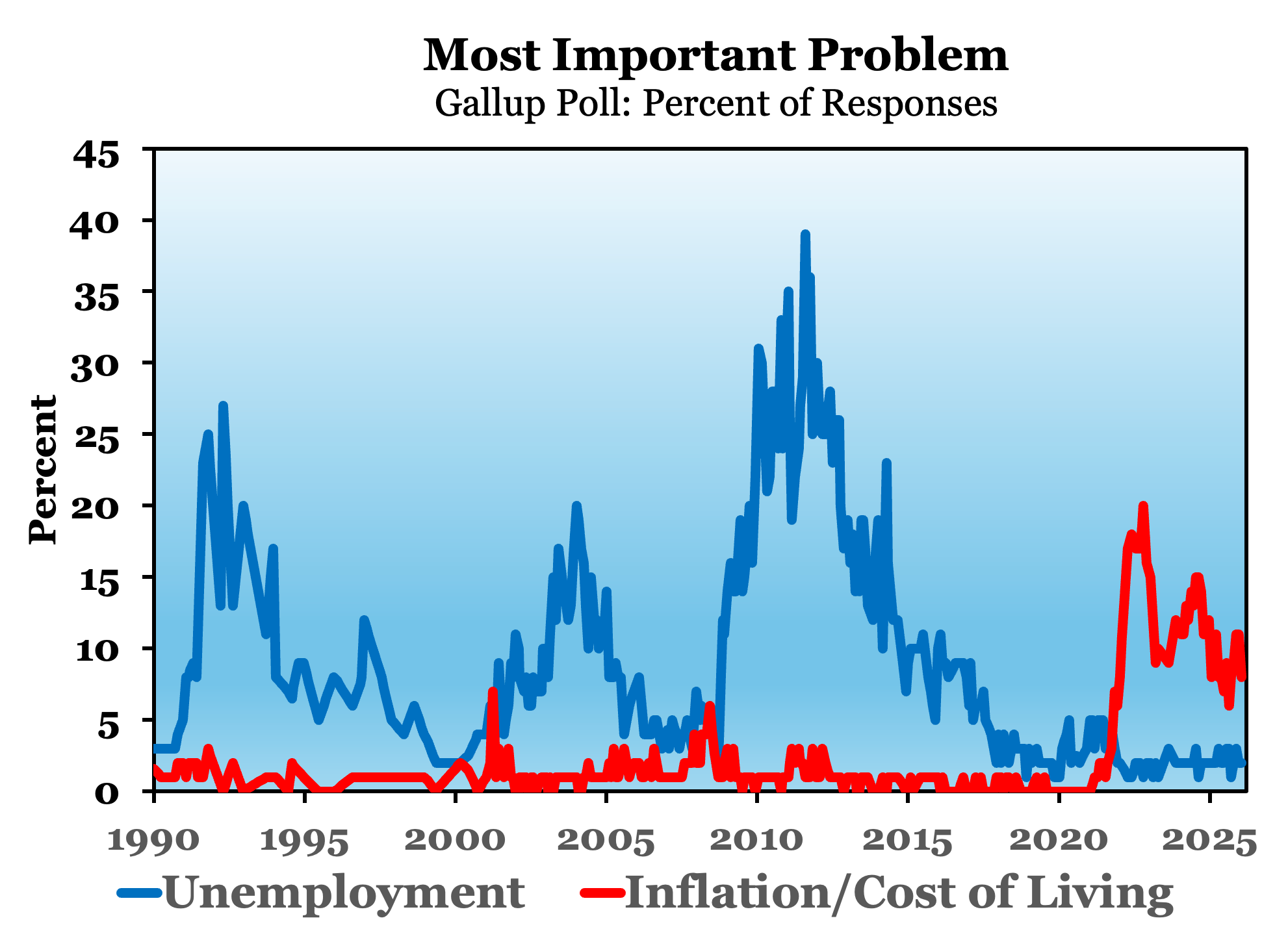
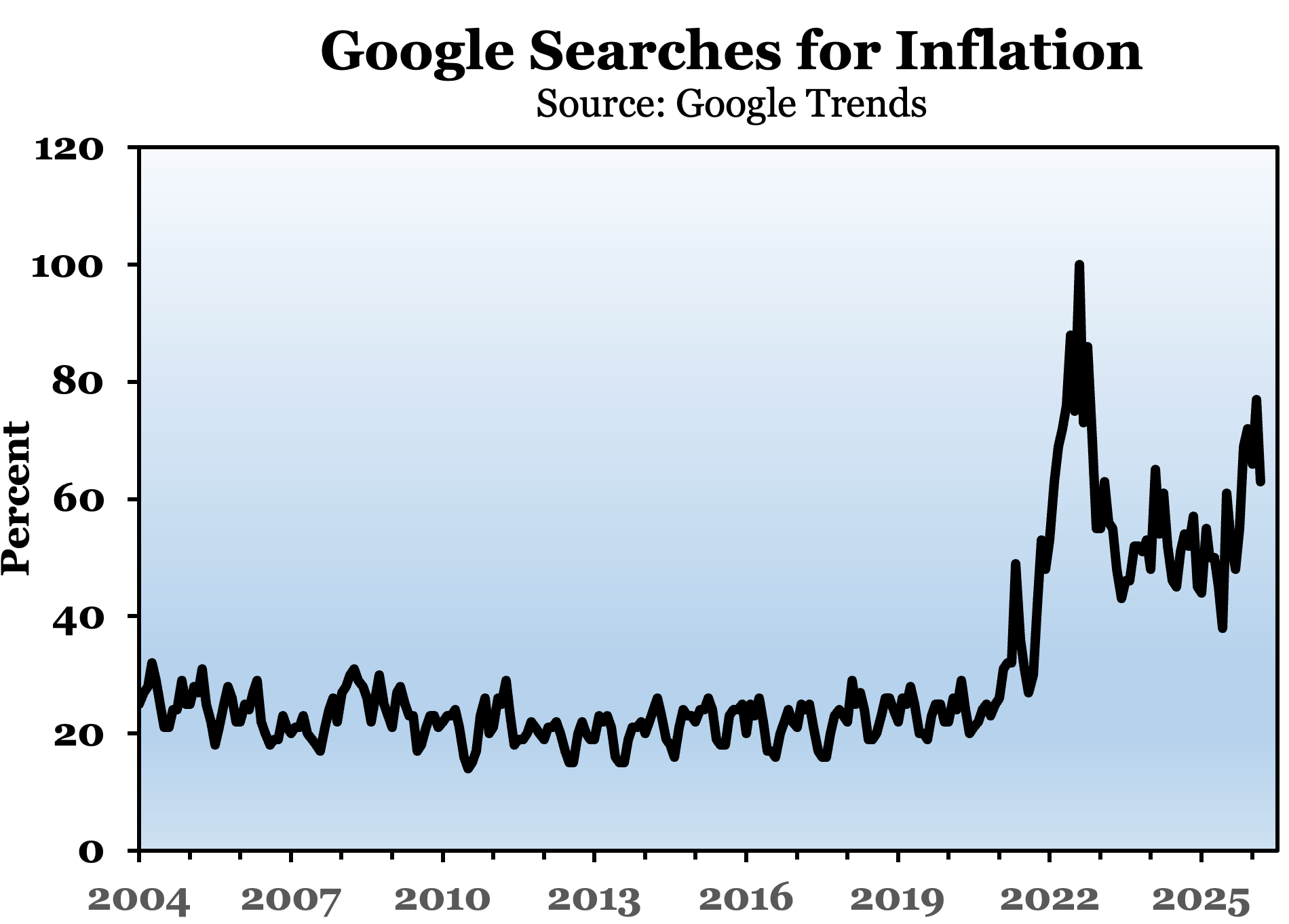
To avoid this latter outcome, it is important for central banks to have established inflation-fighting credibility in the first place. The Federal Reserve has such inflation-fighting credibility over the medium run according to inflation forecasts implied by the treasury market. But there are concerns that the spate of supply shocks over the past five years—the COVID pandemic, Russia-Ukraine war, trade war, Middle east war—plus the persistent above-target inflation over the same period might mean consumer inflation expectations are more fragile than what is seen in the treasury market. Both survey data and Google searches for inflation, as seen below, reveal this may be the case. Inflation continues to be an elevated concern for many Americans.
So what more can the Fed do to keep inflation expectations anchored while looking through supply shocks? Fed Chair Jerome Powell unwittingly hinted at an answer at the March FOMC press conference. It took place during an exchange between him and the Washington Post’s Andrew Ackerman (video of the exchange is above):
ANDREW ACKERMAN: “Thanks, chair Powell. The economy experienced a series of supply shocks, COVID, tariffs, two oil price shocks. Do you think that is bad luck or something has changed in the world that makes supply shocks more common and does the Central Bank need to take into account the supply shocks as a more common problem?”
JEROME POWELL: “We did go through a long period where the shocks were all demand shocks, and so we’ve had a lot of practice thinking about supply shocks in the last four or five years, for sure. It’s just a very different thing, and much more difficult thing, because it does immediately raise the question of tension between the two parts of our mandate. But, you know, has the world changed? COVID is a one-time thing, right? This energy supply shock is a one-time thing. It is not because of some broad tendency, I don’t think. The oil shock with Ukraine was a consequence of military action. I don’t know that the world changed that there will be more supply shocks but people have written that paper and that speech a number of times. People tried to make the case that is the case. In fact, we have seen more supply shocks in the last five years than we have seen in many years before that. It is a fact.”
Chair Powell makes two important points here. First, he is not convinced the world has fundamentally changed in a way that makes supply shocks more common, but still acknowledges the steady stream of supply shocks raises challenges for the Fed’s dual mandate. So the FOMC needs a robust way to handle them.
Second, even if supply disruptions have become more frequent, he does not see them as altering the underlying structure of the economy “because of some broad tendency.” His understanding is consistent with his colleagues on the FOMC as seen in the Summary of Economic Projections (SEP). FOMC participants continue to expect real GDP to grow around 2 percent over the long run. This forecast for relatively stable growth of potential real GDP plus the Fed’s 2 percent inflation target implies the FOMC is effectively aiming for approximately 4 percent NGDP growth.
These two observations—the FOMC needs a robust way to handle supply shocks and is implicitly targeting about 4 percent NGDP Growth—point to what more the Fed can do. If the FOMC were to (1) explicitly acknowledge this implied nominal anchor and (2) cross-check its actions against it, policymakers could more easily look through supply shocks while still keeping inflation expectations anchored. Under such an approach, it would not matter whether the world is prone to more supply shocks or not.
To be clear, nothing else needs to change. The FOMC keeps its current inflation-targeting framework, but simply acknowledges the implicit 4 percent NGDP target and then uses it as a cross-check on monetary policy.
Yes. Here is an illustration of why this works. Consider a $30 trillion economy with an implied 4 percent NGDP target. Total dollar spending grows by 4 percent ($1.2 trillion), and the spending is evenly split, as intended, between higher prices and real economic growth. This first scenario can be seen in the table below under the “No Supply Shock” scenario.
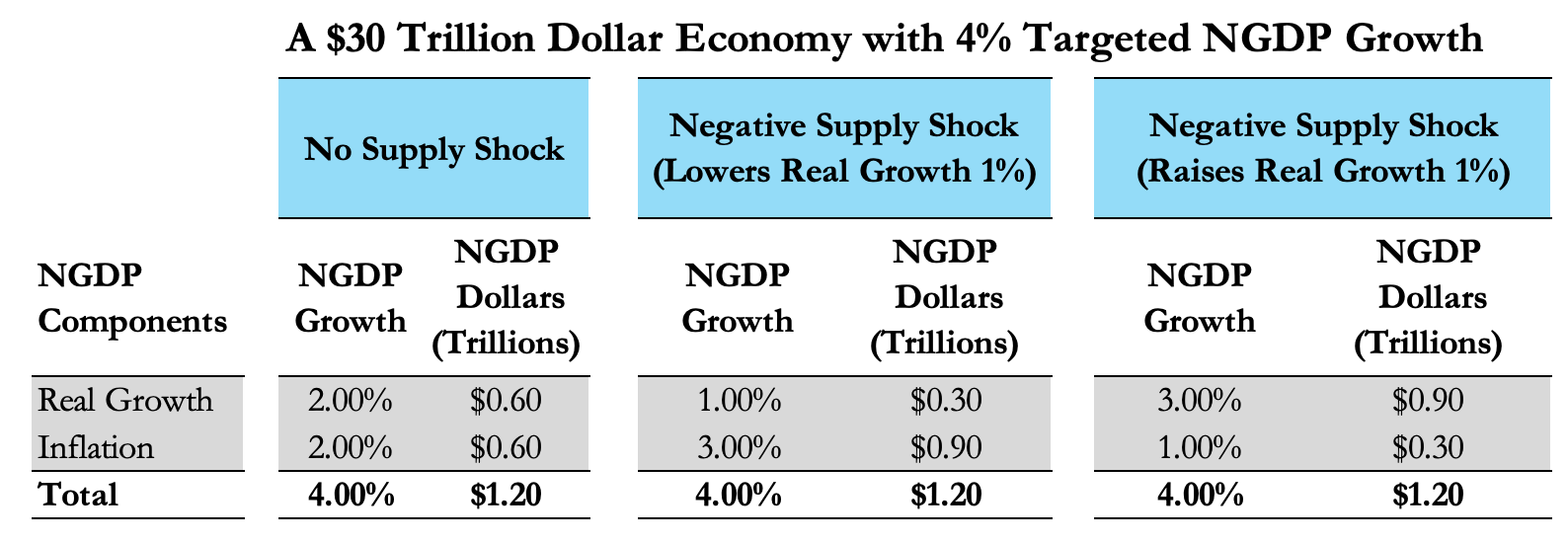
Now imagine there is a negative supply shock. The economy still grows by $1.2 trillion, but now three-fourths of that spending ($0.90 trillion) goes to higher prices; only one-fourth ($0.30 trillion) goes to real economic growth. The FOMC does not need to know in real time how that nominal spending is split between inflation and real economic growth. Rather, it is content to see the dollar size of the economy anchored at 4 percent NGDP growth or $1.2 trillion.
Consider now a positive supply shock. The economy, again, grows by $1.2 trillion, but now three-fourths of that spending ($0.90 trillion) goes to real economic growth while one-fourth ($0.30 trillion) goes to higher prices. The FOMC again is content to see the nominal anchor of 4 percent NGDP hold.
Here is the key: FOMC members can look past short-run movements in inflation by cross-checking policy against the implicit 4 percent NGDP growth target. Put differently, when total dollar spending is on a stable 4 percent path, policymakers are automatically “looking through” supply shocks.
If these shocks are idiosyncratic and roughly symmetric over time—pushing inflation above target in some periods and below in others—then inflation will still average around 2 percent over the medium term.
So by cross-checking their decisions against the implicit 4 percent NGDP growth target, FOMC members can worry less about what is causing inflation in the short term and still feel confident they are anchoring inflation expectations over the medium run.
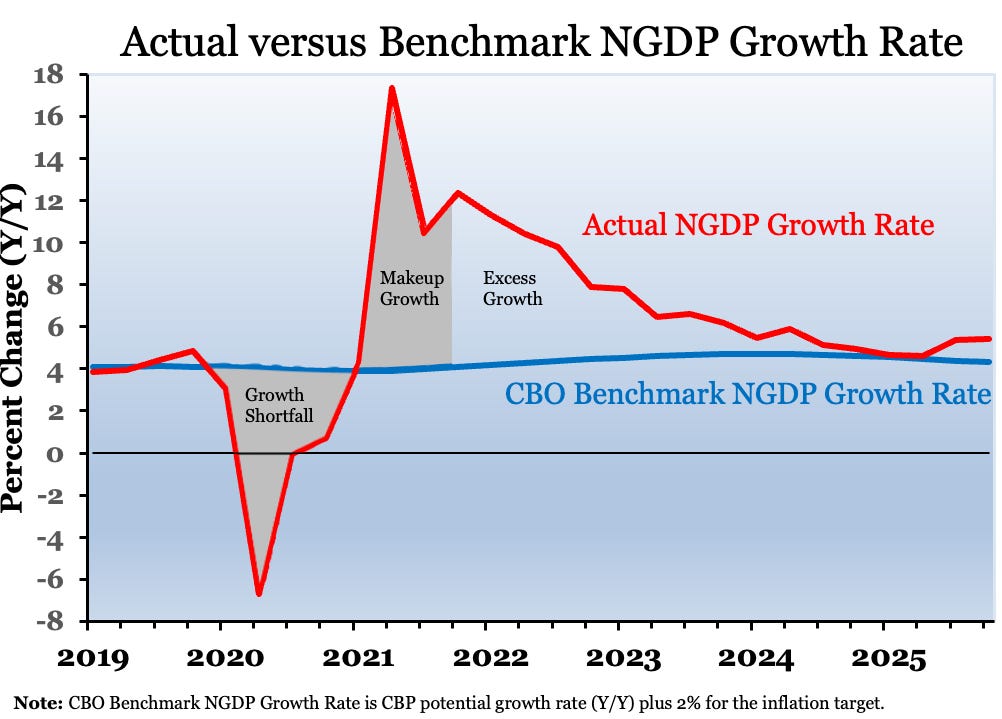
Okay, but how does the FOMC cross-check in practice? One simple way is to plot the actual NGDP growth rate against a benchmark NGDP growth rate. The figure below shows a benchmark measure—the blue line—created by taking the sum of the CBO’s potential real GDP growth rate plus 2 percent for the inflation target.
There is some art to interpreting this figure, but the key is that the FOMC should be trying to avoid NGDP growth run persistently above or below the benchmark. The two grey regions highlight an initial growth shortfall in 2020 followed by a period of makeup growth. These largely offset one another and are mostly a wash.
What matters more is what comes next: NGDP growth remains elevated above the benchmark for an extended period, albeit gradually declining, through 2024. NGDP growth briefly returned to the benchmark in the first half of 2025, but has since shown signs of reacceleration.
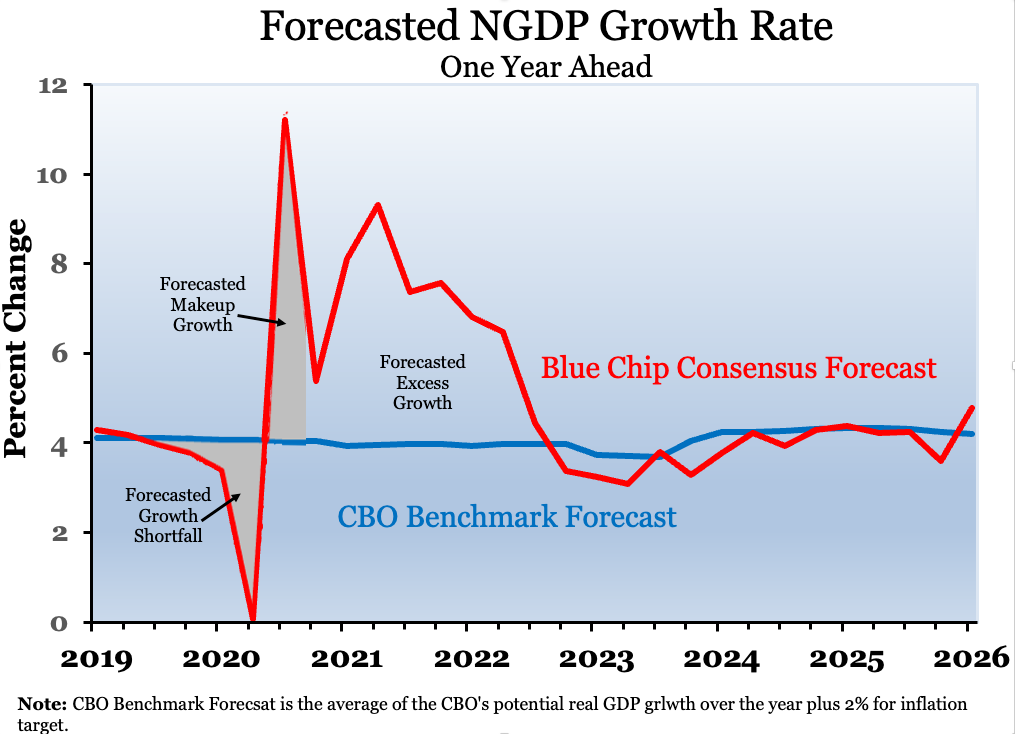
NGDP data are subject to revision, so the FOMC should also look to forecasts and high frequency data in cross-checking their decisions. The figure below shows the one-year ahead forecasted growth of NGDP from the Blue Chip consensus forecast along with the implied NGDP forecast using the CBO’s projection of the real potential GDP plus 2 percent for inflation.
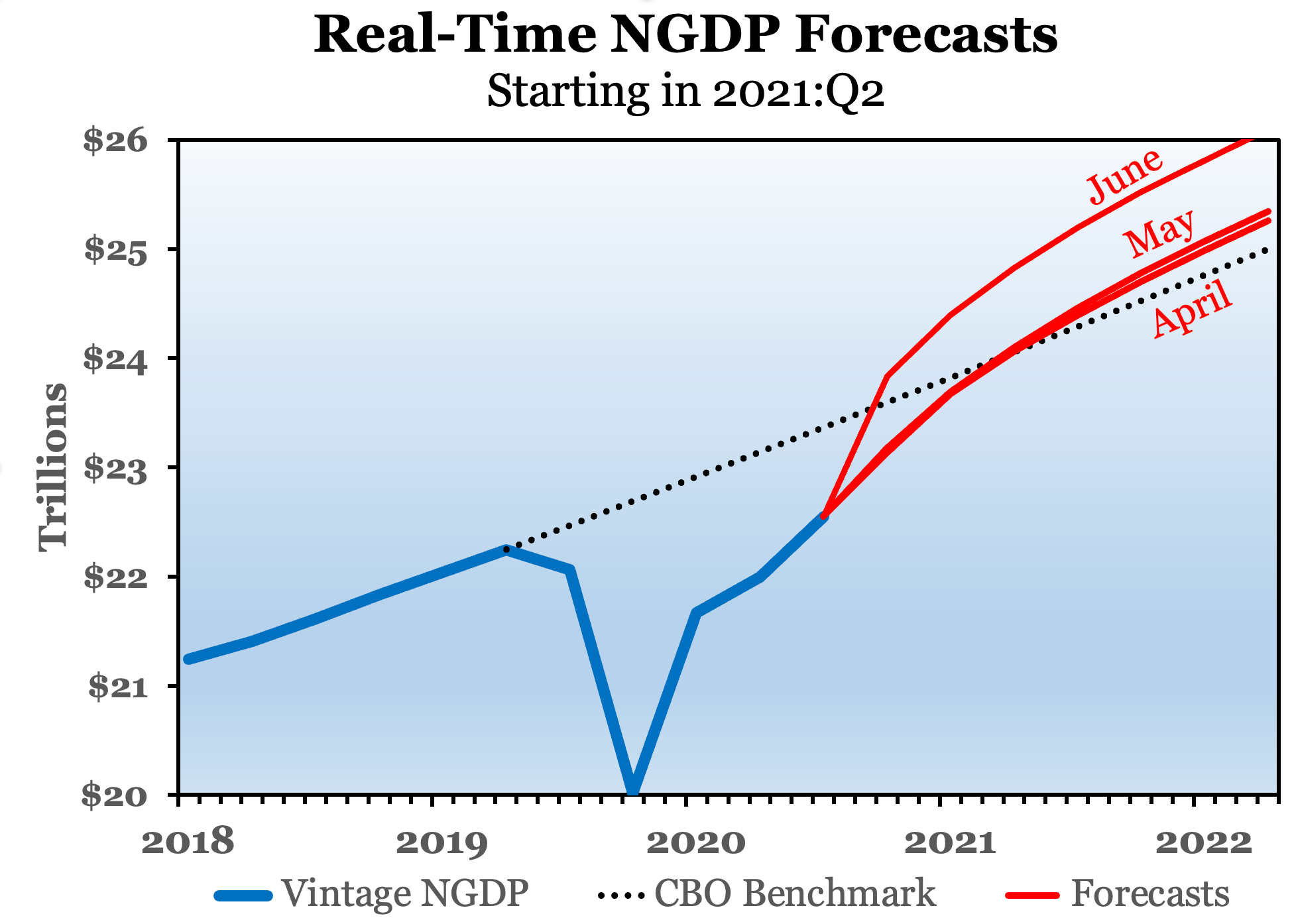
An alternative way to visualize the forecast data is to look at the NGDP in level form. The figure below, using the same Blue Chip forecasts, reveals that by the second quarter of 2021 that the outlook was for an overheated economy in 2022 in terms of excess NGDP.
Finally, FOMC members can cross-check themselves with high frequency data like the monthly aggregate payroll index series (a proxy for aggregate labor income) or monthly nominal personal consumption expenditures. These series are narrower in scope, but are closely related to NGDP. Also, work by Skanda Amarnath, Carola Binder, and Lars Christensen show other ways to use real-time data in this context.
There are more sophisticated versions of this approach and I have written elsewhere about how the FOMC could more thoroughly incorporate some of these ideas. The more modest goal here, however, is simply to have the FOMC cross-check its decisions against basic NGDP measures.
It is worth nothing that cross-checking with NGDP is not a new idea. Former Fed Vice Chair Don Kohn, as a staff economist, used it during the 1990 energy shock. More recently, Vice Chair Rich Clarida also invoked NGDP as a useful gauge in assessing the economy. These examples suggest the approach is already familiar within the Fed. It just needs to be used in a more systematic manner.
Supply shocks are difficult, but they do not have to be destabilizing. By explicitly acknowledging and cross-checking against its implicit NGDP target, the FOMC can better distinguish between temporary and sustained inflation surges.
In doing so, it can more confidently look through supply shocks in the short run while keeping inflation expectations anchored over the medium run. That is a simple, practical improvement to monetary policy in an increasingly uncertain world.
No posts
Comments
Nothing yet. Say the first thing.
Sign in to join the conversation.