
One recurring topic on both the podcast and this newsletter has been the future of Fed master accounts. These are the accounts that allow financial institutions to settle payments directly with the Federal Reserve and, in turn, grant access to the Fed’s payment rails. Past podcasts where I have covered master accounts include episodes with Julie Hill, George Selgin, Senator Pat Toomey, and Dan Awrey.
Historically, only traditional banks have had access to master accounts, but over the past decade other nonbank firms have been seeking access too. The most prominent cases include The Narrow Bank in 2017, Reserve Trust in 2018, and Custodia and Kraken in 2020. Julie Hill provides a great overview of this history in this Yale Journal on Regulation article where she shows how access to Fed master accounts has become a major regulatory battleground.
This is why the Macro Musings podcast with David Zaring this week is so timely. Zaring, a legal scholar at the University of Pennsylvania, has been thinking hard about this exact problem: how should the regulatory system adapt when firms want to do only part of what banks traditionally do? In his recent paper, “Skinny Charters: Rebuilding the Banking Regulatory Perimeter,” Zaring argues that we should stop treating banking as an all-or-nothing category. Traditional banks take deposits, make loans, and process payments. But many new entrants do not want to do all three. Some want to process payments. Others want to provide custody services. Still others want to lend without taking deposits. So why force all of them into the same full-service bank charter?
Zaring’s proposal is to create more tailored, activity-specific charters—or “skinny charters”—that match regulation to the actual risks a firm creates. A payments firm like Stripe, for example, does not create the same maturity-mismatch risk as a traditional bank that funds long-term loans with runnable short-term deposits. So it may not need the full panoply of bank regulation. It would still need oversight, but the oversight would be tied to payments risk rather than to a loan book it does not have. That is the key point: regulate the activity, not just the institutional label.
As we discussed in the episode, the regulatory system is already moving awkwardly in this direction. The OCC has had a fintech charter concept for years, but no firm has actually received one. Instead, many fintech and crypto firms have looked to OCC trust charters or special-purpose state charters as a workaround. At the same time, the Fed has begun talking about “skinny” master accounts, which would provide limited access to Fed payment services for firms that are not traditional full-service banks. Kraken’s recent approval for a master account suggests that some version of this world may already be arriving.
And then there is the PACE Act, which we discussed as well. This proposed bipartisan bill would create a clearer path for large payment providers—firms such as PayPal, Cash App, Apple Pay, or Google Pay—to get access to Fed payment rails through an OCC-administered licensing regime. These firms would not become full banks. They would face restrictions: they could not fund loans with customer deposits or act like ordinary banks. But they would get a more direct route into the payments system, including access to Fed services and relief from navigating fifty different state regulatory regimes. In effect, the PACE Act would put congressional blessing behind the same basic idea now floating through the master-account debate: payment firms may deserve a separate regulatory lane.
Now, the PACE Act is only proposed legislation and may go nowhere. But even if PACE stalls, the broader point remains: the horse is already out of the barn. The debate over Fed master accounts, skinny charters, and direct access to the payment rails is no longer a niche fight among banking lawyers and fintech firms. The latest manifestation of this shift came after my conversation with David Zaring was recorded, when President Trump issued a new executive order that takes direct aim at these very issues. The order adds further momentum to the idea that payment firms may deserve a separate regulatory lane. Let’s now consider what exactly the executive order does.
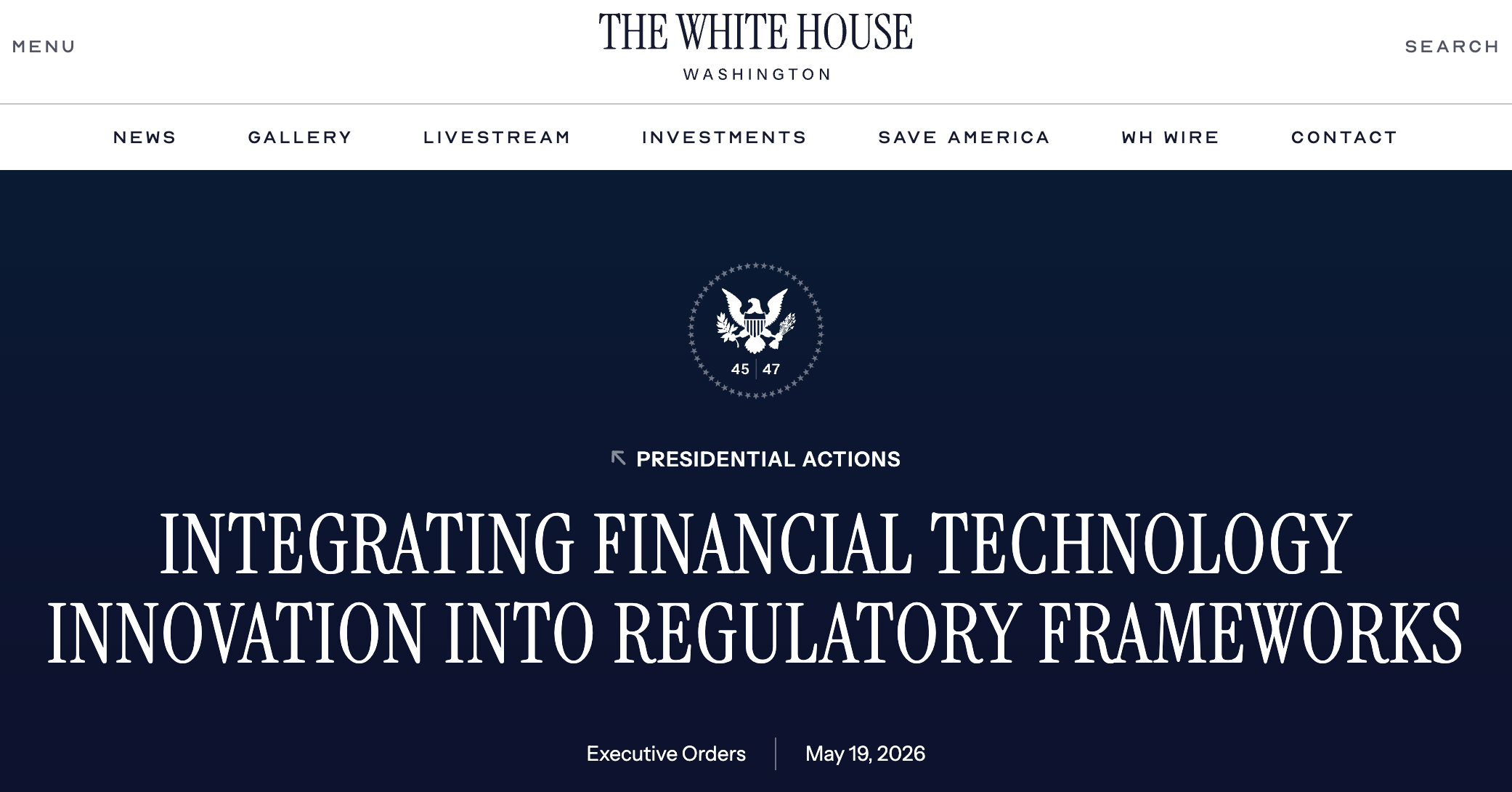
President Trump’s executive order (EO) on May 19 requires federal financial regulators to review their “regulations, guidance, supervisory practices, and application processes” to see what could be updated to better support fintech firms. That review has to be completed within 90 days. Based on it, regulators then have 180 days to “take steps to encourage innovation.” The order’s stated goal is to reduce unnecessary barriers to entry and remove fragmented rules that often end up protecting incumbent financial firms.
The EO singles out the Federal Reserve among the federal financial regulators and asks the Board of Governors to evaluate the legal, regulatory, and policy framework governing access to Reserve Bank master accounts and payment services by nonbank financial companies.
The EO, as I read it, is pushing the Fed to answer several questions it has often preferred to handle quietly and on a case-by-case basis:
Does the Federal Reserve Act allow broader access to Fed payment accounts?
What legal barriers prevent nontraditional firms from getting direct access?
What risk-management conditions would be needed if access were expanded?
How much discretion do the twelve regional Reserve Banks have to approve or deny master account applications on their own?
That last point is important. The Custodia litigation, discussed in the David Zaring podcast above, puts a spotlight on the relationship between the Board in Washington and the regional Reserve Banks. Specifically, the EO is asking the Fed to clarify whether Reserve Banks can act independently in granting or denying access, and, if so, what Board-level rules exist or should exist to make sure applicants are treated consistently across the Federal Reserve System.
To be clear, the EO does not force the Fed to say “yes” to fintech firms. But it does make it harder for the Fed to maintain a master-account process that is opaque, slow, and highly discretionary. In effect, it pushes the Fed toward a more rule-like framework: clearer standards, clearer timelines, and clearer explanations for who gets access to the core plumbing of the dollar system.
That is a big deal. The Fed can still say no. But after this EO, it will face more pressure to say why.
Change is afoot on Fed master accounts. The question now is not whether the regulatory perimeter around payments will evolve, but how it will evolve. Ideally, this transition should occur in a measured and safe manner that balances innovation with financial stability concerns.
One conservative path forward would be to have each of the twelve regional Federal Reserve Banks run a sandbox-style experiment in which they each grant “skinny” Fed master accounts to a limited number of qualifying firms in their district. The firms could vary across payments, custody, and other narrowly defined financial activities. Likewise, the terms and supervisory approaches could vary somewhat across Fed districts. The point would be to allow experimentation, learn what works, identify risks early, and develop best practices before scaling up broader access across the Federal Reserve System.
If done well, this kind of experimentation could allow the Fed to modernize the payment system without compromising the stability and trust that make the dollar system work in the first place.
No posts
Comments
Nothing yet. Say the first thing.
Sign in to join the conversation.