
We’ve built a simulation of the IOTA communication network. The high-fidelity digital twin is an abstracted version of our distributed training architecture, designed as a testing ground to run experiments and develop novel algorithms to increase the speed and quality of model training.
Here’s what you need to know, and why you should care.
The IOTA simulator is a lightweight implementation of the network that abstracts away the machine learning aspects, allowing us to perform research on efficient data communication primitives and iterate quickly without the overhead of orchestrating large fleets of GPUs.
We can inject functions, such as how to route activations through the network, or how to continuously arrange miners across layers, as well as use our simulator to measure expected performance.
IOTA’s a powerful system, but it’s not exactly nimble. It’s a heavyweight architecture that relies on many moving parts (as is the case with all distributed training systems). This means that running tests and tuning hyperparameters on IOTA can be costly and slow.
Over two hours of runtime on the real system takes less than thirty seconds in our simulated environment, making it around 250 times faster than IOTA.
On the financial side, running tests with multiple miners on IOTA adds up fast - it costs around $1 per hour per machine on the real system, whereas the simulator costs almost nothing. For instance, say you wanted to run an experiment that included 100 miners, each with their own machine, for 24 hours - that would cost $2,400. This becomes extremely pricey over time, especially when working on cutting-edge research which requires a lot of trial and error.
The IOTA simulator is so cost effective because it can run locally on a computer, making it lightweight by orders of magnitude. The benefits are therefore substantial in terms of iteration speed and cost, but our objective is even grander: to use the simulator as an environment for open competitions on Apex, outsourcing algorithmic innovations to the Bittensor miners.
The first Apex competition to use the IOTA simulator will involve solving for a hybrid objective: path planning and network topology optimisation. Combining these objectives ensures that compatible solution-pairs are found which maximise overall system performance. This disincentivises narrow solutions which can be detrimental to overall system performance.
Of course, this is not the first IOTA-focused competition on SN1, as we’ve held two matrix compression tasks before where miners built optimal compression setups. However, it will be the first time our simulator can be interacted with by the public.
These are the two tasks which miners need to perform.
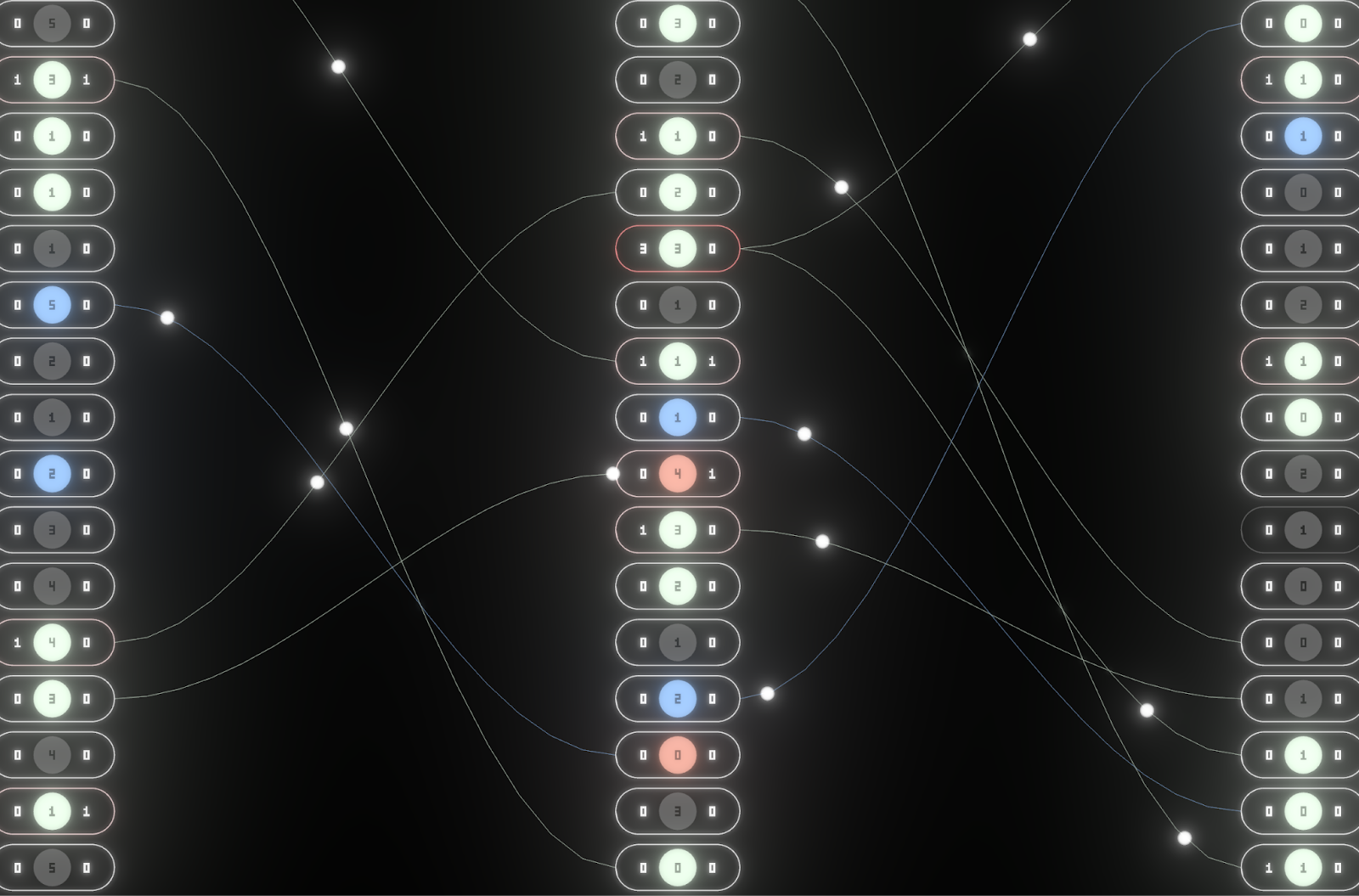
Path planning is where miners discern what the optimal routing path is within the epoch. Their actions are based on a set of parameters that include information such as network speed/latency, how busy a miner is, past performance, and location within the IOTA network. We collect data on what miners are active, latencies between miners, activation processing speeds, activation processing history, and various other metrics. These give us a granular view of the IOTA network. Apex miners would get access to this information and then use it to find activation paths that minimise latency and throughput.
This is a non-trivial task. While at first glance, it looks like you should be able to simply route your activations to your fastest and most reliable IOTA miners, this proves much more complex. For one, routing all traffic to the most powerful nodes will cause massive queueing times, pushing the system over its maximum latency threshold. Because the network is highly heterogeneous, path planning requires balancing nodes that might have high compute availability but low bandwidth with nodes that have low latency but low capacity.
Additionally, in order for the machine learning model to learn properly and maintain stability, work must be reasonably balanced across the network; heavily favouring a few nodes while limiting others can destabilise the training process.
Routing decisions must be made at the very beginning of an activation’s journey through a network that can be 3 to 8 layers deep. Because node dropouts and minor latency fluctuations can shuffle the order of activations as they travel, predicting exactly when an activation will arrive at the final layer is incredibly difficult.
To round off the complexity, the granular metrics provided to Apex miners are never perfectly synced in real time. Information is always delayed by a few seconds, meaning by the time a routing algorithm knows an activation has cleared a layer, that activation may already be two layers further down the line. Therefore, an optimal path planning algorithm must be robust enough to handle high-dimensional trade-offs, delayed telemetry, and dynamic network dropouts all at once.
SN1 miners will be evaluated on the time it takes for the route to complete the entire epoch. The quicker the process, the greater the score. We plan to expand the evaluation metrics, but this is for later iterations.
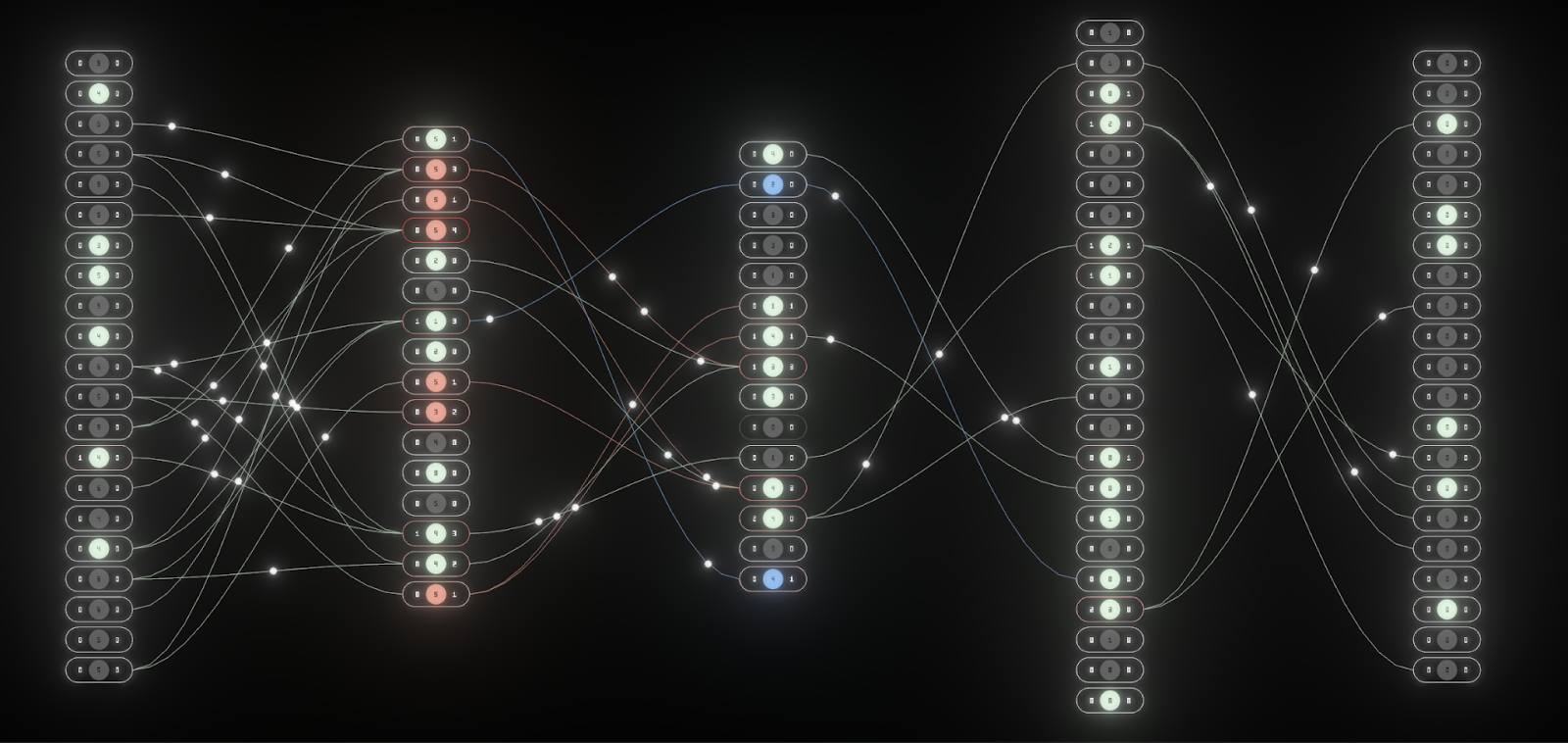
The competition will also be on network topology optimisation. This is the process of discovering how you arrange IOTA miners who have radically different machines and setups in a way that provides the best throughput to the network. Where path planning happens during the epoch, network topology optimisation occurs between epochs.
One of IOTA’s core goals is to allow anybody to train in a distributed setting, even if they don’t have state-of-the-art GPUs. Lowering this barrier is what led us to launch Train at Home, which allows people to train a model using consumer-grade hardware like MacBooks. However, finding the best setup that makes the most out of an Apple M2 device alongside something like an H200 is no easy task.
Like with the path-planning component of this competition, on the surface it looks relatively easy - the straightforward result would be to simply spread the capabilities of the machines evenly across different layers. However, this approach would ignore several latency, memory, and architectural constraints. For instance, it’s often optimal to align powerful data-centre nodes sequentially across layers so that activations can pass through them with minimal latency.
Plus, network layers aren’t built equally, they’re fundamentally asymmetrical, with different hardware requirements. Nodes on the first layer must maintain a large memory cache to store packets while they traverse the entire network and return, whereas the final layer requires zero cache because it processes and returns packets instantly, yet it requires more compute power to calculate the training loss.
In other words, an optimal topology algorithm must balance high-speed node alignment, memory asymmetry, and dynamic hardware utilisation all at the same time. It’s a deeply non-trivial task that’s ideal for SN1 miners to solve as it’s algorithmically optimisable.
The IOTA simulator opens up many new possibilities for us. Not only can we run experiments more efficiently and with ease, but by opening it up to Apex, we can invite our mining community to test new methods out with us. By running this competition in a winner-takes-all setting, we can incentivise high-quality, groundbreaking results that will help push IOTA to new heights. It’s a testament to the symbiotic relationship that SN1 and SN9 have shared since Apex’s relaunch.
This competition is the starting point for the simulator. If the results are fruitful, expect many more to arise. The simulator gives us the ability to try out countless tests, many of which we can open to our SN1 miner-base.
Comments
Nothing yet. Say the first thing.
Sign in to join the conversation.