
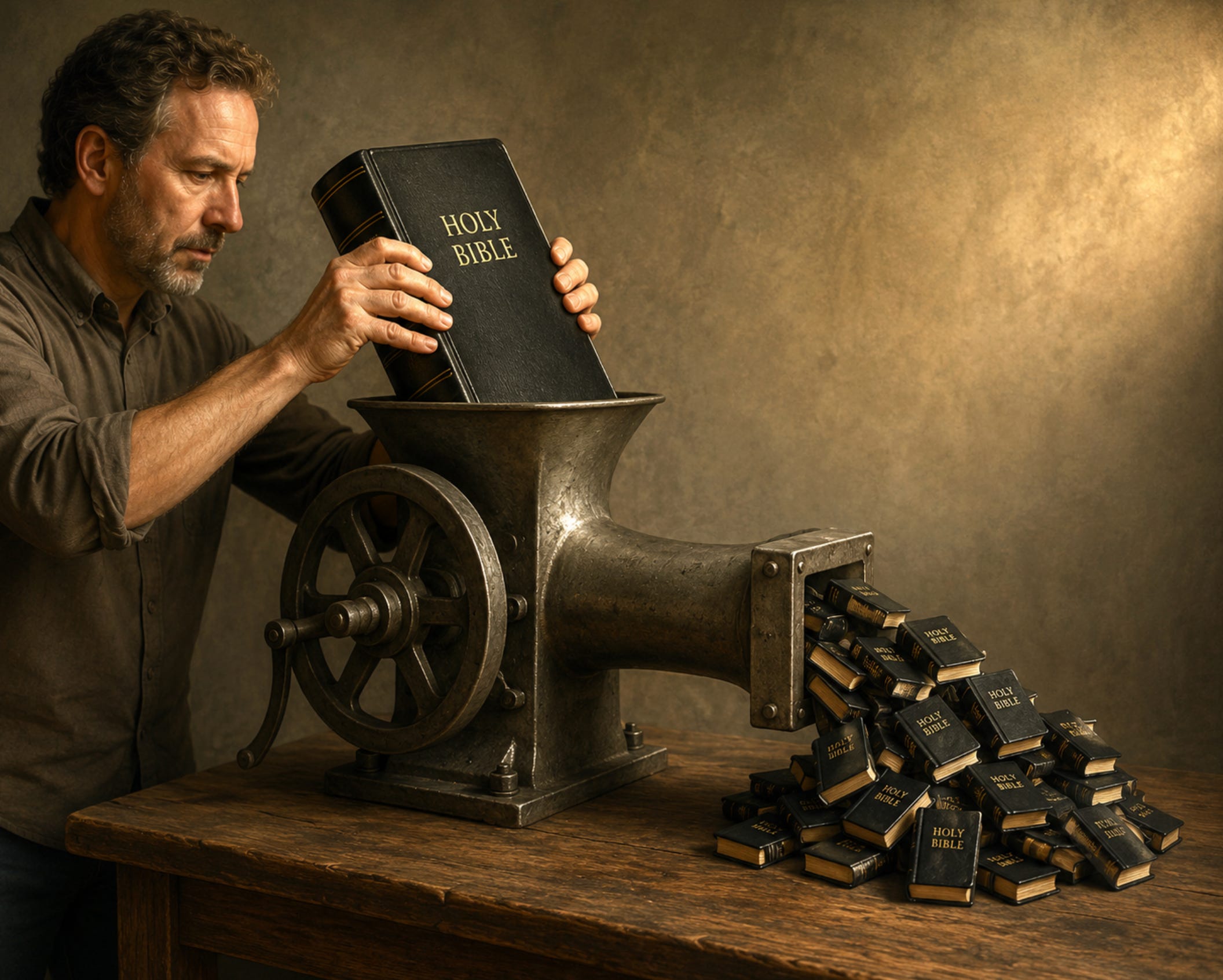
A friend recently challenged something I posted about reading the Bible symbolically. His point was fair.
He said it is historically inaccurate to suggest that ancient Jews and Christians read their sacred stories symbolically, while only modern people came along later and began taking them literally. That is too simple. Literal readings are not merely modern. Many Jews and Christians throughout history received biblical stories as real events.
He is right.
The Bible has always been read in more than one way. Christian tradition itself often spoke of multiple senses of Scripture: the literal, the moral, the allegorical, and the anagogical. In other words, a passage could speak about what happened, how we should live, what it reveals about Christ or the soul, and where it is ultimately leading us.
That means symbolic reading is not a modern escape from tradition.
It is part of the tradition.
The issue is not whether the stories are historical or symbolic. The deeper issue is whether we still know how to read them sacramentally—as outward events that disclose inward and eternal realities.
A story can be true as event and true as symbol.
That is the part we often miss.
So I am not objecting to literal readings. I am objecting to reductive literalism. By that I do not mean everyone who believes the events happened. I mean the habit of treating the surface level as the whole meaning, as though symbolic, mystical, or sacramental readings weaken the text rather than complete it.
A literal reading asks what the story says happened.
A sacramental reading asks what the event reveals.
The Bible is not merely a history book in the modern sense. It contains history, but it gives us history interpreted through covenant, prophecy, wisdom, worship, judgment, mercy, and transformation. It does not simply ask, “What happened?” It asks, “What does this reveal? What does this require of us? What kind of person are we being called to become?”
This matters because sacred story does not function like ordinary information. It is not just data from the past. It is a pattern of meaning we are invited to enter.
Take the miracles of Jesus.
For many believers, the miracles demonstrate who Jesus is. They reveal his authority, his compassion, and his divine sonship. That reading matters. It anchors the story in the real world and gives the tradition form, continuity, and memory.
But if Jesus reveals the Father, then these actions also reveal the character of God.
In the presence of Christ, disease is not treated as final. Blindness is not treated as identity. The leper is not disposable. The hungry crowd is not someone else’s problem.
Each miracle reveals a world in which suffering is confronted by divine life.
That has enormous spiritual value, and over time it also reshapes civilization. The healing stories teach that suffering is not merely fate. The body matters. The poor matter. The excluded matter. Healing is good. Restoration is good. Mercy is not sentimental weakness; it is the action of God moving through the world.
That is not less than history.
It is more than history.
The historical claim is not discarded. It is opened.
When the Bible tells a story, it is not merely trying to preserve the past. It is trying to transform perception. It wants us to see the world differently, and therefore to live differently.
This is where mystical reading becomes essential.
History gives the sacred story its body. Mysticism reveals its soul. A living faith needs both.
The outer story gives the tradition its vessel. The inner meaning pours the wine. Without the vessel, the wine spills into vagueness. Without the wine, the vessel becomes empty form.
Tradition and mysticism need each other.
Without tradition, mysticism can become self-invented and ungrounded. Without mysticism, tradition can become rigid, defensive, and spiritually barren. One protects the form. The other keeps the form alive.
In the modern world, literalism often becomes more defensive because the surrounding culture no longer shares the assumptions of the tradition. When people feel that inherited moral and spiritual structures are dissolving, they naturally reach for something solid. They cling to the surface of the text because the surface feels safe.
I understand that impulse.
Scripture can be a refuge, but it was never meant to become a hiding place. When it becomes only a fortress, it stops being a path.
The Bible is not given merely to defend our position. It is given to renew the mind, awaken the heart, purify desire, and make a new kind of human being possible. Paul calls this “the renewing of your mind.” Jesus calls it eternal life. Revelation imagines its final manifestation as the New Jerusalem.
This is not only about what we believe happened long ago.
It is about what is happening in us now.
The deepest function of sacred story is participation. We are meant to enter the pattern until it becomes true in us.
We do not merely read about Exodus. Somewhere in us, bondage has to break.
We do not merely admire the healings of Jesus. We are called to become people through whom mercy enters the world.
And resurrection is not only a doctrine about the end. It is the pattern of divine life rising where we thought life was over.
That is why I emphasize Christian mysticism.
Not as a rejection of tradition, but as its fulfillment.
The stories are not less than historical memory. They are more than historical memory. They are instruments of transformation. They are meant to teach us how to see, how to suffer, how to love, how to forgive, how to die, and how to rise.
The danger is not that people believe the Bible.
The danger is that they make it smaller than it is.

No posts
Comments
Nothing yet. Say the first thing.
Sign in to join the conversation.